
Textile Quality Control: Complete Guide to AQL and Inspection

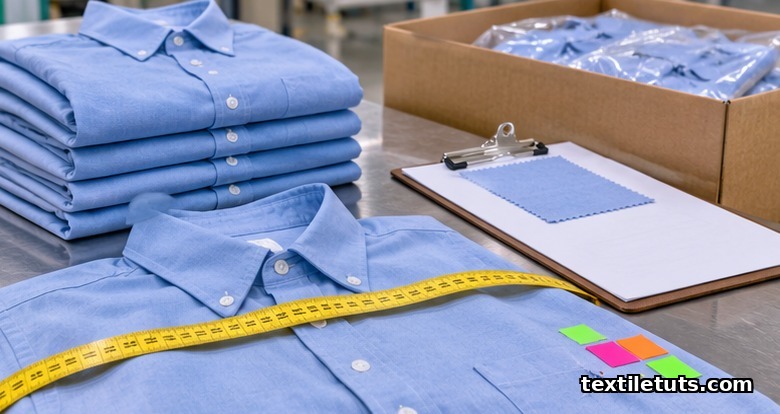
Textile quality control is the system of inspections, sampling decisions, and records that a mill or garment factory runs around production so that defects are found and contained before goods reach the buyer. It covers incoming fabric and trims, checks on the sewing floor, end-of-line audits, and the final random inspection that decides whether a shipment leaves the factory. Its statistical core is AQL sampling, which tells an inspector how many units to pull from a lot and how many defects the lot can carry before it is rejected.
This guide covers the inspection stages in order, the AQL tables of ISO 2859-1 and ANSI/ASQ Z1.4 with a worked example, fabric grading with the 4-point and 10-point systems, a garment inspection checklist, defect classification, and the records a QC department keeps. Laboratory test methods are a separate subject and appear here only where they feed the inspection plan.
Quality Control, Quality Assurance, and Lab Testing: How They Differ
As per ISO 9000:2015, quality assurance is the part of quality management focused on providing confidence that requirements will be fulfilled, and quality control is the part focused on fulfilling them. In a factory, QA writes procedures, approves suppliers, trains staff, and audits whether the system is followed. QC checks actual product and decides, lot by lot, whether it conforms.
Lab testing is one input to QC. A lab report measures properties such as dimensional change or colorfastness on a few conditioned specimens. Inspection asks whether the lot as produced, thousands of meters or thousands of garments, shows visible and measurable defects at a rate the buyer will accept. A fabric can pass every lab test and still fail inspection for slubs, shade bands, or skew, so a QC plan needs both.
The Five Inspection Stages from Fabric Receipt to Shipment
A defect caught at each stage costs less to fix than the same defect caught at the next. A shade problem found at fabric receipt costs a roll replacement; found at final inspection, it costs a recut and a late shipment.

1. Raw material and incoming inspection
Fabric, thread, labels, zippers, buttons, and packing materials are checked on arrival against the approved standard. For fabric, that means visually grading a sample of rolls (commonly at least 10 percent of the shipment, with more drawn if the first rolls fail) and checking width, weight, and shade against the approved lab dip or bulk standard. Trims are checked against the approved trim card. Supplier lab reports are checked here, before cutting.
2. Inline or in-process inspection
Inline inspectors check work at each sewing operation while production runs. Many factories use a traffic-light system: the inspector checks a few pieces from each operator, rates the operator green, yellow, or red, and checks yellow and red operators more often until their work stabilizes. The aim is to correct a faulty machine setting within the first hour, before it repeats across hundreds of garments.
3. End-of-line inspection
Finished garments are inspected at the end of each sewing line, often 100 percent, and sorted into pass, rework, and reject. These results feed the line’s DHU figure, reviewed hourly or per shift.
4. Pre-final inspection
The factory’s own QC team runs a full AQL inspection on packed goods, using the buyer’s sampling plan and checklist, before the buyer’s inspector arrives.
5. Final random inspection
The final random inspection (FRI), or pre-shipment inspection, is carried out by the buyer’s QC staff or a third-party inspection company once production is complete and normally at least 80 percent of the order is packed. The inspector selects cartons at random, draws the sample the AQL plan specifies, inspects every sampled unit, and issues a pass, fail, or pending result. That result usually decides whether the shipment is released.
How AQL Sampling Works Under ISO 2859-1 and ANSI/ASQ Z1.4
Acceptance sampling replaces 100 percent inspection with a defined sample and a decision rule. The two standards used in apparel trade are ISO 2859-1, whose 2026 third edition replaced the 1999 edition, and ANSI/ASQ Z1.4-2003 (R2018), which descends from MIL-STD-105E. Z1.4 and the 1999 edition of ISO 2859-1 share the same single-sampling code letters, sample sizes, and accept/reject numbers, so buyer manuals often quote them together.
The acceptance quality limit (AQL) is the worst tolerable process average when a continuing series of lots is submitted for sampling. An AQL of 2.5 for major defects does not mean the buyer accepts 2.5 percent defective goods. The plan accepts lots produced at that level most of the time and rejects worse lots with rising probability. The NIST Engineering Statistics Handbook explains the risks on both sides of lot acceptance sampling.
Lot size and inspection levels
The lot is the quantity submitted for inspection, usually one style and color in one shipment. The inspection level sets how much is inspected relative to lot size. General Level II is the default. Level I draws smaller samples, and Level III draws larger ones for a new supplier or a history of failures. Special levels S-1 to S-4 draw very small samples for destructive or slow checks such as seam strength, measurement audits, or carton drop tests.
Sample size code letters and the sampling table
The inspector reads two tables. Table I converts lot size and inspection level into a code letter. The single sampling table for normal inspection converts the code letter into a sample size and gives an acceptance number (Ac) and rejection number (Re) for each AQL. At or below Ac, the lot is accepted; at or above Re, it is rejected. In single sampling under normal inspection, Re is always Ac plus one.
| Lot size | Code letter (Level II) | Sample size | AQL 1.0 Ac/Re | AQL 1.5 Ac/Re | AQL 2.5 Ac/Re | AQL 4.0 Ac/Re |
|---|---|---|---|---|---|---|
| 151 to 280 | G | 32 | use H plan* | 1/2 | 2/3 | 3/4 |
| 281 to 500 | H | 50 | 1/2 | 2/3 | 3/4 | 5/6 |
| 501 to 1,200 | J | 80 | 2/3 | 3/4 | 5/6 | 7/8 |
| 1,201 to 3,200 | K | 125 | 3/4 | 5/6 | 7/8 | 10/11 |
| 3,201 to 10,000 | L | 200 | 5/6 | 7/8 | 10/11 | 14/15 |
| 10,001 to 35,000 | M | 315 | 7/8 | 10/11 | 14/15 | 21/22 |
Where a cell in the full table shows an arrow, the inspector moves to the first plan in that direction and uses that plan’s sample size as well as its Ac and Re.
Choosing AQL values for critical, major, and minor defects
Buyers set a separate AQL for each defect class. The common apparel convention is 0 for critical, 2.5 for major, and 4.0 for minor defects. “AQL 0” does not appear in the tables; buyers use it to mean that one critical defect in the sample rejects the lot. Premium and children’s wear buyers often tighten majors to 1.5 or 1.0. All classes are judged on the same sample, each against its own Ac/Re pair, and failing any one class fails the lot.
Worked example: a 3,000-piece shirt order
A factory submits 3,000 woven shirts of one style and color. The buyer specifies General Level II with AQL 0 critical, 2.5 major, and 4.0 minor.
- Code letter. 3,000 falls in the 1,201 to 3,200 band, so Level II gives code K. (Level I would give H, and Level III would give L.)
- Sample size. Code K means 125 pieces.
- Accept/reject numbers. AQL 2.5 at K: Ac 7, Re 8. AQL 4.0 at K: Ac 10, Re 11. Critical: Ac 0, Re 1.
- Sampling. The inspector opens cartons chosen at random (a common practice is roughly the square root of the carton count) and pulls 125 shirts spread across cartons and sizes.
- Decision. Every sampled shirt is inspected and each defect is recorded by class.
With 0 critical, 6 major, and 9 minor defects, the lot passes, since 6 is within the major Ac of 7 and 9 within the minor Ac of 10. With 8 major defects, it fails regardless of the minor count. A single broken needle fragment fails it outright, and most buyers would then require a 100 percent metal-detector check of the order.
Normal, tightened, and reduced inspection
Both standards assume a continuing stream of lots and include switching rules. Inspection starts at normal. It switches to tightened when 2 out of 5 or fewer consecutive lots are not accepted on original inspection; tightened plans lower the acceptance numbers. It returns to normal after 5 consecutive lots are accepted. Reduced inspection, with smaller samples, is allowed when the supplier’s recent record meets the standard’s criterion, production is steady, and the responsible authority approves. Reduced reverts to normal when a lot fails. If lots keep failing on tightened inspection, the standards call for inspection to stop until the supplier corrects the process. Many apparel buyers ignore these rules and inspect every lot at normal severity. ISO 2859-1:2026 also adds skip-lot procedures for consistently good suppliers.
Fabric Inspection with the 4-Point and 10-Point Systems
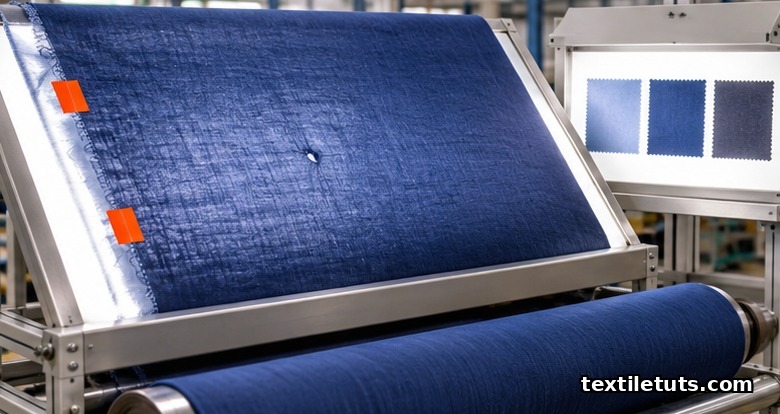
Fabric is graded on an inspection frame. The roll runs over a lit table while the inspector marks each defect and assigns penalty points by size, and the total is converted to a rate comparable across rolls.
The 4-point system per ASTM D5430
ASTM D5430, Standard Test Methods for Visually Inspecting and Grading Fabrics, describes the point-assignment options used in trade, and the 4-point system is the one most buyers name. Points are assigned by defect length in any direction:
- Up to 3 inches: 1 point
- Over 3 up to 6 inches: 2 points
- Over 6 up to 9 inches: 3 points
- Over 9 inches: 4 points
- Holes and openings: 2 points for 1 inch or less, 4 points for over 1 inch
No linear yard is charged more than 4 points, however many defects it holds, and a continuous defect is charged 4 points for every yard it runs. ASTM D5430 notes that different point options give different totals for the same roll, so purchaser and supplier should agree on one in advance.
Calculating points per 100 square yards
Points per 100 sq yd = (Total points x 3,600) / (Yards inspected x Cuttable width in inches)
The 3,600 is 100 square yards expressed in yard-inches (100 x 36). A 120-yard roll with a 58-inch cuttable width and 28 points scores (28 x 3,600) / (120 x 58) = 100,800 / 6,960 = 14.5 points per 100 square yards. In metric units, points per 100 square meters = (total points x 100) / (meters inspected x cuttable width in meters).
The pass limit is set by the buyer, not the standard. A limit of 40 points per 100 square yards per roll is widely used for apparel fabric, often with a lower limit for the shipment average and tighter limits for shirting or premium knits.
The 10-point system
The older 10-point system grades warp and filling defects separately and penalizes more heavily:
- Warp: up to 1 inch, 1 point; 1 to 5 inches, 3; 5 to 10 inches, 5; 10 to 36 inches, 10.
- Filling: up to 1 inch, 1 point; 1 to 5 inches, 3; 5 inches to half the width, 5; over half the width, 10.
Under its usual rule, a piece is first quality if total points do not exceed its length in yards.
Shade, width, bow, and skew checks
- Shade within a roll: center-to-selvage and end-to-end shading, judged in a light cabinet under the buyer’s specified source.
- Shade between rolls: a swatch from every roll is used to group rolls into shade bands, so the cutting room never mixes bands within one garment. Many buyers also set a spectrophotometer limit against the standard, such as a ΔE CMC(2:1) value.
- Width: cuttable width is measured at the start, middle, and end of each roll. Narrow fabric changes the marker and raises consumption.
- Bow and skew: distortion of filling yarns or knit courses from a straight line across the width, measured per ASTM D3882 as a percentage of width. Rolls are normally judged on their maximum bow or skew, and the standard notes the distortion shows most in stripes, plaids, and printed geometrics.
Also Read:
Garment Inspection Checklist for Final Random Inspection
A written checklist makes two inspectors record the same defects on the same lot. Visual and workmanship checks cover every sampled garment, while measurements and functional checks often use a smaller special-level subsample.
Measurements against the spec sheet and tolerance
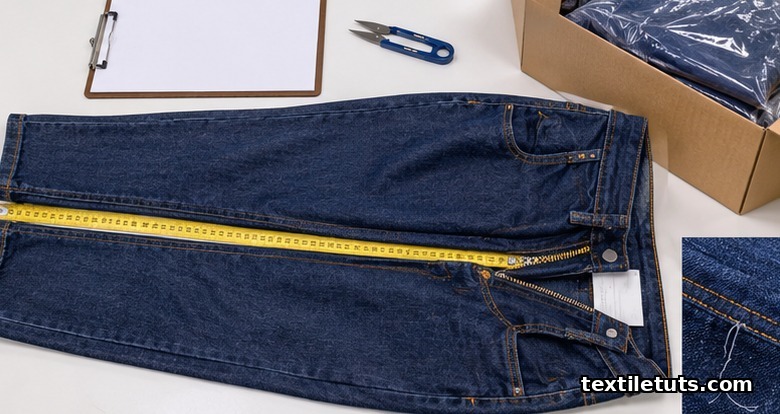
The inspector measures each point on the spec sheet (chest, waist, hip, body length, sleeve, inseam) across a spread of sizes and records the deviation. Each point carries a plus or minus tolerance, tighter for small points like collar height than for girths. Any point outside tolerance is usually a major defect. If every size runs long in the sleeve by a similar amount, the fault is in the pattern or marker, and re-screening the lot will not fix it.
Workmanship and visual appearance
- Seams: open or broken seams, skipped stitches, puckering, wrong stitch density.
- Fabric: holes, slubs, shade variation between panels, stains, print or embroidery faults.
- Assembly: twisted legs or sleeves, mismatched stripes at seams, uneven hems, crooked pockets.
- Closures: zippers that run and lock, secure and aligned buttons, correctly set snaps.
- Finishing: untrimmed threads, pressing marks, shine, chalk marks.
Labeling and compliance
Main, size, care, and fiber-content labels must be present, placed correctly, legible, and right for the destination market. A wrong fiber content or missing care instruction is often classed critical because it breaks labeling law where the garment is sold. Hangtags and barcodes are checked against the packing instructions, and a sample of barcodes is scanned.
Packing, carton checks, and the carton drop test
Packing checks cover the fold, polybag size and warning print, size assortment per carton, carton dimensions and markings, gross weight, and carton count against the packing list. Many inspection protocols include a carton drop test based on ISTA Procedure 1A, which drops a packed carton 10 times: on one corner, the three edges radiating from it, and all six faces. Drop height falls as packed weight rises, starting at 30 inches for packages up to 21 lb. The inspector then opens the carton and checks the goods inside.
Classifying Defects as Critical, Major, or Minor
A critical defect could injure the user or breaks a mandatory safety or legal requirement. A major defect is likely to cause a return or makes the product unsaleable as first quality. A minor defect departs from the standard but is unlikely to affect sale or use. The buyer’s quality manual is the final authority and should classify every common defect in advance.
| Class | Typical AQL | Garment examples |
|---|---|---|
| Critical | 0 | Broken needle or metal fragment; sharp edge on a trim; drawstring at the hood or neck of children’s upper outerwear; small parts that detach from infant garments; mold; wrong fiber-content or missing care label |
| Major | 2.5 (sometimes 1.5 or 1.0) | Open seam or broken stitching; hole; measurement outside tolerance; shade variation between panels; visible stain; zipper that fails to close; wrong size label |
| Minor | 4.0 | Untrimmed threads; slight puckering; small stain on an inside area; slightly uneven topstitching; light pressing marks |
Two conventions keep classification consistent. Visibility is judged at a fixed distance, commonly arm’s length, and location matters, so the same small stain is major on a shirt front and minor inside the hem. A garment with several defects has each one recorded but counts once as a defective unit.
QC Documentation and Metrics: Inspection Reports, DHU, First-Pass Yield, and CAPA
A QC department is judged by its records as much as its rejects. The core documents are the fabric inspection report (roll number, length, width, points, points per 100 square yards, shade band, result), inline and end-of-line reports by operation and operator, the measurement report, and the final inspection report, which states the sampling plan used (level, code letter, sample size, AQLs), defects by class with photos, packing checks, and the result.
Three metrics summarize floor performance:
- DHU (defects per hundred units) = (Total defects / Units inspected) x 100. One garment can carry several defects, so DHU can exceed 100. It is the better measure of a line’s process.
- Defective percentage = (Defective units / Units inspected) x 100. It counts garments and cannot exceed 100.
- First-pass yield (FPY) = (Units passing first time without rework / Units inspected) x 100. A line with good final results but low FPY is fixing problems through rework, which costs labor and time.
When a defect repeats, a corrective and preventive action (CAPA) record closes the loop. It states the problem with data, finds the root cause with a structured method such as the 5 Whys, records the fix on the current order and a preventive action for future orders, and names an owner and a date to verify the result.
How to Build a Textile QC Plan for a Production Order
A QC plan is a short document, agreed before bulk production, that fixes what is checked, when, by whom, and against what limit.
- Collect requirements: buyer quality manual, spec sheet with tolerances, approved samples, lab-test requirements, labeling and packing instructions, defect classification list.
- Define incoming checks: fabric grading system and roll limit, share of rolls inspected, shade banding, width and bow/skew limits, trim checks, lab tests required before cutting.
- Hold a pre-production meeting: production, QC, and merchandising review the approved sample and the style’s critical operations.
- Set inline and end-of-line controls: checking frequency, traffic-light rules, and DHU targets per line.
- Fix the sampling plans: standard, inspection level, and AQL per defect class for pre-final and final inspection, plus the special level for measurements and drop tests.
- Calibrate people and tools: check tapes, light cabinets, and scales, and calibrate inspectors against a set of defect samples.
- Review and close: after shipment, compare defect data with the plan, open CAPAs for repeating defects, and carry the lessons to the next order.
Key Takeaways
- QC inspects product and decides; QA builds and audits the system; lab testing supplies property data to both.
- A 3,000-piece lot at General Level II is code K, sample 125, Ac 7 / Re 8 at AQL 2.5 and Ac 10 / Re 11 at AQL 4.0.
- The 4-point system caps charges at 4 points per linear yard and normalizes the total to points per 100 square yards.
Frequently Asked Questions
What AQL is standard for garments?
The common apparel convention is AQL 0 for critical, 2.5 for major, and 4.0 for minor defects at General Inspection Level II. These are buyer choices, not values fixed by ISO 2859-1 or ANSI/ASQ Z1.4, and premium or children’s wear buyers often use 1.5 or 1.0 for majors.
How many pieces are inspected in a lot of 5,000 garments?
At General Level II, 5,000 falls in the 3,201 to 10,000 band: code letter L, sample 200. Under normal inspection, AQL 2.5 accepts up to 10 major defects and rejects at 11, and AQL 4.0 accepts up to 14 minor defects and rejects at 15.
What is the difference between ISO 2859-1 and ANSI/ASQ Z1.4?
ISO 2859-1 is the international standard, revised in 2026. ANSI/ASQ Z1.4 is the American national standard, last reaffirmed in 2018. Both trace back to the same military-standard tables, and Z1.4 shares its single-sampling code letters, sample sizes, and accept/reject numbers with the 1999 edition of ISO 2859-1. Contracts should name the standard and edition they use.
How many points per 100 square yards is acceptable in 4-point fabric inspection?
ASTM D5430 does not set a pass limit; the buyer does. A limit of 40 points per 100 square yards per roll is widely used for apparel fabric, often with a tighter limit for the shipment average.
When should a final random inspection be booked?
Book it for when production is complete and at least 80 percent of the order is packed, so the inspector samples finished, packed goods. The factory should run its own pre-final inspection a day or two earlier with the same plan.
References
- ISO 2859-1:2026, Sampling procedures for inspection by attributes, Part 1: Sampling schemes indexed by acceptance quality limit (AQL) for lot-by-lot inspection. International Organization for Standardization. https://www.iso.org/standard/2859-1
- ASQ. ANSI/ASQ Z1.4 & Z1.9 Sampling Plan Standards for Quality Control. https://asq.org/quality-resources/z14-z19, overview of ANSI/ASQ Z1.4-2003 (R2018), Sampling Procedures and Tables for Inspection by Attributes.
- NIST/SEMATECH. e-Handbook of Statistical Methods, Section 6.2: Test Product for Acceptability: Lot Acceptance Sampling. https://www.itl.nist.gov/div898/handbook/pmc/section2/pmc2.htm
- ASTM D5430, Standard Test Methods for Visually Inspecting and Grading Fabrics. ASTM International. https://store.astm.org/standards/d5430
- ASTM D3882, Standard Test Method for Bow and Skew in Woven and Knitted Fabrics. ASTM International. https://store.astm.org/standards/d3882
- International Safe Transit Association. ISTA Test Procedures (Procedure 1A). https://ista.org/test_procedures.php
Editorial by Sabbir Ahmed, TextileTuts. Sources: ISO 2859-1, ANSI/ASQ Z1.4, NIST e-Handbook of Statistical Methods, ASTM D5430, ASTM D3882, and ISTA Procedure 1A as cited.


