
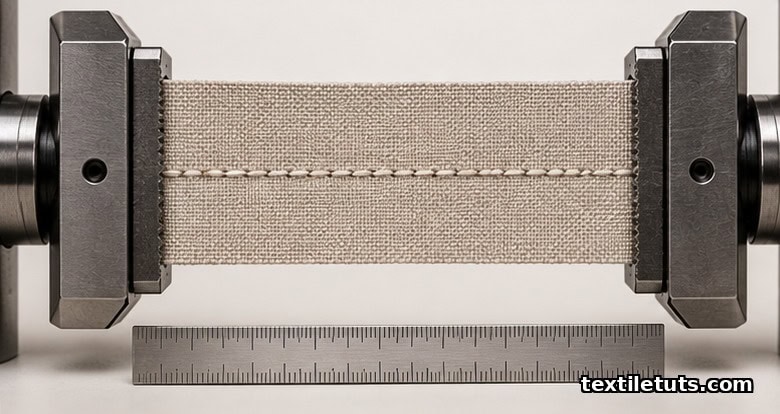
Seam Strength Testing

Seam strength is the maximum tensile load a sewn seam can withstand before failing, measured by pulling the seam in a specific direction until either the sewing thread breaks, the fabric tears, or the thread pulls out of the fabric. Seam strength testing is the standard QC method for any sewn textile product, apparel, upholstery, bedding, technical textiles, protective clothing, because the seam is typically the weakest part of a sewn article and the place where the article is most likely to fail in use.
Seam strength is the result of four engineering variables: the sewing thread (its fiber content, ticket, ply, and finish), the stitch type (lockstitch, chainstitch, overlock, coverstitch, etc.), the seam type (plain seam, French seam, flat-felled, bound, etc.), and the stitch density (stitches per inch or stitches per cm). Optimizing the four variables for the end use is “seam engineering,” and the seam strength test is the measurement that validates the engineering choice. This article covers the standard test methods, the typical seam strength values for different fabric categories, and the most common failure modes.
The standard test methods
Two test-method families dominate seam strength testing. The choice between them depends on the fabric type and the buyer’s specification.
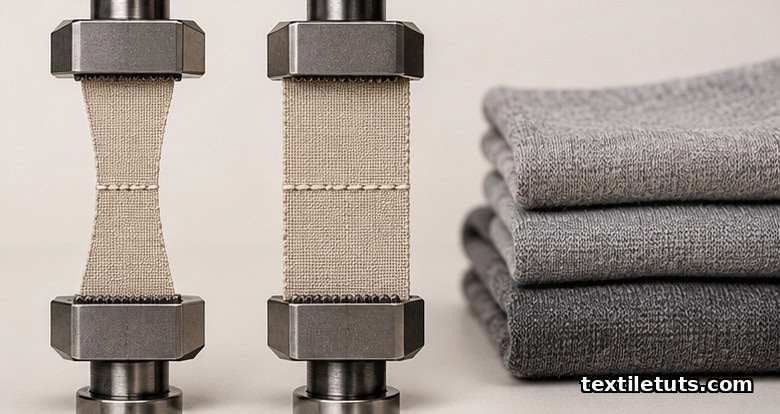
Grab method (ASTM D1683, ISO 13935-2)
ASTM D1683 / D1683M is the standard test method for failure in sewn seams of woven fabrics. The seam specimen is cut to a defined size (typically 100 mm × 200 mm with the seam at the center), mounted in the jaws of a universal testing machine, and pulled at a defined rate of extension (typically 50 mm/min) until failure. The peak load is recorded as the seam strength, and the failure mode (thread break, fabric tear, thread pull-out) is noted.
ISO 13935-2 is the equivalent international method for woven-fabric seam strength using the grab principle. The two methods are functionally similar but differ in specimen dimensions, jaw face dimensions, and rate of extension. A buyer specification will name one or the other.
Strip method (ISO 13935-1)
ISO 13935-1 is the strip method for seam strength on woven fabrics. The full width of the seam is gripped in the jaws (rather than just the central 25 mm as in the grab method), which gives a more accurate measurement for high-density fabrics where the grab method may give anomalous results.
Knitted fabric seam strength (ISO 13935-3)
Knits are tested by a similar procedure, but the lower fabric strength and the higher extensibility of knits mean the test conditions are different (lower rate of extension, often 100 mm gauge length to accommodate the stretch).
Seam slippage (ISO 13936)
Seam slippage is a related but distinct test. The specimen is loaded to a defined force (typically 25% of the fabric’s tensile strength), and the gap that opens between the two pieces of fabric at the seam is measured. Excessive slippage means the stitches are too long for the yarn density, or the fabric is too loosely woven. A buyer specification often includes both a seam strength minimum and a slippage maximum.
Seam engineering: the four variables
Seam strength is the result of how the four engineering variables interact. Optimizing one variable at a time is straightforward; optimizing all four together is the actual challenge.
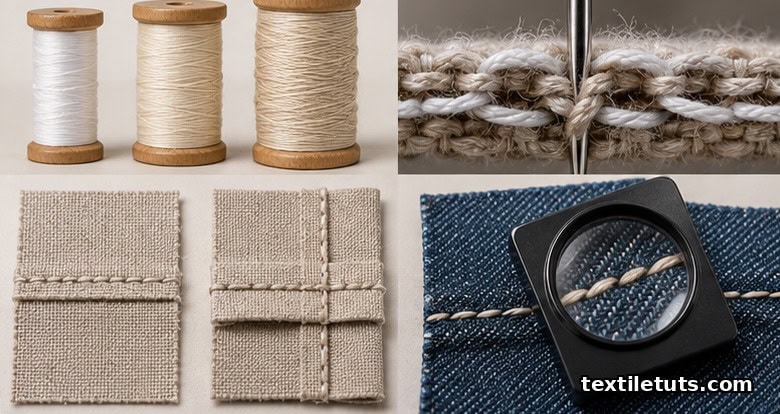
1. Sewing thread
The sewing thread is the most influential variable. Thread is typically:
- Core-spun polyester (polyester filament core with cotton or polyester wrap) – the standard for apparel, balancing strength, sewability, and cost.
- Spun polyester – softer hand, used for visible topstitching and for garments where the thread hand matters.
- Cotton – used historically and for heritage garments. Lower strength and lower UV resistance than polyester, but matches cotton fabric for dye and care behavior.
- Filament polyester or nylon – for technical textiles (luggage, automotive, outdoor gear) where high strength and UV resistance matter.
- Aramid (Nomex, Kevlar) – for protective clothing (FR garments, ballistic panels).
Thread ticket (Tex or Tkt number) sets the thread size. Tex is grams per 1,000 m of thread; Tkt is a commercial numbering. A typical apparel topstitching thread is Tex 30 or Tkt 80; a heavy denim topstitching thread is Tex 80–120; a fine shirt collar stitch is Tex 18–24.
Higher ticket (heavier) thread gives higher seam strength, up to a limit. Beyond a certain point, the thread is too thick for the needle and the fabric, and seam strength actually drops (the thread tears the fabric or skips stitches).
2. Stitch type
Three stitch families dominate woven garment construction:
- Lockstitch (Type 301) – the most common stitch. Two threads (needle thread and bobbin thread) interlock inside the fabric. Lockstitch is strong, secure, and reversible, but the bobbin thread can unravel if a stitch is broken. Lockstitch seams typically run 8–12 stitches per inch (SPI) for apparel.
- Chainstitch (Type 401) – a single thread loops through itself. Faster to sew than lockstitch (no bobbin change) and slightly more extensible, but unravels easily if a stitch breaks. Used for basting, hems (often with a lockstitch tack at the start and end), and some decorative applications.
- Overlock / serge (Type 504, 505, 512) – 3, 4, or 5 threads interlock along the cut edge, finishing and seaming in one operation. The standard for knit garments and for edge finishing on woven garments. The seam is extensible (good for knits) and trims the seam allowance as it sews.
Lockstitch gives the highest seam strength per stitch; overlock is slightly lower; chainstitch is between. But the choice is usually dictated by the garment construction, not the strength. A pair of jeans uses lockstitch for the main seams and chainstitch for the hem (with a bartack at the start and end to prevent unravel).
3. Seam type
Seam type is the construction: how the fabric pieces are joined. The ISO 4916 standard classifies seams by a numeric code; the most common are:
- Superimposed seam (Type SS) – two pieces of fabric overlapped and sewn together. The standard for most apparel construction (side seams, sleeve seams, etc.).
- Lapped seam (Type LS) – two pieces of fabric folded and overlapped without raw edges meeting. Used for jeans (the flat-felled seam is a type of lapped seam), for some shirt yokes, and for some technical applications.
- Bound seam (Type BS) – a strip of fabric is wrapped around the raw edge of a seam and sewn in place. Used for bound buttonholes, bound plackets, and decorative edges.
- Flat seam (Type FS) – two pieces of fabric placed edge-to-edge and joined by a coverstitch or flatlock. The standard for knit garment side seams, hemming, and activewear construction.
The flat-felled seam (a Type LS variant) is the standard for jeans. The seam allowance is trimmed, folded under, and topstitched, producing a strong, durable, abrasion-resistant seam that is the signature of jeans construction. A flat-felled seam is typically 30–50% stronger than a superimposed seam in the same fabric, because the second row of stitching reinforces the first.
4. Stitch density
Stitch density is stitches per unit length (SPI or stitches per cm). Too few stitches and the seam is weak (the threads slip between stitches); too many stitches and the fabric is perforated and weakened by the needle holes.
Typical stitch densities: 8–12 SPI for apparel woven, 10–14 SPI for knits, 5–7 SPI for denim (where the visible topstitching is part of the design). The optimum is where the thread breaks before the fabric does; if the thread pulls out, increase SPI; if the fabric tears, decrease SPI.
Failure modes
The failure mode tells the engineer what to fix.
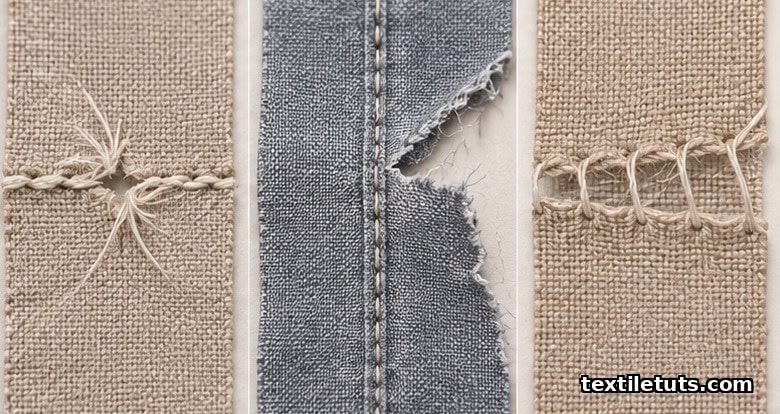
- Thread break – the sewing thread breaks at the peak load. This is the desired failure mode when the seam is “balanced” – the thread is the limiting factor, and the seam is as strong as it can be with the given thread. No change needed.
- Fabric tear – the fabric tears adjacent to the seam, not at the seam itself. The seam is stronger than the fabric, which means either the fabric is the limiting factor (no fix possible for the seam) or the seam is over-engineered (could use lighter thread, fewer stitches). Often seen in heavy fabrics where the seam is well-constructed but the fabric is the weak link.
- Thread pull-out – the thread slips through the fabric without breaking. Indicates insufficient stitch density (stitches too far apart for the fabric), insufficient thread tension (loops not tight), or fabric structure too open (loose weave, low thread count). Fix: increase SPI, check tension, consider different fabric construction.
- Yarn severance – the fabric yarns are cut by the needle during sewing. The seam is weak from the moment of construction. Indicates wrong needle size (too thick for the yarn), wrong needle point (sharp needle cutting woven yarns), or fabric that is too open/yarn too thick.
The relative frequency of each failure mode in a test batch is a useful engineering signal. A run that produces 80% thread break and 20% fabric tear is well-engineered. A run that produces 50% thread pull-out and 50% thread break indicates a construction or tension problem.
Typical seam strength values
Reference values for typical apparel fabrics (lockstitch superimposed seam, 10–12 SPI, 100% polyester thread):
- Lightweight shirting (cotton 100 g/m²) – 80–150 N warp, 70–130 N weft.
- Denim (12 oz cotton) – 400–700 N warp (very strong due to flat-felled seam), 300–500 N weft.
- Lightweight dress (viscose 90 g/m²) – 60–120 N warp, 50–100 N weft.
- Wool suiting (200 g/m²) – 200–350 N warp, 180–300 N weft.
- Knit jersey (cotton 150 g/m²) – 100–200 N (overlock seam, different test conditions).
- Outdoor shell (nylon 70 denier) – 200–400 N (with bonded or taped seam, much higher).
Buyer specifications typically set the minimum at 60–80% of the fabric’s tensile strength, with adjustments for seam type (a flat-felled seam in denim is expected to be 70%+ of the fabric tensile; a superimposed seam in shirting is expected to be 50%+).
Frequently Asked Questions
What is the difference between seam strength and seam slippage?
Seam strength is the maximum load before failure (thread break, fabric tear, or thread pull-out). Seam slippage is the gap that opens between the two fabric pieces at the seam at a defined load (typically 25% of the fabric tensile). Both are important: high strength with high slippage means the seam stretches and gaps under load but doesn’t fail; high strength with low slippage is the ideal for a structured garment.
Is a higher SPI always better?
No. SPI must be matched to the fabric structure. Too few stitches and the seam is weak (threads slip between stitches). Too many stitches and the fabric is perforated and weakened by the needle holes. The optimum is where the thread breaks before the fabric does. For dense woven fabrics, 8–12 SPI is typical; for knits, 10–14 SPI; for denim, 5–7 SPI because the topstitching is decorative and the construction is the flat-felled seam.
What causes a seam to fail in use even though it passed QC?
Three common causes. First, the QC test is on a single seam, but the article has hundreds of seams, and statistical variation means some seams will be weaker. Second, the QC test is on a new sample, but in-use damage (UV, abrasion, washing, perspiration) degrades the thread over time, especially with cotton thread. Third, the in-use load is different from the test load, a vertical pull test doesn’t simulate the multi-directional stresses of actual wear.
Is lockstitch or chainstitch stronger?
Lockstitch is typically 10–20% stronger than chainstitch at the same SPI, because the two-thread interlock is more secure than the single-thread chain. But chainstitch is more extensible and recovers better under cyclic loading, which is why some manufacturers prefer it for garments that need stretch. Overlock (serger) seams are 30–50% stronger than lockstitch because they use 3 or 4 threads instead of 2.
What is a “balanced” seam?
A balanced seam is one where the failure mode is thread break, the thread is the limiting factor, not the fabric, the stitch density, or the tension. A balanced seam is the engineering goal: it means the seam is as strong as it can be with the chosen thread, fabric, and stitch type, and the result is reproducible across multiple tests. Imbalanced seams (where thread pull-out is the dominant failure) indicate construction problems that should be fixed before production.
References
- ASTM D1683 / D1683M-22, Standard Test Method for Failure in Sewn Seams of Woven Fabrics. https://store.astm.org/d1683_d1683m-22.html, primary test method for woven-fabric seam strength, including significance, equipment, procedure, and reporting.
- ISO 13935-1:2014, Textiles, Seam tensile properties of fabrics and made-up textile articles, Part 1: Determination of maximum force to seam rupture using the strip method.
- ISO 13935-2:2014, Textiles, Seam tensile properties of fabrics and made-up textile articles, Part 2: Determination of maximum force to seam rupture using the grab method.
- ISO 4916:1991, Textiles, Seam types, Classification and terminology.
- ISO 13936:2004, Textiles, Determination of slippage resistance of yarns at a seam in woven fabrics, Part 1: Fixed seam opening method.
This article is the working reference for seam strength testing. Editorial by Kazi Sifat Muntasir, TextileTuts. Sources: ASTM D1683 / D1683M-22 (primary test method standard), ISO 13935 / 13936 (related international standards), ISO 4916 (seam classification) as cited.


