
Textile Printing: Complete Guide to Printing Methods

What is textile printing?
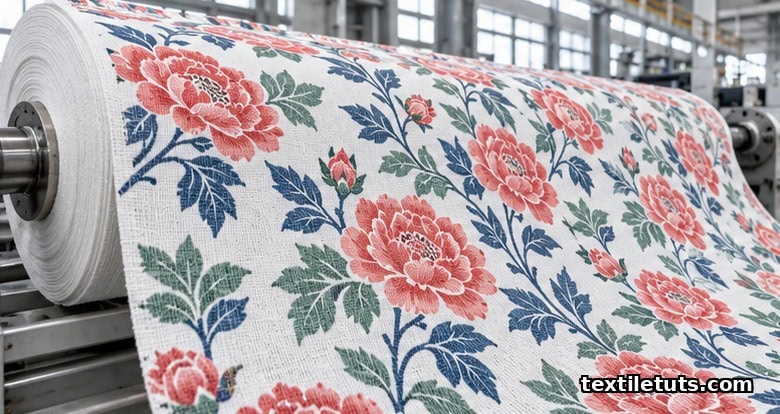
Textile printing is the process of applying color to fabric in defined areas to create a pattern or design. It is one of the major routes for adding color and design to textiles, alongside yarn dyeing (color applied to yarn before weaving) and piece dyeing (color applied to the finished fabric as a solid). Printing is unique in that it applies color only to selected areas, creating patterns, while dyeing typically colors the entire fabric.
The global textile printing market is roughly USD 30-35 billion, dominated by rotary screen printing (the workhorse for high-volume apparel and home textile production) and digital inkjet printing (the fastest-growing segment, especially for sampling, fast fashion, and custom design). Other methods (flatbed screen, block, roller, transfer) occupy smaller niches.
Why textile printing is used
Printing is the most cost-effective way to add complex patterns and designs to fabric. A solid-dyed fabric costs the same per meter as a printed fabric (in modern high-speed printing), but the printed fabric can have a pattern worth 2-10x the value of the solid version. The premium for printed fabric depends on the design complexity, the color count, and the end use.
Printing is also the most flexible method for short runs and custom design. Digital printing can produce a single meter of fabric with a unique design at a cost only slightly higher than bulk production. This enables small-batch production, on-demand manufacturing, and rapid design iteration, a major shift from the traditional model of long production runs with limited design flexibility.
Major printing methods
Textile printing methods fall into two broad categories: contact printing (the print paste or ink is applied directly to the fabric surface) and non-contact printing (the ink is sprayed or jetted onto the fabric). The dominant methods today are rotary screen, flatbed screen, and digital inkjet.
Rotary screen printing
Rotary screen printing is the workhorse of the textile printing industry. A cylindrical screen (a perforated metal or nickel cylinder with the design pattern as openings in the screen) is mounted in the printing machine, with the print paste inside the cylinder. As the fabric passes under the rotating screen, the print paste is forced through the screen openings onto the fabric. Each color in the design requires a separate screen, so a 6-color design uses 6 screens in sequence.
Rotary screen printing is fast (50-100 meters per minute), produces sharp prints with high color accuracy, and is the most cost-effective method for runs of 1,000+ meters. The main limitations are the high setup cost (each screen costs $200-500 and must be made for each design) and the inability to do photographic or highly detailed designs (limited by the screen mesh size and the need for separate screens per color).
Flatbed screen printing
Flatbed screen printing uses flat screens (rather than cylindrical) and is typically used for sampling, short runs, and very large repeat patterns. The fabric is held stationary while the screen is pressed down and the print paste is forced through. Flatbed printing is slower than rotary (10-20 meters per minute) but more flexible for large repeats and for printing on thicker fabrics (towels, carpets) that rotary screens can’t easily handle.
Digital inkjet printing
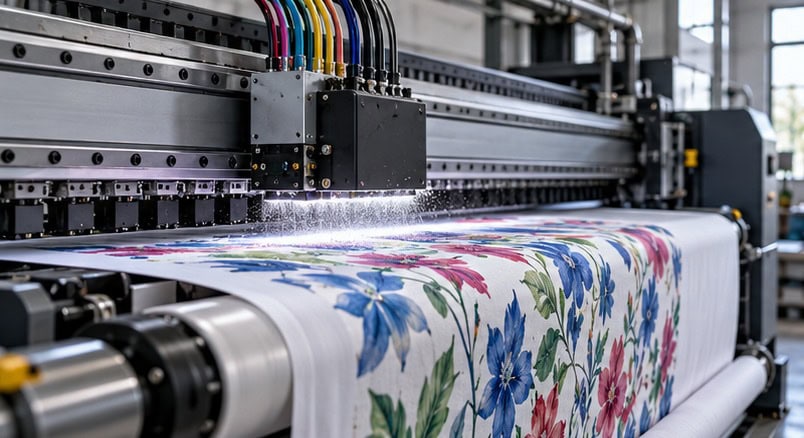
Digital inkjet printing is the fastest-growing segment of the textile printing market. Print heads (similar to office printers but much larger and faster) jet tiny droplets of ink onto the fabric as it passes under the print heads. The design is stored digitally and printed directly, with no screens required.
Digital printing is ideal for sampling (a single meter can be printed to test a design), short runs (the per-meter cost is the same for 1 meter or 1,000 meters, because there are no setup costs), and complex designs (photographic quality, gradient effects, very high color counts). The main limitations are the slower speed (5-50 m/min, vs. 50-100 m/min for rotary) and the higher per-meter cost for long runs (because ink cost is higher than print paste cost).
The main digital ink types for textile printing are reactive inks (for cellulose fibers like cotton), acid inks (for protein fibers like wool and silk), disperse inks (for polyester and other synthetics), and pigment inks (universal, but with lower wash fastness). The choice of ink determines which fibers can be printed and what fastness properties the print will have.
Other methods
- Block printing, the original method, still used for some heritage and artisan applications. A carved wooden or linoleum block is dipped in print paste and pressed onto the fabric. Slow but with a distinctive hand-made look.
- Roller printing (copper roller) – the historical method, replaced by rotary screen for most applications. Still used for some very high-volume, very fine designs (e.g., some high-end ties and scarves).
- Transfer printing, the design is printed on a special paper, then transferred to the fabric via heat and pressure. Used for some synthetic apparel (especially polyester) and for short runs of complex designs.
- Discharge printing, a dye is applied to a pre-dyed fabric, and the discharge paste removes the dye in the printed areas, creating a white or contrasting pattern. The result is a soft-hand print on a dark ground, which is hard to achieve with direct printing.
- Resist printing, a resist paste is applied to the fabric to block dye uptake in the printed areas; the fabric is then dyed, and the resisted areas remain the original color. Used for some heritage and artisan applications (batik, shibori).
The printing process
A typical printing production line has the following stages:
- Pre-treatment, the fabric is prepared to receive the print. For reactive and disperse printing, this includes scouring, bleaching, and (for cotton) a pre-treatment with a print auxiliary that helps the dye fix to the fiber.
- Printing, the design is applied via the chosen method (rotary, flatbed, digital, etc.).
- Drying, the printed fabric is dried to prevent bleeding of the print. Hot air drying is typical; infrared or radio-frequency drying is faster.
- Fixation, the dye is fixed to the fiber. For reactive printing, this is done by steaming at 100-103 °C for 8-15 minutes. For disperse printing, this is done by heat setting at 180-200 °C.
- Washing, the unfixed dye and auxiliaries are washed off. Multiple wash boxes with progressively cleaner water are typical.
- Drying, the fabric is dried again, typically on a stenter frame (which also sets the fabric width and imparts stability).
- Finishing, additional finishes (softener, easy-care, water-repellent) may be applied depending on the end use.
- Inspection, the fabric is inspected on a frame with backlighting, defects are marked, and the fabric is graded (typically 4-point system, with first-quality fabric having 0-20 points per 100 linear yards).
Print quality parameters
Print quality is measured by several parameters:
- Color fastness to washing, the printed colors should not bleed or fade significantly when washed. Tested per ISO 105-C06, with grades of 1-5 (5 is best).
- Color fastness to light, the printed colors should not fade significantly when exposed to light. Tested per ISO 105-B02, with grades of 1-8 (8 is best).
- Color fastness to rubbing (crocking) – the printed colors should not transfer to other fabrics by rubbing. Tested per ISO 105-X12.
- Print sharpness, the edges of the design should be crisp, not bleeding. Measured by visual inspection or by image analysis.
- Penetration, the print should penetrate through the fabric, not just sit on the surface. Important for double-sided prints and for printing of pile fabrics (towels, fleece).
- Hand, the print should not significantly stiffen the fabric. Heavy print pastes or excessive auxiliaries can give a stiff or boardy hand, which is unacceptable for most apparel end uses.
Digital printing in detail
Digital inkjet printing has transformed the textile printing industry by enabling small-batch production, rapid design iteration, and complex designs that were previously impossible or uneconomical. The technology uses print heads with thousands of nozzles that jet picoliter-sized droplets of ink at high frequency (10-50 kHz) onto the fabric. The print heads are mounted on a carriage that moves across the fabric as it advances through the machine.
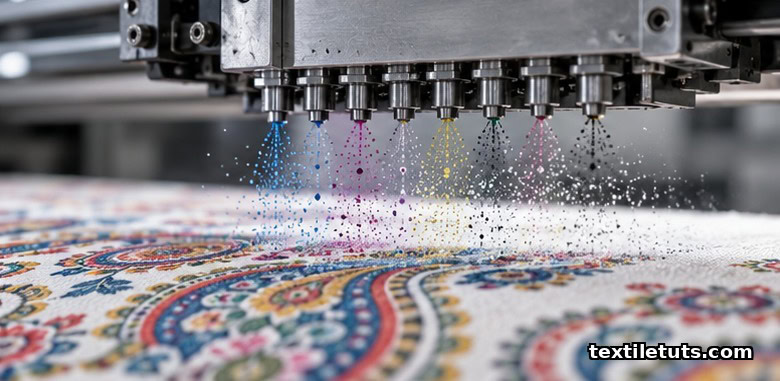
Digital printing systems use either scanning print heads (which move back and forth across the fabric) or single-pass print heads (which span the full fabric width and print in a single pass). Single-pass systems are faster (50-100 m/min) but more expensive. Scanning systems are slower (5-30 m/min) but more common at the mid-market level.
The main digital printing equipment manufacturers are:
- EFI Reggiani (Italy) – leading manufacturer of mid- and high-end digital printers for apparel and home textiles
- Kornit (Israel) – leading manufacturer of direct-to-garment and roll-to-roll digital printers, especially strong in cotton printing
- MS Printing Solutions (Italy) – entry-level and mid-range digital printers
- Durst (Italy) – high-end digital printers for fashion and home textiles
- SPGPrints (Netherlands) – digital and rotary screen printing systems
Digital printing requires specially prepared fabric (pre-treated to receive the ink) and specially formulated inks (viscosity, surface tension, particle size are all controlled for jetting reliability). The pre-treatment is typically a padding process that applies a thin layer of print auxiliary to the fabric surface. The inks are then jetted onto the prepared fabric and fixed via steaming or heat setting, followed by washing to remove unfixed ink.
Environmental considerations
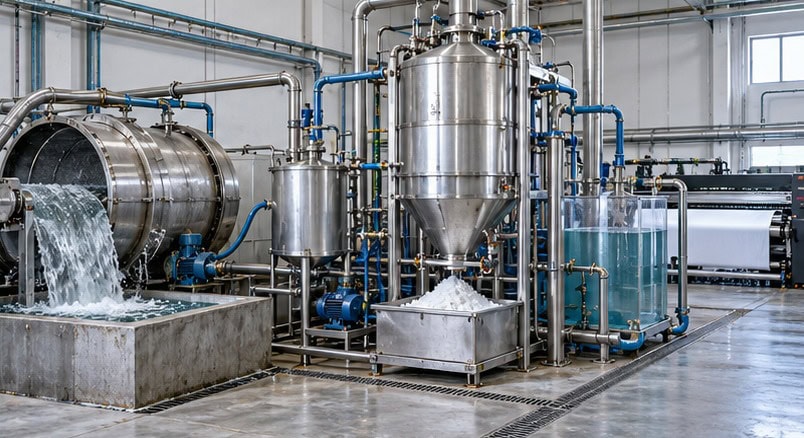
Textile printing is one of the most water- and chemical-intensive textile processes. The environmental impact depends on the printing method and the chemistry used. Rotary and flatbed screen printing use water-based print pastes (relatively low environmental impact) and the wash water contains the unfixed dye and auxiliaries (which must be treated). Digital printing uses much less water (no print paste, just ink) but the inks themselves may contain glycols and other organic solvents (which must be captured and treated).
The most sustainable printing approaches include:
- Digital printing with water-based inks, less water, less waste, less energy than conventional screen printing
- Pigment inks, pigments (insoluble color particles) are universal (work on any fiber) and have the best lightfastness; they are the lowest-impact ink type when used with a binder that doesn’t compromise the fabric hand
- Closed-loop water systems, recycle the wash water for multiple cycles, reducing both water use and wastewater volume
- Low-temperature or no-fixation inks, eliminate the steaming or heat-setting step, reducing energy use
Frequently Asked Questions
What is the difference between printing and dyeing?
Dyeing applies color to the entire fabric (or yarn) uniformly. Printing applies color to selected areas to create a pattern or design. The result is similar in that color is added to the fabric, but printing requires a more sophisticated application method to create the pattern. Most printed fabrics are first dyed to a base color, then overprinted with the pattern, combining the two processes.
Which printing method is most cost-effective?
Depends on the run length. For runs of 10,000+ meters, rotary screen printing is the most cost-effective. For runs of 1,000-10,000 meters, rotary screen is still competitive but digital becomes viable. For runs of 100-1,000 meters, digital printing is typically the most cost-effective because there are no setup costs. For runs under 100 meters, digital is essentially the only cost-effective option because screen setup is too expensive to amortize over so few meters.
What is the difference between rotary and flatbed screen printing?
Rotary screen uses cylindrical screens that rotate continuously, allowing high-speed production (50-100 m/min). Flatbed screen uses flat screens that press down on the fabric for each print, allowing slower production (10-20 m/min) but more flexibility for very large repeat patterns and for printing on thick or irregular fabrics. Most apparel and home textile printing is done on rotary equipment; flatbed is used for specialty applications.
Can digital printing match the quality of screen printing?
Modern digital printing can match screen printing for most designs, with the exception of very fine details, very saturated colors, and some specialty effects. Digital printing has the advantage of unlimited color count (any design can be printed), photographic quality (gradients, fine details, complex images), and minimal setup (no screens). Screen printing has the advantage of higher production speed, lower per-meter cost at long runs, and the ability to use specialty inks (metallic, glitter, puff, etc.) that digital inks cannot match.
What is the most sustainable printing method?
Digital printing is generally the most sustainable, with the lowest water use, lowest chemical use, and lowest waste. Pigment inks (universal, water-based) are the lowest-impact ink type. Conventional screen printing with water-based reactive or disperse inks is also relatively low-impact. The least sustainable options are printing with solvent-based inks (high VOC emissions) and printing with heavy metal-based dyes (toxicity and effluent issues).
References
- Little Cocalico (industry resource). Understanding Fabric Printing Methods and Why It Matters. https://littlecocalico.com/fabric-printing-methods/ – practical guide to fabric printing methods for designers and buyers.
- ISO 105-C06:2010, Textiles, Tests for colour fastness, Part C06: Colour fastness to domestic and commercial laundering. https://www.iso.org/standard/51021.html, wash fastness test, applicable to printed textiles.
- ISO 105-X12:2016, Textiles, Tests for colour fastness, Part X12: Colour fastness to rubbing. https://www.iso.org/standard/50979.html, crocking fastness test for printed textiles.
This article is the working reference for textile printing. Editorial by Shahrukh Islam, TextileTuts. Sources: industry resource on printing methods, ISO 105-C06 (wash fastness), ISO 105-X12 (crocking) as cited.


