
What is tensile strength?

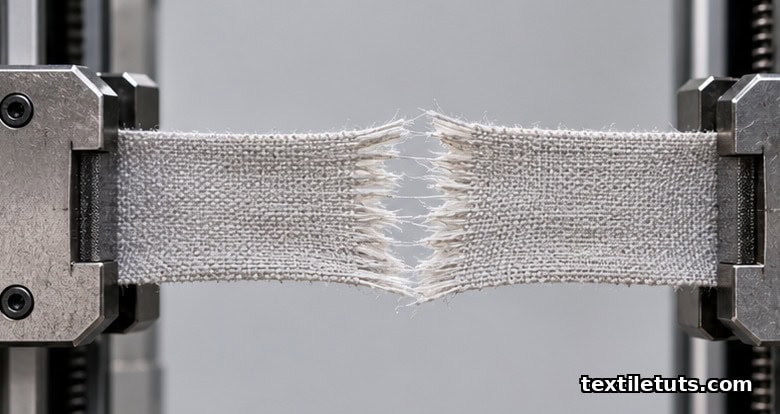
Tensile strength is the maximum tensile (pulling) force a fabric can withstand before breaking. It is the single most important mechanical property of a textile for most end uses, because fabrics in use are subjected to tensile forces from body movement, washing, wear, and handling, and failure under those forces is the most common mode of in-use failure. The tensile strength of a fabric is determined by the strength of the yarns, the density of the yarns, the construction (weave, knit, nonwoven), and the finish.
Tensile strength is measured in Newtons (N) or pounds-force (lbf) per unit width (typically 50 mm strip or 25 mm grab). The result is reported as the breaking force in N or N/50mm. For quality control, the result is compared to a buyer-specified minimum; for design, the result is used to predict how the fabric will perform in use.
Why tensile strength matters
Tensile strength is the primary specification the buyer uses to verify fabric quality. A buyer requesting “200 N warp, 150 N weft” expects the fabric to meet those minimums, and any fabric below the spec is either rejected, accepted with a price concession, or downgraded to a lower-quality end use.
Tensile strength also predicts in-use performance. A fabric that meets 200 N warp tensile strength will withstand typical apparel stresses (wearing, washing, body movement) for years; a fabric that barely meets the spec may fail prematurely. The strength is also the basis for predicting fabric behavior in subsequent manufacturing (sewing, cutting, fusing) where the fabric is subjected to additional tensile forces.
How tensile strength is measured
There are two main test methods for fabric tensile strength: the strip method and the grab method. Both use a universal testing machine (UTM) to pull a fabric specimen until it breaks, but they differ in how the specimen is gripped.
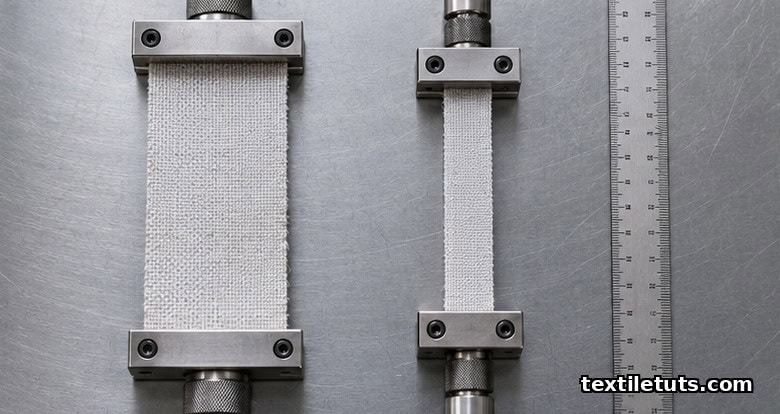
Strip method (ISO 13934-1)
The strip method grips the full width of a fabric strip (typically 50 mm wide by 200 mm long) in the UTM jaws. The full width of the strip is under tension, and the result represents the strength of the fabric as a whole. The strip method is the international standard and is preferred for quality control and specification.
The specimen is cut to size, conditioned at 20 °C and 65% RH for 24 hours, and mounted in the UTM with a gauge length of 100 mm. The UTM pulls the specimen at a constant rate of extension (50 mm/min for apparel fabrics, 100 mm/min for industrial fabrics) until the specimen breaks. The peak force is recorded as the breaking force.
Grab method (ISO 13934-2, ASTM D5034)
The grab method grips only the central 25 mm of a fabric strip (typically 100 mm wide by 150 mm long) in the UTM jaws. Only the central portion of the fabric is under tension; the outer portions are held in the jaws but not under test. The grab method gives a result that is typically 20-40% higher than the strip method because the central portion of the fabric is reinforced by the outer portions (which act as a stress-distribution region).
The grab method is the historical US standard (ASTM D5034) and is still common in the US textile industry. The international standard for the grab method is ISO 13934-2. The grab method is faster and uses less fabric than the strip method, which is why it remains popular in production environments.
Which method to use
For international trade, the strip method (ISO 13934-1) is preferred. The result is more conservative and more reproducible. For US-domestic trade, the grab method (ASTM D5034 or ISO 13934-2) is still common. Buyer specifications should always name the test method explicitly to avoid ambiguity; the same fabric tested by the two methods will give different numerical results.
Tensile strength in different fiber types
Tensile strength varies widely by fiber type. The strongest common textile fibers are:
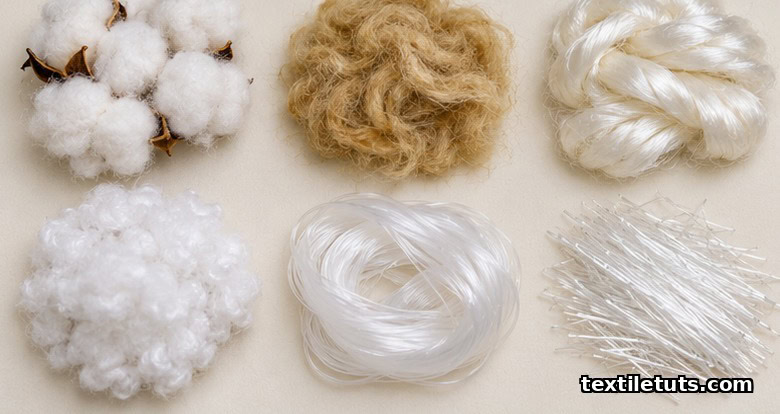
- Aramid (Nomex, Kevlar) – 2,000-3,000 MPa fiber tensile strength. Used in ballistic protection, fire-resistant garments, and high-performance composites.
- Ultra-high molecular weight polyethylene (Dyneema, Spectra) – 2,000-3,500 MPa. Used in cut-resistant gloves, ballistic protection, and high-performance ropes.
- Glass fiber, 2,000-3,500 MPa. Used in technical textiles and composites.
- Carbon fiber, 3,000-7,000 MPa. Used in composites.
- Nylon (polyamide) – 800-1,000 MPa. Used in apparel, carpets, and technical textiles.
- Polyester, 800-1,000 MPa. Used in apparel, home textiles, and technical textiles.
- Cotton, 400-800 MPa. Used in apparel, home textiles, and industrial textiles.
- Wool, 150-300 MPa. Used in apparel and home textiles.
- Silk, 400-600 MPa. Used in luxury apparel.
These are fiber tensile strengths (in MPa, which is N/mm²). The yarn strength is lower than the fiber strength (typically 50-80% of the fiber strength) due to yarn construction effects (fiber alignment, twist, friction). The fabric strength is lower than the yarn strength (typically 50-80% of the yarn strength) due to fabric construction effects (yarn interlacing, slip, stress concentration at crossover points).
Factors that affect tensile strength
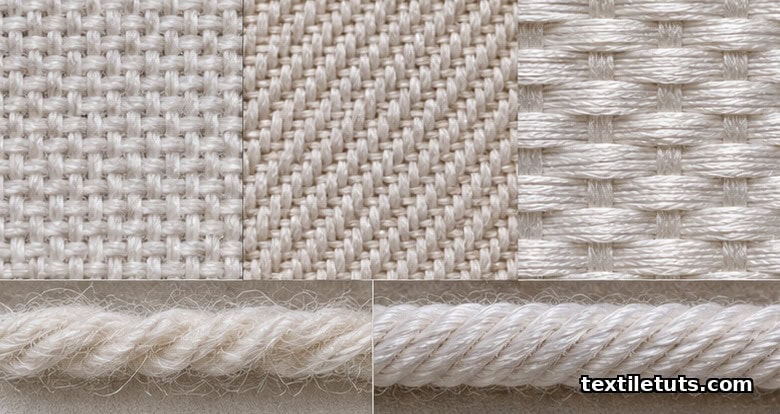
The tensile strength of a fabric is determined by the combination of fiber, yarn, fabric, and finish factors. The main factors are:
- Fiber strength, stronger fibers make stronger fabrics. This is the primary determinant.
- Yarn count (linear density) – thicker yarns have more fibers per cross-section, so they can withstand more load. A 30 tex yarn is stronger than a 20 tex yarn of the same fiber.
- Yarn twist, higher twist increases fiber cohesion and yarn strength, up to a point. Beyond the optimum twist, higher twist reduces yarn strength because the fibers are held at too steep an angle to the yarn axis.
- Yarn construction, filament yarns are stronger than staple yarns of the same count (because the filaments are continuous and aligned).
- Fabric density, more yarns per unit length (higher thread count) gives more load-bearing elements per cross-section, so a denser fabric is stronger than a less dense fabric of the same yarn count.
- Fabric construction, woven fabrics are generally stronger than knit fabrics of the same yarn and weight. Among weaves, plain weave is strongest, then twill, then satin (which has long floats that can catch and pull).
- Finish, some finishes (especially chemical finishes like easy-care resin) reduce tensile strength. Other finishes (like water-repellent finishes) have minimal effect. The buyer specification should account for any finish-related strength loss.
Frequently Asked Questions
What is the difference between tensile strength and tear strength?
Tensile strength is the force required to break the fabric by pulling it from both ends. Tear strength is the force required to propagate an existing tear in the fabric. A fabric can have high tensile strength (resistant to being pulled apart from both ends) and low tear strength (easily torn once a cut is started), or vice versa. Both are important for different end uses: tensile strength matters for body movement and handling; tear strength matters for snags and cuts (which can propagate into large tears in low tear-strength fabrics).
What is the relationship between tensile strength and elongation?
Elongation is the amount a fabric stretches before breaking, reported as a percentage of the original length. Most fabrics have 10-30% elongation at break. Higher elongation generally means lower strength (the fabric stretches rather than resisting), and lower elongation generally means higher strength. The relationship is not strict: a fabric can have high strength and high elongation (strong and stretchy, e.g., spandex blends) or low strength and low elongation (weak and rigid, e.g., heavily finished cotton).
Is warp or weft tensile strength higher?
Depends on the fabric. In most woven fabrics, the warp (lengthwise) yarns are more numerous, finer, and more tightly tensioned, so warp tensile strength is typically higher than weft tensile strength. The warp/weft ratio is typically 1.2-1.5x. In some fabrics (especially weft-faced satins and some specialty weaves), the weft can be stronger. Knit fabrics typically have similar strength in both directions, with slight differences due to construction (wales vs courses).
How does moisture affect tensile strength?
Most fibers absorb some moisture, and wet fibers are typically weaker than dry fibers. Cotton loses about 10-20% of its strength when wet; wool loses about 10-15%; viscose loses about 30-50%. Synthetic fibers (polyester, nylon) absorb very little water and lose little strength when wet. The wet strength is an important specification for fabrics that will be washed (apparel, home textiles, towels).
What is the difference between tensile strength and bursting strength?
Tensile strength is measured by pulling the fabric in one direction (warp or weft). Bursting strength is measured by applying a multi-directional force (typically a hydraulic or pneumatic pressure applied perpendicular to the fabric surface) until the fabric ruptures. Bursting strength is the standard test for knit fabrics, where the multi-directional stress better simulates the in-use load (which is rarely purely unidirectional). For woven fabrics, tensile strength is the standard; for knit fabrics, bursting strength is often preferred.
References
- ISO 13934-1:2013, Textiles, Tensile properties of fabrics, Part 1: Determination of maximum force and elongation at maximum force using the strip method. https://www.iso.org/standard/60676.html, primary international standard for strip tensile strength.
- ISO 13934-2:2014, Textiles, Tensile properties of fabrics, Part 2: Determination of maximum force using the grab method. https://www.iso.org/standard/60677.html
- ASTM D5034-21, Standard Test Method for Breaking Strength and Elongation of Textile Fabrics (Grab Test). https://www.astm.org/d5034_d5034m-21.html, US grab tensile strength standard.
- ASTM D5035-11, Standard Test Method for Breaking Force and Elongation of Textile Fabrics (Strip Method). https://www.astm.org/d5035-11.html, US strip tensile strength standard.
This article is the working reference for tensile strength testing. Editorial by Iftay Khairul Alam, TextileTuts. Sources: ISO 13934-1/2 (primary international standards), ASTM D5034/5035 (US standards) as cited.


