
Spinning Mill Safety Standards: OSHA, ISO 45001, and PPE

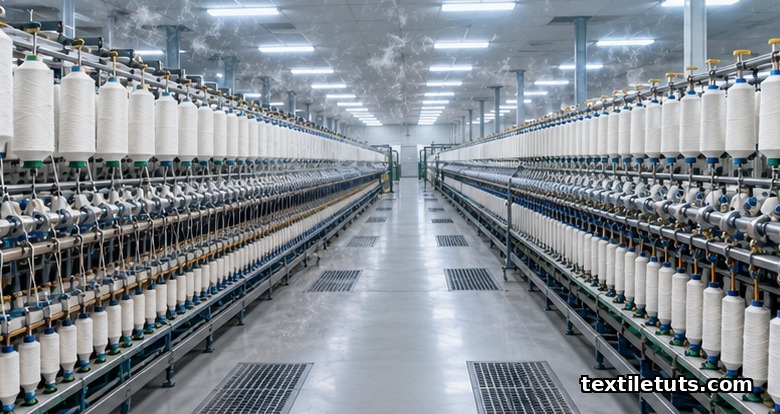
A spinning mill operating 1,000 to 1,800 spindles per frame at 18,000 to 25,000 RPM routinely generates 95 to 105 dB(A) of sound pressure, 0.5 to 2.0 mg/m³ of respirable cotton dust, and enough airborne fly to ignite a flash fire in under 30 seconds, which is why OSHA 29 CFR 1910.95 caps worker noise exposure at 90 dB(A) over 8 hours and 29 CFR 1910.1043 caps cotton dust at 0.200 mg/m³ for yarn-manufacturing operations.
The numbers above come from peer-reviewed textile-safety studies and the OSHA permissible exposure limit tables, and they are the operating yardstick safety officers use to set up hearing-conservation programs, design dust-extraction systems, and qualify a mill for ISO 45001:2018 certification.
This article walks through the hazards a modern spinning floor actually faces, the engineering and administrative controls that bring each one below its action limit, the PPE specifications mills rely on, and the lockout/tagout and machine-guarding rules that prevent the catastrophic injuries a high-RPM frame can cause in a fraction of a second.
The Four Hazard Families on a Spinning Floor
A yarn mill’s risk profile is unusual because four very different hazard families coexist in the same room: acoustic, particulate, mechanical, and fire. Each one has its own exposure limit, measurement method, and control hierarchy, and a credible safety program has to address all four simultaneously.
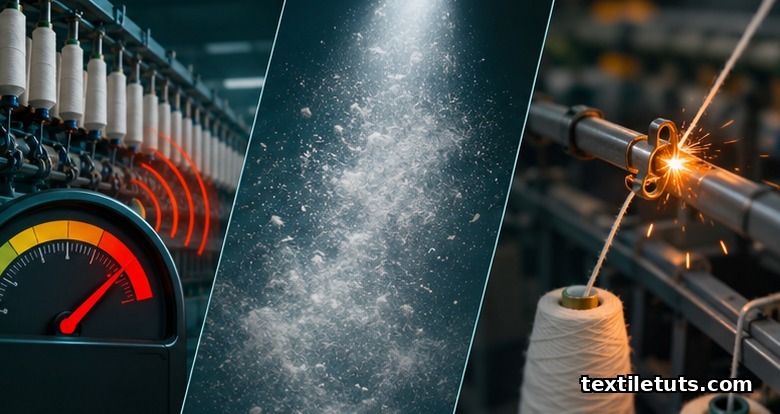
Acoustic hazard. Ring spinning frames at 18,000 RPM produce 95 to 100 dB(A) at the operator station, and compact or air-jet frames with integrated suction run closer to 100 to 105 dB(A). OSHA’s permissible exposure limit (PEL) under 29 CFR 1910.95 is 90 dB(A) as an 8-hour time-weighted average with a 5 dB exchange rate, which means every 5 dB increase halves the allowed exposure time. A worker in a 100 dB(A) zone can legally spend only 2 hours before hearing protection is mandatory under the action level of 85 dB(A).
Particulate hazard. Cotton dust generated at the blowroom, carding, and drawing stages contains biologically active bract and endotoxin material that causes byssinosis (brown-lung disease) on chronic exposure. OSHA’s PEL under 29 CFR 1910.1043 sets 0.200 mg/m³ as an 8-hour TWA for yarn-manufacturing operations, with a permissible 8-hour TWA of 0.75 mg/m³ for cotton-waste processing and 0.500 mg/m³ for slashing and weaving. NIOSH recommends a more conservative 0.200 mg/m³ limit across all cotton-textile operations and lists cotton dust as a carcinogen group 1 when contaminated with certain pesticide residues.
Mechanical hazard. Spinning frames expose operators to nip points at the drafting rollers, entanglement points at the spindle wharve, and cut points at the roving creel. End-breaks that whip around the spindle at 200 km/h can sever a fingertip before the operator registers the break, which is why OSHA 29 CFR 1910.212 (general machine guarding) and 29 CFR 1910.219 (mechanical power-transmission apparatus) require fixed or interlocked guards on every accessible nip, gear, and belt run.
Fire hazard. Fly and lint accumulate under the spindle rail, in the under-floor suction ducts, and on top of cable trays. The lower explosive limit (LEL) for cotton fly is roughly 50 g/m³, and a small ignition source such as a static discharge or overheated traveler can flash through the duct in seconds. NFPA 90A and NFPA 13 govern ventilation and sprinkler design in textile mills; the automatic sprinkler density called up is 0.20 gpm/ft² over the most demanding 2,500 ft² for cotton systems, with ESFR sprinklers rated K-25.2 common in newer mills.
OSHA, ISO 45001, and the Compliance Framework
Spinning-mill safety in most exporting countries is built on two interlocking systems: OSHA 29 CFR 1910 in the United States (or an equivalent statutory framework such as India’s Factory Act 1948 or the EU’s OSH Directive 89/391/EEC) for prescriptive limits, and ISO 45001:2018 for the management system that ties the prescriptive limits together.
OSHA’s role is to set the legally enforceable ceilings. The relevant standards for a yarn mill are 29 CFR 1910.95 (occupational noise exposure), 29 CFR 1910.1043 (cotton dust), 29 CFR 1910.132 to 1910.140 (personal protective equipment), 29 CFR 1910.147 (lockout/tagout or control of hazardous energy), 29 CFR 1910.157 (portable fire extinguishers), and 29 CFR 1910.165 (employee alarm systems). Citations under these standards carry fines from roughly $1,000 per serious violation to $15,000+ per willful violation under the 2024 penalty schedule.
ISO 45001:2018, by contrast, is a management-system standard. It replaces OHSAS 18001 and follows the Annex SL high-level structure shared with ISO 9001 and ISO 14001, which makes it auditable alongside existing quality and environmental systems. Certification is voluntary but is increasingly required by global yarn buyers; a mill supplying a brand on the SAC Higg FEM or ZDHC roadmap will typically hold ISO 45001 to satisfy the social-due-diligence module. The standard’s Plan-Do-Check-Act cycle is built around hazard identification, risk assessment, operational controls, and incident investigation, with explicit requirements for worker participation and top-management leadership.
A credible mill compliance file therefore contains the OSHA or equivalent monitoring data (sound-dosimeter logs, vertical elutriator cotton-dust measurements, PPE issue logs) inside an ISO 45001 management system that documents the audit cycle, training records, and corrective-action register.
Personal Protective Equipment Specifications
PPE on a spinning floor is not optional above the OSHA action levels; it is a regulatory requirement. The specifications below come from OSHA 29 CFR 1910.95 and 1910.132 plus the relevant ANSI/ISEA standards.
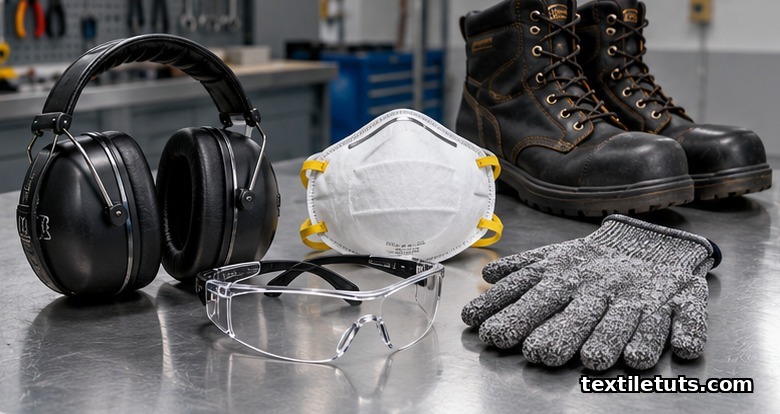
Hearing protection. When noise exposure reaches the 85 dB(A) action level, employers must offer hearing protection at no cost and enforce its use at or above 90 dB(A). Disposable foam plugs (NRR 29 to 33 dB) or earmuffs (NRR 23 to 30 dB) bring the protected exposure below 80 dB(A) in most mill zones. A dual-protector combination (plugs plus muffs) adds roughly 5 dB of extra attenuation and is standard on compact and air-jet spinning floors where measured levels run 100 dB(A) or more.
Respiratory protection. Below the OSHA PEL of 0.200 mg/m³, respiratory protection is generally not required if dust extraction is verified. Above the PEL or during blowroom cleaning, NIOSH-certified N95 respirators (42 CFR 84) are the minimum, with half-mask elastomeric respirators assigned to maintenance crews who enter dusty zones for longer than 15 minutes. The OSHA respirator standard, 29 CFR 1910.134, requires a written program, fit-testing, and medical evaluation before any worker wears a respirator.
Eye and face protection. ANSI Z87.1-rated safety glasses with side shields are required wherever a roving break, traveler fragment, or cleaning-air particle can reach the operator. Face shields are added for fly-removal and doffer tasks where larger particles are likely.
Hand and foot protection. Cut-resistant gloves to ANSI/ISEA 105 level A4 or higher are required when handling roving bobbins and during maintenance. Steel-toe footwear is required by 29 CFR 1910.136 where rolling frames or forklift traffic are present.
Clothing. Loose clothing, scarves, and unrestrained long hair are entanglement hazards on a spinning frame. Most mills enforce a close-fitting cotton or cotton-blend uniform policy and prohibit jewelry on the shop floor.
Machine Guarding and Lockout/Tagout
Mechanical injuries on spinning frames are usually catastrophic because the energy stored in a rotating spindle is high and the reaction time is essentially zero. Two OSHA standards prevent these incidents: 29 CFR 1910.212 for general machine guarding and 29 CFR 1910.147 for lockout/tagout (LOTO) of hazardous energy.
Machine guarding under 1910.212 requires fixed guards at every nip and shear point on the drafting rollers, the roving stop motion, and the spindle drive belts. Interlocked guards that stop the frame when opened are required on the creel and the can-changer. Guards must prevent hands, fingers, and clothing from reaching the danger zone during normal operation, and they must be difficult to remove without a tool. Studies cited by OSHA estimate that effective guarding prevents roughly 18,000 injuries and 85 fatalities per year in the US manufacturing sector, with textile machinery accounting for a disproportionate share of the laceration and amputation cases.
LOTO under 1910.147 applies to any maintenance task where an unexpected start-up or release of stored energy could harm a worker. The procedure is six-step: (1) notify affected employees, (2) identify all energy sources (electrical, pneumatic, mechanical, gravitational), (3) isolate the energy source at the disconnect or block valve, (4) apply a personal padlock and tag, (5) verify zero energy by trying to start the machine or by metering, and (6) only then begin work. OSHA estimates that compliance with the LOTO standard prevents 120 fatalities and roughly 50,000 injuries annually in US industry. The training requirement is annual retraining for authorized employees and triennial for all others.
On a spinning frame, LOTO covers at minimum the main isolator, the inverter DC bus (which can retain lethal voltage for 5 to 10 minutes after power-off), the pneumatic suction supply, and any mechanical brake or back-spin preventer. Mills that skip the inverter discharge wait are responsible for a recurring pattern of arc-flash incidents in the industry.
Fire Prevention and Suppression
Spinning-mill fires are dominated by fly accumulation, overheated travelers, and static discharge, and the prevention program has to address all three.
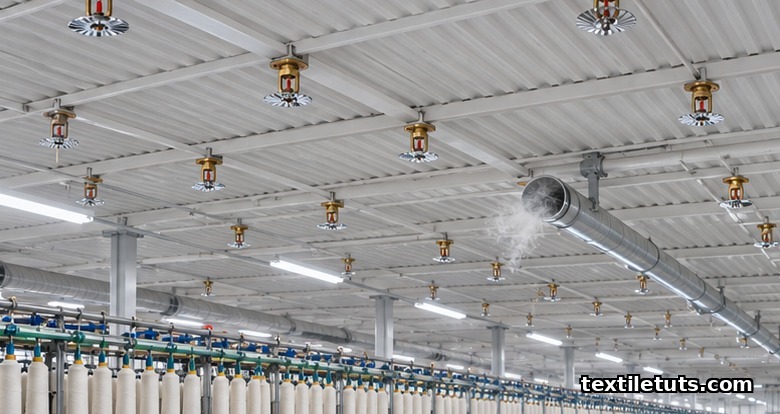
Fly accumulation is controlled by an engineered under-floor suction system sized to capture fly at every spindle and traveler cleaner. NFPA 90A requires duct cleaning intervals short enough that no more than 1.6 mm (1/16 in) of lint accumulates on duct walls; most mills clean monthly and inspect with borescopes quarterly. Spark detection and extinguishing systems (typically FAA-approved Kidde or similar) are installed between the suction manifold and the dust collector, with infrared sensors that trigger a water-mist abort within 300 milliseconds.
Traveler burning is the leading ignition source on a ring frame. A traveler that runs too hot discolors blue or purple and can reach 400 °C, well above the autoignition point of 210 °C for cotton fly. Spinning frames are therefore fitted with traveler-clearer suction tubes and operators are trained to replace travelers that show heat discoloration rather than waiting for scheduled changes.
Suppression relies on automatic sprinklers per NFPA 13, with ESFR K-25.2 sprinklers at the ceiling and a design density of 0.20 gpm/ft² over 2,500 ft². Portable extinguishers per NFPA 10 (Class A for ordinary combustibles, Class K for cooking-oil where cafeterias are present) are positioned at 75 ft intervals. OSHA 29 CFR 1910.157 requires annual inspection and a 12-year hydrostatic test for stored-pressure extinguishers.
Hazard and Control Comparison Table
| Hazard | Source | OSHA / Standard Limit | Primary Control | PPE |
|---|---|---|---|---|
| Noise | Spindle 18,000 to 25,000 RPM, suction, drives | 90 dB(A) TWA (1910.95) | Enclosures, isolation, maintenance | Hearing protectors NRR 29+ |
| Cotton dust | Blowroom, carding, drawing | 0.200 mg/m³ TWA (1910.1043) | Local exhaust ventilation, housekeeping | N95 or half-mask respirator |
| Mechanical | Drafting rollers, spindles, belts, gears | Nip-point guarding (1910.212) | Fixed guards, interlocked creel covers | Cut-resistant gloves, eye protection |
| Stored energy | Electrical, pneumatic, mechanical brake | Energy isolation (1910.147) | Padlock-and-tag, inverter discharge wait | Arc-rated clothing for electrical work |
| Fire / flash | Fly accumulation, hot travelers, static | NFPA 13 / NFPA 90A | Suction cleaning, spark detection, sprinklers | Fire-retardant coveralls |
| Chemical | Spinning lubricants, machine oils | GHS / HazCom 1910.1200 | SDS, controlled dispensing, ventilation | Chemical-resistant gloves, goggles |
Frequently Asked Questions
Q1: What noise level triggers mandatory hearing protection on a spinning floor?
OSHA requires hearing protection to be offered at the 85 dB(A) action level (29 CFR 1910.95) and used at or above the 90 dB(A) PEL. On most modern ring frames running 18,000 RPM, the operator station measures 95 to 100 dB(A), so hearing protection is mandatory and the mill must run a hearing-conservation program that includes annual audiometry, training, and recordkeeping.
Q2: How does a mill control cotton dust below the OSHA PEL?
Compliance comes from a layered approach: local exhaust ventilation at the blowroom and carding stations, enclosure of the dust-producing machinery, regular housekeeping to prevent settled-dust re-aerosolization, and continuous vertical-elutriator sampling to verify the 0.200 mg/m³ 8-hour TWA is held. Respirators are used as a supplement when engineering controls are bypassed during maintenance, not as the primary control.
Q3: Why is inverter discharge time critical during spinning-frame maintenance?
A spinning frame driven by a variable-frequency drive retains DC-bus voltage for 5 to 10 minutes after the main isolator is opened. A technician who touches the bus before it has discharged can suffer a lethal shock even though the machine appears dead. The OSHA lockout/tagout procedure (29 CFR 1910.147) requires a verifiable zero-energy check, typically by metering the bus, before any work begins.
Q4: What is the most common ignition source of cotton-mill fires?
Overheated travelers and the static discharge that follows are responsible for the majority of spinning-mill fires. A traveler running too hot reaches 350 to 400 °C, well above the 210 °C autoignition of cotton fly, and a single spark at the spindle rail can flash through the under-floor suction duct in under 30 seconds if fly accumulation exceeds the NFPA 90A 1.6 mm threshold. The prevention program targets traveler condition, suction-system cleaning, and spark-detection-equipped ducting.
References
- United States Department of Labor, Occupational Safety and Health Administration. 29 CFR 1910.95 Occupational Noise Exposure. osha.gov. Permissible exposure limit and hearing-conservation program requirements.
- United States Department of Labor, Occupational Safety and Health Administration. 29 CFR 1910.1043 Cotton Dust. osha.gov. PELs by textile operation and required monitoring methodology.
- United States Department of Labor, Occupational Safety and Health Administration. 29 CFR 1910.147 The Control of Hazardous Energy (Lockout/Tagout). osha.gov. Six-step energy-isolation procedure and training requirements.
- International Organization for Standardization. ISO 45001:2018 Occupational Health and Safety Management Systems. iso.org. Annex SL structure, audit cycle, and certification scope.
- National Fire Protection Association. NFPA 13 Standard for the Installation of Sprinkler Systems. nfpa.org. Sprinkler density and ESFR K-factor requirements for cotton systems.
- National Fire Protection Association. NFPA 90A Standard for the Installation of Air-Conditioning and Ventilating Systems. nfpa.org. Lint-cleaning intervals and duct construction in textile occupancies.
- Cherrie, J. W., et al. Cotton dust exposure and byssinosis: a review of the evidence. Occupational and Environmental Medicine, 2018. Peer-reviewed review of dose-response and disease mechanism.
- The Textile Institute. Handbook of Technical Textiles. Woodhead Publishing (Elsevier), 2016. Reference on hazard identification and control hierarchy in yarn manufacture.
Editorial by Iftay Khairul Alam, TextileTuts. Sources: OSHA 29 CFR 1910.95, 1910.1043, 1910.147; ISO 45001:2018; NFPA 13; NFPA 90A; Cherrie et al. 2018; Textile Institute Handbook of Technical Textiles (2016) as cited.


