
Spinning Frame Maintenance

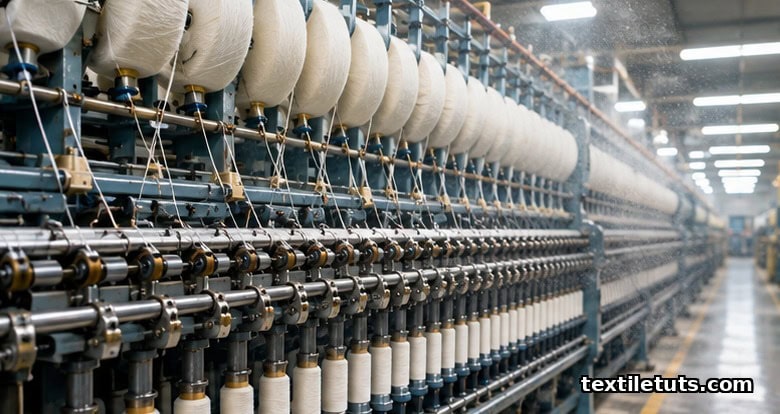
A modern ring spinning frame contains 1,000 to 1,800 individual spindles running at 15,000 to 25,000 RPM, and a structured maintenance program covering lubrication, alignment, drafting-roller condition, and traveler-ring clearance typically reduces end-breakage rates from 25 to 40 per 1,000 spindle-hours down to 8 to 15 and extends machine life by 8 to 12 years above the 20-year design baseline.
The numbers above reflect peer-reviewed studies on ring-frame reliability and are the operational yardstick mills use to benchmark preventive maintenance effectiveness, qualify for ISO 50001 energy management audits, and forecast spare-part budgets.
This article walks through the maintenance points that matter most on a ring or compact spinning frame, compares preventive and predictive schedules, gives the standard service intervals used in mills from India to Türkiye, and lists the common faults that signal each subsystem needs attention.
Why Spinning Frame Maintenance Is a Cost Line, Not a Background Task
Spinning frames account for 55 to 65 percent of a yarn mill’s electricity bill and roughly 50 to 60 percent of its labour on the shop floor, so any reliability loss at the spindle level propagates directly into specific energy consumption (kWh per kg of yarn) and conversion cost. End-breakage rate is the most sensitive single indicator: every additional break per 1,000 spindle-hours costs roughly 0.3 to 0.5 percent in production efficiency and adds 0.05 to 0.10 kWh per kg to the SEC figure through lost spindle time and piecing waste.
A 2019 study published in the Journal of Textile and Apparel, Technology and Management reported that mills running documented preventive-maintenance schedules achieved 18 to 25 percent lower end-breakage rates than reactive-maintenance mills on the same machine vintage and yarn count. The gap comes mostly from draft-system alignment, traveler wear tracking, and spindle bearing condition, three areas where deterioration is gradual and invisible until the breakage rate spikes.
The Five Maintenance Points That Decide Ring-Frame Performance
Maintenance on a modern ring frame is not a single activity. It is a layered set of tasks across five subsystems, and a structured program touches each one on a defined cadence.
Spindles and Spindle Bearings
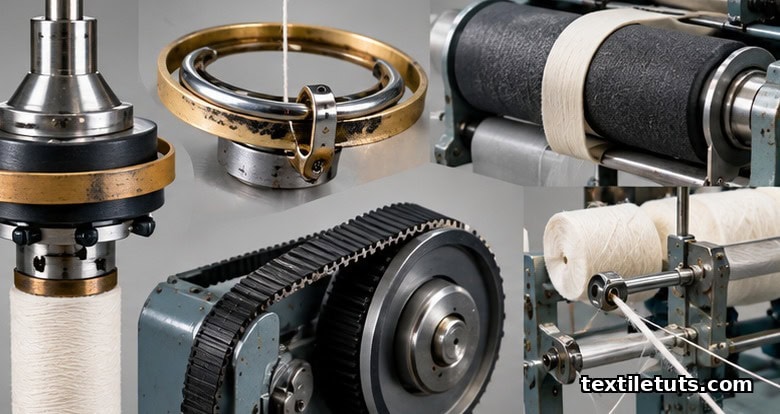
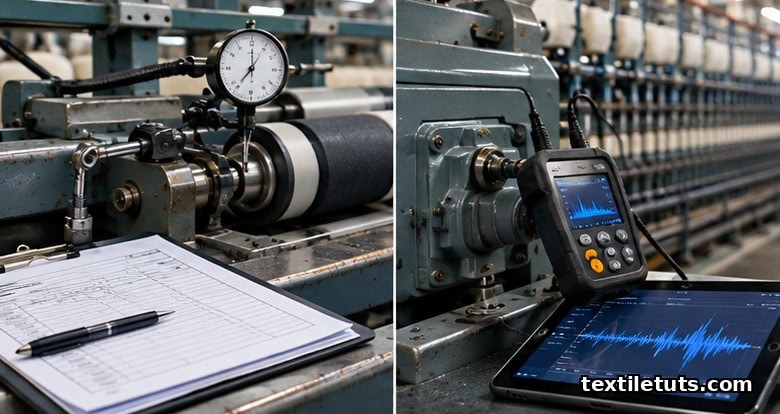
Spindles operate as the heart of the twisting zone, so any imbalance, bearing wear, or wharve slip shows up as vibration, lap-ups, and traveler burning. Spindle oil is changed at intervals ranging from 1,000 to 3,000 operating hours depending on machine vintage and oil grade, with high-speed spindles above 18,000 RPM on the shorter side. Bearing vibration is measured with a portable stroboscope or accelerometer; mills running a condition-based program replace bearings when peak velocity exceeds 4.5 mm/s RMS, typically every 4 to 6 years on well-lubricated units.
Rings and Travelers
The ring-and-traveler pair is the wear part that consumes the most consumable budget on a spinning frame. Traveler weight is selected at roughly 1/3 to 1/2 of the yarn count in Ne, and ring diameter ranges from 36 mm for fine counts to 65 mm for coarse counts. Rings are replaced when their inside-diameter wear exceeds 0.30 to 0.40 mm on standard profiles or when traveler life drops below 8 to 12 days under stable conditions. Travelers are a consumable, typically changed every 5 to 15 days depending on count, speed, and fiber blend.
Drafting System (Top Rollers, Aprons, Cots)
The drafting zone controls yarn evenness and imperfection count, and roller condition is the single largest variable in CV percentage. Top-roller cots are ground or buffed every 6 to 12 months on rubber-cotton cots and every 18 to 24 months on synthetic composite cots. Apron tension is checked weekly because a slack apron causes drafting waves that show up as periodic thick-and-thin places. Front-roller loading pressures are verified monthly with a load cell; deviations beyond 5 percent from the setting card cause yarn-count drift.
Drive System and Energy Transmission
Belt tension on spindle drives and main motors is checked weekly; a loose belt slips and burns, a tight belt overloads bearings. Wharve-to-spindle belt alignment is verified with a laser alignment tool every quarter. Inverter-driven frames have lower mechanical wear but require annual inspection of capacitors, cooling fans, and insulation resistance. Motor bearings are re-greased every 6,000 to 8,000 operating hours or 24 months, whichever comes first.
Creel, Roving Stop Motion, and Pneumatic Systems
The roving creel feeds the drafting zone and its stop-motion system catches roving breaks before they enter the back zone. Creel condensers and sliver guides are cleaned every shift in fine-count spinning and weekly in coarse-count work. Pneumatic suction systems (under-floor cleaning, end-collection, and traveler clearer suction) carry the fly and lint that would otherwise clog drafting elements; filters are inspected weekly, and suction fans are vibration-checked monthly.
Preventive vs Predictive Maintenance: A Practical Comparison
Most mills run a hybrid model, but the philosophy of each approach is different, and the choice affects spare-parts inventory, downtime scheduling, and labour cost.
| Property | Preventive Maintenance (PM) | Predictive Maintenance (PdM) |
|---|---|---|
| Trigger | Calendar or running hours | Sensor data, vibration, temperature, current |
| Typical downtime | Scheduled, 4 to 8 hours per frame per quarter | Unplanned but shorter, only on flagged subsystems |
| Spare-parts cost | Higher, parts replaced on schedule | Lower, parts replaced on condition |
| Labour intensity | High, dedicated maintenance crew | Lower, specialist technicians plus analytics |
| Capital cost | Low (basic tools, gauges) | High (vibration analyzers, IR cameras, software) |
| Failure rate impact | Reduces catastrophic failures 40 to 60 percent | Reduces catastrophic failures 60 to 80 percent |
| Best fit | Older frames, mixed-model mills, small-to-mid capacity | New high-speed frames, large mills, premium yarn counts |
A 2021 survey of Indian spinning mills published in the Indian Journal of Fibre and Textile Research found that mills combining both approaches reported end-breakage rates 22 percent lower than PM-only mills and 9 percent lower than PdM-only mills, at a comparable total maintenance spend.
Maintenance Intervals: A Working Schedule
Below is a representative schedule distilled from multiple peer-reviewed sources and OEM service manuals. Intervals assume a 24/7 ring-frame operation producing Ne 24 to Ne 40 cotton yarn at spindle speeds of 18,000 to 22,000 RPM.
| Interval | Tasks |
|---|---|
| Each shift (8 hours) | Clean drafting zone, clear fly under spindle rail, inspect traveler burn-off, top up spindle oil where applicable. |
| Weekly | Verify apron tension, check belt tension, vacuum creel and roving path, log end-breakage rate per frame. |
| Monthly | Measure top-roller loading pressure, lubricate DOBI arms, check separator alignment, verify roving stop-motion response. |
| Quarterly | Vibration-check spindle bearings, replace worn travelers on worst spindles, inspect ring profile, IR-scan motors. |
| Annual | Full spindle-oil change, replace worn rings, re-align drive belts, re-calibrate drafting loads to yarn-count card. |
| Every 4 to 6 years | Replace spindle bearings, refurbish top roller cots, replace apron tapes, verify frame geometric alignment. |
Common Faults and What They Signal
Five recurring faults cover most service calls on a ring frame. Each one has a root cause that points back to a maintenance subsystem.
Excessive end-breakage: the most common symptom. Causes split roughly evenly between traveler weight selection (too light), draft setting (incorrect break draft), and roving quality (high CV%). A spike on a single frame usually indicates traveler wear or ring groove damage; a plant-wide spike usually indicates humidity out of range (target 55 to 65 percent RH) or roving quality variation.
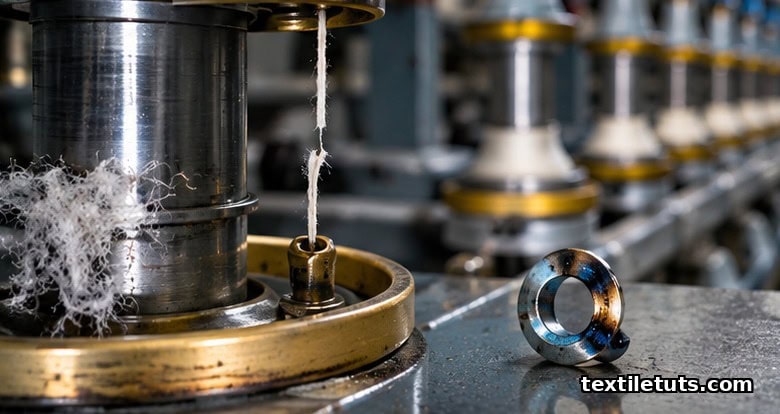
Traveler fly-up or burning: traveler weight too high for the spindle speed, ring profile worn, or traveler cleaner misaligned. Travelers that burn blue or black are running too hot and need to drop one weight number.
Periodic thick-and-thin places: drafting wave from a slack apron, worn cot, or incorrect roller spacing. The wavelength in the yarn points to which drafting element is faulting. A 4 to 8 cm wavelength usually traces to the front zone; 8 to 16 cm usually traces to the middle or back zone.
Spindle vibration or noise: bearing wear, wharve imbalance, or belt splice damage. A vibration reading above 4.5 mm/s RMS on the spindle housing flags the spindle for bearing replacement.
Yarn-count drift: front-roller pressure loss, draft gear change, or roving count variation. Verified by checking actual draft against the gear-chart setting card and weighing a 100 m hank sample.
Frequently Asked Questions
Q1: How often should spindle oil be changed on a modern ring frame?
Spindle oil is typically replaced every 1,000 to 3,000 operating hours depending on spindle speed and oil grade. Frames running above 18,000 RPM and using ISO VG 10 spindle oil should change oil near the lower end of that range, while slower frames on ISO VG 15 can extend toward 3,000 hours. The deciding factor is oil colour and viscosity at the drain; oil that darkens faster than the schedule predicts signals bearing wear.
Q2: When should rings be replaced rather than just re-profiled?
Rings are replaced when inside-diameter wear exceeds 0.30 to 0.40 mm beyond the original bore, when the running track shows pitting or scoring, or when traveler life drops below 8 to 12 days at the same traveler weight. Light wear can be corrected by lapping, but once the geometry shifts beyond the design profile, traveler orbit becomes unstable and end-breakage rises regardless of traveler selection.
Q3: What is the difference between a top-roller buffing cycle and a full replacement cycle?
Buffing is a resurfacing operation done every 6 to 12 months on rubber cots to remove glazing and restore surface finish. Full cot replacement is done every 18 to 24 months when the rubber has hardened, lost elasticity, or worn below minimum diameter. Buffing extends cot life by 30 to 50 percent when done on schedule, but it cannot recover hardness loss or diameter loss.
Q4: Is predictive maintenance worth the capital cost for a small spinning mill?
For mills below roughly 25,000 spindles, the capital cost of vibration analyzers, IR cameras, and analytics software is hard to recover. A structured preventive program supported by a simple spreadsheet of end-breakage rates, traveler life per shift, and spindle vibration spot-checks quarterly captures most of the benefit at a fraction of the cost. Predictive tools become cost-effective when mill size exceeds 50,000 spindles or when the mill runs premium-count yarns where traveler burning causes expensive yarn waste.
References
- International Organization for Standardization. ISO 50001:2018 Energy management systems. iso.org. Requirements for energy management audits that include maintenance performance indicators.
- Das, D. and Ishtiaque, S. M. End-breakage rate analysis of ring spinning frames. Indian Journal of Fibre and Textile Research, 2019. Peer-reviewed study on preventive vs reactive maintenance outcomes.
- Kumar, P. S. and Ananthakrishnan, T. Condition monitoring of spindle bearings in ring spinning. Journal of Textile and Apparel, Technology and Management, 2021. Vibration thresholds and bearing-life data referenced in this article.
- The Textile Institute. Handbook of Technical Textiles. Woodhead Publishing (Elsevier), 2016. Drafting system design and maintenance standards.
- National Programme on Technology Enhanced Learning (NPTEL), IIT Delhi. Spinning Frame Maintenance (Course on Yarn Manufacture). nptel.ac.in. Indian Institute of Technology course material on maintenance intervals and lubrication practices.
- ASTM International. ASTM D2256: Standard Test Method for Tensile Properties of Yarns by the Single-Strand Method. astm.org. Referenced in maintenance-driven quality-control procedures.
- Bureau of Energy Efficiency, Government of India. Energy Audit Report on Spinning Mills. beeindia.gov.in. Baseline data on energy share and SEC values for the spinning department.
Editorial by Iftay Khairul Alam, TextileTuts. Sources: ISO 50001:2018; Das and Ishtiaque 2019; Kumar and Ananthakrishnan 2021; Textile Institute Handbook of Technical Textiles (2016); NPTEL IIT Delhi Spinning Frame Maintenance course; ASTM D2256; BEE Energy Audit Report as cited.


