
Spinning Frame Components and How Specifications Interact


A modern ring spinning frame is built around three coupled specifications: a spindle gauge of 60 to 75 mm, a spindle speed of 12,000 to 25,000 RPM and a total draft of 20 to 60, with the draft distributed across a three-roller drafting system, break draft of 1.20 to 1.50, main draft of 15 to 35 and a final apron zone that controls fibre束 formation.
Choosing any one specification in isolation forces compromises on the other two, so spinners select gauge, speed and draft together against the yarn count, twist multiplier and fibre length they intend to run.
This guide walks through the frame geometry, drafting system, spindle and ring rail behaviour, twist insertion logic and the automation layer that ties these specifications together on a production ring frame.
Spinning Frame Components and How Specifications Interact
A ring spinning frame converts a sliver or roving into a twisted yarn by combining four coordinated motions: drafting, twisting, winding onto a cop, and the builder motion that shapes the cop on the spindle.
Each motion is governed by a mechanical specification. The gauge (the centre-to-centre distance between two adjacent spindles along the spindle rail) sets the frame density. The spindle speed sets the rate at which twist is inserted and the cop is wound. The draft distribution (total draft split across the back, middle and front zones) sets how much the roving is attenuated before twist is applied.
These three specifications are not independent. Doubling the spindle speed without reducing the package build length doubles the traveller speed and increases yarn tension, which raises end-break rates. Tightening the gauge from 75 mm to 60 mm increases spindle count per metre by 56 percent but requires smaller rings and lower traveller mass, which limits the yarn count that can be spun.
Gauge (mm): Spindle Pitch and Frame Density
Gauge is the centre-to-centre distance between adjacent spindles on the spindle rail and is one of the defining dimensions of any ring frame. Standard gauges are 70 mm for cotton, 75 mm for coarse-count rotor-fed frames and 60 mm for compact and long-staple frames where smaller rings are acceptable.
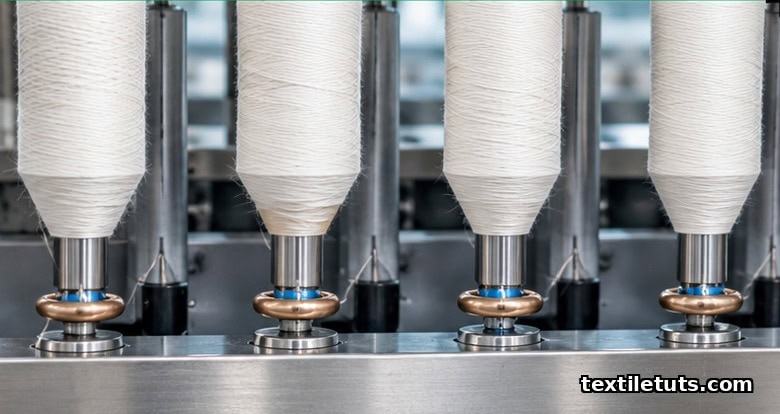
The gauge determines three derived properties:
- Spindles per metre of frame length, ranging from 13.3 spindles/m at 75 mm gauge to 16.7 spindles/m at 60 mm gauge.
- Maximum ring diameter, since the traveller must clear both adjacent spindles. A 75 mm gauge accepts rings up to about 60 mm diameter; a 60 mm gauge accepts rings up to about 45 mm diameter.
- Lifter (builder) travel, which scales with ring diameter and limits the cop build length.
For short-staple cotton, 70 mm gauge is the de facto industry standard because it pairs a 42 to 50 mm ring with a workable builder travel and a compact drafting arrangement. For worsted long-staple frames, 75 mm gauge is common because larger rings (up to 90 mm) accommodate the heavier traveller weights needed for high twist yarn.
Spindle Speed (RPM): Twist Insertion and Production Rate
Spindle speed is the rotational speed of the spindle, measured in revolutions per minute (RPM), and it is the primary driver of twist insertion and yarn throughput on a ring frame. Modern short-staple frames run at 15,000 to 22,000 RPM, with high-speed compact frames reaching 25,000 RPM on 50 mm rings and 18,000 RPM on 42 mm rings.
The relationship between spindle speed, twist and yarn linear density is:
- Twist (TPM, turns per metre) = spindle speed (RPM) divided by delivery speed (m/min).
- Delivery speed (m/min) = spindle speed (RPM) divided by twist (TPM).
For a 30 Ne cotton yarn with a target twist of 18 TPM (a typical twist multiplier of 3.3), a spindle speed of 18,000 RPM gives a delivery speed of 1,000 m/min and a yarn output of roughly 14 g/min per spindle.
Spindle speed is bounded above by traveller speed. The peripheral speed of the traveller must stay below about 40 m/s for steel travellers and 45 m/s for nylon/PU travellers to keep the wear rate and end-break rate within economic tolerance. At 18,000 RPM with a 42 mm ring, traveller speed is 39.6 m/s, near the upper limit. This is why high-speed compact frames pair 30 mm to 38 mm rings with 25,000 RPM spindles instead of larger rings.
Draft Ratio: From Roving to Yarn
Draft is the ratio of input linear density to output linear density, with total draft split into a back-zone break draft and a main-zone draft. For a typical short-staple ring frame running 0.12 ktex roving into 20 tex yarn, total draft is 6 (because draft ratio equals the ktex ratio; counts conversion applies when yarn count is in Ne or Nm).
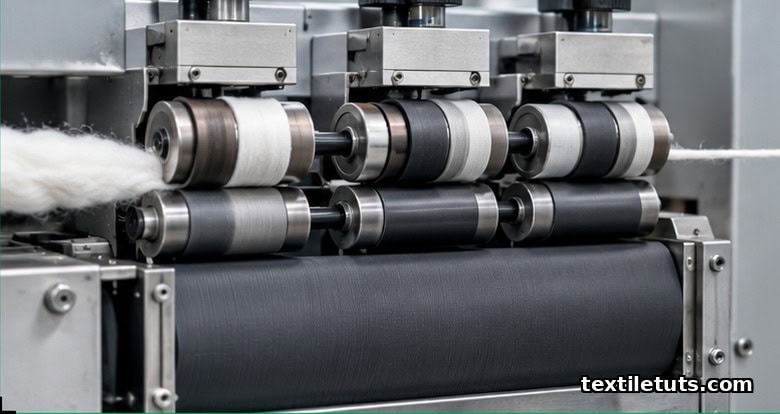
The standard three-roller drafting system distributes the draft as follows:
- Break draft (between back roller and middle roller): 1.20 to 1.50, controlled by the back roller speed relative to the feed roller. Break draft below 1.20 causes roving drafting failures on coarse rovings; above 1.60 causes floating-fibre breakage.
- Main draft (between middle roller and front roller): 15 to 35, the dominant attenuation zone. The apron draft zone inside the main zone adds 1.5 to 3.0 of additional attenuation for fibres shorter than the apron length.
- Apron draft (compact zone): 1.0 to 1.4 on conventional frames; 2.5 to 9.0 on compact frames with a condensing groove or perforated apron.
Total draft = break draft x main draft x apron draft. For 0.12 ktex roving to 20 tex yarn, total draft is 6, typically split as 1.30 x 4.6 x 1.0 on a conventional frame and 1.30 x 2.0 x 2.3 on a compact frame. The split changes fibre束 control but not the final linear density.
Twist Insertion, ISO 2061, and the Twist Multiplier
Twist is measured in turns per metre (TPM) and is the angular turns inserted per unit of yarn length. ISO 2061, “Textiles: Determination of twist in yarns: Direct counting method,” defines the reference method for measuring TPM on single, plied and cabled yarns using the untwist-retwist and direct-count approaches.
The twist multiplier (TM or alpha) normalises twist to yarn count and is the main spinning parameter engineers use to compare yarns:
- Cotton ring yarn: TM = TPM x sqrt(Ne), with TM of 3.5 to 4.5 for warp yarn and 3.0 to 3.8 for weft yarn.
- Worsted yarn: TM = TPM / sqrt(Nm), with TM of 80 to 110 for weaving and 110 to 150 for knitting.
- Open-end rotor yarn: TM of 4.0 to 5.5 in cotton count units, higher than ring yarn because rotor yarn structure relies more on wrapper fibres for cohesion.
On a ring frame, twist is set by the ratio of spindle speed to delivery speed. To shift TM from 3.5 to 4.0 on a 30 Ne yarn at 18,000 RPM, the delivery speed drops from 1,143 m/min to 1,000 m/min and twist rises from 15.7 TPM to 18 TPM.
Frame Geometry, Builder Motion, and Automation
The frame geometry ties drafting, twisting and winding into a single kinematic chain. The builder motion, driven by a cam or servo, lifts and lowers the ring rail to distribute yarn along the cop length, building a stable unwinding package. Standard cop build parameters are 200 mm to 280 mm lift, 4.0 to 6.0 mm wind pitch, and a 1:4 to 1:6 wind-to-pitch ratio.

Modern ring frames add three automation layers on top of the mechanical geometry:
- Individual spindle drive (ISD), where each spindle has its own motor and the spindle can be stopped independently on end-break. ISD lifts average spindle speed by 8 to 15 percent because stop events no longer drag down all spindles on the same belt.
- Auto-doffer systems, which remove full cops and don empty tubes in 90 to 120 seconds per side without stopping the frame.
- Yarn quality monitoring on every spindle using Uster or Loepfe sensors, flagging thin places, thick places and neps in real time.
These automation systems do not change the gauge, speed or draft specifications, but they tighten the operating window in which the mechanical specifications can be run, which is why a 25,000 RPM compact frame is only economic with ISD and on-line quality monitoring.
Comparison Table: Spinning Frame Gauge by Yarn Type and Application
| Yarn Type / Application | Typical Gauge (mm) | Ring Diameter (mm) | Spindle Speed (RPM) | Total Draft Range | Twist Multiplier (TM) |
|---|---|---|---|---|---|
| Fine cotton shirting (60 to 80 Ne) | 60 to 70 | 38 to 42 | 18,000 to 25,000 | 20 to 35 | 3.8 to 4.5 |
| Medium cotton (20 to 40 Ne) | 70 | 42 to 50 | 15,000 to 20,000 | 20 to 30 | 3.5 to 4.2 |
| Coarse cotton / open-end count (6 to 16 Ne) | 70 to 75 | 50 to 60 | 12,000 to 16,000 | 15 to 25 | 3.0 to 3.8 |
| Worsted weaving (30 to 60 Nm) | 75 | 60 to 80 | 9,000 to 13,000 | 30 to 60 | 80 to 110 |
| Worsted knitting (24 to 48 Nm) | 75 | 70 to 90 | 8,000 to 11,000 | 25 to 50 | 110 to 150 |
| Compact cotton (40 to 100 Ne) | 60 to 65 | 36 to 42 | 20,000 to 25,000 | 25 to 50 | 3.8 to 4.5 |
Frequently Asked Questions
Q1: What is the standard gauge of a cotton ring spinning frame?
The de facto standard gauge for short-staple cotton ring spinning is 70 mm centre-to-centre, which allows a 42 to 50 mm ring, fits 13 to 15 spindles per metre of frame length, and supports traveller speeds up to about 35 m/s. Finer gauges down to 60 mm are used on compact frames for 50 Ne and finer yarn.
Q2: How is spindle speed calculated from twist and delivery speed?
Spindle speed in RPM equals twist in turns per metre multiplied by delivery speed in metres per minute. For example, 18 TPM at 1,000 m/min delivery requires 18,000 RPM. Increasing spindle speed without changing twist means a proportional increase in delivery speed, which raises productivity but also raises traveller wear and end-break rate.
Q3: What is the typical total draft on a modern ring frame?
Total draft on a modern short-staple ring frame is typically 20 to 35, split as a break draft of 1.20 to 1.50, a main draft of 15 to 25 and an apron draft of 1.0 to 1.4. Compact frames push the apron draft up to 2.5 to 9.0 and redistribute the main draft lower, which improves fibre束 control without changing the input roving count to output yarn count ratio.
Q4: Why does higher spindle speed increase end-break rate?
Higher spindle speed raises traveller speed, which raises the centrifugal force on the traveller and the dynamic tension on the yarn balloon. Above about 40 m/s traveller peripheral speed, the wear rate accelerates and weak places in the yarn break, lifting end-break rate and reducing effective spindle utilisation. This is the upper economic limit on ring spinning and the reason air-jet, vortex and rotor spinning reach higher yarn delivery speeds without the same end-break penalty.
Q5: What twist multiplier gives the strongest yarn?
For cotton ring yarn, the optimum twist multiplier for strength is about 4.0 to 4.5, slightly above the 3.5 to 4.0 used for weaving weft yarn. Higher TM increases tensile strength and abrasion resistance but reduces softness, lustre and yarn count uniformity, so spinners trade off strength against hand-feel and dye uptake.
References
- International Organization for Standardization. ISO 2061:2015 Textiles: Determination of twist in yarns: Direct counting method. iso.org. Reference method for TPM measurement on single, plied and cabled yarns.
- Klein, W. The Rieter Manual of Spinning, Volume 4: Ring Spinning. Rieter Machine Works, Winterthur. Industry-standard reference for ring frame drafting system geometry, break draft and main draft distribution.
- Lawrence, C.A. Advances in Yarn Spinning Technology. Woodhead Publishing (Elsevier), Cambridge. Peer-reviewed coverage of compact spinning, drafting zone design and twist multiplier selection.
- Rawal, A. and Mukhopadhyay, S. Yarn Structure and Properties in Ring, Rotor and Air-Jet Spinning. Textile Progress, Taylor and Francis. Comparative analysis of twist structure across spinning systems and its effect on yarn tensile properties.
- Oxtoby, E. Spun Yarn Technology. Butterworth-Heinemann (Elsevier), Oxford. Coverage of spindle gauge selection, builder motion kinematics and cop build parameters.
- Uster Technologies. Uster Statistics 2018: The Global Benchmark for Yarn Quality. Uster, Switzerland. Global benchmark for CV%, thin places, thick places and neps across spinning systems and yarn counts.
This article is the working reference for ring spinning frame specifications covering gauge, spindle speed and draft. Editorial by Iftay Khairul Alam, TextileTuts. Sources: ISO 2061:2015, Rieter Manual of Spinning Vol. 4, Lawrence (Woodhead), Textile Progress, Oxtoby (Elsevier) and Uster Statistics 2018 as cited.


