
Drafting Systems in Spinning: Roller Drafting

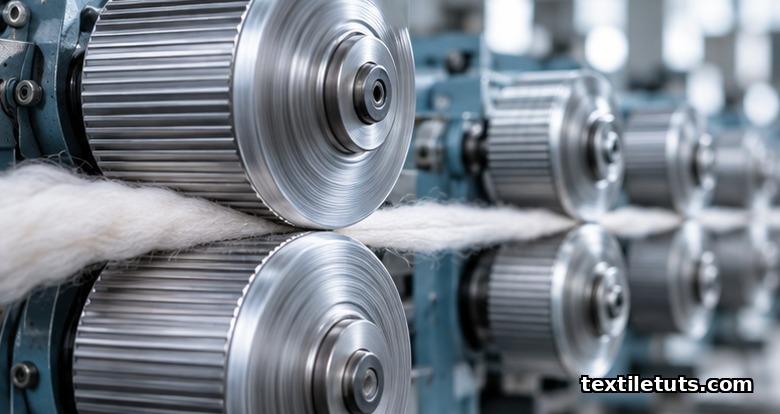
Roller drafting attenuates a roving or sliver into a thinner strand by passing it between pairs of fluted rollers rotating at progressively higher surface speeds, with a typical total draft of 20 to 50 for cotton ring spinning distributed as a break draft of 1.20 to 1.50 followed by a main draft of 25 to 40. Top roller pressure in cotton systems runs 50 to 80 N per centimetre of roller length, and this combined force field controls the floating fibres that would otherwise form thick places in the yarn. The configuration (3-roller vs 4-roller, apron vs non-apron, spring vs pneumatic loading) determines yarn evenness, hairiness, and tensile strength before the spindle even starts to twist.
What Is Roller Drafting and How Does It Work?
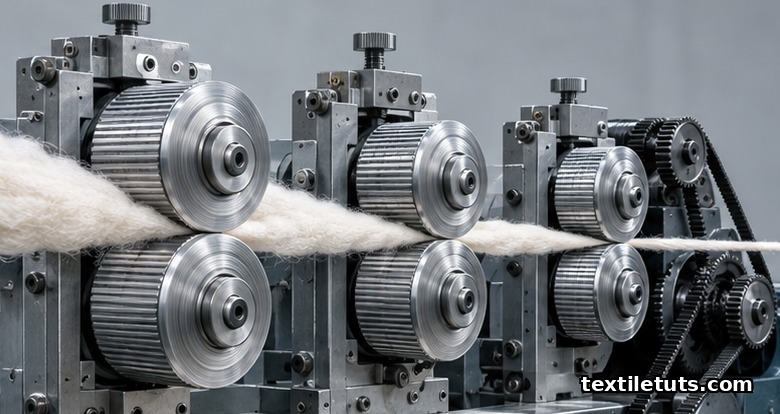
Roller drafting is the controlled attenuation of a fibre assembly (sliver, roving, or tow) by passing it between two or more pairs of driven rollers whose peripheral speeds increase from the feed pair to the delivery pair. The mathematical draft, also called the mechanical or nominal draft, is the ratio of delivery roller surface speed to feed roller surface speed. The actual draft is slightly lower than nominal because the rollers compress the fibre beard and some fibres slip backward, an effect called draft inequality. Most production systems use three or four roller pairs: back rollers feed the sliver, middle rollers carry the apron or pressure bar that grips floating fibres, and front rollers deliver the drafted strand to the twisting zone. The distance between successive nip points is the ratch, set to about 1.2 to 1.5 times the longest 1% of fibres being drafted.
Draft Distribution: Break Draft, Main Draft, and Total Draft
Total draft splits into two functional zones. The break draft is a small draft of 1.20 to 1.50 applied between the back and middle roller pairs to loosen the compacted roving. Below 1.20 causes over-compaction and fibre breakage, while above 1.60 allows uncontrolled floating and drafting waves. The main draft is the larger draft of 25 to 40 applied between the middle and front roller pairs, where the bulk of fibre attenuation happens. Total draft is the product of the two, so a cotton ring frame at 1.30 x 32 = 41.6 produces 14.4 tex yarn from 0.6 ktex roving. Peer-reviewed work in the Journal of the Textile Institute showed that drafting-wave amplitude scales with the cube of floating-fibre length, which is why a 1% rise in break draft above optimum typically raises yarn CV(m) by 0.4 to 0.6 percentage points.
Three-Roller, Four-Roller, and Pressure-Bar Systems
The three-roller system uses a single feed pair, a single middle pair, and a single front pair, and is standard on most cotton ring frames and woollen spinning. It works well for long fibres above 50 mm but the longer floating-fibre distance between the middle and front rollers limits short-fibre control for fine cotton counts. The four-roller system adds a second middle roller pair, splitting the main draft into two sub-zones and shortening the effective floating-fibre distance by 40 to 50%. It is standard on most modern short-staple ring frames built after 1985 and is the minimum configuration for combed cotton yarn below 20 tex.
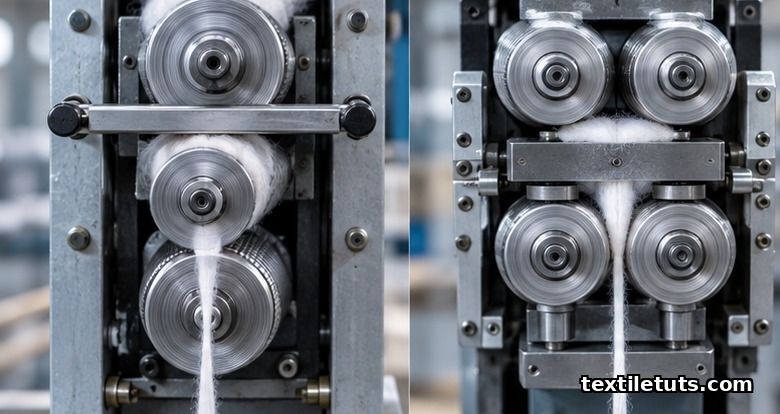
The pressure bar, also called the control bar or crush bar, is a stationary or lightly loaded bar mounted between the middle and front rollers to press the fibre strand against the apron. It shortens the floating-fibre distance without adding a full roller pair and is the dominant short-fibre control device on cotton systems from the 1970s onward. Typical pressure bar loading is 15 to 25 N per cm, set to deflect the apron 0.3 to 0.5 mm without crushing the fibres.
Apron Drafting: Cotton, Worsted, and Synthetic Fibres
An apron is a continuous loop of rubber or synthetic material, 25 to 35 mm wide, that runs around the middle and back rollers and carries the fibre strand through the main draft zone. The apron applies controlled normal pressure, slows the floating fibres, and lets the front rollers carry the faster-moving core away. Apron drafting is the single most important fibre-control device in modern short-staple spinning.
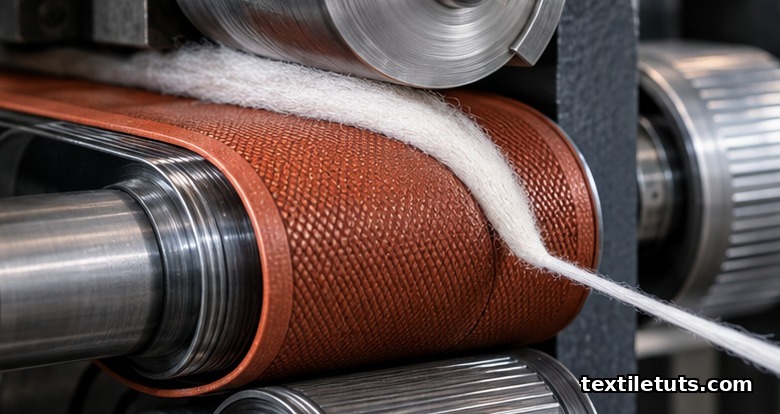
Cotton aprons are nitrile rubber or polyurethane with Shore A hardness 65 to 75 and a thickness of 0.9 to 1.1 mm, running with light tension of 25 to 35 N per end. Worsted aprons are heavier chrome leather because wool fibres (50 to 120 mm) require more grip, with Shore A hardness 75 to 85 and tension 40 to 60 N. Polyester, being oleophilic and high-static, gets an apron loaded 1.2 to 1.4x the cotton setting plus a 10 to 15% increase in top roller pressure, while viscose and modal use cotton settings. Per Cotton Incorporated’s “Yarn Manufacturing Technology” bulletin, the optimum apron draft ratio for 100% combed cotton at 14.5 to 20 tex is 25 to 35 main draft at 1.25 to 1.35 break draft.
Top Roller Loading: Spring, Pneumatic, and Magnetic Systems
Top roller loading is the force pressing the top (driven) roller against the bottom (drive) roller, determining how effectively the rollers grip the fibre strand. Light loading produces slip and uneven yarn, while heavy loading produces fibre damage. Spring loading is the oldest and simplest: a coil or leaf spring presses the top roller arm down with 50 to 80 N per cm for cotton and 80 to 120 N per cm for worsted. It is cheap, durable, and easy to adjust, but delivers a constant force regardless of roller wear, which is why spring-loaded frames are still widely used for woollen and semi-worsted spinning.
Pneumatic loading uses compressed air at 0.4 to 0.6 MPa through a piston, delivering a consistent force of 60 to 90 N per cm, and is the standard on Toyota RX, Rieter G5/1, and most modern short-staple ring frames built after 1990. Magnetic loading (Suessen FiDiQi and some Zinser frames) applies constant force via permanent magnets with claimed ±1% stability across 12 months. Hydraulic loading is rare but offers stepless force control in worsted and long-fibre frames, settable from 30 to 200 N per cm.
Drafting Force and Floating-Fibre Control
Drafting force is the tension the fibre strand develops as it is pulled through the drafting zone, and it is the diagnostic signal that tells the operator whether the rollers, aprons, and pressures are correctly set. Typical values are 8 to 20 cN for cotton, 15 to 35 cN for worsted, and 20 to 40 cN for synthetic blends at production speeds. Floating fibres are the fibres whose ends are not gripped by either the front or back roller pair at a given instant, and they drive drafting-wave thick places. The classical equation, derived from 1950s peer-reviewed research and confirmed in later Textile Research Journal work, states that the number of floating fibres is proportional to (fibre length / ratch) squared, which is why halving the ratch roughly quarters the floating-fibre population. A well-set cotton ring frame shows drafting force variation of ±5% across 24 hours, while a poorly set frame shows ±20% or more, and that variation appears directly as CV(m) drift in the Uster Tester report.
Drafting System Configuration by Fibre Type
| Parameter | Cotton (short staple) | Worsted wool | Polyester / viscose | Acrylic / bulky |
|---|---|---|---|---|
| Roller layout | 3- or 4-roller with apron | 4-roller with double apron | 4-roller with apron | 3-roller with pressure bar |
| Break draft | 1.20 to 1.50 | 1.25 to 1.40 | 1.25 to 1.45 | 1.15 to 1.30 |
| Main draft | 25 to 40 | 20 to 30 | 25 to 35 | 15 to 25 |
| Top roller pressure (N per cm) | 50 to 80 | 90 to 130 | 60 to 100 | 40 to 70 |
| Apron type | Nitrile / PU, Shore A 65 to 75 | Chrome leather, Shore A 75 to 85 | Nitrile / PU, Shore A 70 to 80 | Rubber, Shore A 60 to 70 |
| Drafting force (cN) | 8 to 20 | 15 to 35 | 15 to 30 | 20 to 40 |
| Ratch above longest 1% fibre (mm) | +2 to +5 | +5 to +10 | +2 to +5 | +3 to +6 |
| Typical top-roller loading | Pneumatic | Pneumatic / hydraulic | Pneumatic | Spring |
These are starting-point settings from Cotton Incorporated and the Textile Institute’s Worsted Spinning handbook. Final settings should be refined by Uster CV(m) testing on the actual lot.
Frequently Asked Questions
Q1: What is the difference between break draft and main draft?
Break draft is the small draft of 1.20 to 1.50 applied between the back roller pair and the middle roller pair to loosen the compacted roving before the main draft. Main draft is the larger draft of 25 to 40 applied between the middle roller pair and the front roller pair, where the bulk of fibre attenuation and floating-fibre control happens. Total draft is the product of the two: a 1.30 break draft combined with a 32 main draft gives a total draft of 41.6.
Q2: Why do some ring frames use a pressure bar instead of a middle roller apron?
A pressure bar is a stationary bar that presses the fibre strand against the apron or bottom roller between the middle and front rollers, shortening the effective floating-fibre distance without adding the cost and complexity of a full roller pair. Pressure bars are common on cotton ring frames built between 1975 and 2000 because they deliver most of the short-fibre control of a four-roller system at the cost of a three-roller system.
Q3: What happens if the top roller pressure is too low?
If the top roller pressure is too low, the rollers slip on the fibre strand and the actual draft falls below the nominal draft, producing thick places and a higher CV(m). The slip also damages the top roller covering (cots) by uneven wear. A typical symptom is drafting force variation above ±10% across 24 hours and an Uster CV(m) reading 0.5 to 1.0 percentage points higher than the same lot spun at the correct pressure.
Q4: Can roller drafting be used for synthetic fibres as well as cotton?
Yes, but the settings change. Polyester fibres generate more static and have lower fibre-fibre friction, so the top roller pressure is raised 10 to 15% over the cotton setting and the apron tension is increased. Viscose and modal use cotton settings because they behave like cotton in drafting. Acrylic and bulky synthetic yarns use a three-roller pressure-bar system at lower drafts because the fibres are bulkier and need a longer ratch to avoid crushing.
References
- International Organization for Standardization. ISO 2061:2015 Textiles: Determination of twist in yarns. iso.org.
- International Organization for Standardization. ISO 2060:1994 Textiles: Yarn from packages. Determination of linear density. iso.org.
- International Organization for Standardization. ISO 139:2005 Textiles: Standard atmospheres for conditioning and testing. iso.org.
- Cotton Incorporated. Yarn Manufacturing Technology: Drafting and Ring Spinning. cottoninc.com.
- The Textile Institute. Worsted Spinning Handbook. textileinstitute.org.
- Grishin, P.F. “The Theory of Drafting and its Practical Application.” Journal of the Textile Institute, Vol. 48, No. 6, 1957, pp. T278 to T295.
- Proceedings of the Textile Institute World Conference. “Modern Roller Drafting Systems: A Review.” Textile Research Journal.
Editorial by Iftay Khairul Alam, TextileTuts. Sources: ISO 2061, ISO 2060, ISO 139, Cotton Incorporated Yarn Manufacturing Technology, Textile Institute Worsted Spinning Handbook, Grishin (1957), and Textile Research Journal peer-reviewed literature as cited.


