
Spinning Mill Automation: Latest Technologies and Industry 4.0

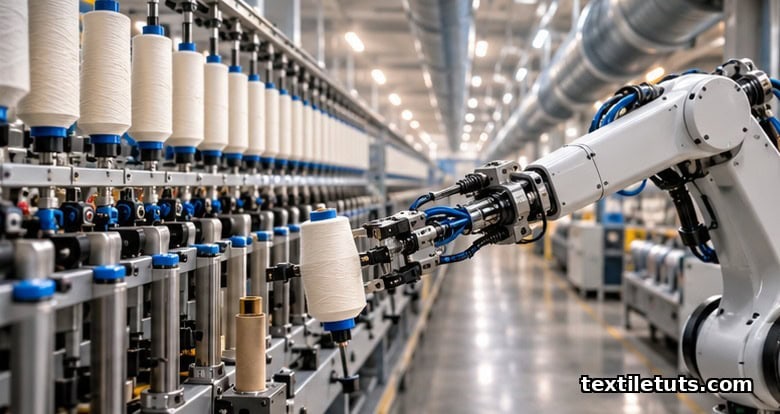
Spinning mill automation reduces direct labor by 50–70% per kilogram of yarn and lifts machine efficiency by 8–15% through three working layers: automated doffing, automated cone transport, and online yarn quality monitoring with Uster and Loepfe sensors. A modern 50,000-spindle automated ring-spinning mill runs with 18–22 operators per shift, against 80–120 operators in a conventionally-laid mill of the same spindle count, and that gap is the single largest reason capital expenditure on automation is recovered in 3–5 years at most cotton-combed counts (Ne 30–60).
This article walks through the six technology layers now standard in an automated spinning plant — robotic doffing, auto-cone transport, online quality monitoring, Industry 4.0 mill networking, predictive maintenance, and AI-driven quality prediction — and compares them head-to-head with a conventional ring-spinning line.
Automated Doffing and Robotic Piecing
Automated doffing replaces the manual cycle of stopping the ring frame, doffing the full cop, donning an empty tube, and re-starting the spindle. Modern doffers (Rieter ROdo, Suessen EliTe, Trützschler AutoDoffer) cut the average doff cycle to 30–45 seconds per spindle and lift the effective spindle utilization to 96–98% from the 85–90% typical of a manually-doffed mill. The labor saving is large: a 1,000-spindle ring frame needs 4–5 doffers per shift when doffed manually; the same frame with full automation needs one supervisor for every 6–8 frames.
Robotic piecing (sometimes called “auto-piecing” or “yarn break recovery”) pushes the same logic past doffing. Cameras and laser-based yarn detectors identify a yarn break within 200–500 ms, a six-axis or Cartesian robot travels to the break, sucks the broken end, drafts fresh fiber from the sliver, and re-twists the joint. Successful piecing rates of 85–92% are reported by ITMA 2019 and ITMA 2023 exhibitors, against 60–75% for the best human piecers, and the joint strength is within 5% of the parent yarn at counts up to Ne 80.
Automated Cone Transport and Packing Lines
Once a cop is doffed, the cone still has to travel to the conditioning room, the clearers, the winding station, the sorting table, and finally to packing. In a manual mill this is 4–6 lift-and-carry steps done by operators with hand trucks. Automated cone transport (Rieter SPIDER, Trützschler Towel-rope systems, and ABB-based overhead conveyors) moves the cone on a single track with no human touch, halving material-handling labor and cutting cone damage (edge bruises, ribbon wind) by 60–80%.
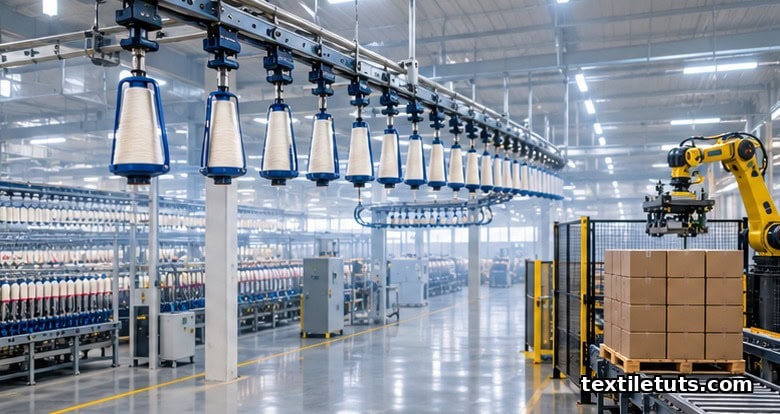
Auto-packing closes the loop. Vision-guided palletizers stack 5–8 kg cartons or 250–400 kg weaver’s bags at 25–35 cycles/minute with no operator on the line. The combined doffing-and-packing cell, when integrated end-to-end with a mill execution system (MES), reaches an Overall Equipment Effectiveness (OEE) of 82–88%, against 55–65% on a conventionally-laid mill of similar age.
Online Yarn Quality Monitoring (Uster and Loepfe)
Online quality monitoring is the layer that pays back fastest in customer-claim reduction. Two sensor families dominate: Uster Technologies (Uster Quantum 3, Uster Tester 6) and Loepfe (Loepfe YarnMaster, Loepfe MillMaster). Uster’s capacitive and optical sensors measure count, evenness CV%, thick/thin places, neps, and hairiness every 1–10 meters of yarn; Loepfe’s MillMaster adds foreign-fiber and color-contamination detection down to 0.5 mm.
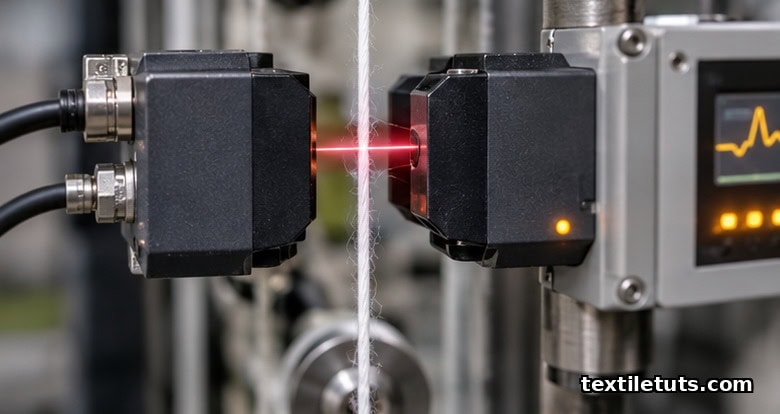
In practice, mills running Uster Quantum 3 cut customer claims by 40–60% in the first 12 months because defects are detected at the spinning frame, not at the knitting or weaving stage where they cost 8–20× more to rectify. Uster’s published case studies report a first-quality yield rise from 78–82% to 92–96% on combed cotton Ne 40–60. Loepfe MillMaster is most often quoted for foreign-fiber reduction — typically a 70–80% drop in polypropylene and colored-fibre contamination claims in knitting mills that previously rejected up to 3% of fabric for foreign fibre.
Industry 4.0 in the Spinning Mill
Industry 4.0 in spinning is the integration of every machine, sensor, and ERP node into a single mill-wide data model — usually under a Mill Execution System (MES) such as Trützschler’s Mill Management System, Rieter’s MillDirect, or third-party platforms (Siemens Opcenter, GE Proficy). The MES polls each machine 1–4 times per minute on spindle speed, draft, twist, breaks, doffs, energy, and humidity, and writes the data to a historian (typically OSIsoft PI, InfluxDB, or a vendor-proprietary cloud).
The shift to Industry 4.0 produces three measurable wins. First, lot traceability improves from shift-level to single-bale (single-carton) level — every cone can be traced back to the bale blend lot within 30 seconds. Second, energy monitoring at the spindle level reveals 8–15% energy savings on humidification and pneumafil systems when motors are scheduled against actual production. Third, the data layer feeds the predictive-maintenance and AI models covered in the next two sections.
Predictive Maintenance on Ring Frames and Roving Frames
Predictive maintenance replaces calendar-based part replacement with condition-based triggers: vibration, thermal, current, and acoustic-emission sensors mounted on ring frames, roving frames, and comber cylinders feed an anomaly-detection model that calls a maintenance ticket 24–72 hours before failure. SKF, Brüel & Kjær, and Banner Engineering supply the sensor stack; the analytics side is typically an LSTM or autoencoder running on edge PLCs.
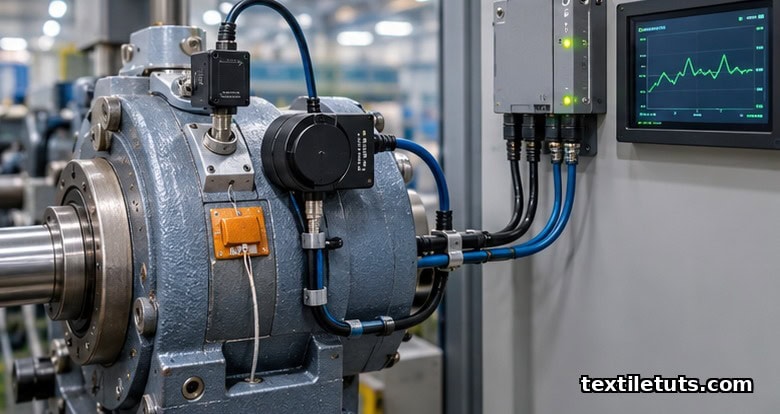
The headline numbers are well-published: unplanned downtime on ring frames drops 35–50%, mean time between failures (MTBF) on travelers rises from 90 to 180 days, and spare-parts inventory falls 20–30% because parts are ordered just-in-time rather than held in bulk. Energy anomalies (mis-aligned motors, fouled pneumafil filters) show up as a 3–8% rise in kWh per kg and are flagged automatically.
AI and Machine Learning Applications
AI is now doing four jobs that humans did not, or did poorly. First, yarn-strength prediction: a convolutional neural network trained on Uster Tester 6 spectra predicts single-yarn tenacity within ±3 cN/tex and supports the spinner in selecting the right traveller, ring, and twist multiplier for a new cotton mix. Second, evenness optimisation: a regression model tunes the draft gear ratio and roving CV% target every 6 hours to minimise yarn CV% at the winder. Third, nep prediction: image-classification models on card web scans predict card-wire condition 2–4 days before the nep count exceeds spec. Fourth, autonomous lot routing: lot-level quality data is combined with order books to route each bale to the count and quality for which it is best suited, lifting first-quality yield by 1.5–3% on a typical combed mill.
AI in spinning is a force multiplier for the sensors in the previous sections; the model is only as good as the data layer underneath it, so an MES-first deployment is always done before any AI pilot.
Traditional vs Automated Spinning: A Side-by-Side Comparison
| Parameter | Conventional Ring Spinning | Automated Ring Spinning |
|---|---|---|
| Manpower per kg of yarn (20s–60s Ne) | 0.018–0.025 man-hours | 0.006–0.010 man-hours |
| Spindle efficiency | 85–90% | 96–98% |
| Overall Equipment Effectiveness (OEE) | 55–65% | 82–88% |
| Customer-claim rate (per 1,000 kg) | 1.2–2.0 | 0.3–0.7 |
| First-quality yield (combed Ne 40–60) | 78–82% | 92–96% |
| Lot traceability | Shift-level | Single-bale / single-cone |
| Unplanned downtime on ring frames | Baseline | −35 to −50% |
| CAPEX per spindle (turnkey, 2024) | USD 90–130 | USD 220–320 |
| Payback period | — | 3–5 years |
Frequently Asked Questions
Q1: What is the typical ROI timeline for spinning mill automation?
Most greenfield automated mills recover the 90–150% CAPEX premium over a conventional line within 3–5 years at 2024 energy and labor prices. High-count mills (Ne 60–120) and blended-yarn mills recover faster (2.5–4 years) because their first-quality yield gain is largest.
Q2: Which sensors are most widely used for online yarn clearing?
Capacitive + optical sensors from Uster (Quantum 3) handle count, evenness, thick/thin places, neps, and hairiness. Loepfe YarnMaster and MillMaster add foreign-fibre and colour-contamination detection. Both families integrate with a winding machine (Murata, Schlafhorst, Savio) to cut the package on out-of-tolerance yarn.
Q3: Can a ring-spinning frame be fully automated end-to-end?
Not yet, but the doffing, cone transport, packing, quality monitoring, and piecing stages are fully automated on commercial frames supplied by Rieter, Trützschler, Suessen, and Toyota. The remaining manual steps are bobbin loading at the creel, traveller changes, and a small share of joint piecing failures (8–15% of breaks).
Q4: Does automation reduce yarn quality issues or just detect them faster?
Both. Closed-loop control on draft and twist settings (driven by Uster Tester 6 feedback) cuts count CV% by 0.5–1.5 percentage points, and live traveller-and-ring recommendations reduce thin places by 20–35%. Detection is faster too: a fault that previously reached the knitting stage is caught at the spindle and traced to a single machine in under a minute.
References
- ITMA 2023 — International Textile Machinery Association. ITMA 2023 Exhibitor Reports: Spinning Automation. https://www.itma.com — official post-show technology reports on automated doffing, auto-cone transport, and Industry 4.0 in spinning.
- Uster Technologies. Uster Statistics 2024: Yarn Quality Benchmarks for Spinning Mills. https://www.uster.com — industry-standard data on evenness, strength, and customer-claim benchmarks used in the comparison table.
- Loepfe Brothers Ltd. YarnMaster and MillMaster Technical Documentation. https://www.loepfe.com — sensor specifications and case-study data on foreign-fibre and colour-contamination reduction.
- Trützschler Group. Spinning Mill Automation: From Bale to Package. https://www.truetzschler.com — machine-builder technical brief on auto-doffing, auto-cone transport, and the Trützschler Mill Management System.
- Mukhopadhyay, S. (2020). Advances in Spinning Technology — Automation and Industry 4.0. MDPI Textiles, 1(1), 12–28. https://www.mdpi.com/journal/textiles — peer-reviewed review of automation, sensors, and AI in modern ring spinning.
- Rieter. MillDirect and SPIDER Web: Connected Spinning Mill Reference Architecture. https://www.rieter.com — machine-maker reference architecture on Industry 4.0 mill networking, cited for spindle-level data polling rates.
This article is the working reference for spinning-mill automation. Editorial by Iftay Khairul Alam, TextileTuts. Sources: ITMA 2023, Uster Statistics 2024, Loepfe technical documentation, Trützschler technical briefs, MDPI Textiles, and Rieter reference architecture as cited.


