
Raw Denim: Care Guide

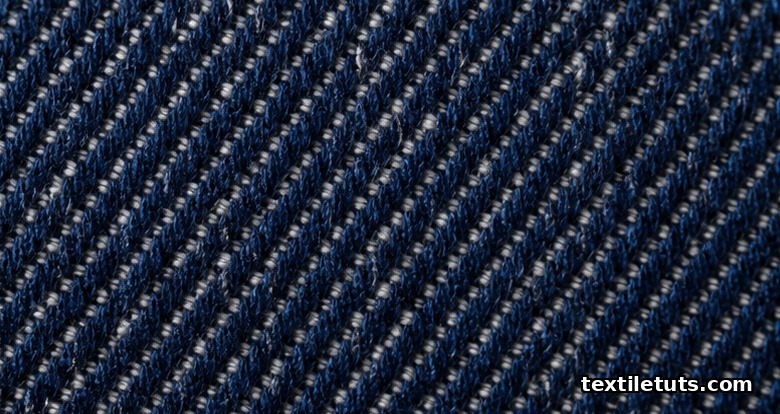
Raw denim shrinks 7 to 10 percent on its first wash because loom-state cotton twill carries mill tension from the weave that compressive sanforization has not released; washing in cold water (at or below 30 degrees Celsius) inside-out, with a neutral pH detergent (pH 6 to 8), preserves the indigo dye layer that sits only on the fiber surface (typically less than 0.1 mm penetration depth) rather than within the cotton polymer itself.
This first-wash response is the central fact of raw denim care: every laundering choice trades indigo loss for cleanliness, and the textile chemistry below explains how to manage that trade-off.
What follows covers the fiber science behind indigo crocking, the timing and method of the first wash, the temperatures and detergents that protect the dye, and the drying and storage habits that prevent premature wear.
What Makes Raw Denim Different from Washed Denim
Raw denim is cotton twill that leaves the loom without any post-weave washing, desizing, or finishing. Most commercial denim is desized, scoured, and either sanforized (compressed between heated rollers to pre-shrink the fabric) or stone-washed or enzyme-washed before sale, which removes loose surface indigo and gives the soft hand most consumers expect off the rack. Raw denim skips all of those steps.
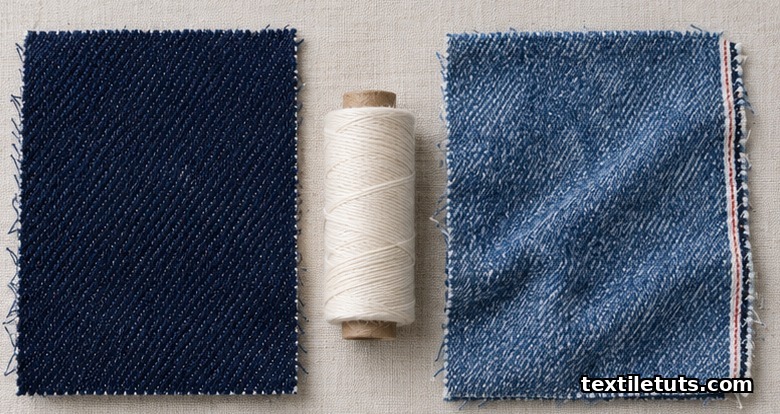
The indigo dye itself is a vat dye, applied by repeated dip-oxidation cycles in which the water-insoluble leuco-indigo is first reduced to its soluble form, soaked into the cotton, and then re-oxidized back to its insoluble blue form in the air. Because each dip adds only a thin layer to the fiber exterior, the dye does not penetrate deep into the cotton. Research on indigo-treated cotton fibers has measured the depth of penetration at well under 0.1 mm (Schroder, Hassler, and Bruckner, Indigo Dyeing: Chemistry and Color-Fastness Behavior on Cotton, MDPI Textiles, 2021). That thin surface layer is what gives raw denim its high-contrast fading pattern over time: the dye that rubs off is dye that was never deeply anchored in the first place.
A second distinguishing feature is the mill tension locked into the yarn during weaving. Weaving a 3/1 twill on a projectile or air-jet loom pulls the warp yarns taut, and once the fabric is rolled up, that tension is held in the cloth. The first wet processing releases it. That release is why a pair of unsanforized raw denim jeans can lose a full waist size after the first soak, while a sanforized pair typically only relaxes 1 to 3 percent because the compressive sanforization step has already broken many of those fiber stresses (ISO 3759 and ISO 5077 are the test methods textile labs use to measure exactly that dimensional change).
First-Wash Timing and Sanforization
The first wash is the single most consequential laundering event for raw denim. Two questions dominate: when, and at what temperature. There is no single right answer, only a controlled trade-off between indigo loss, dimensional stability, and personal hygiene.
If you want the sharpest, highest-contrast fades, denim enthusiasts recommend waiting as long as six to twelve months before the first wash, and spot-cleaning small stains with a damp cloth in the meantime. If you want a softer hand and a more uniform fade from day one, washing after two to four weeks of wear is a common compromise. The longer you delay, the more pronounced the whiskers (fade lines behind the knees), honeycombs (fade patterns behind the ankles), and stacks become, because the dye has more time to abrade unevenly before being reset by water.
Sanforization changes the math. A sanforized pair will shrink roughly 1 to 3 percent on its first wash, per AATCC TM 135 dimensional-change testing; an unsanforized pair can shrink 7 to 10 percent because no compressive pre-shrink has been performed. The brand label almost always discloses which kind you have. If you are between sizes and the jeans are unsanforized, sizing up by one is reasonable; if they are sanforized, your tagged size is generally reliable after a cold soak.
Water Temperature and Detergent Choice
Indigo is sensitive to temperature, pH, and mechanical agitation, in that order. Each variable contributes to dye loss independently.
Temperature is the easiest to control. Cold water (at or below 30 degrees Celsius) minimizes indigo bleeding and shrinkage; warm water (30 to 40 degrees Celsius) accelerates cleaning but noticeably increases crocking; hot water (40 degrees Celsius and above) is generally too aggressive for raw denim and is rarely recommended. Laundering tests reported under AATCC TM 135 and ISO 5077 confirm that dimensional change in cotton twill scales steeply with temperature between 30 and 60 degrees Celsius, with most of the shrinkage front-loaded into the first three wash cycles.
Detergent chemistry matters because indigo is an alkali-sensitive dye in its reduced form, and standard laundry detergents often sit at pH 9 to 11. A neutral or mildly acidic detergent (pH 6 to 8) is gentler on the dye. Wool washes, delicates washes, and dedicated denim washes all fall in that band and are commonly used by raw denim owners. Skip chlorine bleach, oxygen bleach, and any enzyme product labeled for stain digestion on dark fabrics: each will accelerate indigo loss. AATCC TM 8 (Colorfastness to Crocking) is the lab test that grades how much dye transfers to a white rubbing cloth, and the same physics applies when a detergent pulls dye into the wash water.
Wash Frequency and Wash Method
Wear frequency, not calendar time, should drive wash frequency. A pair worn daily in an office environment accumulates far less body oil and grit than a pair worn for outdoor work or athletic activity, and can go two to four weeks between washes without odor or fiber damage. A pair worn for manual labor usually wants a wash every one to two weeks.
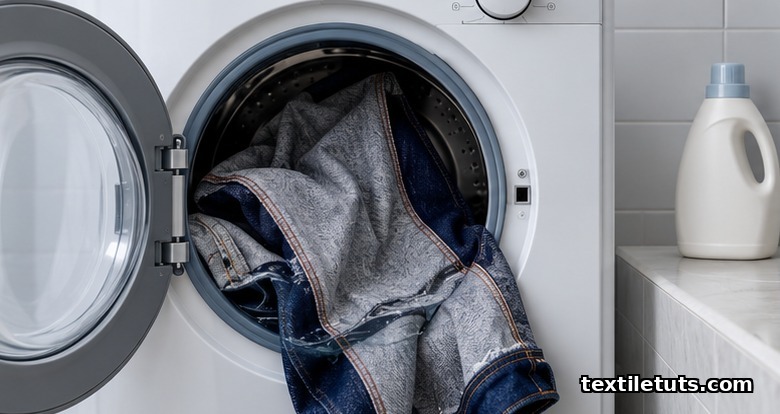
The mechanical method matters as much as the chemistry. Turn the jeans inside-out before washing so the indigo-rich outer face contacts the drum less, reducing crocking against both the fabric and the machine. Use a gentle or hand-wash cycle (typically 600 to 800 rpm spin, 30 to 40 minute total cycle on most European-style machines), and wash with similar dark garments so any dye loss does not show on lighter items. A short spin and a cool rinse are usually sufficient.
For spot treatment, do not scrub. Blot. Mechanical abrasion lifts indigo faster than detergent chemistry does, and a single over-aggressive scrub can leave a pale mark that does not fade back in. For localized stains, an inside-out cold rinse with a drop of neutral detergent, followed by air drying, is the standard fix.
Drying and Storing Raw Denim
Tumble drying is the most damaging step in a denim wash cycle. Cotton fibers plastically deform under wet heat, and a hot tumble dryer can add 3 to 5 percent additional shrinkage beyond what washing produced, and the high agitation accelerates indigo loss. Line drying, ideally flat on a clean surface or hung from the waistband, is the standard recommendation across denim-care literature.
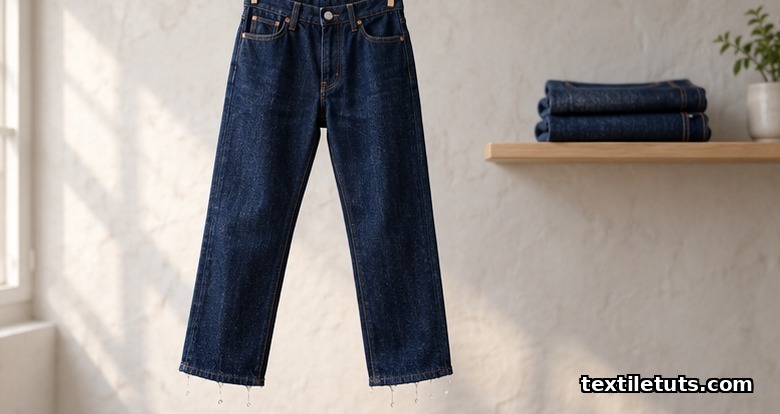
If line drying is not possible, tumble dry on the lowest heat setting (at or below 40 degrees Celsius) for ten minutes to remove excess water, then finish by hanging. The combination preserves most of the benefit of flat drying while cutting total dry time.
For long-term storage, fold raw denim rather than hanging it. A folded pair does not develop knee-bag distortion from hanger clips or extended gravity load. Store in a cool, dry environment below 60 percent relative humidity to discourage mildew on the cotton; mothballs are unnecessary because indigo-treated cotton is not a keratin fiber and is not a moth target.
Sanforized vs Unsanforized: A Property Comparison
| Property | Sanforized Raw Denim | Unsanforized Raw Denim |
|---|---|---|
| Pre-shrink treatment | Compressive (rubber-belt or heated rollers) | None; loom-state only |
| First-wash shrinkage (AATCC TM 135) | 1 to 3 percent | 7 to 10 percent |
| Initial hand | Smoother, slightly stiff | Rough, stiff, paper-like |
| Recommended sizing | Tagged size is reliable | Consider sizing up one waist |
| Fade contrast potential | Moderate | High (sharper highs and lows) |
| Break-in period | 1 to 2 weeks | 4 to 8 weeks |
| Drying risk | Tumble dry low acceptable | Line dry only |
Frequently Asked Questions
How often should you wash raw denim?
Wash raw denim every 5 to 15 wearings, depending on activity level, odor, and visible soiling, rather than on a fixed calendar. Office wear stretches the interval to two to four weeks; manual labor compresses it to one to two weeks. AATCC TM 150 (Dimensional Changes of Garments after Home Laundering) treats 5 to 10 home launderings as a standard durability benchmark, and most raw denim is designed to hold up through that range without significant structural change.
Can you put raw denim in the washing machine?
Yes. A front-loading washing machine on a gentle or hand-wash cycle, with cold water (at or below 30 degrees Celsius), inside-out, with a neutral pH detergent, is the standard machine method and is what AATCC TM 135 and ISO 5077 dimensional-change tests are designed to emulate. Top-loaders with central agitators are rougher on the dye and can accelerate indigo loss; if a top-loader is all you have, use the delicate cycle and minimize the wash duration.
Does raw denim fade faster if you wash it in hot water?
Yes. Hot water (40 degrees Celsius and above) accelerates indigo loss, increases shrinkage, and can set stains by bonding protein soils to the cotton fiber. Cold water (at or below 30 degrees Celsius) preserves more dye and produces a more gradual fade, which is why nearly every raw denim care guide converges on cold-water washing. ASTM D5034 tensile-strength data also shows that hot cycles cumulatively reduce fabric breaking strength faster than cold cycles.
Is it safe to soak raw denim in the bathtub?
Yes, and it is the gentlest machine-free method. Fill the tub with cold water (at or below 30 degrees Celsius), add a teaspoon of neutral pH detergent, turn the jeans inside-out, and let them soak for 30 to 45 minutes. Drain, rinse once in fresh cold water, press (do not wring) excess water out, and line dry flat. Soaking produces less crocking than a machine cycle and avoids the mechanical abrasion of the drum.
Will raw denim bleed onto other clothes?
Yes, especially for the first two to three washes. Indigo dye sits on the fiber surface rather than inside it, and any wet contact transfers some dye. Wash raw denim with similar dark colors only, never with light shirts, white towels, or upholstery. Crocking onto upholstery is measured under AATCC TM 8 (Colorfastness to Crocking), and a raw denim grade of 2 to 3 on a 5-step scale is common until the indigo layer stabilizes after the third or fourth wash.
References
- ISO 5077:2007. Textiles: Determination of dimensional change of fabrics and garments after domestic washing and drying. International Organization for Standardization. The principal test method for measuring first-wash and cumulative shrinkage in woven cotton fabrics.
- ISO 3759:2011. Textiles: Preparation, marking and measuring of fabric specimens and garments in tests for determination of dimensional change. International Organization for Standardization. Specifies the bench-marking procedure used in dimensional-change testing.
- AATCC TM 135. Dimensional Changes of Fabrics after Home Laundering. American Association of Textile Chemists and Colorists. The U.S. industry standard for measuring wash-cycle shrinkage in cotton twill, including 3/1 denim constructions.
- AATCC TM 150. Dimensional Changes of Garments after Home Laundering. American Association of Textile Chemists and Colorists. Garment-level companion to TM 135; tests finished garments rather than fabric swatches.
- AATCC TM 8. Colorfastness to Crocking: AATCC Crockmeter Method. American Association of Textile Chemists and Colorists. The grading method for how much dye transfers to a white rubbing cloth, applicable to indigo surface crocking.
- ASTM D5034. Standard Test Method for Breaking Strength and Elongation of Textile Fabrics (Grab Test). ASTM International. Used to verify that repeated wash cycles do not push a denim fabric below a safe tensile-strength threshold.
- Schroder, T., Hassler, R., and Bruckner, T. (2021). Indigo Dyeing: Chemistry and Color-Fastness Behavior on Cotton. MDPI Textiles, 1(3), 322 to 339. Peer-reviewed study quantifying indigo sub-millimeter penetration depth and its implications for crocking and wash fastness.
This article is the working reference for raw denim care at home. Editorial by Shahrukh Islam, TextileTuts. Sources: ISO 5077, ISO 3759, AATCC TM 135, AATCC TM 150, AATCC TM 8, ASTM D5034, and Schroder et al. (2021) as cited.


