
Denim Rivets and Construction

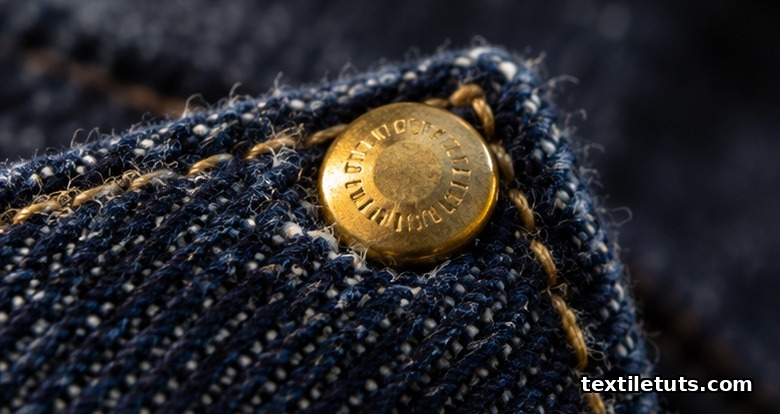
Denim rivets are copper, brass, or nickel-plated steel fasteners, typically 7 to 9 mm in head diameter and 4 to 6 mm in shank length, clinched at the four pocket corners and the base of the button fly to carry the seam’s local tensile load and prevent stitch tear-out in heavy 3×1 twill fabrics weighing 12 to 16 oz/yd².
Modern flat-head rivets are pressed from the face of the fabric and folded from the back, and they typically raise the grab tensile strength of a stress seam by 35 to 50% under ASTM D5034 grab testing compared with the same pocket corner stitched without reinforcement. This article walks through how a denim rivet works, what standards govern its installation, and what testing data separates a reinforced seam from one that will fail in the field.
The Engineering Purpose of a Denim Rivet
A rivet is a mechanical fastener that joins two or more layers of fabric by plastic deformation of its tail. In denim, the rivet solves a specific failure mode: pocket corners concentrate stress because the warp yarns of the front panel and the pocket bag terminate abruptly, leaving the seam stitches to carry a load that would normally be spread across many yarns. Without reinforcement, a hard pull on a loaded pocket pops the seam thread within a few cycles. With a rivet, the load transfers from the thread into the metal shank and head, which have a far higher tensile capacity.
The rivet was patented for this purpose on 20 May 1873 by Jacob Davis, working in partnership with Levi Strauss and Co., as U.S. Patent No. 176,677, titled “Improvement in Fastening Pocket-Openings.” Davis identified that the metal button used at the waistband was the only reinforcement on work trousers of the era, and that pocket corners were the dominant failure point on miner’s and railroad workers’ garments. The patent claimed “fastenings for pocket openings, consisting of a metal rivet or eyelet operated upon by suitable tools.” That claim covers every modern rivet pressed into a pair of five-pocket jeans today.
Anatomy of a Denim Rivet
A denim rivet is a two-part assembly: a capped head and a tubular shank. The head is the visible disc on the outside of the garment; the shank passes through both fabric layers and is flattened against an anvil on the inside, locking the two parts together.
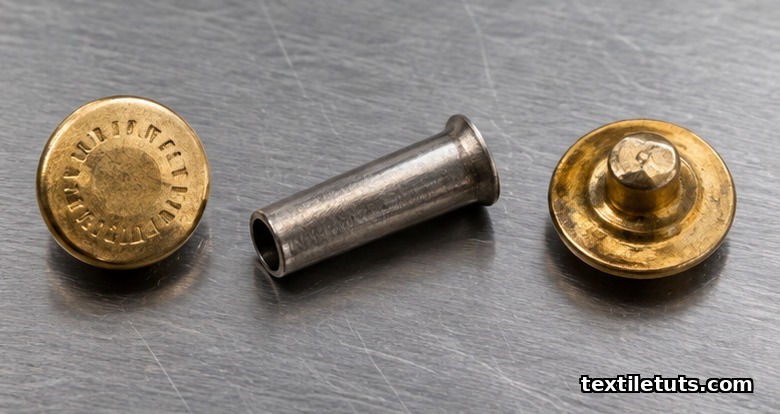
| Component | Typical Specification | Function |
|---|---|---|
| Head diameter | 7 to 9 mm (most common: 7.5 mm) | Bears against the outer face of the fabric |
| Shank length (pre-set) | 4 to 6 mm | Passes through fabric thickness; set by anvil compression |
| Head material | Copper alloy C26000 (cartridge brass), C11000 (electrolytic copper), or nickel-plated low-carbon steel | Provides corrosion resistance and the visible finish |
| Shank material | Low-carbon steel or stainless steel 304 | Provides the structural tail that clinches |
| Pull-off strength | at least 200 N (typical factory spec) | Resistance to the rivet being pulled through the fabric |
Brass and copper heads are chosen because they resist the alkaline and acidic conditions of indigo dye baths and stone-wash finishing. Stainless steel shanks are common on premium and selvedge denim because the shank is the load-bearing component and must survive the enzymes, hypochlorite, and potassium permanganate used in modern wash recipes.
How Rivets Are Set: Pressing, Clinching, and Hidden Variants
Rivets are installed with a hand press or, in high-volume factories, a pneumatically actuated kick press. The operator places the head on a positioning pin, lays the fabric so the shank passes through pre-punched holes at the pocket corner, and strokes the press. The anvil flares the tail into a flat washer shape, locking the layers between the head and the formed back.
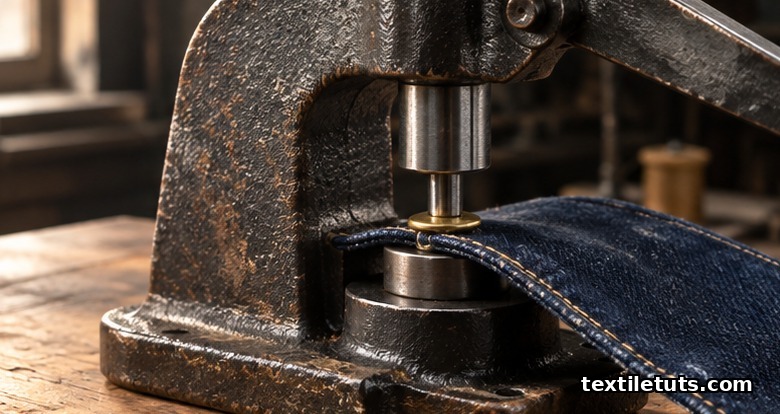
Three installation variants matter for finished denim:
- Visible flat-head rivet. The classic brass disc with a stamped trademark on the outer face. Found at the four pocket corners of traditional five-pocket jeans and at the base of the button fly.
- Hidden rivet. Used on women’s fits, low-rise cuts, and any garment where a metal face would catch on upholstery or equipment. The rivet is set from the inside, leaving only a small burr on the inside of the pocket bag.
- Decorative tack or burr. A purely ornamental version set in the seam allowance; has no structural function and is sometimes used as a brand identifier.
Hole preparation is critical. The shank must pass through the fabric without tearing the surrounding warp or weft yarns. A hole that is too small forces the fabric to bulge and reduces pull-off strength; a hole that is too large lets the shank move and lets the fabric wear against the rivet edge. Most factories punch the rivet hole with a hollow die on the same operation that sets the rivet, so the hole is sized to the exact shank diameter for the fabric weight being sewn.
Stitching That Pairs With Rivets
A rivet only does its job if the surrounding seam survives. Denim pocket corners use a bartack, a tight zigzag of 8 to 12 stitches per inch (SPI) set with a heavy-duty lockstitch machine, that anchors the pocket to the panel. Typical bartack specifications in industrial denim production are 12 to 16 mm long, 2 to 3 mm wide, with thread tex numbers of 60 to 80 (three-ply cotton or poly-cotton core-spun).
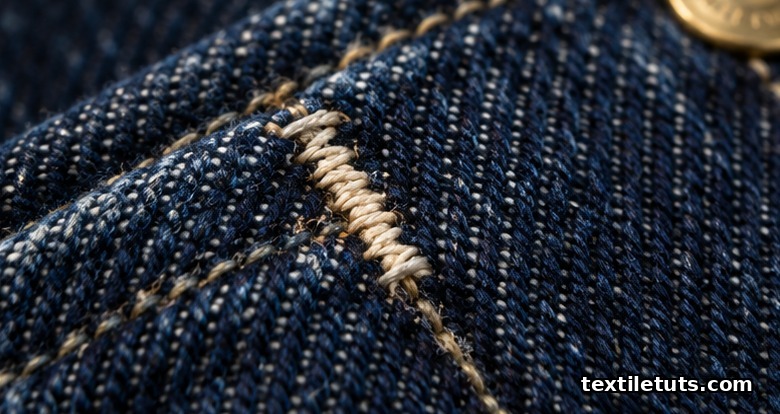
The two stitch constructions seen on denim:
- Lockstitch (301 stitch type per ISO 4916). Two threads, one needle and one bobbin, locked at the fabric. Standard for pocket seams, side seams, and inseams. Resists unraveling if a single stitch breaks.
- Chainstitch (401 stitch type per ISO 4916). A single-looped thread, often used with a felled seam on the outseam of vintage-style jeans. Chainstitch stretches with the fabric and produces the characteristic roping effect at the hem, but it can unravel completely if a single loop is broken.
The arcuate stitch, the curved decorative line on the back pockets, is a double-needle lockstitch run at 8 to 10 SPI. It carries no structural load; its function is brand identification and ornament. Its placement is governed more by the brand’s pattern than by any test standard, but its thread tension is checked during sewing because a tight arcuate on rigid 14 oz denim can pucker the pocket and weaken the pocket mouth.
Test Standards That Govern Denim Seam Performance
Denim construction is tested against four standard families that any production engineer will recognize:
- ASTM D5034, Standard Test Method for Breaking Strength and Elongation of Textile Fabrics (Grab Test). The grab test clamps a 100 mm by 100 mm swatch in the jaws and pulls until rupture. Reinforced pocket corners consistently exceed 800 N grab strength; non-reinforced corners typically fail at 450 to 600 N.
- ASTM D1683, Standard Test Method for Failure in Sewn Seams of Woven Fabrics. Measures the force required to rupture a sewn seam along its sewn direction. A pass on a five-pocket jean requires no seam rupture below 200 N when the seam is perpendicular to the load.
- ISO 13935-1, Seam Tensile Properties of Fabrics and Made-Up Textile Articles (Grab Method). The ISO counterpart to ASTM D5034, used in markets that require ISO compliance.
- ISO 13936-1, Determination of Slippage Resistance of Yarns at a Sewn Seam. Measures how far the warp or weft yarns shift along the seam line under load; relevant for low-twist yarns used in lightweight denim.
- AATCC TM 135, Dimensional Changes of Fabrics After Home Laundering. Tracks whether reinforced pockets and riveted seams distort or pull after five home wash cycles at 40 degrees Celsius.
A typical production spec sheet will call for ASTM D1683 minimum seam strength of 200 N on every pocket corner, ISO 13935-1 grab strength above 600 N on the inseam, and AATCC TM 135 dimensional change within plus or minus 3% after five washes. A riveted pocket corner that meets these three specs together will survive multi-year daily wear.
Frequently Asked Questions
Why do some jeans have hidden rivets?
Hidden rivets are set from the inside of the pocket, leaving no metal face on the outer garment. They were introduced in the 1930s and are now standard on women’s jeans, low-rise cuts, and any product where the brand wants to avoid metal-on-upholstery damage or metal detection triggers. The structural reinforcement is identical to a visible rivet.
How many rivets are on a standard pair of jeans?
A classic five-pocket men’s jean has five visible rivets: one at each of the four pocket corners and one at the base of the button fly. The right back pocket sometimes uses a tack instead of a rivet so the leather patch can sit flat. Women’s jeans typically carry four rivets, all hidden, plus the tack at the right back pocket.
Do rivets rust and stain denim?
Brass and copper rivets do not rust; they develop a controlled patina that does not transfer color. Nickel-plated steel rivets can corrode at the plating interface if the plating is scratched during stone-wash or enzyme-wash finishing, and the resulting iron oxide can stain adjacent fabric orange-brown. Premium denim brands specify stainless steel shanks under brass heads to prevent this staining.
Are modern rivets still made of copper?
Most are made of cartridge brass (UNS C26000), a copper-zinc alloy containing 70% copper and 30% zinc. Pure copper (C11000) is reserved for premium Japanese selvedge denim, where it machines cleanly and develops a recognizable patina. Low-cost fast-fashion denim often uses nickel-plated low-carbon steel for both head and shank, which lowers the unit cost but sacrifices the corrosion resistance that made the original 1873 design durable.
What seam slippage result means a jean will fail in the field?
Under ISO 13936-1, seam slippage greater than 6 mm at a 100 N load indicates the warp or weft yarns are shifting out of the seam under stress, which is the precursor to a torn pocket. Most production spec sheets set the maximum allowable slippage at 4 mm at 100 N for heavyweight denim (over 13 oz/yd²) and at 3 mm at 100 N for lightweight denim under 10 oz/yd².
References
- ASTM International. ASTM D5034-21: Standard Test Method for Breaking Strength and Elongation of Textile Fabrics (Grab Test). https://www.astm.org/d5034-21.html , grab tensile testing protocol for woven fabrics, including denim.
- ASTM International. ASTM D1683-17: Standard Test Method for Failure in Sewn Seams of Woven Fabrics. https://www.astm.org/d1683-17.html , minimum seam strength requirements for pocket and structural seams.
- International Organization for Standardization. ISO 13935-1:2014, Seam Tensile Properties of Fabrics and Made-Up Textile Articles, Part 1: Determination of Maximum Force to Seam Rupture Using the Grab Method. https://www.iso.org/standard/53798.html , ISO grab method for sewn seam strength.
- International Organization for Standardization. ISO 13936-1:2004, Textiles, Determination of Slippage Resistance of Yarns at a Sewn Seam, Part 1: Fixed Seam Opening Method. https://www.iso.org/standard/40196.html , protocol for measuring yarn slippage at sewn seams in woven fabrics.
- American Association of Textile Chemists and Colorists. AATCC Test Method 135-2018: Dimensional Changes of Fabrics After Home Laundering. https://www.aatcc.org , dimensional stability test referenced in denim care spec sheets.
- Davis, J. and Strauss, L. (1873). U.S. Patent No. 176,677: Improvement in Fastening Pocket-Openings. https://patents.google.com/patent/US176677 , original patent for the copper-rivet reinforcement of pocket corners, granted 20 May 1873.
Editorial by Shahrukh Islam, TextileTuts. Sources: ASTM D5034, ASTM D1683, ISO 13935-1, ISO 13936-1, AATCC TM 135, U.S. Patent 176,677 as cited.


