
Quality Management Systems (ISO 9001)


ISO 9001:2015 is the current international standard for quality management systems (QMS), published by the International Organization for Standardization (ISO), built on a 10-clause High-Level Structure, the Plan-Do-Check-Act cycle, and 7 quality management principles, with 1,538,881 valid certificates issued across 195 economies as of the 2023 ISO Survey.
For textile and apparel manufacturers, ISO 9001 is less about a certificate on the wall and more about the repeatable system that proves to buyers that the next shipment will meet the same specifications as the last one. This article explains what the standard requires, how it applies to textile operations from spinning through garmenting, and what certification actually costs in time and auditor-days.
What ISO 9001:2015 Is (and What It Is Not)
ISO 9001 is a generic QMS standard. It does not prescribe product specifications, test methods, or performance thresholds for any particular material. Instead, it specifies the requirements for the management system an organization uses to control its processes and demonstrate that it can consistently provide products and services that meet customer and applicable regulatory requirements.
The current edition, ISO 9001:2015, replaced ISO 9001:2008 in September 2015 and introduced three structural changes that matter to textile operations: the High-Level Structure (HLS) that aligns ISO 9001 with ISO 14001 (environmental management) and ISO 45001 (occupational health and safety), a formal requirement for risk-based thinking, and the replacement of the separate terms “documents” and “records” with the single concept of “documented information.”
ISO 9001 is also not a one-time event. A certification is valid for three years, with surveillance audits typically conducted at 12 and 24 months and a re-certification audit at the end of the third year, according to the ISO Survey methodology and ISO/IEC 17021-1, which governs bodies that audit and certify management systems.
The 10-Clause Structure and the PDCA Cycle
ISO 9001:2015 is organized into 10 clauses. Clauses 1 to 3 are introductory (scope, normative references, terms and definitions) and contain no auditable requirements. Clauses 4 to 10 contain the seven mandatory requirements groups that auditors score: context of the organization (4), leadership (5), planning (6), support (7), operation (8), performance evaluation (9), and improvement (10).
The structure follows the Plan-Do-Check-Act (PDCA) cycle at two levels. At the overall QMS level, clause 4 sets the plan, clauses 5 to 7 cover the do, clauses 8 and 9 cover the check, and clause 10 covers the act. The same PDCA logic is reapplied to each individual process within the QMS, which means every process needs a defined owner, measurable outputs, internal audits, and a corrective action loop.
| Clause | Title | PDCA Stage |
|---|---|---|
| 4 | Context of the organization | Plan |
| 5 | Leadership | Plan / Do |
| 6 | Planning | Plan |
| 7 | Support | Do |
| 8 | Operation | Do / Check |
| 9 | Performance evaluation | Check |
| 10 | Improvement | Act |
The 7 Quality Management Principles
Annex B of ISO 9000:2015, the companion vocabulary and fundamentals standard, lists the seven quality management principles that the 9001 requirements are designed to operationalize. Each principle maps to specific clauses, and certification auditors typically ask interview questions that probe each principle in turn.
- Customer focus (clause 8.2)
- Leadership (clause 5)
- Engagement of people (clauses 7.1, 7.2, 7.3)
- Process approach (clause 4.4)
- Improvement (clause 10)
- Evidence-based decision making (clause 9.1)
- Relationship management (clause 8.4)
For a textile mill, “engagement of people” means documented competency matrices for each production role (spinning, weaving, knitting, dyeing, printing, finishing, cutting, sewing, finishing) and training records that match the matrix. “Evidence-based decision making” means corrective actions reference production data, defect Pareto charts, and customer complaint trends rather than individual opinion.
Risk-Based Thinking and the Process Approach
ISO 9001:2015 introduced risk-based thinking as a formal requirement at clause 6.1. The organization must determine the risks and opportunities that need to be addressed to give the QMS the ability to achieve its intended outcomes, prevent or reduce undesired effects, and achieve continual improvement. Where ISO 9001:2008 used a separate “preventive action” clause, ISO 9001:2015 absorbed preventive thinking into every clause.
In textile practice, risk-based thinking shows up as a documented risk register that lists the top operational risks (for example, dye lot shade variation, GSM drift in knitting, dimensional stability failures in finishing, seam slippage in garments, on-time delivery misses), assigns each risk a likelihood and consequence score, and names the controls that mitigate it. The same register feeds the management review agenda required at clause 9.3.
The process approach (clause 4.4) requires a process map, documented inputs and outputs for each process, process owners, performance indicators, and the sequence and interaction of the processes. In a vertical textile operation the process map typically runs: order intake, fabric or yarn sourcing, production planning, weaving or knitting, dyeing or printing, finishing, cutting, sewing, pressing, final inspection, packing, and dispatch.
How ISO 9001 Applies to Textile and Apparel Manufacturing
Textile QMS work is anchored in three categories of documents: the QMS manual and procedures (ISO 9001 documents), the technical specifications and test methods (often ISO, AATCC, or ASTM standards), and the quality records that prove the system is working.

AATCC, the Association of Textile, Apparel and Materials Professionals, publishes the AATCC Technical Manual used as the primary reference for colorfastness, dimensional stability, and stain testing in the US supply chain. ASTM Committee D13 on Textiles publishes over 300 standards covering fiber, yarn, fabric, and garment test methods. ISO/TC 38 covers textiles at the international level, and ISO 2859-1 is the workhorse sampling plan for inspecting textile lots by attribute using Acceptable Quality Limits (AQL).
When a buyer audits a mill, they typically combine an ISO 9001 system check (do the procedures exist, are they followed, are records current) with product-level testing against AATCC or ASTM methods (do the actual fabrics meet the agreed specifications). ISO 9001 alone does not certify that the fabric passes a particular test. It certifies that the mill has a system capable of catching nonconforming fabric before shipment.
The Certification Process: From Gap Analysis to Surveillance Audit
Certification requires an accredited certification body, which must itself be accredited by an IAF (International Accreditation Forum) member accreditation body. The certification body conducts the audit, and the credibility of the certificate depends entirely on the accreditation behind it.

A typical first-time certification takes 6 to 12 months from kickoff to certificate issue. The path runs through four steps:
- Gap analysis (optional but common) against ISO 9001:2015 to identify the work needed before stage 1.
- Stage 1 audit, focused on documentation readiness, scope definition, and site conditions. Stage 1 typically takes 1 to 2 auditor-days for a single-site textile operation.
- Stage 2 audit, the main certification audit, which tests whether the documented QMS is actually implemented and effective. Stage 2 for a medium textile mill typically runs 4 to 8 auditor-days.
- Surveillance audits at roughly 12 and 24 months, each shorter than stage 2 (typically 30 to 50 percent of stage 2 duration), and re-certification at year 3.
The total auditor-days for the three-year cycle for a mid-sized textile operation generally falls between 12 and 25 auditor-days, depending on headcount, number of shifts, and number of product lines included in the certification scope.
Common Implementation Failures in Textile Factories
The most frequent ISO 9001 nonconformities in textile audits cluster around five clauses. Clause 8.5.1 (control of production) fails when process parameters (liquor ratio and temperature in dyeing, stitch density in sewing, tenter frame temperature in finishing) are not documented or not monitored. Clause 8.7 (control of nonconforming outputs) fails when rejected fabric is not physically segregated or the rejection record does not show disposition.
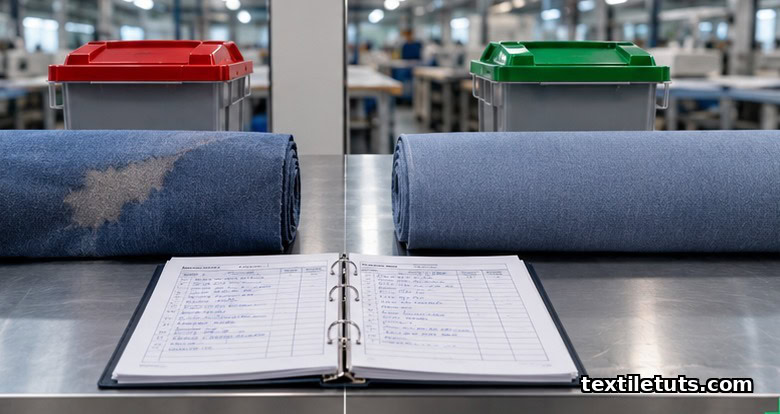
Clause 7.5 (documented information) fails when the documented information is out of date, when obsolete versions are still in use on the shop floor, or when records are not retained for the period stated in the procedure. Clause 9.2 (internal audit) fails when internal audits are announced well in advance, do not cover all clauses over the audit cycle, or are not performed by auditors trained in ISO 19011 auditing guidelines.
Clause 10.2 (nonconformity and corrective action) fails when corrective actions close the immediate issue but do not address the root cause, or when the effectiveness of the corrective action is never verified. Root cause analysis using 5-Why or fishbone diagrams is the standard expectation and the easiest signal to an external auditor that the system is real rather than performative.
Frequently Asked Questions
Is ISO 9001 mandatory for textile manufacturers?
ISO 9001 is voluntary at the regulatory level in most markets, but in practice it is effectively mandatory for textile factories that want to supply global brands. Major apparel and home-textile buyers in the EU, US, and UK routinely require ISO 9001 certification as a precondition for vendor onboarding, and most second-tier buyers follow the same requirement through their own supplier codes of conduct.
How long does an ISO 9001 certificate remain valid?
An ISO 9001 certificate is valid for three years from the date of issue. During those three years, the certification body conducts surveillance audits, typically at 12 and 24 months, to confirm continued conformity, followed by a re-certification audit at the end of the third year to renew the certificate for another three-year cycle.
What is the difference between ISO 9001 and ISO 9000?
ISO 9001 is the requirements standard, the document organizations are audited and certified against. ISO 9000 is the vocabulary and fundamentals standard, and ISO 9004 is a guidance standard for sustaining long-term QMS success. Certification bodies audit against ISO 9001 only, not against ISO 9000 or ISO 9004.
How much does ISO 9001 certification cost?
Certification cost varies with organization size, number of sites, and the chosen certification body. For a single-site textile mill with 100 to 500 employees, the total first-year cost (consultant fees, internal resource time, and certification body fees) typically ranges from USD 15,000 to USD 50,000, with annual surveillance audit costs around 40 to 60 percent of the initial certification audit fee.
Does ISO 9001 replace product-specific testing like AATCC or ASTM?
No. ISO 9001 covers the management system, not the product. A mill can hold a valid ISO 9001 certificate and still ship fabric that fails an AATCC colorfastness test. Buyers typically require ISO 9001 plus product-specific testing against AATCC, ASTM, or ISO standards on a lot-by-lot basis, and many also require ISO 14001 and ISO 45001 alongside ISO 9001.
References
- International Organization for Standardization. ISO 9001:2015 Quality management systems — Requirements. https://www.iso.org/standard/62085.html — official standard overview and scope.
- International Organization for Standardization. ISO Survey of certifications to management system standards 2023. https://www.iso.org/survey.html — global certificate counts by standard, sector, and country.
- International Organization for Standardization. ISO 9000:2015 Quality management systems — Fundamentals and vocabulary. https://www.iso.org/standard/45481.html — the 7 quality management principles and core definitions.
- International Organization for Standardization. ISO 2859-1:1999 Sampling procedures for inspection by attributes — Single sampling plans by AQL. https://www.iso.org/standard/11481.html — workhorse attribute sampling plan used in textile lot inspection.
- AATCC. AATCC Technical Manual. https://www.aatcc.org/ — annual compilation of AATCC test methods for colorfastness and dimensional stability.
- ASTM International. ASTM Committee D13 on Textiles. https://www.astm.org/committee-d13 — over 300 textile test standards.
- International Accreditation Forum. ISO/IEC 17021-1 Conformity assessment — Requirements for bodies providing audit and certification of management systems. https://www.iaf.nu — accreditation framework for ISO 9001 certification bodies.
This article is the working reference for ISO 9001 as applied to textile and apparel manufacturing operations. Editorial by Sabbir Ahmed, TextileTuts. Sources: ISO 9001:2015, ISO 9000:2015, ISO Survey 2023, ISO 2859-1, AATCC Technical Manual, ASTM D13, IAF as cited.


