
Knit Fabric Stretch and Recovery Test

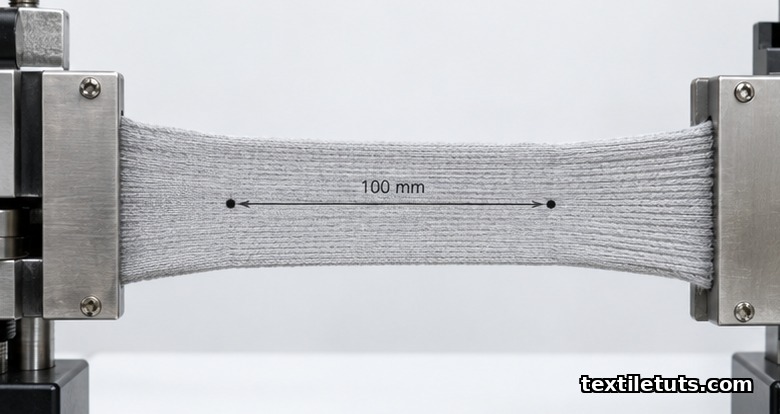
The knit fabric stretch and recovery test is the single most important mechanical test for predicting whether a T-shirt, legging, or polo will bag at the knees, sag at the elbows, or hold its shape after repeated wear and wash cycles. ASTM D2594 quantifies stretch as the elongation a knitted fabric reaches under a defined load and quantifies recovery as the percentage of that elongation that returns after a fixed relaxation period, and a well-behaved cotton single jersey typically stretches 60–80% in the width direction and recovers 90–95% of that stretch within 60 minutes of relaxation.
If you sew knits, source knit fabric, or run a QC lab, this test tells you whether a fabric will survive the cut-and-sew operation and the consumer’s wash cycle, and the rest of this article walks through how the test is run, what the numbers mean, and which specification limits to write into a purchase order.
What Is the Stretch and Recovery Test in Knit Fabric?
The stretch and recovery test is a mechanical test on a rectangular strip of knitted fabric that measures two paired properties: how far the fabric extends under a specified tensile load, and how much of that extension returns after the load is removed and the fabric is allowed to relax. ASTM D2594, titled Standard Test Method for Stretch Properties of Knitted Fabrics Having Low Power Stretch, is the most widely cited method for weft-knit fabrics with modest elastane content, while ISO 20932-1:2022 (Textiles: Determination of the Elasticity of Fabrics, Part 1: Strip Tests) provides a parallel method that is more common in European and ISO-aligned laboratories.
The two values come out as percentages:
- Stretch percentage is calculated as
((L_max − L_0) / L_0) × 100, where L_0 is the original gauge length and L_max is the extended length at the end of the load-hold step. - Recovery percentage is calculated as
((L_max − L_r) / (L_max − L_0)) × 100, where L_r is the length measured after the relaxation interval. The complement,(L_r − L_0), is reported as growth or residual elongation.
Most specifications also distinguish unrecovered growth from delayed recovery, because a fabric can show 95% recovery after 60 minutes but only 88% after 5 minutes, and the first number hides the visible sag a wearer notices on the body.
Why Stretch and Recovery Matter for Knit Garment Quality
Knits stretch because their loops deform under load, not because the fibers themselves extend, and the loop geometry stores recoverable energy up to a limit and then slips into permanent distortion. A fabric with high stretch and poor recovery feels comfortable on the body but grows irreversibly at stress points: knees in leggings, elbows in long-sleeve tees, seat in underwear, neckline in crewnecks. A fabric with low stretch and high recovery holds its silhouette but fights the body and seams during construction, leading to popped stitches and distorted panels.
The buyer’s specification has to balance both. Most commercial specs for weft knits in the 150–220 GSM range land in this band:
| Fabric type | Width stretch (%) | Length stretch (%) | Recovery after 60 min (%) |
|---|---|---|---|
| 100% cotton single jersey, 180 GSM | 60–80 | 20–30 | 90–95 |
| Cotton/Lycra single jersey, 95/5, 180 GSM | 100–140 | 40–60 | 95–98 |
| 1×1 rib, cotton/Lycra 95/5 | 120–180 | 80–120 | 92–96 |
| Interlock, cotton, 220 GSM | 40–60 | 30–40 | 88–92 |
| Scuba/poly double knit, 280 GSM | 30–50 | 30–50 | 96–99 |
These bands are typical ranges reported across mills and academic studies; exact values vary with yarn count, loop length, finishing route, and elastane percentage. Always confirm against the mill’s QC sheet rather than the literature alone.
ASTM D2594 Test Procedure, Step by Step
The method uses a bench-top tensile tester or a simple hand rig with a calibrated load. The procedure below follows ASTM D2594-04(2012) for low-power stretch knits.
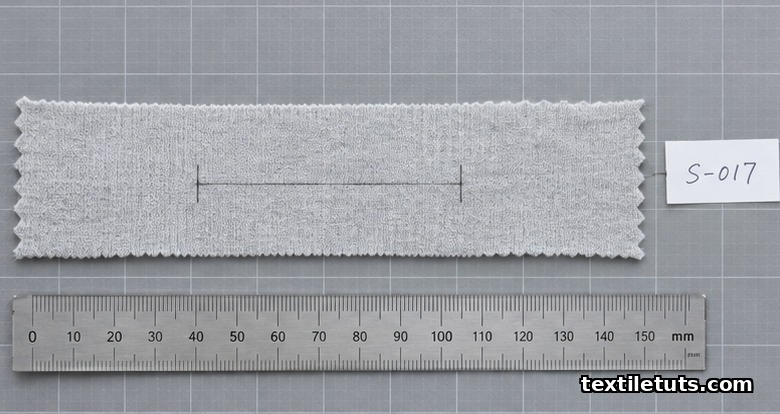
- Specimen prep. Cut three specimens each in the wale (length) and course (width) directions, each 50 mm wide and 200 mm long (the gauge length marked between the jaws). Specimens are conditioned for 4 hours at 20 °C and 65% RH per ISO 139.
- Mark gauge points. Mark two reference points exactly 100 mm apart in the middle of the specimen so the elongation is read on fabric, not at the jaws.
- Mount in tensile tester. Set the initial jaw separation to 100 mm and pre-tension the specimen with a small load (typically 1.0 N for lightweight knits) to remove slack.
- Load to elongation. For low-power stretch fabrics, ASTM D2594 prescribes a load of 1.5 lbf (≈ 6.7 N) per inch of fabric width. For a 2-inch (≈ 50 mm) wide specimen, that is 3.0 lbf (≈ 13.4 N). Hold the load for 1 minute.
- Measure stretched length. Record the jaw separation or the gauge-point distance at the end of the hold.
- Relax and measure. Remove the load, allow the specimen to relax on a smooth horizontal surface for a prescribed time (commonly 5 min, 30 min, 60 min, or 24 h), and re-measure the gauge-point distance.
- Calculate. Compute stretch and recovery per the formulas above and report as the average of the three specimens per direction.
For fabrics with higher elastane content (above about 5% Lycra/spandex), mills often substitute a higher load or use a cyclic method such as ISO 20932-1, which prescribes a defined number of stretch-recovery cycles at a fixed elongation rather than a fixed load.
How to Calculate Stretch and Recovery Percentages
A worked example makes the math concrete. Suppose a wale-direction cotton/Lycra single jersey specimen is cut to a gauge length of 100 mm. After loading to 13.4 N and holding 1 minute, the gauge points read 175 mm. The load is removed; after 60 minutes of relaxation, the gauge points read 108 mm.
- Stretch = (175 − 100) / 100 × 100 = 75%
- Recovery = (175 − 108) / (175 − 100) × 100 = 67 / 75 × 100 = 89.3%
- Growth (unrecovered elongation) = (108 − 100) = 8 mm (8%)
In trade specifications this fabric would be written as “75% stretch, 89% recovery after 60 min, 8% growth in length”, and the same triplet would be repeated for the width (course) direction. Most QC labs report at three relaxation intervals (5 min, 30 min, 60 min) because the gap between short-term and long-term recovery is a sensitive predictor of in-use sag.
Cyclic Stretch and Recovery: Beyond a Single Cycle
A single stretch-and-hold test hides a real-world behaviour called stress softening, where the second cycle takes less force to reach the same elongation because the loop structure has already partly rearranged. Cyclic testing, performed on an Instron-style tensile tester with programmed elongation, applies 5 or 10 repeated cycles at a fixed percentage elongation (commonly 30%, 50%, or 80% of the fabric’s measured stretch) and reports recovery after each cycle.
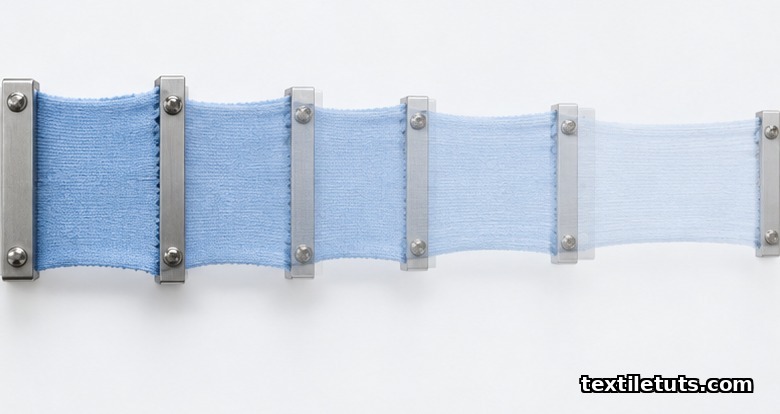
The first cycle is always the worst (largest growth), the second is much better, and cycles 3 through 10 usually plateau within 1–2% of each other. This plateau value is the most predictive number for garment performance, since a real consumer stretches the same panel of fabric many times, not just once.
A useful companion method is AATCC TM 150, Dimensional Changes of Fabrics After Home Laundering, which quantifies how recovery behaviour shifts after a defined wash cycle (typically 5 machine washes), separating fibre relaxation shrinkage from mechanical stretch growth.
Factors That Affect Stretch and Recovery
Several variables move both numbers in a finished knit, and they are largely under the knitter’s and finisher’s control:
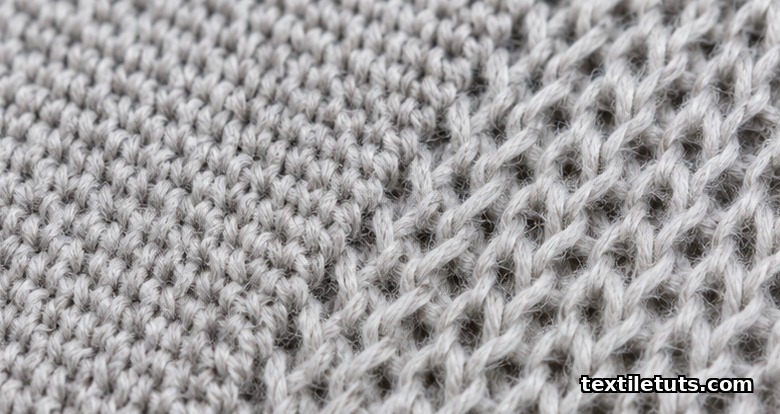
- Loop length (stitch length). A shorter loop length packs more yarn into the same area, restricts course-wise extension, and improves recovery. A longer loop length produces a softer, more extensible fabric that recovers less aggressively. The literature on stitch length and dimensional/mechanical properties is well established in journals like Textile Research Journal.
- Yarn count and twist. Finer, higher-twist yarns typically produce fabrics with higher recovery, because the yarn resists permanent rotation under load.
- Elastane content. Adding 2–5% Lycra/spandex can lift recovery by 5–15 percentage points and is the most common route to push a cotton-rich knit into the 95%+ recovery band.
- Relaxation and finishing. Heat-setting (for synthetics) and compressive shrinkage (for cotton) lock the loop geometry into a stable configuration. Without proper relaxation, the fabric still carries finishing-induced tensions that read as low recovery at the test bench.
- Laundering history. A pre-relaxed fabric (5+ wash cycles) reports more stable stretch and recovery numbers than a greige or just-finished sample.
Interpreting Results and Setting Specifications
When you receive a mill’s stretch-and-recovery report, three checks separate a usable fabric from a problem:
- Stretch range vs. garment design. If the pattern needs a body-hugging fit that stretches with the body, look for width stretch of at least 80% with width recovery of at least 90%. If the pattern is a loose T-shirt, 50–70% stretch with the same recovery band is fine.
- Recovery symmetry. Width and length recovery should be balanced. A fabric that recovers 96% in width but only 85% in length will elongate in the body direction and distort the garment silhouette.
- Growth after wash. Ask for recovery measured after 5 home launderings (per AATCC TM 150), not only on greige or just-finished fabric. The post-wash number is what the consumer will see.
For most woven-style knit garments, a written acceptance criterion of “stretch ≥ 60% width, recovery ≥ 90% after 60 min, growth ≤ 5% after 5 washes” is a sensible starting point, with looser limits for rigid interlock and tighter limits for body-hugging styles.
Frequently Asked Questions
What Is Considered Acceptable Recovery for a Knit Fabric?
For most apparel applications, recovery of 90% or higher after a 60-minute relaxation is the industry baseline, with 95%+ expected for fabrics containing elastane. Recovery below 85% is a red flag for any garment that will see repeated body movement, especially at the knees, elbows, and seat.
What Is the Difference Between Growth and Recovery?
Growth is the permanent elongation that remains after the load is removed and the fabric has relaxed; recovery is the percentage of stretch that returns. A fabric that stretches 100% and recovers 95% has 5% growth. Growth is the visible defect (the sag), while recovery is the headline number that hides it.
How Long Does a Stretch and Recovery Test Take?
The active test (loading, holding, measuring) takes 5–10 minutes per specimen. The relaxation interval is the gating step: 5-minute tests give a fast screening number, 60-minute tests give the most common QC value, and 24-hour tests give the long-term residual elongation used in performance-fabric specifications.
Can Stretch and Recovery Be Tested at the Production Line?
Yes. Hand-operated jig tests with a calibrated weight and a marked gauge length can run in 1–2 minutes per specimen and are widely used in cutting rooms and sourcing offices. They do not replace the lab tensile tester for certification, but they catch the worst offenders before fabric is cut.
How Does Washing Affect Knit Fabric Recovery?
Most cotton-rich knits improve in measured recovery after the first 1–3 wash cycles because relaxation shrinkage removes residual finishing tension. Synthetic-rich knits, especially those with spandex, lose recovery slowly across 20+ wash cycles as the elastane fatigues; heat-set finishing is what slows this loss.
References
- ASTM International. ASTM D2594-04(2012): Standard Test Method for Stretch Properties of Knitted Fabrics Having Low Power Stretch. ASTM International, West Conshohocken, PA. Method for stretch and growth of low-power-stretch knit fabrics.
- International Organization for Standardization. ISO 20932-1:2022: Textiles — Determination of the Elasticity of Fabrics — Part 1: Strip Tests. ISO, Geneva. Cyclic strip method for elastic recovery of fabrics.
- American Association of Textile Chemists and Colorists. AATCC TM 150-2018: Dimensional Changes of Fabrics After Home Laundering. AATCC, Research Triangle Park, NC. Laundering-induced dimensional change method, often paired with stretch/recovery testing.
- International Organization for Standardization. ISO 139:2005: Textiles — Standard Atmospheres for Conditioning and Testing. ISO, Geneva. Specifies 20 °C and 65% RH conditioning prior to mechanical testing.
- ResearchGate. Effect of Stitch Length on Dimensional and Mechanical Properties of Weft Knitted Fabrics. Peer-reviewed paper documenting how loop length changes both stretch and recovery numbers.
- Sage Open / SAGE Journals. Stretch and Recovery Behaviour of Weft-Knit Cotton and Cotton/Spandex Fabrics. Open-access paper on cyclic recovery and stress softening in apparel knits.
This article is the working reference for the knit fabric stretch and recovery test, including the ASTM D2594 and ISO 20932-1 procedures, calculation formulas, typical specification ranges, and the relaxation/growth interpretation that QC labs report on commercial knit shipments. Editorial by Iftay Khairul Alam, TextileTuts. Sources: ASTM D2594-04(2012); ISO 20932-1:2022; ISO 139:2005; AATCC TM 150-2018; peer-reviewed literature on stitch length and cyclic recovery as cited.


