
How to Remove Mud Stains from Clothes

Mud stains demand one ironclad rule: never treat them wet. Wet mud is a suspension of fine clay mineral particles, organic matter, and water — and applying water or detergent at this stage is the single most damaging mistake you can make. The clay particles, measuring less than 4 micrometers, are small enough to penetrate deep into the gaps between fabric fibers. When you add liquid to wet mud, you re-suspend those particles and drive them further into the fibre bundle, expanding the stain rather than removing it.
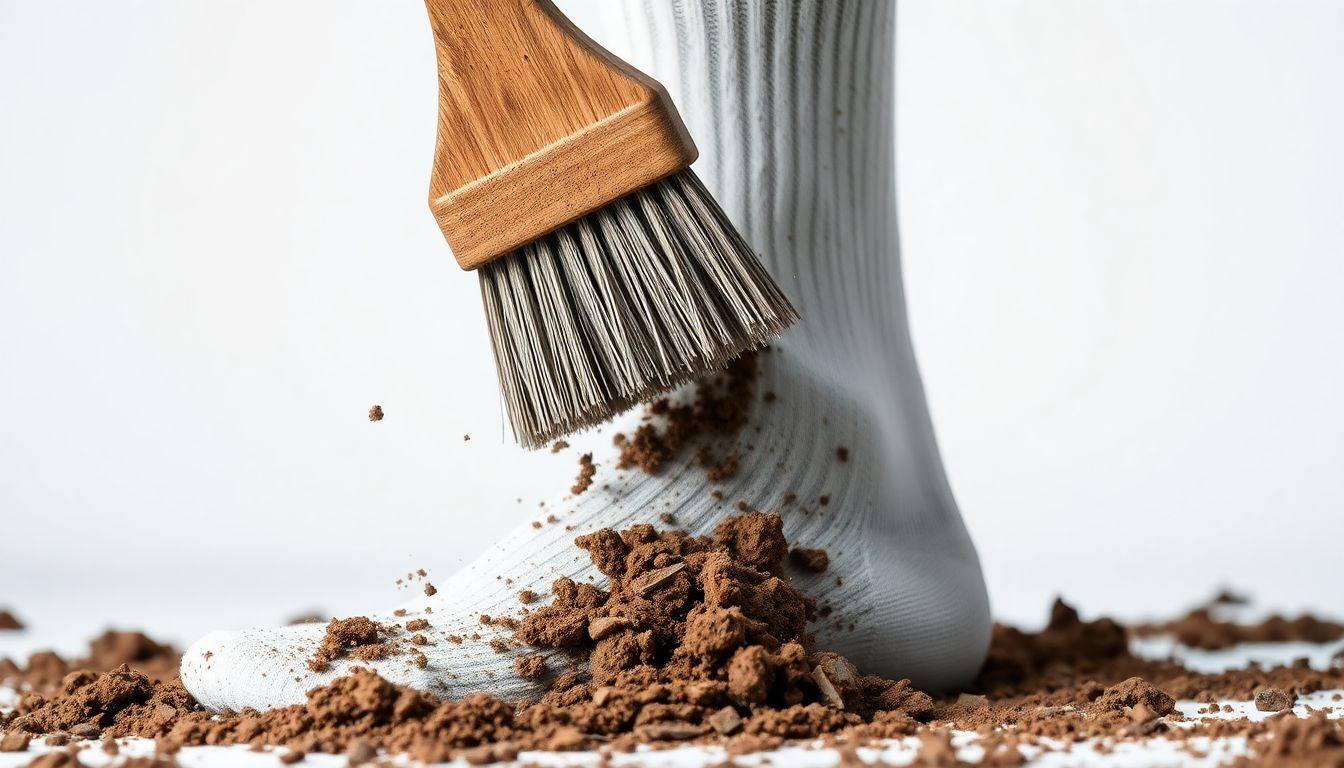
The solution is counterintuitive but scientifically sound: let the mud dry completely, then brush off the solid residue before applying any treatment. Drying causes the clay minerals to compact and harden as water evaporates, transforming a smeared, penetrant stain into a brittle crust that lifts away from the fibre surface. This step alone reduces the total stain mass requiring chemical treatment by approximately 80–90%.
Why You Must Wait for Mud to Dry
Drying mud before treatment prevents clay particles from being driven deeper into fabric fibers, making removal significantly easier. To understand why this works, it helps to understand what mud actually is. Street and garden mud is composed of two distinct elements: fine clay mineral particles (the inorganic component) and organic matter including decomposed plant material, and tannin compounds from soil humus (the organic component).
Clay minerals form in sheet-like layer configurations (1:1 or 2:1 tetrahedral-octahedral structures) that develop plasticity when wet. The fine particles — less than 4 micrometres in diameter — are so small they cannot be characterised by ordinary optical methods and behave as a colloidal suspension in water. When this suspension is pressed into a fabric, capillary action draws it between and within individual fibres.
Adding water or detergent to this wet system re-suspends the clay. The surfactants in detergent work by emulsifying compounds — but with wet mud, this emulsification occurs at the worst possible location: inside the fibre bundle. The clay mineral particles become mobile again, and surface tension effects push them deeper into fabric interstices rather than lifting them out.
When mud dries, the water disappears through evaporation and the clay layers compress and bond together through hydrogen bonding between sheet surfaces. The result is a hard, brittle crust — essentially a miniature ceramic — that has minimal adhesion to smooth fibre surfaces and can be physically dislodged by brushing alone. The tannin component also oxidises and darkens during drying, which can leave a discoloured trace, but this is far easier to treat chemically than a full-depth clay infiltration.
Step-by-Step Mud Stain Removal
The following six-step process handles standard mud stains on washable fabrics. For fabric-specific considerations (wool, silk, synthetics), check the care label and adapt the temperature accordingly.
Step 1 — Wait: Allow Mud to Dry Completely
Patience is the most critical step. Place the garment in a warm, ventilated area and leave it undisturbed. In warm, dry conditions (above 20°C / 68°F), mud typically dries in 1–2 hours. In cool or damp conditions — such as a muddy jacket left in a car boot overnight — allow 4–6 hours. Do not attempt to speed drying with a tumble dryer on high heat, as this can bake the organic tannin component into the fabric. A fan on low or a heated airing cupboard is acceptable.
Step 2 — Brush: Remove Dried Mud Particles
Use a stiff-bristled brush — a dedicated clothing brush, an old toothbrush, or a clean vegetable brush. Work over a bin or, ideally, outside. Brush briskly in one direction to lift the dried mud crust. Do not wet the fabric at this stage. For heavy deposits on sturdier fabrics like denim or canvas, a stiff nylon brush works well. For lighter fabrics like cotton shirts, use a softer brush to avoid abrading the fibre surface.
Expect to remove approximately 80–90% of the stain mass at this stage. If any discolouration remains — typically a brownish mark from tannin oxidation — proceed to Step 3.
Step 3 — Pre-treat: Apply Enzyme Detergent
Apply a liquid detergent containing enzymes directly to the remaining stained area. Enzyme detergents are far more effective than non-enzyme detergents for mud stains because they target the organic component — the tannin compounds, decaying plant matter, and proteins — that the brushing step could not remove.
Modern enzyme detergents typically contain four classes of enzymes, each targeting a different substrate. Proteases (such as savinase) hydrolyze protein-based organic matter. Lipases break down fats and oils that may be present in certain mud types. Amylases target carbohydrate stains. Cellulases act on cellulose-based soils and also help release trapped particles from within the fibre structure. For mud stains, the protease and amylase components are particularly valuable.
Work the detergent into the fabric gently with the brush. Do not scrub aggressively — the goal is to distribute the enzyme throughout the fibre bundle. Use a generous amount; for a stained area roughly the size of a fist, use approximately 1–2 tablespoons of liquid detergent.
Step 4 — Let Sit: Allow Enzyme Treatment to Work
Enzyme activity is time-dependent. Allow the pre-treated garment to sit for a minimum of 30 minutes at room temperature. In cool conditions, extending this to 60 minutes improves results. During this period, the protease and amylase enzymes hydrolyse the organic residue into smaller, water-soluble fragments that can be rinsed away. Do not allow the detergent to dry on the fabric — if sitting for longer than 30 minutes, keep the garment in a sealed plastic bag to prevent evaporation.
Step 5 — Wash: Machine Wash at the Highest Safe Temperature
Wash the garment at the highest temperature safe for the fabric. As a general guide (per ISO 3758 care labelling standards), check the wash tub symbol on the care label:
- 30°C (one dot): Delicate synthetics, nylon, polyester
- 40°C (two dots): Cotton blends, coloureds, synthetic cycle — this is the standard wash temperature for most sports kits including football and rugby shorts
- 60°C (three dots): White cotton, linen, heavy-duty cycles
Use a normal or heavy-duty wash cycle (maximum agitation). The mechanical action of the wash drum, combined with the enzyme pre-treatment and detergent, works synergistically to lift and suspend any remaining staining compounds. Add an additional dose of enzyme liquid detergent to the drum itself, not just the pre-treated area.
Step 6 — Check: Inspect Before Drying
This step is critical and frequently skipped. Before placing the garment in a tumble dryer — where heat will set any remaining stain permanently — inspect it in good lighting. Hold the fabric up to a window or use a bright overhead light. Residual tannin staining from the organic mud component shows as a faint brownish or yellowish discolouration, particularly visible on white or light-coloured fabrics.
If discolouration remains, do not dry the garment. Instead, proceed with an OxiClean soak (see below) or a second enzyme pre-soak before drying.
Also Read:
- How to Remove Stains from White Clothes (All Stain Types)
- How to Remove Blood Stains from Clothes (Fresh and Set-In)
- How to Remove Turmeric Stains from Clothes
Mud Types and Their Removal Challenges
Not all mud is the same. The mineral and organic composition of mud varies significantly depending on its source, and this affects both the difficulty of removal and the specific approach required.
Garden Soil Mud
Garden soil mud is primarily composed of basic clay minerals (illite and kaolinite groups) mixed with decomposed organic matter from plant material. This is the most common type and responds well to the standard dry-brush + enzyme method described above. The clay component dries and hardens predictably, and the organic component is effectively broken down by protease enzymes. Expect excellent results with a single treatment cycle.
Red / Clay-Heavy Soil
Red clay soils — common in parts of the UK, France, the American South, and Australia — contain higher concentrations of iron oxide (hematite) in addition to standard clay minerals. The iron oxide gives the mud its characteristic red colour and contributes to persistent brownish discolouration after brushing. The tannin content is also typically higher in these soils. After the standard dry-brush and enzyme treatment, a residual reddish-brown mark may remain. An OxiClean soak (1–2 hours in a solution of approximately 100g per 4 litres of warm water) is effective at lightening this residual staining through oxidative bleaching of the iron compounds.
Organic Mud (Pond Mud, Park Mud)
Mud from freshwater environments (ponds, lakes, riverbanks) and well-used parkland contains a higher proportion of decomposed organic matter including algae and leaf litter. This organic component responds exceptionally well to enzyme detergents, particularly protease and amylase formulations. Because the organic fraction is the primary staining agent rather than clay minerals, the drying step is still beneficial but the subsequent chemical treatment is generally more effective. Expect good results with one or two enzyme treatment cycles.
Sandy Mud
Sandy mud contains a high proportion of silica sand particles mixed with minimal clay. Because the clay content is low, sandy mud dries to a lighter, more powdery crust that brushes off more easily. The tannin content is typically minimal. Standard washing with enzyme detergent is usually sufficient without additional treatment steps. This is the easiest mud type to remove.
Sports-Specific Mud Stain Advice
Sports kit faces tougher mud challenges than everyday clothing. Mud encountered on pitches, trails, and fields is often mixed with organic materials (grass clippings, soil, animal matter) and is worked deeper into fabric by physical activity. The following guidance applies to specific sports.
Football and Rugby Kits
Football and rugby kits are typically made from polyester synthetic blends (often interlock or spacer fabric) designed for moisture management. These fabrics are durable but can trap mud particles in their microporous structure. Pre-treat while still away from home by allowing mud to dry and giving a preliminary dry brush — do not apply wet treatments in a changing room. When washing at home, use a 40°C synthetic cycle with an enzyme liquid detergent. Avoid fabric softener, which coats fibres and reduces moisture-wicking performance. For persistent staining on white kits, add oxygen bleach ( sodium percarbonate-based, branded as OxiClean) to the wash drum.
Cricket Whites
Cricket whites present a particular challenge because the white fabric shows all staining and the ball is bowled on a prepared pitch that leaves especially iron-rich, clay-heavy mud on the cloth. The standard approach for cricket whites is: dry brush thoroughly → enzyme pre-soak (30–60 minutes) → OxiClean soak (1–2 hours in warm water) → hot wash at 60°C if the fabric is pure cotton. For cotton/polyester blends, stay at 40°C to avoid damaging the polyester component. Multiple treatment cycles are often necessary for heavy mud accumulation.
Transporting Wet Sports Gear
A common mistake is placing freshly muddied sports kit into a sports bag for transport. In a closed bag, any remaining wet mud continues to work into the fabric through the motion of transport, and the anaerobic environment can promote microbial activity that worsens staining and causes odour. Always allow kit to dry before bagging. If drying is not possible, place the garment in a sealed plastic bag separately from other kit.
Using OxiClean for Stubborn Mud Stains
OxiClean (sodium percarbonate, 2Na₂CO₃·3H₂O₂) is an oxidizing bleaching agent that releases hydrogen peroxide when dissolved in water. The active oxygen content of typical sodium percarbonate products is approximately 5% by weight, making it significantly more effective than hydrogen peroxide alone. The oxidation mechanism breaks down tannin compounds and organic colouring matter into colourless fragments.
For a standard OxiClean soak for mud-stained garments:
- Use approximately 100g of OxiClean powder per 4 litres of warm (not hot) water
- Stir to dissolve completely before adding garments
- Submerge the stained area and soak for 1–2 hours
- For white cotton or linen, soak up to 4 hours for heavier staining
- Rinse thoroughly before washing
Do not use OxiClean on wool, silk, or leather. Do not mix OxiClean with chlorine bleach — the combination produces dangerous gases. Always test on an inconspicuous area of the garment first, particularly on coloured synthetics where oxidative bleaching may affect the dye.
Frequently Asked Questions
Should you rinse mud off immediately?
No — the counterintuitive answer is to let mud dry completely before treating. Rinsing wet mud spreads the clay particles deeper into the fabric weave, making the stain larger and harder to remove.
Does OxiClean work on mud stains?
Yes — after brushing off dried mud, OxiClean soak (1–2 hours) removes residual tannin and organic matter discoloration effectively, especially for red clay mud or muddy sports gear.
Can mud stains be removed from white fabric?
Yes — white cotton or linen with mud stains responds well to: dry brush, enzyme pre-soak, OxiClean soak, hot wash. Red clay mud may require multiple treatment cycles.
References
- Clay Minerals Society. (2025). Introduction to Clay Minerals. https://www.clays.org/
- ISO. (2012). ISO 3758:2012 — Textiles — Care labelling code using symbols. International Organization for Standardization. https://www.iso.org/standard/53425.html
- Wikipedia. (2025). Laundry detergent — Enzyme types and mechanisms. https://en.wikipedia.org/wiki/Laundry_detergent
- Wikipedia. (2025). Sodium percarbonate — Active oxygen content and mechanism. https://en.wikipedia.org/wiki/Sodium_percarbonate
- Wikipedia. (2025). Clay mineral — Sheet structure and water interaction. https://en.wikipedia.org/wiki/Clay_mineral


