
GSM to Yarn Count Calculator: Find Count for Specific GSM

To find yarn count from GSM, use the formula: Yarn Tex = GSM × 1,000 ÷ (Loop Length × Stitch Density). Once you have the Tex value, you can use a yarn conversion tool to convert it to any yarn numbering system from denier and decitex to English Cotton Count (NeC) and Metric Count (Nm) using the conversion tables below.
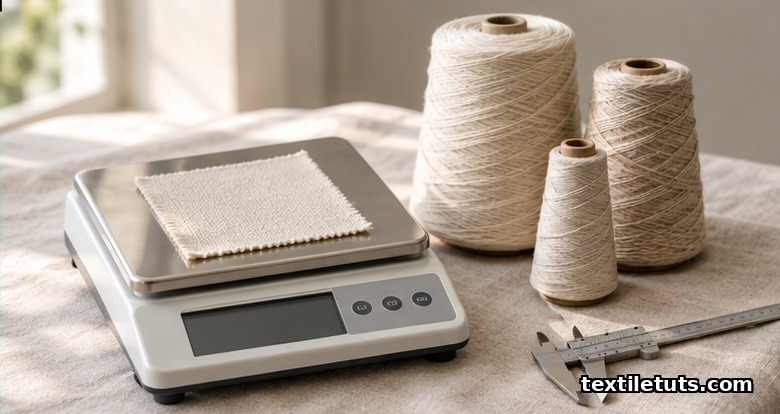
GSM (grams per square metre) measures fabric weight directly. A 100cm × 100cm fabric square is weighed on a precision scale. The standard test methods are ASTM D3776 in the US and ISO 3801 internationally. Fabric weight affects drape, warmth, breathability, and durability — making the right GSM essential for every textile project.
What Is GSM and Why Does It Matter?
GSM stands for grams per square metre — a direct measurement of fabric weight. A higher GSM indicates a denser, heavier fabric. GSM is measured by cutting a 100cm × 100cm square of fabric and weighing it on a precision scale. The standard test method follows ASTM D3776 in the US and ISO 3801 internationally.
Fabric weight directly affects drape, warmth, breathability, and durability. A 120 GSM single jersey fabric weighs 120 grams per square metre. Cheap T-shirt fabric typically falls around 150 GSM, while premium tees reach 180-200 GSM. Understanding GSM helps you select fabric appropriate for its end use — lightweight summer wear versus heavy winter garments.
The Formula to Convert GSM to Yarn Count
Converting GSM to yarn count requires understanding stitch length, loop length, and the specific construction of the fabric. The basic relationship follows this formula:
GSM = (Loop Length × Stitch Density × Yarn Tex) ÷ 1,000
Where loop length is measured in centimetres, stitch density is the number of loops per square centimetre, and yarn tex is the weight in grams of 1,000 metres of yarn. Solving for yarn count (tex):
Yarn Tex = GSM × 1,000 ÷ (Loop Length × Stitch Density)
Yarn Numbering Systems Explained
Textile industries use two categories of yarn numbering systems — direct and indirect — and converting between them requires specific formulas. The table below summarises all common systems and their Tex conversions.

| System | Definition | Formula to Tex | Example |
|---|---|---|---|
| Tex | Grams per 1,000 metres | — | 20 tex = 20g per 1,000m |
| Denier (den) | Grams per 9,000 metres | Denier ÷ 9 = Tex | 30 den = 3.3 tex |
| Decitex (dtex) | Grams per 10,000 metres | Dtex ÷ 10 = Tex | 200 dtex = 20 tex |
| NeC (English Cotton Count) | Number of 840-yard hanks per pound | 590.5 ÷ NeC = Tex | 30/1 cotton ≈ 19.7 tex |
| Nm (Number Metric) | Number of 1,000-metre hanks per kilogram | 1,000 ÷ Nm = Tex | 60 Nm ≈ 16.7 tex |
| NeK (Worsted Count) | Number of 560-yard hanks per pound | 885.5 ÷ NeK = Tex | 36 NeK ≈ 24.6 tex |
| NeL (Linen Count) | Number of 300-yard hanks per pound | 1,653.5 ÷ NeL = Tex | 40 NeL ≈ 41.3 tex |
Direct Systems (Weight per Fixed Length)
Direct systems express yarn count as the weight of a fixed length. Higher numbers indicate thicker yarn.
Tex = grams per 1,000 metres. A 20 tex yarn weighs 20 grams per 1,000 metres.
Denier (den) = grams per 9,000 metres. The formula is: Denier = Tex × 9. A 30 denier yarn equals 3.3 tex.
Decitex (dtex) = grams per 10,000 metres. The formula is: Dtex = Tex × 10.
Indirect Systems (Length per Fixed Weight)
Indirect systems express yarn count as the length of yarn per fixed weight. Higher numbers indicate thinner yarn.
NeC (English Cotton Count) = number of 840-yard hanks per pound. Formula: Tex = 590.5 ÷ NeC. A 30/1 cotton yarn is approximately 19.7 tex.
Nm (Number Metric) = number of 1,000-metre hanks per kilogram. Formula: Tex = 1,000 ÷ Nm. A 60 Nm yarn equals approximately 16.7 tex.
NeK (Worsted Count) = number of 560-yard hanks per pound. Formula: Tex = 885.5 ÷ NeK.
NeL (Linen Count) = number of 300-yard hanks per pound. Formula: Tex = 1,653.5 ÷ NeL.
Fabric GSM to Yarn Count Calculator
How the Yarn Count to GSM Calculator Works
The yarn count to GSM calculator at TextileTuts uses your fabric’s stitch parameters to compute the required yarn count. Input your GSM target, loop length in centimetres, and Wales per inch (wpi) and Courses per inch (cpi). The calculator applies the GSM formula to output the precise tex or NeC value for your yarn. Use the companion yarn count to GSM calculator when you know your yarn count and need to find the resulting fabric weight.
Recommended GSM for Common Garments
Selecting the correct GSM for your project ensures the finished garment has the right weight, drape, and thermal properties. The following table provides standard fabric weight ranges for common textile products:

GSM | CATEGORY | FABRIC EXAMPLE |
8-136 | EXTRA LIGHT | WADDING HOLLOW FIBER FABRIC, VOILE, CHIFFON |
136 – 204 | LIGHT | LIGHTWEIGHT COTTON, PVC METTING |
204 – 272 | MEDIUM | QUILTED WATERPROOF FABRIC |
272 – 339 | MEDIUM LIGHT | JUTE CLOTH HESSIAN FABRIC, STRETCH DENIM |
339 – 407 | HEAVY | RIGID DENIM, CANVAS, WOOL |
407 – 475 | EXTRA HEAVY | DENIM FABRIC, COATING |
GSM Ranges for Summer Versus Winter Garments
Summer clothing requires lightweight, breathable fabrics with low GSM values. Single jersey T-shirt fabric for warm weather typically ranges from 80 to 120 GSM. Lightweight blouse fabrics fall between 60-80 GSM. A 100 GSM single jersey allows sufficient air circulation while maintaining enough opacity for a quality appearance.

Winter clothing demands heavier fabrics that provide insulation and wind resistance. Sweatshirt fleece commonly ranges from 250 to 350 GSM. Heavy polar fleece can reach 400 GSM or higher. Winter cardigan fabrics typically fall between 200-300 GSM depending on the knit structure and desired warmth.
If you have an existing fabric and want to verify its weight before starting a project, use the fabric GSM calculator to determine its exact GSM without specialised equipment. You can also use a tshirt fabric consumption calculator to estimate how much fabric you will need for your project. This tool is especially helpful when working on larger quantities, ensuring you minimize waste and make the most of your fabric. By accurately assessing your fabric needs, you can save both time and money in your production process.
References
- Wikipedia. (2025). Yarn count. Wikimedia Foundation.
- ASTM International. (2025). ASTM D3776 — Standard Test Methods for Mass per Unit Area (Weight) of Fabric. ASTM International.
- International Organization for Standardization. (2025). ISO 3801 — Textiles — Determination of Mass per Unit Area and Mass per Unit Length of Woven Fabrics. ISO.


