
Basic T-Shirt Fabric Consumption Calculator: Pounds and Yardage

A standard T-shirt requires approximately 0.65–0.75 yards (0.59–0.69 meters) of 60-inch wide tubular single jersey knit fabric at 160 GSM, including standard seam and shrinkage allowances. This calculator determines your exact requirement based on your specific body measurements and chosen fabric type.
The T-shirt fabric consumption calculator converts your body measurements into precise fabric weight requirements in pounds, grams, or yards—eliminating costly over-ordering and preventing production shortfalls. Every T-shirt pattern must account for body dimensions, ease requirements, and fabric characteristics before a single cut is made.
What Measurements Do You Need to Calculate T-Shirt Fabric Consumption?
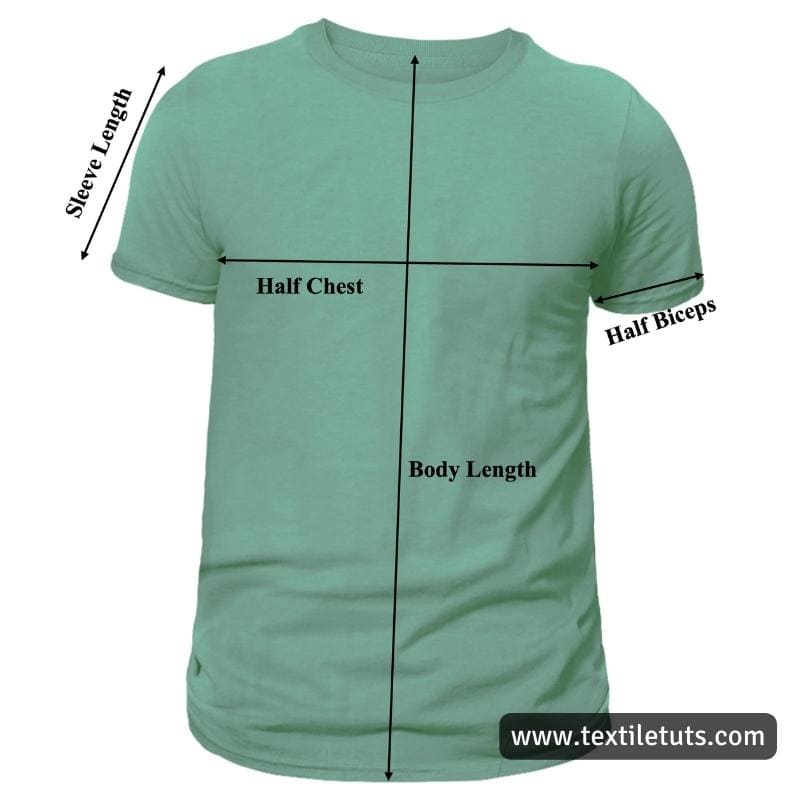
To calculate T-shirt fabric consumption accurately, you need four primary body measurements and four standard allowances. These values are entered into the calculator fields to produce an exact fabric requirement figure.
| Measurement | Description | Unit |
|---|---|---|
| Body Length | Center back neck to hem edge | inches or cm |
| Half Chest Width | One-half of total chest circumference at fullest point | inches or cm |
| Sleeve Length | Shoulder seam to wrist or desired sleeve end | inches or cm |
| Half Biceps Circumference | One-half of upper arm circumference at widest point | inches or cm |
Standard Industry Allowance Values for T-Shirt Fabric Calculation
Allowances compensate for seams, hems, shrinkage, and styling differences. The following values represent standard industry practice for basic T-shirt production. Adjustments may be necessary for specialized designs or non-standard fit requirements.
- Body Length Allowance = 2.5 inches (6.35 cm) — covers hem seam and fabric shifting during washing
- Half Chest Length Allowance = 1.75 inches (4.45 cm) — accounts for side seam and contour shaping
- Sleeve Length Allowance = 1.5 inches (3.81 cm) — provides hem stitching margin and cuff attachment
- Half Biceps Allowance = 0.8 inches (2.03 cm) — enables comfortable arm movement without binding
Fabric Consumption Calculation Formula for T-Shirts
The fabric consumption formula converts flat pattern dimensions into linear fabric yardage requirements. It accounts for the usable fabric width and includes a wastage percentage to cover cutting losses, pattern matching, and defective material.
Step 1 — Calculate total flat area: Add the flat area of each garment component (body front, body back, two sleeves, collar or binding) by multiplying length by width for each piece.
Step 2 — Convert to linear yardage: Divide the total fabric area in square inches by the usable fabric width in inches to obtain linear inches required.
Step 3 — Apply wastage factor: Multiply the linear figure by 100 divided by (100 minus wastage percentage). Beginners should set wastage at 20%–25%; experienced cutters can reduce this to 10%–15% with accurate marker making.
Formula: Linear yards = (Total component area ÷ Usable fabric width) × (100 ÷ (100 − Wastage %))
T-Shirt Fabric Consumption Calculator (Pounds and Grams)
Enter your measurements and allowances into the calculator below to determine the fabric weight required for your T-shirt production run.
Quick-Reference: T-Shirt Fabric Consumption by Size
Use this quick-reference guide to estimate fabric requirements for standard-size T-shirts before running the calculator. Values assume 60-inch wide tubular single jersey fabric at 160 GSM with 15% wastage allowance.
| Size | Fabric Weight (lbs) | Fabric Weight (g) | Yardage (yd) |
|---|---|---|---|
| XS | 0.31–0.35 | 141–159 | 0.55–0.62 |
| S | 0.34–0.38 | 154–172 | 0.60–0.67 |
| M | 0.37–0.42 | 168–190 | 0.65–0.73 |
| L | 0.40–0.46 | 182–209 | 0.70–0.80 |
| XL | 0.44–0.50 | 200–227 | 0.77–0.87 |
| 2XL | 0.48–0.55 | 218–250 | 0.84–0.95 |
Common T-Shirt Fabric Calculation Mistakes to Avoid
Avoiding these frequent errors ensures accurate fabric ordering and reduces waste in T-shirt production.
- Ignoring fabric width: Tubular 58–60 inch fabric requires less yardage than 36–44 inch open-width fabric for the same garment. Always calculate based on your actual fabric width.
- Skipping shrinkage allowance: Knit fabrics typically shrink 3%–5% lengthwise after washing. Failing to account for this results in finished garments that are shorter than planned.
- Using wrong wastage percentage: Beginners should use 20%–25% wastage to account for marker making inefficiencies. Using 10% without proper experience leads to fabric shortages.
- Mismeasuring half-chest: The half-chest is one-half of the total chest circumference, not the full width. Measuring the full chest and dividing by two is the most reliable method.
- Forgetting collar and binding: Rib knit collar and binding require additional fabric—typically 0.03–0.05 lbs extra for a standard crew neck. Factor this into your total consumption.
Knit Fabric Weight and GSM Ranges for T-Shirts
Fabric weight directly influences consumption calculations—a heavier fabric uses more material by weight but may require less yardage depending on construction. Understanding GSM (grams per square meter) and oz/yd² (ounces per square yard) helps you select the right material for your T-shirt production.
| Fabric Type | GSM Range | Oz/Yd² Range | Typical T-Shirt Use |
|---|---|---|---|
| Lightweight Single Jersey | 100–130 GSM | 3.0–3.8 oz/yd² | Summer tops, fashion tees |
| Standard Single Jersey | 130–160 GSM | 3.8–4.7 oz/yd² | Everyday basic T-shirts |
| Heavyweight Single Jersey | 160–200 GSM | 4.7–5.9 oz/yd² | Premium athletic wear |
| Interlock Knit | 150–200 GSM | 4.4–5.9 oz/yd² | Higher-quality T-shirts |
| Rib Knit (Collar/Cuffs) | 180–220 GSM | 5.3–6.5 oz/yd² | Trims and finishing |
How to Calculate Fabric Yardage for a Basic T-Shirt
The yardage calculation accounts for all pattern pieces, standard allowances, and fabric width. Standard knit fabric widths for T-shirt production include 58–60 inches (147–152 cm) for tubular fabric and 36–44 inches (91–112 cm) for open-width fabric.
Example calculation: A standard men’s T-shirt (size M) with body length 28 inches, half chest 21 inches, sleeve length 8.5 inches, and half biceps 6.5 inches requires approximately 0.65–0.75 yards of 60-inch wide tubular single jersey fabric at 160 GSM, including a 15% wastage allowance.
Fabric consumption varies by garment fit—slim fit T-shirts use 5%–8% less fabric than regular fit, while oversized or extended-length styles require 10%–15% more. Always calculate based on the specific pattern being used.
T-Shirt Fabric Consumption vs. Woven Shirt Fabric Consumption
Knit T-shirt fabric and woven shirt fabric have fundamentally different construction properties that affect consumption calculations. Single jersey knit fabric has 20%–30% crosswise stretch, which reduces the fabric needed for a given body measurement compared to non-stretch woven fabric.
| Factor | Knit T-Shirt Fabric | Woven Dress Shirt Fabric |
|---|---|---|
| Fabric Stretch | 20%–30% crosswise stretch | 0%–5% stretch (minimal) |
| Typical Fabric Width | 58–60 inches (tubular) | 36–60 inches (open-width) |
| Allowance for Fit | Lower ease (comfort stretch) | Higher ease (no recovery stretch) |
| Shrinkage Allowance | 3%–5% lengthwise | 1%–3% lengthwise |
| Pattern waste | 10%–15% | 15%–20% |
The woven shirt fabric calculator on TextileTuts uses different allowance values and formulas specifically designed for non-stretch woven fabrics. That tool accounts for collar stands, plackets, and button closures that are absent in knit T-shirts.
Standard T-Shirt Size Measurements Reference
The following measurements represent industry-standard body dimensions for T-shirt production. These values serve as baseline patterns before allowances are applied.
| Size | Body Length (in) | Half Chest (in) | Sleeve Length (in) | Half Biceps (in) |
|---|---|---|---|---|
| XS | 26 | 16.5 | 7.5 | 5.5 |
| S | 27 | 18 | 8 | 6 |
| M | 28 | 19.5 | 8.5 | 6.5 |
| L | 29 | 21 | 9 | 7 |
| XL | 30 | 22.5 | 9.5 | 7.5 |
| 2XL | 31 | 24 | 10 | 8 |
Fabric Consumption Calculator for T-Shirt Yardage
| Fabric Length in Yards | Fabric Length in Meters |
|---|---|
| Insert values first | Insert values first |
References
- Pandey, D. et al. (2020). Fabric Consumption Calculation for Knit Garments. PMC/NCBI. https://pmc.ncbi.nlm.nih.gov/articles/PMC7588612/
- Cotton Incorporated. (2024). Knit Fabric Construction and Selection. CottonWorks. https://cottonworks.com/en/topics/production/fabric-selection/knit-fabric-construction/
- ASTM International. (2023). ASTM D3887 – Standard Specification for Knit Fabrics. https://www.astm.org/
- Textile Exchange. (2023). Preferred Fiber and Materials Market Report. https://textileexchange.org/
- AATCC International. (2024). Technical Manual – Fabric Dimensional Change Testing. https://www.aatcc.org/


