
Garment Exports in Bangladesh Reached Record High in 2021-2022 Fiscal Year

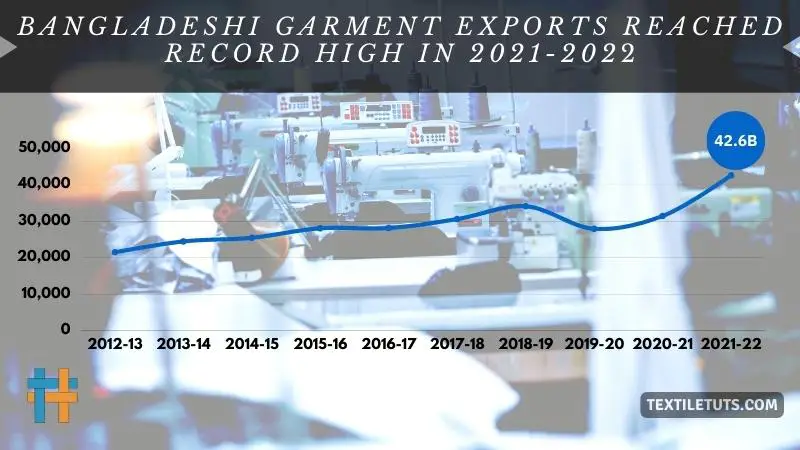
Bangladesh’s garment industry achieved record-breaking export performance in the 2021-2022 fiscal year, reaching $42.61 billion in ready-made garment (RMG) exports—a 35.47% increase over the previous fiscal year’s $31.456 billion. This surge occurred despite the economic disruption caused by the COVID-19 pandemic, demonstrating the sector’s resilience and competitive strength in global markets. The remarkable growth was driven by rebounding consumer demand in Western markets, strategic relocation of manufacturing capacity from China and Vietnam, and Bangladesh’s continued advantage in labor costs. The RMG sector accounted for over 97% of Bangladesh’s total export earnings of $39.73 billion in FY2021-22, solidifying its position as the backbone of the national economy.
Despite pandemic-related disruptions in the preceding fiscal year, Bangladeshi factory owners not only sustained their operations but expanded production capacity in FY2021-22. The country’s garment exports reached record levels, representing a major success story for Bangladeshi manufacturing and international trade. This growth trajectory positioned Bangladesh as the world’s second-largest apparel exporter, trailing only China.
| Product Category | Exports (in billion USD) | % of Total Exports |
|---|---|---|
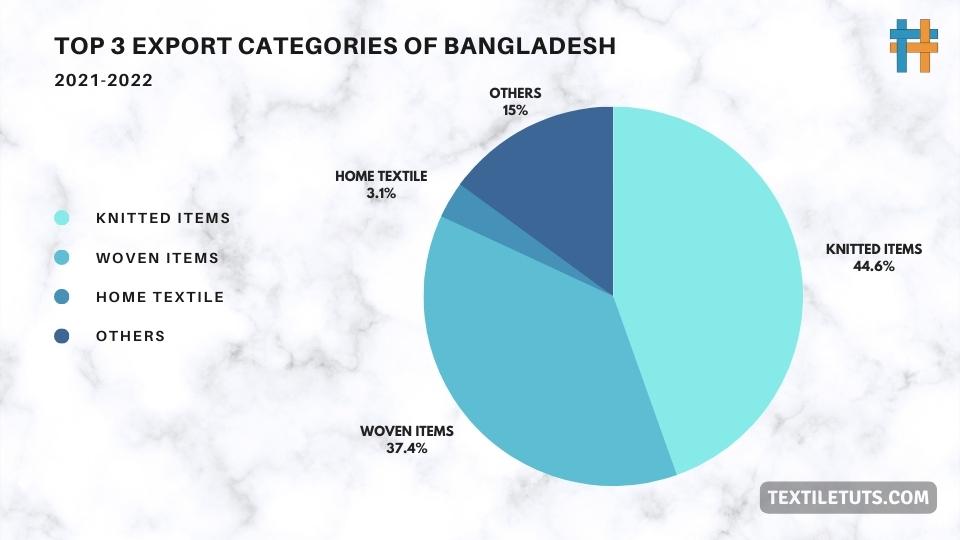
| Knitted Apparel and Accessories | 23.21 | 44.56% |
| Woven Apparel and Accessories | 19.40 | 37.37% |
| Home Textile | 1.62 | 3.11% |
| Leather and Leather Goods | 1.24 | 2.38% |
| Agricultural Products | 1.16 | 2.23% |
| Jute and Jute Goods | 1.12 | 2.16% |
| Others (including services, chemicals, etc.) | 4.16 | 8.00% |
Overview of Bangladesh’s Garment Export Industry in 2021-2022
Bangladesh is a major exporter of ready-made garments (RMG) and textiles, contributing significantly to the country’s economy. The nation’s garment sector employs over 4.1 million workers, making it one of the largest employers in the manufacturing sector globally.
| Fiscal Year | RMG Exports (in billion USD) | % Change in RMG Exports |
|---|---|---|
| 2020-21 | 31.456 | 12.55% |
| 2021-22 | 42.613 | 35.47% |
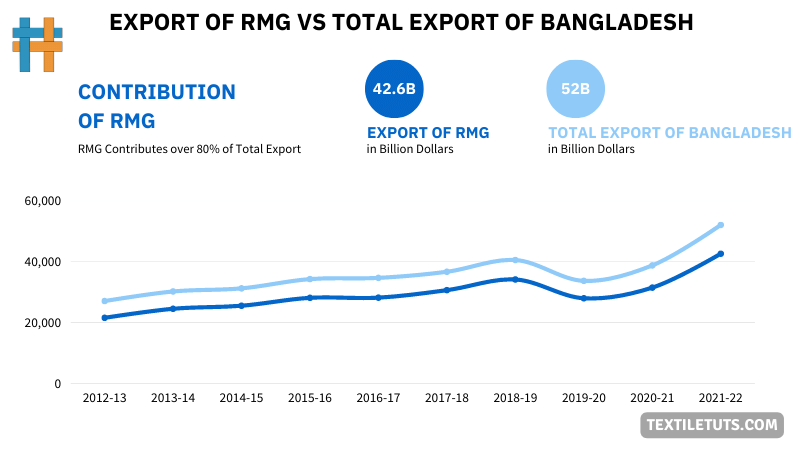
In the fiscal year 2021-2022, Bangladesh’s garment exports grew by 7.14% compared to the previous year. The country earned a total of $39.73 billion from exports, of which $38.70 billion came from the RMG sector alone. The RMG sector dominated Bangladesh’s export market, accounting for over 97% of total export earnings. Bangladesh’s total export earnings in FY2021-22 reached $52.08 billion, with RMG comprising approximately 81-82% of the nation’s total exports.
The United States remained the largest export destination for Bangladesh’s RMG products, accounting for 34.10% of total RMG exports. Other significant export destinations included Germany, the United Kingdom, France, Spain, Italy, Canada, the Netherlands, Belgium, and Turkey. These ten countries together accounted for over 84% of Bangladesh’s total RMG exports.
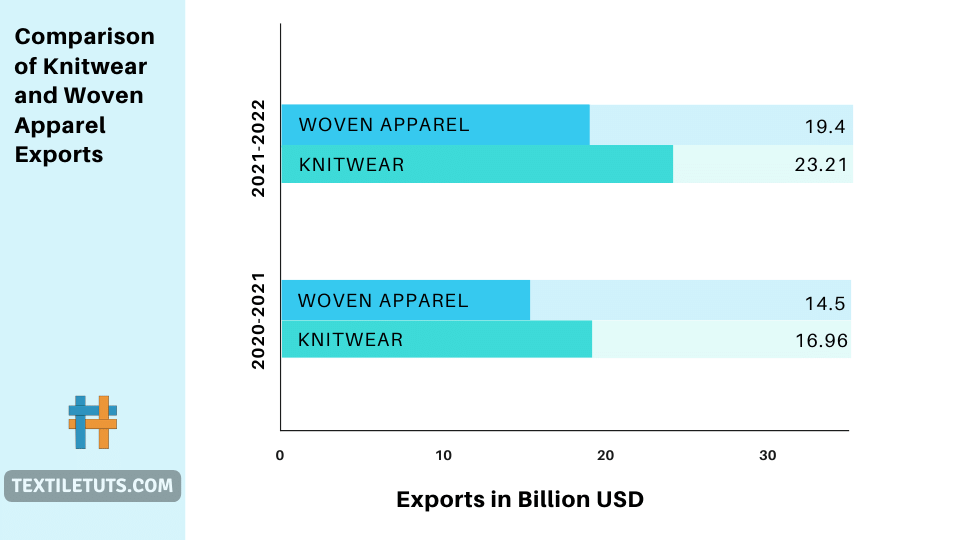
Knitwear exports grew by 5.29%, earning a total of $19.14 billion, while woven garment exports grew by 9.12%, earning $19.56 billion. Among knitwear products, T-shirts represented 41.71% of total knitwear exports, jerseys accounted for 13.42%, and pullovers made up 11.29%.
| Product Category | % Change in Exports |
|---|---|
| Knitwear | 36.88% |
| Woven Apparel | 33.82% |
Among woven garment products, trousers represented 24.27% of total woven garment exports, shorts accounted for 16.69%, and jackets made up 14.66%. Overall growth was driven by the country’s competitive labor costs, a workforce of approximately 4.1 million garment workers, and a business environment favorable to foreign investment.
| Product Category | Home Textile Exports (in million USD) in 2020-21 | Home Textile Exports (in million USD) in 2021-22 | % Change in Exports |
|---|---|---|---|
| Home Textile | 1132.03 | 1621.93 | 43.28% |
Factors Driving the Record-Breaking Growth of Garment Exports in Bangladesh 2021-2022
In FY2021-22, Bangladesh experienced record-breaking growth in garment exports as the global economy recovered from pandemic-induced contractions. Export earnings from RMG exceeded $42 billion, though rising production costs—including energy prices, raw material costs, and logistics expenses—compressed profit margins. Bangladesh’s average monthly minimum wage for garment workers was approximately $95-$190 USD during this period, significantly below competitor nations, maintaining cost competitiveness.
Woven garment exports increased by 33.82% while knitwear exports achieved 36.88% growth compared to FY2020-21, reflecting the robust rebound in global apparel demand.
1. Global Demand Post-Pandemic
The COVID-19 pandemic caused a substantial decline in demand for many products, including clothing and apparel. With vaccination efforts underway and countries gradually reopening their economies, consumer spending on fashion items rebounded sharply in 2021-2022. This surge in demand directly benefited Bangladesh’s garment manufacturers, resulting in higher export volumes and revenues across all major product categories.
2. Factory Closings in China and Vietnam
Rising labor costs in China—where average manufacturing wages reached $800-$1,000 USD per month—combined with stricter environmental regulations, prompted many international brands to relocate orders to lower-cost countries. Vietnam faced similar challenges with increasing wages and COVID-19-related factory shutdowns. Bangladesh benefited from this shift in global sourcing patterns, capturing market share as brands diversified their supplier bases away from China.
3. Price Hikes for Raw Materials Globally
Raw materials such as cotton and synthetic fibers experienced significant price increases due to global supply chain disruptions caused by COVID-19. Cotton prices on the ICE Futures exchange rose to over $1.50 per pound in 2021, up from around $0.70 per pound in 2020. Bangladesh, as one of the largest low-cost garment producers, leveraged its scale to absorb input cost increases while maintaining competitive pricing for international buyers.
Challenges Bangladesh Faces in Further Expanding Its Garment Exports
Bangladesh has experienced strong growth in its garment industry over the past decades, becoming the world’s second-largest apparel exporter after China. However, the nation faces several challenges as it seeks to further expand its garment exports beyond the FY2021-22 record.
Competition from Other Low-Cost Producers
Bangladesh faces intense competition from other low-cost countries such as Vietnam and Cambodia in the global textile market. Vietnam’s garment workers earn approximately $200-$280 USD per month on average, while Cambodia’s minimum wage reached $194 USD per month in 2023. These countries offer competitive pricing that pressures Bangladesh to differentiate through quality, compliance, and speed-to-market rather than cost alone.
Increasing Labor Costs
Although labor costs remain relatively affordable in Bangladesh compared to Western nations, wages have increased significantly. The minimum wage for garment workers rose from $95 USD per month in 2018 to $204 USD per month by 2024, driven by inflation and advocacy for improved working conditions. These rising labor costs have increased production expenses, prompting factories to invest in automation and productivity improvements to maintain competitiveness.
| Country | Monthly Garment Worker Wages (USD) | Key Notes |
|---|---|---|
| Bangladesh | $95–$204 | Rose from $95 (2018) to $204 (2024) |
| Vietnam | $200–$280 | Higher wages but stronger automation adoption |
| Cambodia | $194+ | Minimum wage set by government annually |
| China | $800–$1,000 | Highest wages; shifting to higher-value production |
High Tariffs for Exported Goods
Many importing countries impose high tariffs on Bangladeshi garments, with the U.S. maintaining tariff rates of 15-20% on many apparel categories from Bangladesh. The European Union’s Everything But Arms (EBA) arrangement provides duty-free access for Bangladesh’s garments, but post-2023 monitoring of labor standards has created uncertainty around this preferential access.
Global Economic Factors
Global economic conditions significantly impact Bangladesh’s apparel exports. Inflationary pressures in major markets—including the U.S. and EU—led some brands to reduce order volumes in 2023. Additionally, recession concerns prompted buyers to maintain lower inventory levels, resulting in shorter order cycles and reduced order sizes. These economic headwinds contributed to a decline in Bangladesh’s RMG exports to $38.14 billion in FY2022-23, down from the $42.61 billion record.
Strategies for Bangladeshi Companies to Capitalize on This Growth Opportunity
To sustain growth in garment exports, Bangladeshi companies must adopt strategies that differentiate them from other low-cost producers such as Vietnam and Cambodia. The following approaches will help the industry maintain its competitive edge.
1. Increase Efficiency and Productivity
Efficiency and productivity improvements can be achieved by modernizing production processes with automation technology, investing in labor-saving machinery, and improving supply chain management systems. factories implementing lean manufacturing principles have reported productivity gains of 15-25%, reducing per-unit costs and increasing output capacity without proportional labor cost increases.
2. Invest in Quality Control
By implementing rigorous quality control systems aligned with international standards such as ISO 9001 and OEKO-TEX certification, Bangladeshi firms can differentiate their products from competitors. Quality certifications provide verifiable proof of product safety and manufacturing excellence, enabling producers to command premium pricing from environmentally and socially conscious brands.
3. Invest in Branding and Marketing
Investing in branding and marketing establishes Bangladesh’s garment industry as a premium sourcing destination rather than merely a low-cost option. Building a recognized national brand identity—highlighting compliance achievements, workforce skills, and production capabilities—helps attract higher-value orders from international fashion brands seeking reliable long-term suppliers.
4. Develop Strong Relationships with Buyers
Building strong, long-term relationships with international buyers is essential for securing stable order volumes. Regular communication, transparent reporting, and consistent delivery performance foster buyer trust, resulting in preferential order allocation and more favorable payment terms. Suppliers with established buyer relationships reported 20-30% higher order retention rates during market downturns.
5. Offer Innovative Products
Bangladesh’s garment industry must develop innovative products that stand apart from competitor offerings. Developing new fabric blends, utilizing unique design prints, and creating customized garments for specific markets—including sustainable and eco-friendly product lines—opens higher-margin revenue streams. Investing in advanced manufacturing technologies such as 3D fitting and digital prototyping reduces sample development time by up to 60%, enabling faster response to market trends.
By offering differentiated products and embracing sustainability—including eco-friendly dyes, water-efficient production processes, and recycled materials—Bangladeshi firms can capture market share in the growing premium and sustainable fashion segments.
Comparison of RMG Exports in Bangladesh, India, Pakistan, and China (2021-2022)
The following table compares ready-made garment (RMG) export performance across four major textile-exporting nations for fiscal year 2021-2022.
| Country | RMG Export Earnings (FY 2021-22) |
|---|---|
| Bangladesh | $42.613 billion |
| India | $8.127 billion |
| Pakistan | $19.33 billion |
| China (First 8 Months) | $220.302 billion |
Bangladesh’s RMG exports increased by 35.47% to $42.613 billion in FY2021-22—the highest percentage growth among the four countries. Pakistan recorded textile exports worth $19.33 billion, contributing approximately 61% of the country’s total exports. India’s RMG exports stood at $8.127 billion, showing growth of 10.8% over the previous fiscal year.
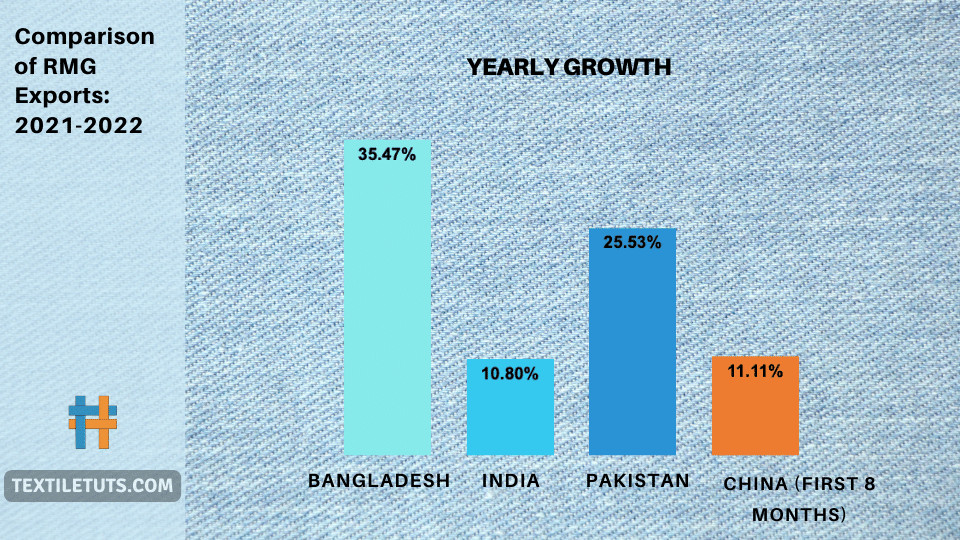
China’s RMG exports reached $143.361 billion for the full year, with an annual growth rate of 16.2%. Despite Bangladesh’s impressive growth, China maintained a commanding lead as the world’s largest apparel exporter, with annual exports approximately 3.4 times Bangladesh’s total RMG export value.
India’s RMG exports of $8.127 billion reflected a 10.8% year-over-year increase, demonstrating steady growth in the competitive South Asian market. Bangladesh’s superior growth rate of 35.47% highlighted its growing competitiveness in the global garment trade.
How the Record High Garment Exports in Bangladesh Affected the Garment Bag Market for Storage and Protection
The record high garment exports in Bangladesh have positively impacted the garment bag market for storage and moth protection. Increased production volumes and longer supply chains mean more garments require protective storage solutions during transit and distribution. Consumers seeking to protect their clothing investments have driven demand for high-quality garment bags designed for moth protection and long-term clothing storage.
Conclusion
Bangladesh’s garment exports experienced remarkable success in the 2021-2022 fiscal year, reaching a record $42.61 billion in RMG exports—a 35.47% increase year-over-year. The industry’s growth was fueled by abundant labor, expanding manufacturing capacity, and increasing global demand for affordable apparel. Despite challenges including rising labor costs, competition from Vietnam and Cambodia, and global economic headwinds, Bangladesh maintained its position as the world’s second-largest garment exporter.
The record-breaking performance of FY2021-22 created significant opportunities for Bangladeshi companies to strengthen their global presence. While subsequent years saw export values decline to $38.14 billion (FY2022-23) and $36.15 billion (FY2023-24) due to global economic pressures, the industry demonstrated resilience with a partial recovery to $39.35 billion in FY2024-25. With continued focus on productivity improvement, quality certification, and product innovation, Bangladesh’s garment sector is well-positioned for sustained growth in the competitive global apparel market.
The future of Bangladesh’s garment exports depends on the industry’s ability to balance cost competitiveness with higher wages, embrace sustainable manufacturing practices, and move up the value chain toward premium product segments.
REFERENCES:
- Bangladesh Garment Manufacturers and Exporters Association (BGMEA). (2022). Export Performance Data FY 2021-22. BGMEA.
- Export Promotion Bureau (EPB), Bangladesh. (2022). Export Data 2021-2022. Government of Bangladesh.
- International Labour Organization (ILO). (2023). Bangladesh Minimum Wage for the Garment Sector. ILO.
- McKinsey & Company. (2023). State of the Fashion Industry Report. McKinsey.


