
What is Interlining | Types of Interlinings

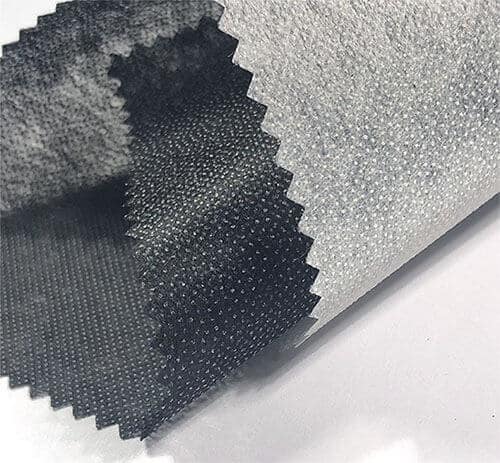
What is Interlining? A Complete Guide to Textile Interlining Types and Applications
Interlining is a piece of fabric placed between the shell fabric and lining of a garment to provide reinforcement, shape retention, and improved hand feel. It is an essential internal component in tailored garments — commonly used in collars, cuffs, waistbands, facings, and jacket fronts — and is produced from cotton, wool, nylon, polyester, or blended yarns through woven, knitted, or nonwoven bonding processes.
What is Interlining? — Definition and Role in Garment Construction
Interlining is a textile layer positioned between the outer shell fabric and the lining of a garment. Its primary functions are to provide reinforcement, maintain shape under stress, improve the hand feel of the finished laminate, and extend the service life of the garment component. Interlinings are manufactured from filaments of cotton, nylon, polyester, wool, or blended combinations, and the resulting fabric is produced by weaving, sewing, or felting (nonwoven) methods. Each interlining type offers distinct performance characteristics suited to specific end-use requirements.
Garment segments that are traditionally fused or sewn with interlining include:
- Skirts and pants: belts, overlap, underlap;
- Blouses, shirts, and dresses: collars, facings, cuffs;
- Coats and jackets: fronts, facings, collars, pocket folds, pocket openings, sleeves, and hem areas.
A single type of interlining is typically used in blouse and dress components, selected based on the face fabric characteristics. Two distinct interlining types are used in skirts and pants: a softer interlining to allow flexibility around closures and a harder, thicker interlining to provide rigid support for the belt. A minimum of three interlining types are used in coats, selected according to the size, function, and position of the face fabric segment. The fronts and facings of women’s jackets use hard interlining for structural support, while collars and armhole sections use softer interlining for comfort and movement. The lightest interlining is used in the upper back, rear armholes, sleeves, and coat hems. Fusible interlining application accounts for at least 90% of interlining use in modern garment production, particularly in collars, cuffs, belts, epaulettes, and plackets.
Why Use Interlining? — Key Functional Benefits in Apparel
Interlining serves four primary functions in garment construction:
- Quality and support: Interlining provides essential reinforcement to garment components that bear stress or require shape maintenance, such as waistbands and collar stands.
- Composite reinforcement: When fused to the outer shell fabric, interlining forms a composite laminate that stabilizes the shell against distortion under load or pressure.
- Improved aesthetics and hand feel: The fused laminate achieves a superior tactile quality and visual drape compared to the shell fabric alone.
- Shape retention and longevity: Interlining helps the combined component retain its shape during wear, laundering, and dry cleaning, significantly extending the service life of the garment.
Interfacing vs Lining vs Interlining vs Underlining
These four textile terms describe distinct construction layers that are hidden from view when a garment is worn, yet each serves a specific structural and functional purpose.
Interfacing is a supplementary fabric used in areas requiring greater strength than the base fabric weight alone provides. Interfacing is found in belts, clothing collars, sleeve heads, closures, and hem areas. It functions as a fabric stiffener agent. In tailored garments, interfacing may cover the entire garment section, and more than one type is used within a single garment. Felt can be used as a substitute for interfacing in certain non-structural applications.
The lining is a separate inner fabric layer used primarily to conceal internal construction details and to allow the garment to slide smoothly over other clothing. Lining fabrics are typically slippery and silky in texture. The lining is constructed separately from the garment shell and attached at the facing or hem by machine or hand stitching.
Interlining is an additional layer inserted between the shell fabric and the lining to create thermal insulation, body, and loft. In winter coats, interlining may consist of a quilted or batting layer constructed from wool, cotton, or synthetic insulation. Interlining can be permanently sewn into the garment or made removable for laundering flexibility.
Underlining is a fabric layer attached to the wrong side of each shell fabric piece before garment assembly. Underlining is used to make fabric opaque, increase body, or add warmth. It is attached to each pattern piece individually and then all layers are processed together as a single unit during construction. Pattern markings are often transferred to the underlining rather than the fashion fabric to preserve the visible outer surface.
Types of Interlining — Classification by Application, Fabric, and Resin
Interlinings are classified across three primary dimensions: the method of application, the fabric construction type, and the resin coating used for fusible products. Each classification addresses a distinct performance requirement in garment manufacturing.
According to the Application
- Sewn interlining (non-fusible): Attached to shell fabric by stitching. Used where heat or pressure application is impractical or where specific performance requirements such as flame resistance must be met.
- Fusible interlining: Coated with a heat-activated resin that bonds to the shell fabric under controlled temperature and pressure. Accounts for approximately 90% of modern garment interlining applications due to speed, consistency, and cost efficiency.
According to Fabric Construction
- Woven interlining: Produced from interlaced warp and weft yarns. Provides high strength and stability, making it suitable for belt loops, outerwear plackets, and coat fronts. Thread density and weave structure (plain, twill, or crepe) determine stiffness and hand feel.
- Knit interlining: Manufactured by interlooping yarns to form a flexible, breathable fabric structure. Fusible knit interlinings are primarily used in knit garments where stretch and recovery properties are required. Circular and jersey knit fusible interlinings offer stretch and elastic recovery suitable for form-fitting apparel.
- Nonwoven interlining: Manufactured directly from fiber to fabric through bonding processes, without yarn interlacement. Nonwoven interlinings are produced from 100% polyamide or polyester fibers and are available in weights from 10 gsm to over 200 gsm, covering light blouse-weight to heavy coat applications. Bonding methods include thermal bonding, chemical (resin) bonding, and needlepunching.
According to Resin Properties
- Polyethylene (P.E.) coated interlining — common for apparel fusibles
- Polypropylene (P.P.) coated interlining — used in technical textiles
- Polyamide (P.A.) coated interlining — widely used in garment interlining due to its activation temperature range
- Polyester coated interlining — standard for medium-weight applications
- Polyvinyl Chloride (PVC) coated interlining — used in industrial and technical textiles
- Polyvinyl Alcohol (PVA) coated interlining — water-soluble option for temporary bonding applications
Key Interlining Specifications at a Glance
The following specifications are critical for selecting the correct interlining type and application method for a given garment production context.
| Specification | Value / Range | Notes |
|---|---|---|
| Fusible interlining market share | ≥ 90% of modern garment production | Dominant due to speed, consistency, and cost efficiency |
| Polyamide (P.A.) activation temperature | 130°C – 160°C | Most widely used resin in garment interlining |
| Typical fusing pressure | 0.5 – 3 bar | Applied during heat-press bonding cycle |
| Typical fusing dwell time | 10 – 20 seconds per panel | Heat and pressure bonding cycle duration |
| Nonwoven weight range | 10 gsm – 200+ gsm | From light blouse-weight to heavy coat and industrial applications |
| Nonwoven base fibers | 100% polyamide, 100% polyester, or polyester-cellulose blends | Fiber choice affects hand feel, durability, and thermal resistance |
| Interlining types used in coats | Minimum 3 distinct types per garment | Selected by size, function, and position of face fabric segment |
Sewn Interlining — Non-Fusible Applications and Advantages
Sewn interlining has been used in garment construction since antiquity. It is produced by combining multiple layers of fabric and stitching them together, followed by treatment with starch or a stiffening agent to enhance its body and resilience. Sewn interlining is attached to the shell fabric through sewing rather than thermal bonding.
The performance characteristics of sewn interlining depend on the type of fibers used, the fabric construction method, the thickness and weight of the interlining, and the finishing treatment applied. The quality of sewn interlining in a garment is determined by the precision and consistency of the stitching that attaches it to the shell fabric.
The production process for sewn interlining is significantly more time-intensive than fusible interlining application. Sewn interlining use has declined in mainstream garment production due to higher labor costs and longer production cycles. However, sewn interlining remains the only viable option for flame-resistant garments and applications where heat bonding would damage the face fabric or the interlining itself.
Common applications for sewn (sew-in) interlining include:
- Flame-resistant garments for firefighters and industrial workers exposed to high heat environments.
- Protective clothing for workers in steel rerolling mills and metal fabrication facilities.
- Embroidery backing fabric used in machine embroidery to stabilize fabric during high-speed stitching.
Advantages of Sewn Interlining
- The only interlining type approved for flame-resistant protective garments where heat-bonded materials cannot withstand service conditions.
- Simple and straightforward attachment procedure requiring basic sewing equipment.
- No specialized thermal bonding equipment is required.
- Effective for use in steel mills, rerolling plants, and other high-heat industrial environments.
Disadvantages of Sewn Interlining
- Bonding quality is lower than fusible interlining when measured by peel strength and durability after laundering.
- Not suitable for high-volume production runs due to labor intensity.
- Not readily available as a standard stock product — must be custom-made or sourced from specialty suppliers.
- Production lead time is significantly longer due to the additional sewing operation.
- Higher labor cost per unit due to the skilled work required for consistent stitching.
Woven Interlining — Structural Support for Tailored Garments
Woven interlinings were first introduced over 100 years ago to reinforce coats, cloaks, and cap components. Early woven interlinings were primarily 100% cotton fabrics treated with starch for stiffness and were exclusively non-fusible. The stiffness, irregular hand feel, and poor dimensional stability after washing led to the development of fusible woven interlinings.
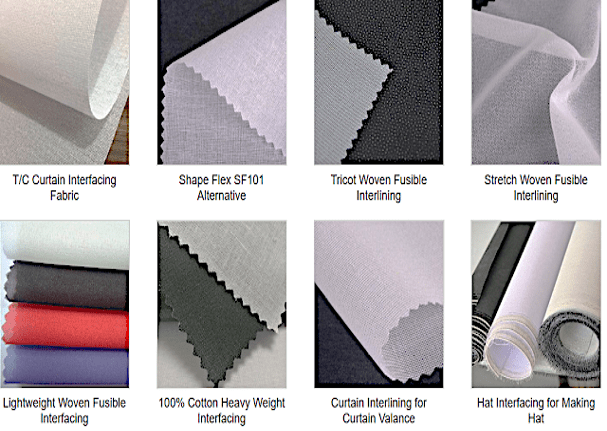
The modern fusible woven interlining process applies a layer of heat-activated resin coating to the interlining fabric, which bonds to the shell fabric under controlled heat and pressure to form a stable composite. This composite supports the outer shell, improving the drape, shape, and structural integrity of the garment component.
Woven interlinings are primarily 100% cotton or cotton-blend constructions with thread densities selected to match the weight and stiffness requirements of the target application. Cotton-polyester blended interlinings address shrinkage concerns inherent to all-cotton constructions while providing a range of warp and weft combinations using rayon, texturized polyester, and wool yarns for varied hand feel and performance. The fusing machines used to apply woven fusible interlining use controlled temperature, pressure, and dwell time to achieve consistent bonding across the garment panel.
Advantages of Woven Interlining
- Woven interlining provides superior strength and dimensional stability, making it the preferred choice for belt loops, waistbands, and other load-bearing garment components requiring high tear strength and shape retention.
- Woven interlinings are available in plain, twill, herringbone, and crepe weave structures. Twill weaves offer good drape with moderate stiffness; plain weaves provide maximum stability for heavy outerwear.
- Texturized polyester yarns are used to add volume, body, and a natural hand feel to the fused composite without adding excessive weight.
- The main limitation of woven interlining is its higher cost compared to nonwoven alternatives, making it less suitable for budget or fast-fashion garments where knitted and nonwoven interlinings have largely replaced it.
Knitted Interlining — Flexible Support for Stretch and Knitwear
The primary limitation of woven interlining is its relative inflexibility, weight, and stiff hand feel when used in garments requiring softness and stretch. Knitted interlinings address these shortcomings through loop-structured fabric construction that provides controlled elasticity, lightweight feel, and a soft hand while still delivering body and stability to the garment.
Knitted fusible interlinings are produced using fine texturized (bulked) fibers to maintain a lightweight and soft hand feel in the finished laminate. They are predominantly used in high-value garments such as women’s blazers, coats, and high-fashion knitwear where drape, comfort, and aesthetic quality take priority over maximum stiffness. The loop structure of knitted fabrics allows for inherent stretch and recovery properties that match the elastic behavior of knit shell fabrics.
Nonwoven Interlining — Versatile Lightweight Reinforcement
Nonwoven interlining is manufactured directly from loose fibers that are bonded together through thermal, chemical, or mechanical processes — without any yarn weaving or knitting stage. This direct-from-fiber-to-fabric production path significantly reduces manufacturing cost and is the primary reason for the widespread adoption of nonwoven interlinings across all apparel segments.
The absence of yarn interlacement means nonwoven fabrics lack the inherent strength of woven or knitted structures. To compensate, manufacturers use a variety of bonding methods to confer the required tensile strength and dimensional stability:
- Thermal bonding: Fibers are heated to partially melt and fuse at crossover points. Polyamide and polyester fibers are commonly used for thermal nonwovens.
- Chemical (resin) bonding: A liquid binder resin is applied to the fiber web and cured, creating bonds at fiber intersections.
- Needlepunching: Barbed needles mechanically entangle fibers to create a coherent fabric structure without heat or chemicals.
Nonwoven interlinings are the most versatile product category, available in weights ranging from 10 gsm (grams per square meter) for sheer blouse applications to over 200 gsm for heavy coat and industrial textile uses. The base fiber composition typically includes 100% polyamide, 100% polyester, or polyester-cellulose blends, with the bonding method selected to match the performance requirements of the target application. Nonwoven cotton and cotton-blend products are also used as insulated batting fabric in quilting and home textile applications.
Fusible Interlining vs Non-Fusible Interlining — A Direct Comparison
The table below compares the key performance, production, and application characteristics of fusible (bonded) interlining and non-fusible (sewn) interlining to guide material selection decisions in garment manufacturing.
| Parameter | Fusible Interlining | Non-Fusible (Sewn) Interlining |
|---|---|---|
| Production time | Less time-consuming; heat and pressure bonding takes 10–20 seconds per panel | More time-consuming; requires sewing operation per attachment point |
| Labor cost | Lower; minimal skill required for machine fusing | Higher; requires skilled operators for consistent stitching |
| Operating skill requirement | Anyone can operate a fusing press with basic training | Experienced garment worker required for quality stitching |
| Bond quality consistency | Consistent across each batch; controlled by machine parameters | Varies with fiber type, fabric construction, interlining thickness, finishing treatment, and operator skill |
| Market availability | Widely available in standard and custom specifications | Limited stock availability; often requires custom production |
| Attachment method | Heat and pressure activation of resin coating | Sewn stitching through all layers |
| Suitable fabric types | Woven, knitted, or felted fabrics tolerant of heat press temperatures | All fabric types including heat-sensitive materials |
| Production volume | Suitable for high-volume production runs | Limited to low-volume and specialty production |
| Temperature requirement | Heat press temperature typically 130°C – 160°C for polyamide-coated interlinings | No heat required during application |
| Equipment | Fusing press or heat press machine required | Standard sewing machine; no specialized equipment required |
Can Interlining Be Used as a Double-Sided Fabric Tape? — Practical Answer
Interlining is not recommended as a substitute for double-sided fabric tape in garment construction. The best double-sided fabric tape for fabric is specifically formulated for rapid, mess-free temporary bonding during fitting and hem adjustments. Fusible interlining requires a heat press with controlled temperature and pressure (typically 130°C – 160°C and 0.5 – 3 bar for 10 – 20 seconds), making it impractical for quick repairs or on-body alterations. For temporary garment modifications, fabric tape provides a significantly faster and simpler solution.
This comprehensive guide has covered the definition, classification, functional benefits, and practical applications of interlining in garment construction. Understanding the distinctions between woven, knitted, and nonwoven interlinings — and between fusible and sewn attachment methods — enables informed material selection for both apparel construction and textile engineering applications.
References
- Bhattacharya, H., & Ajgaonkar, S. (2015). Garment Manufacturing Technology. Elsevier Science. https://www.sciencedirect.com/book/9781782422327/garment-manufacturing-technology
- Carr, H., & Latham, B. (1994). The Technology of Clothing Manufacture (4th ed.). Wiley-Blackwell. https://www.wiley.com/en-us/Carr+and+Latham%27s+Technology+of+Clothing+Manufacture%2C+4th+Edition-p-9781405161985


