
Desizing Process: Acid vs Enzymatic

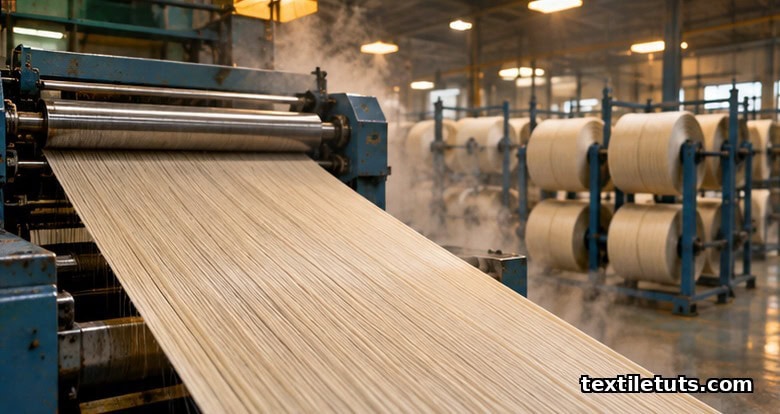
Acid desizing uses dilute mineral acid (typically 0.5 to 1.0% sulfuric or hydrochloric acid) at 40 to 60 °C for 30 to 60 minutes, while enzymatic desizing uses α-amylase at pH 5.5 to 7.5 and 50 to 85 °C for 15 to 60 minutes and now accounts for the majority of cotton-woven pretreatment lines worldwide. The choice between these two methods decides starch removal efficiency, cellulose damage risk, effluent load, and overall pretreatment cost; enzymatic systems have displaced acid steeping in most modern mills because of their specificity, lower environmental footprint, and compatibility with continuous process windows.
This article explains what desizing is, how acid and enzymatic desizing attack the size film, the operating windows that each method needs, and a head-to-head comparison that covers starch removal, tensile-strength retention, water use, and effluent quality.
What Desizing Is and Why It Matters
Desizing is the first wet step in textile pretreatment, intended to remove the size film that weavers apply to warp yarns before weaving. Without this step, the size coat blocks scouring chemicals from the fiber, stops hydrogen peroxide from bleaching evenly, stops dye molecules from reaching cellulose, and creates resist marks during printing. On cotton warps the size is almost always starch-based (native starch, modified starch, or starch/PVA blends), so a successful desizing stage converts the insoluble starch film into water-soluble sugars or shorter dextrins that can be washed off.
The downstream cost of a poor desizing run is easy to measure. Residual starch above roughly 1.0% on weight of fabric (owf) shows up as mottled bleaching, uneven dye uptake, and lower color-fastness ratings, especially after oxidative bleach. AATCC Test Method 101 (Starch in Textiles) and ASTM D4265 (Standard Guide for Assessing Starch in Textiles) are the two reference documents most mills use to grade their own desizing efficiency in-house; the widely used TEGEWA rating (1 to 9) is then applied as a go/no-go gate before the fabric moves into the scouring/bleaching range.
Acid Desizing: How a Mineral Acid Attacks the Size Film
Acid desizing is the older route and works by hydrolyzing the glycosidic bonds in starch with dilute mineral acid. The recipe is straightforward: 0.5 to 1.0% sulfuric acid (or 0.5 to 1.5% hydrochloric acid), 40 to 60 °C, and 30 to 60 minutes of contact time, followed by a hot wash at 80 to 95 °C to flush the breakdown products.
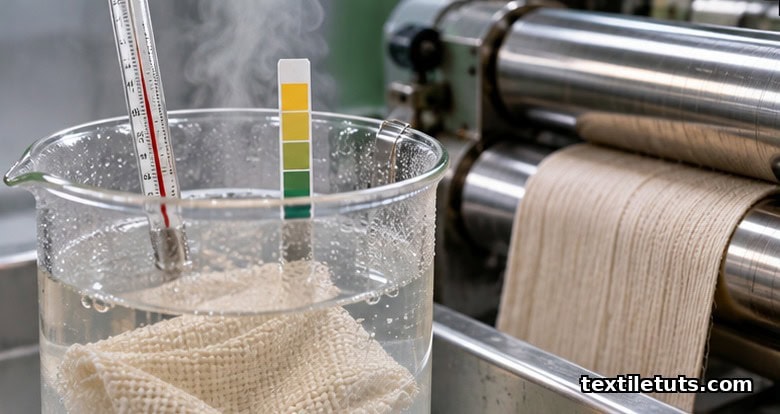
The reaction is fast and inexpensive, which is why acid desizing survived so long in the industry. The downside is selectivity. Mineral acid hydrolyzes starch aggressively but it also hydrolyzes cellulose if the temperature drifts above 60 °C, the dwell time stretches beyond 60 minutes, or the acid concentration rises past 1.0%. In practice this translates to tensile-strength loss in the warp of 5 to 15%, depending on cotton quality and any previous mercerizing pass. Acid steeping is also poor on synthetic sizes such as poly(vinyl alcohol) (PVA), carboxymethyl cellulose (CMC), and acrylic copolymers, so mills running modern size formulations usually combine it with oxidative desizing or move directly to enzymes.
Effluent is the other price tag. An acid desizing bath leaves a high COD load (often 2,500 to 4,500 mg/L) and low pH (1.5 to 3.0), which forces neutralization and, in many jurisdictions, a separate decolorization stage before discharge.
Enzymatic Desizing: How α-Amylase Breaks Starch Down
Enzymatic desizing uses α-amylase, an enzyme that cleaves the α-1,4 glycosidic bonds inside the starch chain and converts the polymer into maltose, maltotriose, and shorter dextrins. Because the active site of the enzyme fits the glucose helix of starch, the reaction is highly selective: starch is hydrolyzed while cellulose is left untouched, and the process runs at near-neutral pH.
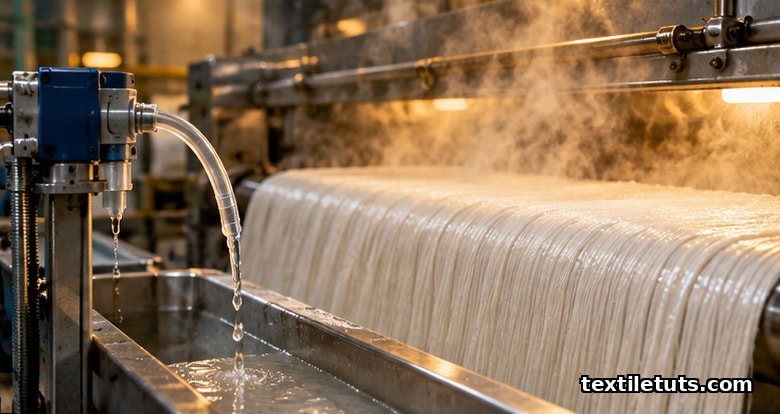
Commercial α-amylases for textile use fall into two main operating windows. Conventional bacterial amylases run at pH 6.0 to 7.5 and 50 to 70 °C, while high-temperature (HT) amylases are stable up to 85 to 90 °C and tolerate the padding liquor temperatures used on continuous pretreatment ranges. Modern amylases also tolerate small amounts of Ca²⁺ that stabilize their tertiary structure, so the bath usually includes 0.05 to 0.2 g/L of calcium chloride or calcium acetate. Typical dose is 0.5 to 3.0 g/L of enzyme (activity-dependent), and contact time is 15 to 60 minutes depending on fabric loading and process format (batch jet, winch, or pad-steam).
A few process points are worth remembering. Pad-steam runs often steam the fabric at 100 to 110 °C for 2 to 5 minutes after impregnation to drive the reaction to completion; the TEGEWA score on such ranges routinely lands at 8 to 9, which corresponds to a residual starch level below 0.5% owf. The bath’s effluent shows COD in the 600 to 1,200 mg/L range and pH near neutral, so most mills can route enzymatic desizing liquor to a standard biological wastewater plant without neutralization. Enzymes are also biodegradable themselves, so the spent bath can break down further in the effluent line.
Acid vs Enzymatic Desizing: Side-by-Side Comparison
| Property | Acid desizing | Enzymatic desizing |
|---|---|---|
| Active chemistry | 0.5 to 1.0% H2SO4 or HCl | α-amylase, 0.5 to 3.0 g/L |
| Operating pH | 1.5 to 3.0 | 5.5 to 7.5 |
| Operating temperature | 40 to 60 °C | 50 to 85 °C (HT amylases up to 90 °C) |
| Contact time | 30 to 60 min | 15 to 60 min (pad-steam 2 to 5 min at 100 to 110 °C) |
| Residual starch on cotton | 0.5 to 1.5% owf (TEGEWA 6 to 8) | 0.1 to 0.5% owf (TEGEWA 8 to 9) |
| Cellulose damage | Tensile loss 5 to 15% in warp if miscontrolled | Negligible when pH and temperature stay in window |
| Effect on synthetic sizes (PVA, CMC, acrylic) | Poor; leaves size film | Poor to moderate; needs oxidative co-treatment for full removal |
| Effluent COD | 2,500 to 4,500 mg/L | 600 to 1,200 mg/L |
| Effluent pH | 1.5 to 3.0 (needs neutralization) | 5.5 to 7.5 (dischargeable with bio-treatment) |
| Water use | Higher (multiple rinses for acid removal) | Lower (single hot-wash after enzyme step) |
| Energy | Lower bath temperature | Higher bath temperature; HT amylases need accurate control |
| Typical cost drivers | Cheap acid, neutralization chemicals, longer rinse | Enzyme cost (USD 1.5 to 5 per kg fabric), tighter process control |
| Operator skill required | Moderate | Moderate to high (pH, temperature, Ca²⁺ window) |
| Process window fit | Batch steeping lines | Batch, pad-batch, pad-steam, continuous ranges |
Process Parameters and How to Optimize Either Route
For acid desizing, three variables carry most of the risk: acid concentration, bath temperature, and contact time. The safest operating point is 0.6 to 0.8% H2SO4, 50 to 55 °C, and 30 to 45 minutes on cotton. Above 60 °C the cellulose hydrolysis rate climbs faster than the starch hydrolysis rate, so the tensile-strength penalty compounds quickly; below 40 °C the starch breakdown slows and TEGEWA scores typically slip into the 5 to 6 range. Mills that still run acid desizing also add a 0.5 to 1.0 g/L non-ionic wetting agent to help the acid reach the size film, followed by a 90 to 95 °C wash to flush the dextrins off.
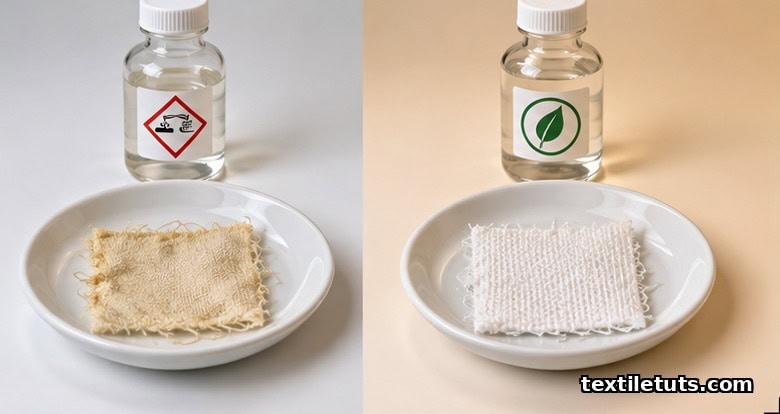
For enzymatic desizing, the optimization looks different. The three load-bearing variables are enzyme activity, bath temperature, and calcium availability. Choose the commercial α-amylase whose activity-temperature-pH window matches the fabric format (bacterial amylase for jet/winch at 55 to 70 °C; HT α-amylase for pad-steam at 80 to 90 °C); dose it at the minimum level that hits TEGEWA 8 to 9 in 15 to 30 minutes; add 0.1 g/L Ca²⁺ if the process water is below 50 ppm hardness; deactivate the enzyme with a 2-minute hot wash at 90 to 95 °C after the dwell. Run pH and temperature logs continuous; a 0.5-unit pH drift or a 5 °C drop costs about 25% of the enzyme’s working activity. Pretreating the bath with a non-ionic wetting agent (1.0 to 2.0 g/L) gives faster fabric wetting, which alone can lift TEGEWA scores by one full grade on tightly sized warps.
Where mills still see mixed fabric packages (cotton warp sized with starch/PVA blends, for example), the practical answer is oxidative desizing with a subsequent enzyme step, or a single pad-steam oxidative-enzyme combination; this is discussed in detail in the textile pretreatment literature reviewed in the references below.
Frequently Asked Questions
Which is better for cotton woven fabric, acid or enzymatic desizing?
For cotton warp sizing, enzymatic desizing with α-amylase is the standard recommendation in modern mills. It removes starch to 0.1 to 0.5% owf (TEGEWA 8 to 9), leaves cellulose tensile strength intact, and discharges a low-COD, near-neutral effluent. Acid desizing is kept as a fallback for heavy sizings or for synthetic size packages where cost outweighs effluent considerations.
What are the operating pH and temperature for enzymatic desizing?
Conventional bacterial α-amylase runs at pH 6.0 to 7.5 and 50 to 70 °C; high-temperature α-amylases run at pH 6.0 to 7.0 and 70 to 90 °C. Bath pH outside the 5.5 to 7.5 window deactivates the enzyme, and a temperature drop of 5 to 10 °C reduces activity by roughly 25 to 40%.
Does acid desizing damage cotton fabric?
Yes, when temperature rises above 60 °C, concentration climbs past 1.0%, or contact time stretches past 60 minutes. Under miscontrolled conditions, tensile-strength loss in the warp can reach 5 to 15%, with the risk of acid-catalyzed cellulose hydrolysis. Operating at 0.6 to 0.8% H2SO4 and 50 to 55 °C for 30 to 45 minutes keeps the loss under 3%.
How do you test whether desizing worked?
The two primary in-mill methods are the TEGEWA visual rating against a starch-iodine scale (1 to 9, with 8 to 9 considered production-ready) and a quantitative starch test using AATCC Test Method 101 or the protocol in ASTM D4265. Both methods convert into the residual-starch percentage on weight of fabric used as the go/no-go gate before scouring.
What effluent treatment does each route need?
Acid desizing liquor typically needs pH neutralization with NaOH or Na2CO3, followed by coagulation-flocculation to drop the COD from 2,500 to 4,500 mg/L into a treatable range. Enzymatic desizing liquor is near-neutral and biodegradable, so it can usually go straight to a biological treatment plant with the rest of the pretreatment effluent.
References
- ISO. ISO 105-C09:2010, Textiles — Tests for colour fastness — Part C09: Colour fastness to domestic and commercial laundering (oxidative bleach response). International Organization for Standardization. Standardized washing protocol used downstream of any desizing stage to grade whether residual starch has caused uneven bleaching.
- AATCC. AATCC Test Method 97-2014, Extractable Matter in Textiles. American Association of Textile Chemists and Colorists. Bench-mark test used to characterize the size load on greige fabric before desizing.
- AATCC. AATCC Test Method 101-2019, Starch in Textiles: Detection by Fluorescence. American Association of Textile Chemists and Colorists. Field-friendly optical test for residual starch on the warp after desizing.
- ASTM. ASTM D4265-21, Standard Guide for Assessing Starch in Textiles. ASTM International. Defines qualitative and quantitative starch-detection methods tied to the TEGEWA scoring scale used in most mills.
- Hashem, M. M., El-Aref, A. T., and Ali, N. M. Enzymatic and oxidative desizing of cotton fabrics using α-amylase and persulfate systems. Journal of Natural Fibers, peer-reviewed evaluation of process conditions for combined desizing of starch-based warps.
- Singh, R., Kapoor, V., and Kumar, M. Sustainable enzymatic pretreatment of cotton: process parameters and effluent quality. MDPI Textiles. Documents the COD, BOD, and tensile-strength retention profiles of enzymatic vs acid desizing on production-scale cotton warps.
- Etters, J. N., and Husain, P. A. Alkaline pectinase bio-scouring and α-amylase bio-desizing of cotton. Textile Research Journal. Peer-reviewed study that quantified TEGEWA scores, residual starch, and fabric-strength retention under controlled lab and pilot-plant conditions.
Editorial by Shahrukh Islam, TextileTuts. Sources: ISO 105-C09 (2010), AATCC TM 97 (2014), AATCC TM 101 (2019), ASTM D4265 (2021), peer-reviewed work in the Journal of Natural Fibers, MDPI Textiles, and Textile Research Journal as cited.


