
Costing Sheet for Garments: Fabric, Trims, Labor


A garment costing sheet totals six line items (fabric, trims, labor, overhead, profit margin, and wastage) and typically resolves to an FOB price where fabric consumes 40–60% and labor (CM/CMT) consumes 20–35% of the total.
This breakdown is the working reference used by merchandisers, production teams, and buying houses before a purchase order is signed, because every line can be negotiated, sourced differently, or recalculated as fabric width, GSM, or labor minute value changes.
Below you will find what each line contains, how the percentages are derived in real factories, and a clean template you can copy into Excel.
What a Garment Costing Sheet Includes
A garment costing sheet is a structured price calculation, usually built in Microsoft Excel, that converts raw material inputs and process times into a final FOB (Free On Board) price per piece. Six cost lines always appear: fabric, trims and accessories, labor (direct and indirect), overhead, profit margin, and wastage allowance. Each line is shown as both a unit cost and a percentage of FOB so the buyer and the supplier can see where the price sits.
The standard format comes from the buyer’s tech pack and the supplier’s cost breakdown. Buying houses in Bangladesh, Vietnam, and India typically send a sheet with the fabric, trims, and CM (Cut and Make) price pre-filled and ask the factory to add overhead, profit, and freight. Independent factories reverse the process: they start from their internal cost and add a markup to reach the FOB quote.
Fabric Cost (40–60% of FOB)
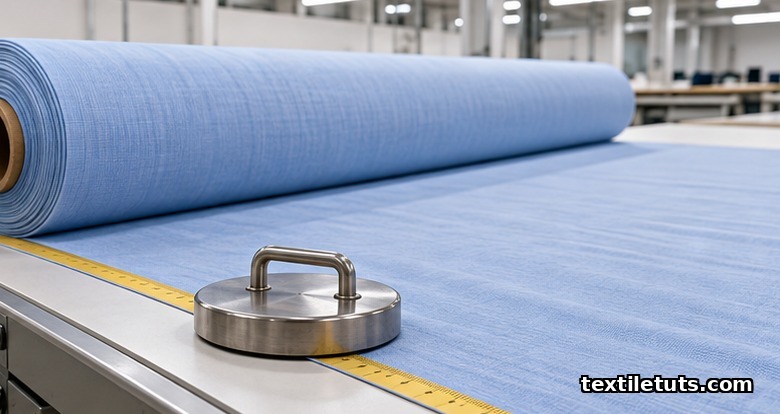
Fabric is the single largest cost driver in most woven and knit garments. For a basic men’s woven shirt using 0.60 m of 110 gsm cotton shirting at USD 2.20/m, fabric alone is USD 1.32, which lands at roughly 45% of a USD 2.95 FOB price. For a knit T-shirt using 0.65 kg of 160 gsm single jersey cotton at USD 4.50/kg, fabric is USD 2.93, about 55% of a USD 5.30 FOB. These ratios appear consistently across industry cost breakdowns and explain why fabric sourcing decisions move the total price more than any other line.
Fabric cost is calculated as:
Fabric cost = Consumption (m or kg) x Price per unit (USD/m or USD/kg) x (1 + wastage %)
Wastage on fabric typically runs 3–8% for woven fabric and 5–10% for knit, depending on marker efficiency, lay length, and fabric width. Marker efficiency on a 60-inch woven lay usually sits between 80% and 88%; anything below 78% signals poor marker planning. The garment-consumption calculators on TextileTuts (woven shirt and T-shirt) compute the consumption side of this equation for a given garment size and fabric width.
Three fabric variables shift the cost fastest: GSM (grams per square meter), fabric width, and unit price. A 10% increase in GSM adds roughly 10% to fabric weight and the same to fabric cost; a 5 cm wider fabric reduces consumption by 3–5%, depending on the garment’s panel widths. ASTM D3774/D3774M is the standard method most factories use to verify the GSM that flows into this calculation, and ISO 3801 covers the equivalent procedure for woven fabric on the international side.
Trims and Accessories Cost Breakdown
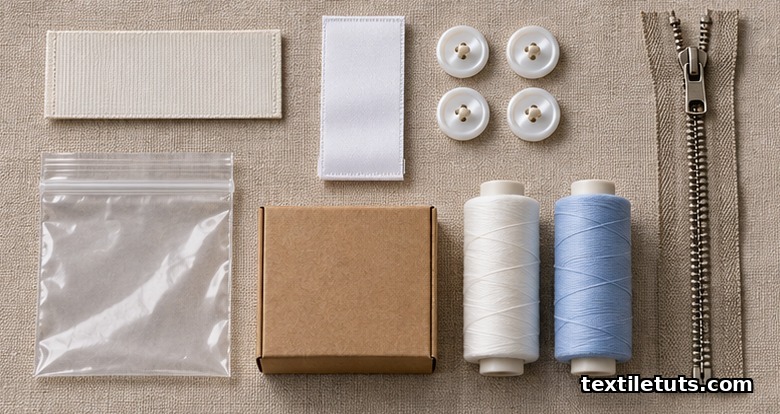
Trims and accessories include every non-fabric item sewn or attached to the garment: main label, care label, size label, price tag, hang tag, interlining, buttons, zippers, snaps, drawcords, elastic, thread, polybags, carton packaging, and any safety pins or stickers. For a basic woven shirt, trims typically land at 8–15% of FOB; for a pair of denim jeans with a metal zipper, rivets, and a leather patch, trims can reach 18–25%.
A useful trim sub-table looks like this:
| Trim Item | Unit | Unit Cost (USD) | Qty/Pc | Cost/Pc |
|---|---|---|---|---|
| Main label (woven) | pc | 0.012 | 1 | 0.012 |
| Care label (printed) | pc | 0.008 | 1 | 0.008 |
| Size label | pc | 0.006 | 1 | 0.006 |
| Buttons (4-hole plastic) | pc | 0.0035 | 8 | 0.028 |
| Polybag (LDPE) | pc | 0.020 | 1 | 0.020 |
| Carton (24 pcs/ctn) | ctn | 0.65 | 1/24 | 0.027 |
| Sewing thread (3 cones/garment) | cone | 0.85 | 0.045 | 0.038 |
The trim list is also where compliance costs hide: REACH-compliant dyes, OEKO-TEX 100 certified components, and CPSIA-tested components for children’s wear can add 2–6% to the trim total. Buyers typically ask for these certifications upfront, so including them in the costing sheet from the first revision prevents mid-production price disputes. AATCC TM88B-2018 is the seam-slippage method that often drives the trim-quality line item.
Labor Cost: CMT vs FOB
Labor cost is the second-largest variable and the line that moves most with country of origin. Two structures dominate the industry:
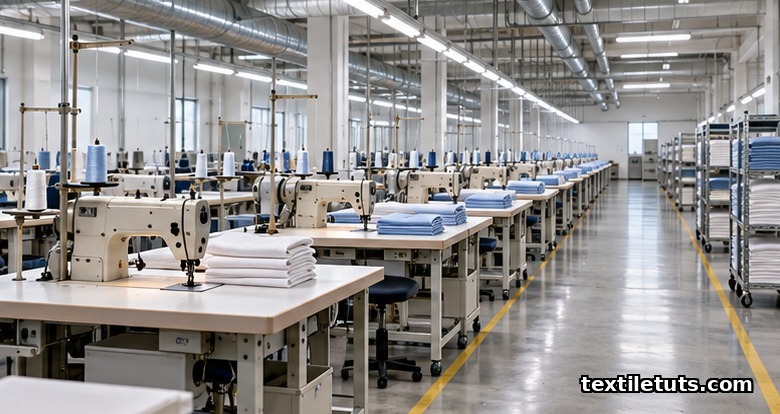
- CM (Cut and Make) or CMT (Cut, Make, Trim): the factory supplies only the labor; the buyer supplies fabric and trims. CM prices are quoted per piece and currently run between USD 0.80 and USD 1.50 for a basic woven shirt in Bangladesh, USD 1.10–2.00 in Vietnam, and USD 1.40–2.40 in China, according to recent ILO wage and industry data.
- FOB (Free On Board): the factory supplies fabric, trims, and labor, then ships to the buyer’s nominated port. FOB absorbs fabric, trim, and CM into a single per-piece price.
Labor minute value (LMV) is the standard unit behind CM pricing. The formula:
LMV = Total factory monthly wage bill / Total productive minutes per month
For a Bangladesh factory paying USD 120/month per operator and running 26 working days x 8 hours x 60 minutes x 80% efficiency, LMV lands near USD 0.10/minute. A basic men’s woven shirt consuming 18 minutes of direct labor then costs USD 1.80 in direct labor, plus 15–25% indirect labor (helpers, supervisors, QC) for a CM of about USD 2.10. These ranges are consistent with Better Work Bangladesh factory-level reporting on the readymade garment sector.
Overhead, Profit Margin, and the Final FOB Formula
Overhead covers everything that is not fabric, trim, or labor: factory rent, utilities, depreciation on sewing machines, maintenance, administration, and selling expenses. Overhead is usually calculated as a percentage of CM (15–35%) or as a percentage of total production cost (8–15%), depending on the factory’s accounting practice.
Profit margin is added last and is a function of risk, capacity utilization, and buyer relationship. New factories and tight-capacity seasons push margin to 8–12%; established factories running at full utilization may accept 4–6%. A buyer asking for a 90-day payment term instead of 30 days typically adds 1–2% to the margin.
The full FOB formula:
FOB = (Fabric + Trims + CM) x (1 + Overhead %) x (1 + Profit %) + Testing/Certification fees
For the basic woven shirt above, the calculation resolves to:
- Fabric: USD 1.32
- Trims: USD 0.18
- CM: USD 2.10
- Subtotal: USD 3.60
- Overhead (15% of CM): USD 0.32
- Subtotal with overhead: USD 3.92
- Profit (6%): USD 0.24
- FOB: USD 4.16
Notice how fabric and CM together account for 84.6% of the FOB. This concentration is why fabric sourcing and line efficiency improvements deliver more savings than trimming overhead. ISO 9001:2015 sets the quality management framework most factories use to track these cost variances across orders.
Costing Sheet Template (Copy-Ready)
The template below uses placeholder prices; replace them with your actual fabric quote, trim list, and CM rate.
| Line | Description | Unit | Qty/Pc | Rate | Amount (USD) | % of FOB |
|---|---|---|---|---|---|---|
| A | Fabric (110 gsm cotton shirting) | m | 0.60 | 2.20 | 1.32 | 31.7 |
| B | Trims and accessories | set | 1.00 | 0.18 | 0.18 | 4.3 |
| C | CM labor (direct + indirect) | min | 22 | 0.10 | 2.20 | 52.9 |
| D | Subtotal (A+B+C) | 3.70 | 88.9 | |||
| E | Overhead (12% of C) | 0.26 | 6.3 | |||
| F | Profit (6% of D+E) | 0.20 | 4.8 | |||
| G | FOB price | 4.16 | 100.0 |
Verify the GSM input against ISO 3801 (woven fabrics) or the equivalent ASTM D3774 method. The GSM line cascades through every other calculation, so a 5% error there propagates straight into the FOB. For knit, sample the fabric lot to ISO 3801 equivalents before locking the fabric rate.
Frequently Asked Questions
What is the difference between CM and CMT costing?
CM (Cut and Make) covers only cutting and sewing labor; the buyer supplies fabric and trims. CMT (Cut, Make, Trim) adds the trimming operation (thread trimming, inspection, finishing) but still excludes fabric and accessories. Full FOB pricing absorbs all three plus overhead and profit. Buyers using CM/CMT contracts must source fabric and trims separately and accept the supplier’s labor-only markup.
How do you calculate fabric consumption for a garment?
Consumption comes from the marker plan: total panel area (sum of all pattern pieces for one garment) divided by fabric width, plus allowance for lay loss and wastage. For a 60-inch woven lay with 85% marker efficiency and 5% wastage, the formula is (panel area / 0.85) x 1.05 divided by fabric width in meters. Marker planning software (Lectra, Gerber) automates this step and outputs the consumption directly.
What is a normal fabric-to-FOB ratio?
For woven shirts and trousers, fabric typically sits at 40–55% of FOB. For knit garments (T-shirts, polo shirts, leggings), fabric rises to 50–65% because knit is sold by weight, not length, and is more expensive per unit area. Children’s wear, with smaller panels and higher trim counts, often lands at 30–40% fabric share.
How do overhead and profit margin differ in a costing sheet?
Overhead is a real cost (rent, utilities, machine depreciation, administration, selling) recovered through a markup on CM. Profit margin is the factory’s return on the order and is negotiated based on capacity, buyer relationship, and payment terms. Both are expressed as percentages but only overhead corresponds to actual money spent on non-production activities.
How often should a garment costing sheet be updated?
Update the sheet whenever any input changes: fabric price, GSM, trim specification, CM rate, labor minute value, overhead allocation, or exchange rate. In practice, factories review active costing sheets monthly because cotton prices and minimum wage adjustments move every quarter in most sourcing countries. A 6-month-old costing sheet on the same style is rarely still accurate.
References
- International Organization for Standardization. ISO 3801:1977 Textiles — Woven fabrics — Determination of mass per unit length and mass per unit area. ISO, Geneva. Defines GSM testing for woven fabric used in cost-sheet consumption calculations.
- ASTM International. ASTM D3774/D3774M Standard Test Methods for Mass Per Unit Area (Weight) of Fabric. ASTM, West Conshohocken. Defines the GSM method most commonly referenced in apparel costing.
- American Association of Textile Chemists and Colorists. AATCC TM88B-2018 Test Method for Resistance to Yarn Slippage at the Sewn Seam. AATCC, Research Triangle Park. Performance benchmark driving seam-strength QC and the related compliance line in trim costing.
- International Organization for Standardization. ISO 9001:2015 Quality management systems — Requirements. ISO, Geneva. Framework most garment factories apply to track cost variances across orders.
- International Labour Organization. Global Wage Report 2022–23: The Impact of Inflation and COVID-19 on Wages and Purchasing Power. ILO, Geneva. Wage and labor-minute benchmarks for readymade garment sectors in Bangladesh, Vietnam, and China.
- ILO and International Finance Corporation. Better Work Bangladesh 2020 Compliance Synthesis Report. Better Work, Dhaka. Factory-level CM rates, working hours, and wage benchmarks for Bangladesh suppliers.
- World Bank Group. Bangladesh Development Update. World Bank, Washington DC. Sector data on Bangladesh RMG wages, productivity, and FOB trends.
Editorial by Kazi Sifat Muntasir, TextileTuts. Sources: ISO 3801:1977, ASTM D3774/D3774M, AATCC TM88B-2018, ISO 9001:2015, ILO Global Wage Report 2022–23, Better Work Bangladesh 2020, World Bank Bangladesh Development Update as cited.


