
Buyer-Seller Communication in Textile Trade

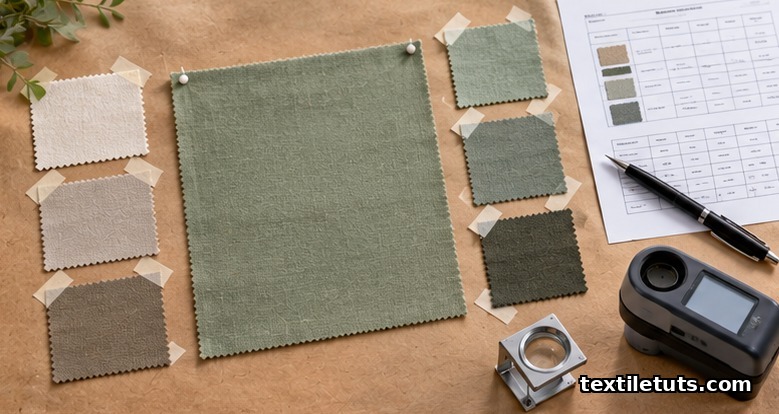
Buyer-seller communication in textile trade passes through 14 documented touchpoints (inquiry, sample, lab dip rounds, pre-production sample, pre-shipment inspection, and 9 intermediate approvals) governed by ISO 9001:2015 clauses 7.4 and 8.2, with every color decision anchored by an AATCC TM 173 CMC reading (tolerance ≤ 2.0) and every GSM reading conditioned per ASTM D1776 (24 hours at 20 ± 2 °C and 65 ± 2% RH).
When shade, hand feel, or GSM drifts beyond ±5% from the approved standard, roughly 60 to 70% of fabric transactions trigger a dispute that costs 30 to 45 days of lead time and 8 to 12% of order value, which is why merchandising teams treat the communication protocol as the highest-yield operational asset in sourcing.
This guide walks through the protocol from inquiry to delivery, the documents each stage produces, the lab tests that resolve ambiguity, and the negotiation mechanics that protect margin on both sides.
The 14 Communication Touchpoints of a Fabric Order
A standard woven or knit order between a buyer (brand, retailer, or importer) and a seller (mill, converter, or vertical supplier) passes through 14 communication checkpoints before bulk fabric is shipped. Each checkpoint produces a controlled artifact that becomes evidence if a dispute arises later.
- Inquiry and fabric specification sheet
- Price quotation and cost breakdown
- Sample request (greige, finished, or yarn-dyed)
- Lab dip or strike-off submission
- Lab dip approval or rejection (round 1)
- Lab dip resubmission (rounds 2 to 3 are common)
- Hand feel and dimensional-change report
- Pre-production sample (PPS) submission
- PPS approval and bulk fabric reservation
- Pre-production meeting notes (knitdown or weave plan)
- In-line inspection report (during weaving or knitting)
- Final inspection report (pre-shipment)
- Shipment authorization and shipping documents
- Post-shipment claim or acceptance
ISO 9001:2015 clause 7.4 (Communication) and clause 8.2 (Requirements for Products and Services) require that every stage above produces documented evidence, from the initial purchase order to the final commercial invoice. A merchandiser who skips any one of these stages loses the evidentiary trail that arbitrates a shade or hand-feel dispute.
Lab Dip and Strike-Off Communication: The AATCC Color-Difference Protocol
Color approval is the single most contested touchpoint in textile trade. The buyer submits a master standard (often a Pantone chip, a previously approved fabric swatch, or a buyer-supplied color target), and the seller submits lab dips dyed against that target.
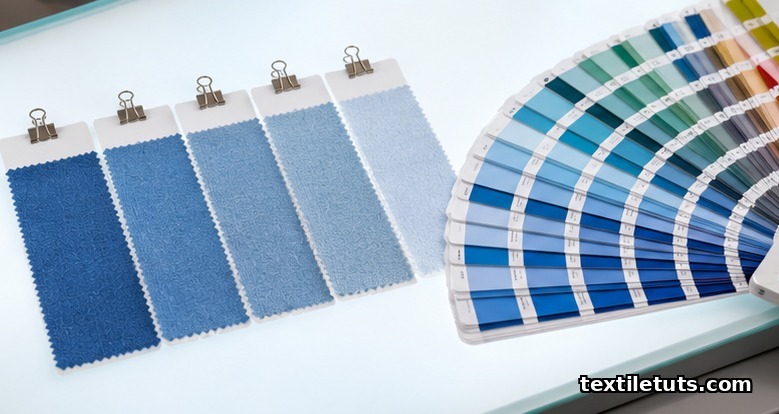
The difference is quantified under AATCC Test Method 173 (CMC), which expresses the visual color deviation as a single Delta-E (CMC) value. Industry tolerance is:
- Delta-E (CMC) ≤ 1.0: acceptable without comment
- Delta-E (CMC) 1.0 to 2.0: acceptable with minor comment
- Delta-E (CMC) > 2.0: reject and resubmit
Buyers and sellers often debate whether 1.5 is acceptable. The answer depends on the master standard’s age and the substrate: a cotton and polyester blend on a knit substrate tolerates up to 2.0 under side-by-side cabinet lighting at D65 (6500 K, per ISO 23603 / CIE S 012), while a solid shade on a woven silk tolerates only 0.8. The CIE standard illuminants D65, D50, and TL84 cover retail, print, and boutique viewing respectively, and a defensible lab dip submission always names the light source used.
Lab dips should arrive with four pieces of evidence: a documented light source, the substrate composition, the dye class used, and a digital spectrophotometer reading alongside the physical swatch. A submission without all four opens the door to subjective dispute that no amount of follow-up email can close.
GSM Tolerance, Shrinkage, and the Hand-Feel Conversation
GSM (grams per square meter) is the most contested physical property in fabric communication. The buyer’s tech pack specifies a target (e.g., 180 GSM for a single-jersey knit) plus a tolerance (typically ±5%). The mill’s shipment must fall within tolerance or trigger a claim.
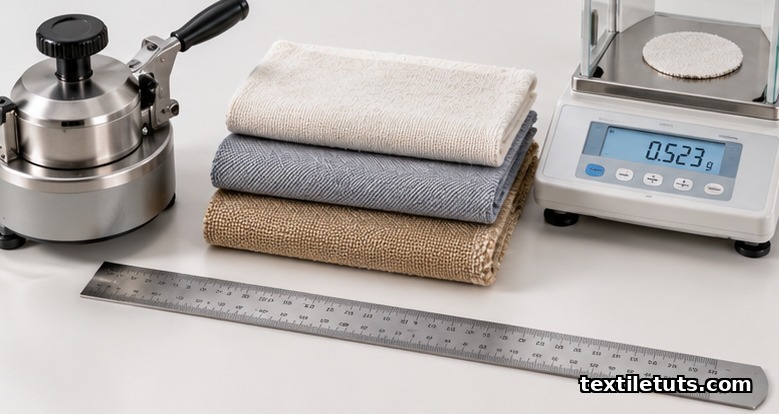
ASTM D3776 (mass per unit area) is the standard test method. Conditioning follows ASTM D1776, which requires 24 hours at 20 ± 2 °C and 65 ± 2% relative humidity before weighing. A GSM reading taken without conditioning is not arbitrable, and a buyer who rejects on unconditioned GSM forfeits the claim.
Shrinkage is reported per AATCC TM 135 (dimensional changes after automatic home laundering) or ISO 6330 (domestic washing and drying procedures). Typical trade tolerances:
| Property | Woven tolerance | Knit tolerance |
|---|---|---|
| Length shrinkage | ±3% | ±5% |
| Width shrinkage | ±2% | ±5% |
| GSM | ±5% | ±5% |
| Spirality | ≤ 3% | ≤ 5% |
Hand feel is the property least amenable to instrument testing. The buyer’s merchandiser and the seller’s QC team must evaluate hand on a calibrated surface (e.g., a tabletop reference panel) at the same temperature and humidity. When disagreement arises, most teams still resolve hand-feel disputes by side-by-side physical comparison under controlled conditioning, with the buyer’s master standard swatch acting as the tie-breaker.
Lab Accreditation: Why ISO 17025 Changes the Outcome
When a buyer and seller cannot agree on a lab dip or GSM reading, a third-party lab accredited under ISO/IEC 17025 (General requirements for the competence of testing and calibration laboratories) breaks the tie. ISO 17025 certification means the lab’s equipment is calibrated to a traceable standard, its technicians are qualified, and its reports are accepted by customs, retailers, and arbitration bodies in more than 130 countries.
Common accredited labs in textile trade include SGS, Intertek, Bureau Veritas, and Testex (for OEKO-TEX certification). A buyer who insists on a non-accredited in-house lab report forfeits the dispute if the seller produces a contradicting ISO 17025 report from a recognized body.
ISO 17025 also anchors the dye-fastness tests. ISO 105-C06 (wash fastness at 40 °C), ISO 105-X12 (rubbing or crocking fastness), and ISO 105-B02 (light fastness) all require accredited lab equipment and procedure. When a buyer’s tech pack says “wash fastness grade 4 minimum,” a seller’s ISO 105-C06 report at grade 3.5 forces a resubmission, regardless of the seller’s verbal assurance.
Negotiation Mechanics: Price, Lead Time, and Claim Windows
Communication in textile trade is not only technical. Three commercial levers determine whether a deal closes profitably: price, lead time, and claim window.
Price negotiations follow the cost-breakdown sheet: yarn cost, dyeing or finishing cost, weaving or knitting cost, overhead, and margin. A buyer who requests a 5% price reduction without seeing the seller’s cost breakdown is negotiating on trust, not data. A seller who provides the breakdown transparently often finds that 5% is achievable through yarn substitution (e.g., from 30s Ne to 24s Ne) without compromising the spec.
Lead time is documented as four stacked phases: sample (7 to 14 days), lab dip (5 to 10 days per round), bulk production (30 to 45 days for woven, 21 to 35 days for knit), and shipment (7 to 21 days by sea or 3 to 5 days by air). Total lead time from inquiry to delivery runs 60 to 120 days. A seller’s verbal “we can deliver in 30 days” usually means 30 days of bulk production after lab dip approval, not 30 days total, which is one of the most common sources of broken promises in textile trade.
Claim windows define when a buyer can reject after delivery. Industry standard is 15 days from receipt for visible defects and 60 days for latent defects (e.g., dye bleeding discovered after finishing). Beyond 60 days, claims are rarely enforceable unless fraud can be shown. A buyer who waits 90 days to raise a dye-bleeding claim has likely forfeited the claim unless an ISO 17025 lab report documents the mill’s responsibility.
Documentation Standards: The 8 Documents That Protect Both Sides
Eight documents appear in every defensible textile transaction:
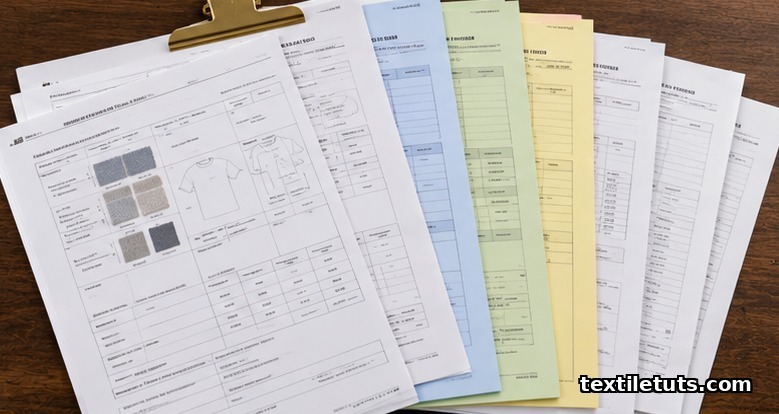
- Purchase order with tech pack (specs, tolerances, lab test requirements)
- Sales confirmation with price, lead time, and payment terms (typically L/C or T/T 30/70)
- Lab dip submission and approval sheet
- Pre-production sample (PPS) approval sheet
- Pre-shipment inspection report (AQL 2.5 sampling per ISO 2859-1)
- Mill test report (lab results for the shipped lot)
- Commercial invoice and packing list
- Bill of lading and certificate of origin
ISO 2859-1 governs the AQL (Acceptable Quality Limit) sampling plan. For general fabric, AQL 2.5 for major defects and 4.0 for minor defects is standard. The pre-shipment inspection must follow the plan exactly; an inspector who inspects 50 garments instead of the required 80 forfeits the evidentiary value of the entire inspection report.
Frequently Asked Questions
What is the most common dispute in textile buyer-seller communication?
Color shade mismatch is the most common dispute, accounting for roughly 60 to 70% of contested fabric shipments. The dispute is resolved through a Delta-E (CMC) reading under AATCC TM 173 against the master standard, with a tolerance of 1.0 to 2.0 depending on the substrate and the buyer’s target market. Disputes that skip the Delta-E reading and rely only on visual judgment are rarely arbitrable.
How long does a typical textile buyer-seller communication cycle take from inquiry to delivery?
A typical cycle runs 60 to 120 days: 7 to 14 days for sampling, 10 to 30 days for lab dip rounds (average 2 to 3 rounds), 30 to 45 days of bulk production for woven or 21 to 35 days for knit, and 7 to 21 days for shipment. Air freight can compress the shipment stage to 3 to 5 days at roughly 3 to 5 times the cost of sea freight.
What happens if the mill’s GSM falls outside the buyer’s tolerance?
If the shipment’s GSM falls outside the buyer’s specified tolerance (typically ±5%), the buyer can reject the lot or negotiate a price concession. The reading must be taken under ASTM D1776 conditioning (24 hours at 20 ± 2 °C and 65 ± 2% RH) and per ASTM D3776 method to be arbitrable. Unconditioned readings do not support a claim and are routinely dismissed by third-party arbitrators.
Why does a mill sometimes quote a price that changes after the lab dip?
Mills often quote based on assumed yarn, dye, and process costs at the inquiry stage. If the lab dip requires a special dye, a higher yarn count, or an extra finishing pass, the cost rises. A defensible quote includes a cost breakdown so the buyer can identify which input changed and negotiate transparently. Quotes without breakdowns shift cost risk entirely to the seller and frequently trigger disputes when the final invoice arrives.
Can a buyer reject a shipment after 30 days if a defect is discovered?
Yes, if the defect is latent (hidden until the fabric is cut, sewn, or washed). Industry-standard claim windows allow 15 days for visible defects and 60 days for latent defects. Beyond 60 days, claims require evidence of fraud or misrepresentation. A buyer who waits 90 days to raise a dye-bleeding claim has likely forfeited the claim unless an ISO 17025 lab report documents the mill’s responsibility.
References
- International Organization for Standardization. ISO 9001:2015 — Quality management systems — Requirements. https://www.iso.org/standard/62085.html — clauses 7.4 and 8.2 governing documented communication and product requirements in textile trade.
- International Organization for Standardization. ISO/IEC 17025:2017 — General requirements for the competence of testing and calibration laboratories. https://www.iso.org/standard/66912.html — basis for accredited lab dispute resolution in textile trade.
- American Association of Textile Chemists and Colorists. AATCC Test Method 173: CMC Calculation of Small Color Differences. https://www.aatcc.org — color-difference threshold for lab dip approval in textile trade.
- American Association of Textile Chemists and Colorists. AATCC Test Method 135: Dimensional Changes of Fabrics after Home Laundering. https://www.aatcc.org — dimensional-change test cited in apparel tech packs.
- ASTM International. ASTM D3776 / D3776M: Standard Test Methods for Mass Per Unit Area (Weight) of Fabric. https://www.astm.org/d3776 — primary GSM test method in textile trade.
- ASTM International. ASTM D1776: Standard Practice for Conditioning and Testing Textiles. https://www.astm.org/d1776 — conditioning protocol for GSM, tensile, and shrinkage testing in textile trade.
- International Organization for Standardization. ISO 2859-1: Sampling procedures for inspection by attributes. https://www.iso.org/standard/1141.html — AQL 2.5 / 4.0 sampling for pre-shipment inspection in textile trade.
- International Organization for Standardization. ISO 105-C06: Textiles — Tests for colour fastness — Part C06: Colour fastness to domestic and commercial laundering. https://www.iso.org/standard/65283.html — primary wash-fastness test cited in textile trade tech packs.
This article is the working reference for buyer-seller communication in textile trade. Editorial by Mohammad Yousuf (Anik), TextileTuts. Sources: ISO 9001:2015, ISO/IEC 17025:2017, AATCC TM 173, AATCC TM 135, ASTM D3776, ASTM D1776, ISO 2859-1, and ISO 105-C06 as cited.


