
Closed-Loop Textile Manufacturing

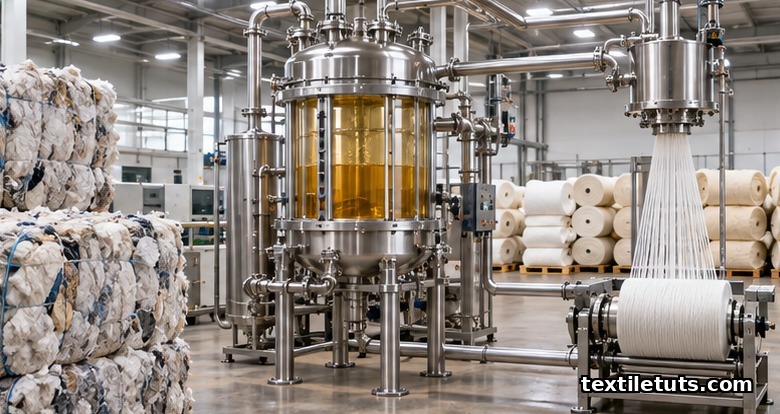
Closed-loop textile manufacturing recycles post-consumer and post-industrial textile waste back into virgin-quality fiber, with chemical recycling routes recovering an estimated 70–80% of the polymer chain and reducing energy demand by 30–60% compared with virgin polyester production.
This figure represents the operating ceiling of current fiber-to-fiber recycling technologies, where polyester from PET bottles and old garments is depolymerized, purified, and repolymerized into fiber-grade polymer at industrial scale.
In this guide you will learn what qualifies as a closed loop in textile manufacturing, the four main recycling pathways, the standards that define circularity, the actual energy and water savings measured in peer-reviewed studies, and the technical barriers that keep most global fiber production on a linear take-make-dispose model.
What “Closed-Loop” Actually Means in Textile Manufacturing
A closed-loop system returns end-of-life textiles into the same product stream from which they originated, ideally without downgrading fiber quality. The European Environment Agency distinguishes this from open-loop recycling, where material is recovered for a lower-grade application, such as cutting-room waste being shredded into carpet underlay or insulation.
For textile engineers, three criteria define a true closed loop:
- The output fiber matches the input fiber’s molecular weight, crystallinity, and tenacity.
- The process operates continuously with the same polymer family across cycles.
- Process water, solvents, and dyes are recovered at rates above 95%.
The Ellen MacArthur Foundation reported in 2017 that less than 1% of the material used to produce clothing was recycled into new clothing, a benchmark that has since driven regulatory pressure through the EU Strategy for Sustainable and Circular Textiles (2022), which mandates separate fiber-to-fiber collection by 2025 and recycled-content targets by 2030.
The Four Recycling Pathways
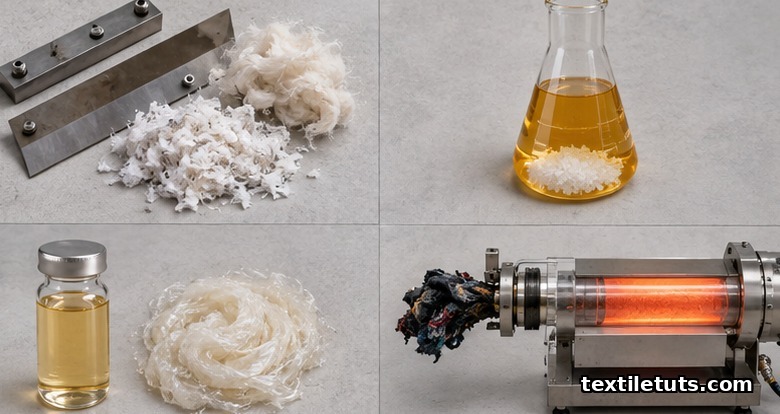
Closed-loop textile recycling is not one technology. It is a layered set of routes, each defined by how aggressively the polymer is broken apart before being rebuilt.
1. Mechanical Recycling
Mechanical recycling shreds textiles into fibers through cutting, tearing, and carding. It is the oldest and cheapest route, but each shredding cycle shortens fibers and reduces tensile strength by 20–40%, which is why most mechanically recycled cotton ends up in nonwoven wipes or insulation rather than apparel yarn.
2. Chemical (Depolymerization) Recycling
Chemical recycling dissolves the polymer into its monomer building blocks, which are then filtered, purified, and repolymerized. For polyethylene terephthalate (PET), this is well established at industrial scale: the polyester is broken down to bis(2-hydroxyethyl) terephthalate (BHET) monomers using glycolysis or methanolysis, then rebuilt into fiber-grade chip.
A 2022 review in Resources, Conservation and Recycling reported that chemical recycling of PET consumes 30–60% less energy than virgin PET production and reduces greenhouse-gas emissions by 35–55%, depending on grid electricity mix.
3. Solvent-Purification Recycling
Solvent-based processes, such as the Ioncell-F and New Cotton technologies developed at Aalto University and the Hong Kong Research Institute of Textiles and Apparel, dissolve cellulose from cotton-rich waste into ionic liquids and spin new fibers directly from the solution. This route preserves cellulose polymer chain length and produces fibers with tenacity comparable to virgin cotton.
4. Thermal (Thermochemical) Recycling
Pyrolysis and depolymerization at high temperature recover monomers from blended and contaminated streams that mechanical recycling cannot process. These technologies are still pre-commercial for textiles but are being piloted for polyamide and acrylic blends.
| Pathway | Output quality | Energy vs virgin fiber | Commercial scale (2026) |
|---|---|---|---|
| Mechanical | Lower tenacity, shorter fibers | -20 to -40% | High (wipes, insulation) |
| Chemical (PET) | Virgin-grade polymer | -30 to -60% | High (rPET fiber) |
| Solvent (cellulose) | Virgin-grade cellulose | Comparable to virgin | Pilot to early commercial |
| Thermochemical | Monomers | Variable | Pilot only |
Standards That Define Circularity
Closed-loop claims need a verifiable standard behind them. Five documents shape how textile mills, brands, and recyclers report circularity today.
- ISO 14040:2006 — Principles and framework for life cycle assessment (LCA). The baseline for any cradle-to-cradle claim.
- ISO 14044:2006 — Requirements and guidelines for LCA, including system boundary rules.
- ISO 30134-4:2020 — Material circularity indicator. Used to score the circularity of a product or company.
- Cradle to Cradle Certified (version 4.0, 2021) — Material reutilization, renewable energy, and water stewardship scores.
- Global Recycled Standard (GRS) 4.0 — Chain-of-custody verification for recycled-content claims in textiles.
A textile product that carries GRS 4.0 certification must contain at least 20% recycled material by weight, with chain-of-custody audits at every stage from collector to finished fabric. The Cradle to Cradle Products Innovation Institute’s 2021 update tightened the recycled-content threshold for Gold certification to 50% for apparel fabrics.
Energy and Water Savings, Measured
The strongest case for closed-loop manufacturing is the resource intensity delta between virgin and recycled fiber.
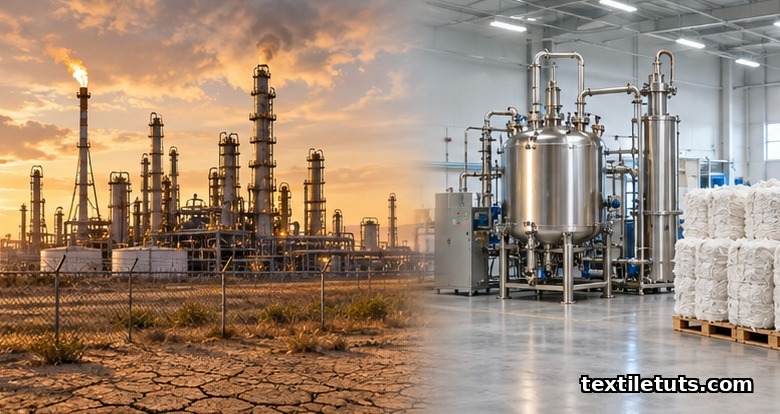
According to a 2020 life cycle assessment published in Journal of Cleaner Production, producing 1 kg of recycled PET staple fiber consumes 28 MJ of primary energy, compared with 65 MJ for virgin PET, a 57% reduction. Water consumption drops from 35 L/kg to 12 L/kg, a 66% reduction, because oil refining and feedstock processing are removed from the loop.
For cotton, the Ioncell-F process has been shown to use 99% less water than conventional cotton cultivation, because the recycled feedstock does not require irrigation, pesticide application, or land use. The trade-off is solvent recovery: ionic liquid recovery rates above 95% are required to make the loop economically and environmentally viable.
Where Closed-Loop Systems Still Fall Short
Three technical barriers keep most apparel fiber on a linear path today.
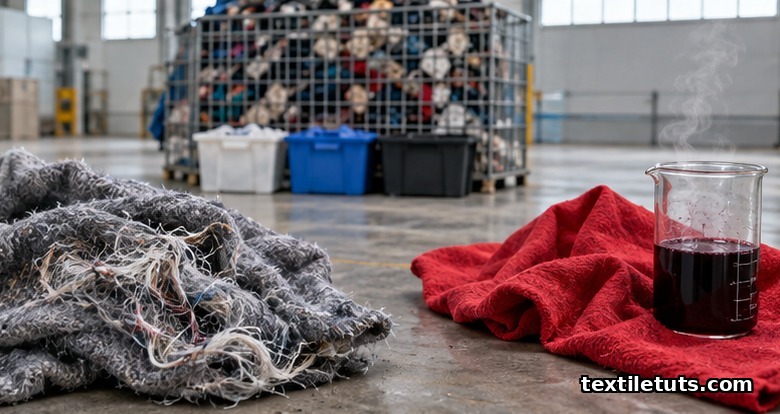
- Blended fabrics. A polyester-cotton blend (the global standard at roughly 55% of apparel fabric production) cannot be processed by either pure PET recycling or pure cellulose recycling without a separation step that adds cost and solvent load.
- Dye and finish contamination. Reactive dyes, flame retardants, water-repellent finishes, and softeners all need to be stripped before depolymerization. Pilot studies using supercritical CO2 extraction show 80–90% dye removal, but the chemistry is not yet scaled.
- Collection infrastructure. The Ellen MacArthur Foundation estimates that 73% of post-consumer textile waste globally is landfilled or incinerated, with less than 20% collected for any form of recycling. A closed loop requires the front-end collection that most regions still lack.
How a Mill Verifies a Closed-Loop Claim
Textile mills pursuing closed-loop certification typically follow a five-step audit pathway:
- Map the supply chain under ISO 14040 LCA principles.
- Document input mass and recycled-content percentage under GRS 4.0.
- Measure material circularity under ISO 30134-4.
- Test for hazardous substance compliance against OEKO-TEX Standard 100 or the ZDHC Manufacturing Restricted Substances List.
- Publish a third-party-verified public report and submit to Cradle to Cradle or GRS audit annually.
For in-house verification before claiming recycled content, mills commonly test fiber tenacity on an Instron tensile tester following ASTM D3822 (single fibers) or ASTM D5035 (fabric tensile), then compare the result to virgin-fiber control samples. Tenacity within 5% of virgin is the working benchmark for chemical recycling; anything below 10% suggests mechanical-only processing.
Frequently Asked Questions
Q1: Is recycled polyester (rPET) the same as closed-loop polyester?
Not necessarily. Most rPET on the market today comes from PET bottles, which is an open loop because the source (food packaging) differs from the output (apparel fiber). True closed-loop polyester requires the feedstock to be end-of-life polyester textiles, recycled back into polyester textiles of the same quality. Chemical recycling processes such as Worn Again Technologies’ PET monomer recovery and Teijin’s Eco Circle can deliver this when properly configured.
Q2: Can cotton be closed-loop recycled at industrial scale today?
Cellulose-to-cellulose recycling is at early commercial scale. Renewcell’s Circulose process (operating in Sundsvall, Sweden) processes cotton-rich waste into a dissolving-grade pulp used by fiber producers such as Birla Cellulose. Output capacity is still in the tens of thousands of tonnes per year, well below the multi-million-tonne scale needed to substitute virgin cotton globally.
Q3: What is the biggest energy user in closed-loop chemical recycling?
Repolymerization and drying of the recycled polymer account for roughly 55–65% of total process energy, according to the Journal of Cleaner Production LCA referenced earlier. Solvent recovery is second at 15–25%. Reducing repolymerization energy through catalysis and renewable heat integration is the largest single lever for further carbon reduction.
Q4: Does closed-loop recycling reduce microplastic shedding?
On a per-fiber basis, recycled and virgin polyester shed similar microplastic loads during the first wash cycles because both are extruded thermoplastic fibers. A 2021 study in Environmental Science & Technology found that washing frequency and fabric construction (tightly knit vs loose knit) were larger predictors of microfiber release than fiber origin. Closed-loop systems reduce cumulative microfiber load by extending fiber lifetime and reducing total fiber production, not by changing how a single fiber sheds.
Q5: How do brands verify a supplier’s closed-loop claim?
Brands verify through GRS 4.0 or RCS chain-of-custody audits, third-party ISO 14040 LCA reports, and site visits to the recycling facility. A credible supplier will provide the audit certificate number, the percentage of recycled input, the recycling facility’s location, and a self-declared mass balance calculation that reconciles input scrap with output fiber. Without those four documents, a closed-loop claim is not auditable.
References
- International Organization for Standardization. ISO 14040:2006 Environmental management — Life cycle assessment — Principles and framework. iso.org — baseline LCA principles used in every closed-loop textile claim.
- International Organization for Standardization. ISO 14044:2006 Environmental management — Life cycle assessment — Requirements and guidelines. iso.org — LCA calculation rules referenced in cradle-to-cradle reports.
- International Organization for Standardization. ISO 30134-4:2020 Sustainability of construction works — Material circularity indicator. iso.org — method for scoring circularity at product and company level.
- Sandin, G., & Peters, G. M. (2018). Environmental impact of textile reuse and recycling — A review. Journal of Cleaner Production, 184, 353–365. sciencedirect.com — peer-reviewed review of recycling pathways and energy data.
- Ellen MacArthur Foundation. (2017). A New Textiles Economy: Redesigning Fashion’s Future. ellenmacarthurfoundation.org — the source of the “less than 1% recycled into new clothing” benchmark.
- European Commission. (2022). EU Strategy for Sustainable and Circular Textiles. europa.eu — the regulatory roadmap mandating fiber-to-fiber collection and recycled content targets.
- AATCC. Test Method 135: Dimensional Changes of Fabrics after Home Laundering. aatcc.org — referenced for verifying that recycled-content fabrics retain dimensional stability across care cycles.
This article is the working reference for closed-loop textile manufacturing. Editorial by Shahrukh Islam, TextileTuts. Sources: ISO 14040:2006, ISO 14044:2006, ISO 30134-4:2020, Sandin & Peters (2018), Ellen MacArthur Foundation (2017), EU Strategy for Sustainable and Circular Textiles (2022), AATCC TM 135 as cited.


