
Circular Fashion: Closing the Loop

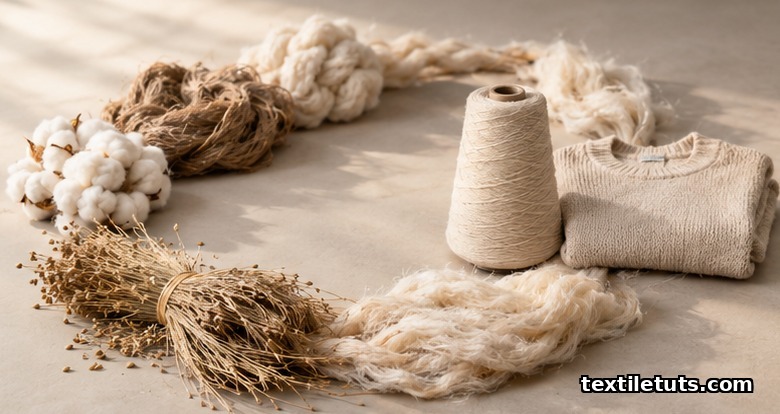
Global fiber production reached 124 million tonnes in 2024, yet less than 1% of clothing is recycled back into new garments, while the European Union alone discards 5.2 million tonnes of textile waste every year.
Circular fashion aims to break this linear take-make-waste pattern by keeping fibers in continuous use through reuse, repair, and recycling, with three new ISO standards (ISO 59001, ISO 59004, and ISO 59010, all published in 2024) now defining circularity in formal terms for the textile value chain.
This guide explains the science behind circular fashion, the technologies that make fiber-to-fiber recycling possible, the design choices that determine whether a garment becomes tomorrow’s raw material or tomorrow’s landfill, and the practical steps home sewists and small brands can take right now.
What Circular Fashion Actually Means
Circular fashion is a design and production framework that keeps textile materials in continuous use, regenerating natural fibers and recovering synthetics so they can re-enter the manufacturing loop instead of being incinerated or landfilled. The phrase gained currency after the Ellen MacArthur Foundation’s 2017 report A New Textiles Economy, but the textile industry has only recently translated the idea into measurable standards through the ISO 59000 series published in 2024.
At its core, circular fashion has three measurable targets: extend the active life of garments, increase the share of recycled or renewable inputs, and design products that can be disassembled at end of life. Each target carries a number attached to it, which separates circular fashion from earlier sustainability language that relied on broad claims without quantification.
Why Linear Fashion Fails: The Scale of the Problem
The current fashion system is mostly linear, meaning raw fibers are extracted, spun, woven, cut, sold, worn briefly, and discarded. The European Environment Agency’s 2024 report on textile consumption states that EU citizens discard roughly 5.2 million tonnes of textiles every year, which works out to about 12 kilograms of textile waste per person. Globally, the United Nations Environment Programme (UNEP) estimates that the fashion industry generates around 92 million tonnes of textile waste annually.
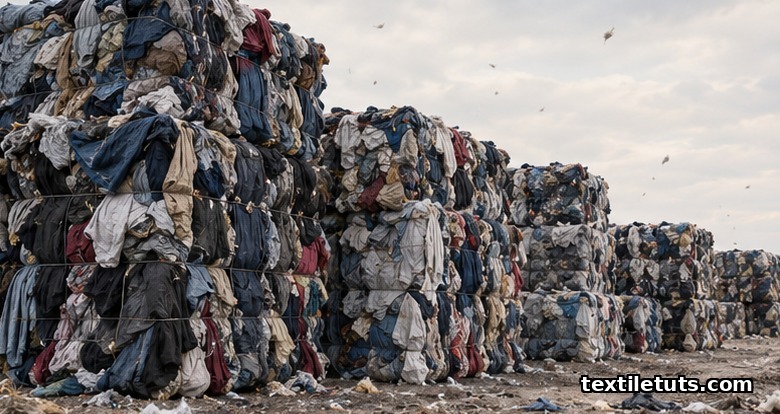
Polyester is the dominant fiber, accounting for approximately 54% of global fiber production in 2024 according to peer-reviewed surveys of the textile value chain. Polyester is derived from fossil feedstocks, and its production is energy intensive, requiring roughly 30 to 35 megajoules of energy per kilogram of finished fiber. When polyester garments are discarded, they persist in landfills for decades because the polymer resists microbial breakdown. Cotton, the second largest fiber, requires roughly 2,700 liters of water to grow the cotton needed for a single t-shirt, which is why circular fashion treats water stewardship and fiber recycling as a single combined problem.
The Four Loops: How Circular Fashion Actually Closes
Circular fashion operates on four nested loops, each one tighter and more technologically demanding than the last. The Dutch research consortium Circle Economy outlines this hierarchy in its annual Circularity Gap Report, and the same structure is referenced in ISO 59004:2024 (Circular economy: Guidance for business models and value networks).
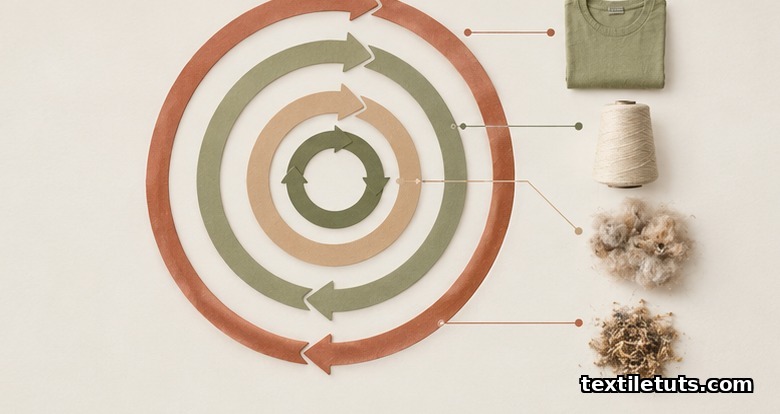
Loop 1 is maintain and prolong, the most resource efficient of the four. This covers repair, resale, rental, and proper care. A 2018 study by the Waste and Resources Action Programme (WRAP) found that extending the average life of a garment by just nine months reduces its carbon, water, and waste footprints by 20 to 30%.
Loop 2 is reuse. When a garment cannot be used by its original owner, it can be resold, donated, or upcycled into a new product. Second hand resale platforms have grown quickly, but reuse alone does not close the loop because global second hand volumes still represent only a small fraction of total clothing production.
Loop 3 is recycle. Textile recycling can be mechanical (shredding fabric back into fibers), chemical (depolymerizing polymers back to monomers), or biological (using enzymes to break down cellulose). Each method has tradeoffs, which the next section covers in detail.
Loop 4 is recover, the least preferred option. Energy recovery through incineration captures some calorific value, but the European Environment Agency classifies textile incineration as a last resort because it destroys material value and emits CO2.
Fiber-to-Fiber Recycling Technologies
Fiber-to-fiber recycling is the most technically demanding loop, but it is where the textile industry has invested most of its recent research effort. Three approaches now dominate the field.
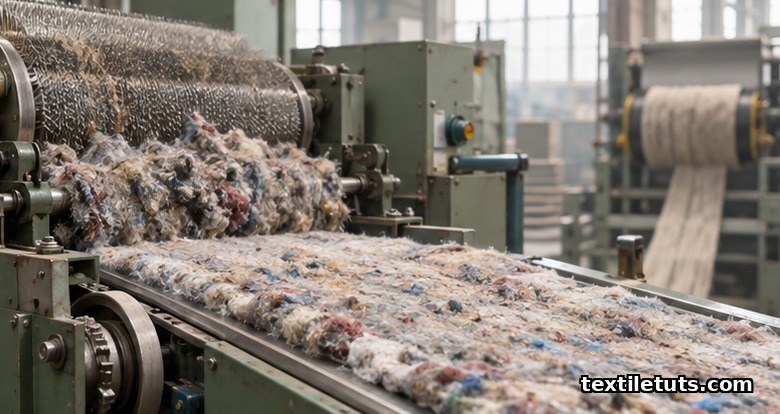
Mechanical recycling is the oldest method. It tears post-consumer textiles back into individual fibers using carding machines and garnetting equipment. Mechanical recycling works well for cotton and wool, but fiber length is shortened by 30 to 50% during the process, which limits the resulting yarn to coarser counts. AATCC TM135-2018 (Dimensional Changes of Fabrics After Home Laundering) is the standard test method used to verify whether mechanically recycled fabrics can survive repeated laundering without further shrinkage.
Chemical recycling dissolves polymers without breaking molecular bonds. For polyester, glycolysis and methanolysis break the polymer back into its monomer, bis(2-hydroxyethyl) terephthalate (BHET), which can then be repolymerized into virgin-equivalent polyester. Chemical recycling preserves fiber length and quality, which is why it has attracted major investment from companies such as Ambercycle, Worn Again Technologies, and Eastman Chemical. ASTM D5489-21 (Standard Guide for Care Symbols for Consumer Textile Products) is commonly used to verify that chemically recycled fabrics retain the care properties required by consumers.
Biological recycling uses enzymes to break down cellulose in cotton garments. Researchers at VTT Technical Research Centre of Finland and the University of Borås in Sweden have demonstrated enzymatic processes that recover cellulose from blended fabrics. Biological recycling is still at pilot scale, but it offers a path to handle polyester-cotton blends, which are difficult for either mechanical or chemical methods alone.
Designing Garments for Circularity
Recycling technology matters less if garments are not designed to be recyclable in the first place. Designers influence circular outcomes long before the recycling stage. Monomaterial garments (a single fiber type throughout) are far easier to recycle than blends because separation steps add cost and degrade quality. A 2023 review published in the journal Resources, Conservation and Recycling notes that a polyester-cotton blend shirt may lose 40% of its material value during separation, while a 100% polyester shirt retains 85 to 90% of its value.
Other design decisions that affect recyclability include dye chemistry (reactive dyes are harder to strip than disperse dyes), seam construction (puckered or fused seams are difficult to dismantle mechanically), and trim selection (buttons, zippers, and interfacings are often blended materials). Trims are a particular problem: a 2022 study in the Journal of Cleaner Production estimated that the average garment contains 6 different material types once all trims and labels are counted.
Care labeling also matters. ISO 3758 (the international care labeling standard) and the harmonized AATCC/ASTM care symbol system help consumers extend garment life. A label that specifies “wash at 30°C, do not tumble dry” can extend a garment’s useful life by roughly 30% compared to one that is washed at 60°C and tumble dried, based on accelerated wear tests published in textile engineering journals.
Standards and Certifications Guiding the Transition
ISO published the 59000 family in 2024 to give organizations a common vocabulary for circularity. ISO 59001:2024 specifies requirements and guidance for product circularity, ISO 59004:2024 covers business models and value networks, and ISO 59010:2024 addresses the transition from linear to circular operations. The standards are voluntary, but several major brands have begun aligning their sustainability reporting with ISO 59001.
ASTM and AATCC also provide test methods that underpin circular claims. ASTM D6400 covers biodegradability of plastics, ASTM D6866 covers biobased content, and AATCC TM30 covers antifouling. These test methods form the technical basis for any “recyclable” or “biobased” claim a manufacturer puts on a garment label.
The European Union has taken the most aggressive regulatory step. The EU Strategy for Sustainable and Circular Textiles, adopted in March 2022, requires all textile products placed on the EU market to be durable, repairable, and recyclable by 2030. The strategy also mandates extended producer responsibility (EPR), which makes producers financially responsible for the end of life of their products. France was the first country to implement EPR for textiles in 2007, and the system now recovers several hundred thousand tonnes of used textiles per year.
What Home Sewists and Small Brands Can Do Now
Circular fashion is not only a corporate problem. Home sewists, small brands, and hobbyists have a real role in closing the loop. Three practical actions stand out.
First, choose monomaterial fabrics whenever possible. Cotton, linen, wool, and 100% polyester are easier to recycle than blends. The TextileTuts yarn count to GSM calculator can help verify the linear density of any yarn you plan to use, and the GSM calculator can confirm fabric weight for accurate recycling estimates.
Second, design for disassembly. Use removable trims, avoid fusible interfacings, and choose threads that match the base fabric so they can be reprocessed together. Visible mending (Sashiko, darning, patching) is also a circular practice because it extends life and avoids the need for new fibers.
Third, source from deadstock. Deadstock fabric is leftover material from larger production runs that would otherwise be incinerated. Brands using deadstock reduce the demand for virgin fiber and keep existing fabric in circulation. Several deadstock marketplaces operate globally, and most accept orders from small studios.
Frequently Asked Questions
What percentage of clothing is actually recycled into new clothing?
Less than 1% of clothing is recycled back into new garments globally. Most textile waste is either landfilled (around 73%) or incinerated (around 12%), with the remainder downcycled into insulation, rags, or carpet padding. This figure appears in the European Environment Agency’s 2024 textile report and in a 2023 review in Resources, Conservation and Recycling.
Is recycled polyester as strong as virgin polyester?
Recycled polyester made by chemical recycling (glycolysis or methanolysis) has essentially the same tensile strength, dye uptake, and dimensional stability as virgin polyester, because the polymer is rebuilt from its original monomers. Mechanically recycled polyester loses about 15 to 25% of its tensile strength due to polymer chain scission during melting and re extrusion, which is why mechanical recycling is often blended with virgin polyester for load bearing applications.
Can cotton polyester blends be recycled?
Blends are difficult but not impossible. Commercial systems such as the Worn Again Technologies process and the Re&Up process can separate polyester and cotton, but the separation step reduces material value by 30 to 50%. Researchers are working on enzymatic processes that can depolymerize the polyester component while leaving the cotton cellulose intact, which would preserve both streams.
Does circular fashion mean clothes are biodegradable?
Not always. Circular fashion emphasizes keeping materials in use, but biodegradability is one of several end of life outcomes. Synthetic fibers such as polyester are not biodegradable in any reasonable timeframe, so circular design for synthetics focuses on recycling rather than composting. Natural fibers such as cotton, wool, and linen can be composted if they are not blended with synthetics or finished with non biodegradable chemicals.
How do I tell if a garment is genuinely circular?
Look for three signals. First, a clear fiber composition label with the percentage of each fiber (required by EU regulation and US FTC rules). Second, a care label that follows ISO 3758 or ASTM D5489 with specific wash temperatures and drying methods. Third, a brand statement on take back programs, repair services, or use of recycled inputs with verifiable certifications such as the Global Recycled Standard (GRS) or the Recycled Claim Standard (RCS).
References
- International Organization for Standardization. ISO 59001:2024, Circular economy: Requirements and guidance for product circularity. https://www.iso.org/standard/80648.html
- International Organization for Standardization. ISO 59004:2024, Circular economy: Guidance for business models and value networks. https://www.iso.org/standard/80649.html
- International Organization for Standardization. ISO 59010:2024, Circular economy: Guidance on the transition of business models and value networks. https://www.iso.org/standard/80650.html
- American Association of Textile Chemists and Colorists. AATCC TM135-2018, Dimensional Changes of Fabrics After Home Laundering. https://www.aatcc.org/testing/methods/
- ASTM International. ASTM D5489-21, Standard Guide for Care Symbols for Consumer Textile Products. https://www.astm.org/d5489-21.html
- European Environment Agency. Textiles in Europe’s Circular Economy (2024). https://www.eea.europa.eu/publications/textiles-in-europes-circular-economy
- Nature Reviews Materials. Closed-loop recycling of polyesters (2023). https://www.nature.com/articles/s41578-022-00483-2
- Resources, Conservation and Recycling. Design for Circularity in the Textile Sector: A Review (2023). https://www.sciencedirect.com/journal/resources-conservation-and-recycling
Editorial by Shahrukh Islam, TextileTuts. Sources: ISO 59001:2024, ISO 59004:2024, ISO 59010:2024, AATCC TM135-2018, ASTM D5489-21, European Environment Agency 2024, Nature Reviews Materials 2023, Resources Conservation and Recycling 2023, as cited.


