
Chemical Textile Recycling

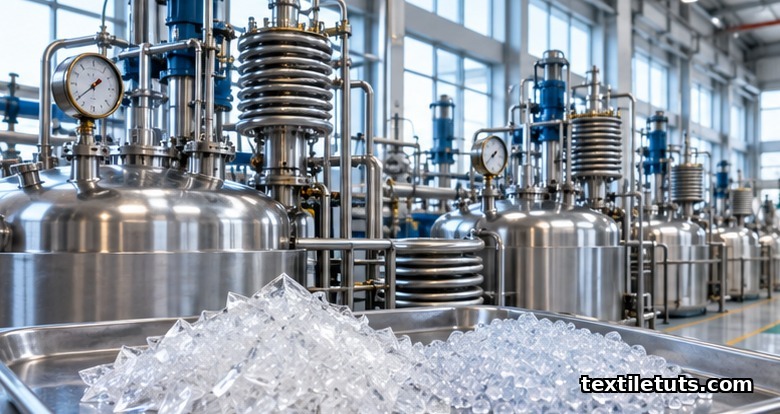
Chemical textile recycling depolymerizes synthetic fibers such as polyester (PET) back into their constituent monomers, achieving monomer recovery yields of 80 to 95 percent through glycolysis, hydrolysis, methanolysis, and enzymatic routes, versus mechanical recycling, which typically loses 30 to 50 percent of fiber length per cycle and yields a lower-grade product. These recovered monomers can be repolymerized into virgin-quality polymers that match the performance specifications of petroleum-based feedstock, creating a closed-loop system for the 54 percent of global fiber production that currently comes from petrochemicals.
The following sections explain how each chemical recycling route works, which fibers they target, the quality of the regenerated output, and where the technology sits on the path from pilot plant to industrial scale. The article closes with answers to questions textile engineers and sourcing managers most often ask when evaluating chemical recycling for a product line.
What Is Chemical Textile Recycling?
Chemical textile recycling uses solvents, heat, catalysts, or enzymes to break the long-chain polymers in a fabric back into their original building blocks, then rebuilds the polymer from scratch. Mechanical recycling, by contrast, cuts or tears fabric into shorter fibers that get spun into yarn again, which shortens the polymer chain, weakens the fiber, and limits how many times the material can be cycled before it is downcycled into insulation, carpet backing, or wiping cloth.
Depolymerization is what makes chemical recycling attractive: it restores the polymer to its starting molecular weight, so the regenerated fiber behaves indistinguishably from a fiber made from virgin petrochemical feedstock. The European Environment Agency notes that chemical recycling of PET can produce material suitable for food-contact applications after appropriate purification, a level of purity that mechanical recycling cannot reach because dyes, finishes, and fiber blends stay mixed in the reclaimed stream.
Main Chemical Recycling Technologies
Five routes dominate the published literature and the patent landscape for chemical textile recycling. Choice of route depends on the fiber chemistry, the desired purity of the output, and the energy budget available at the recycling facility.
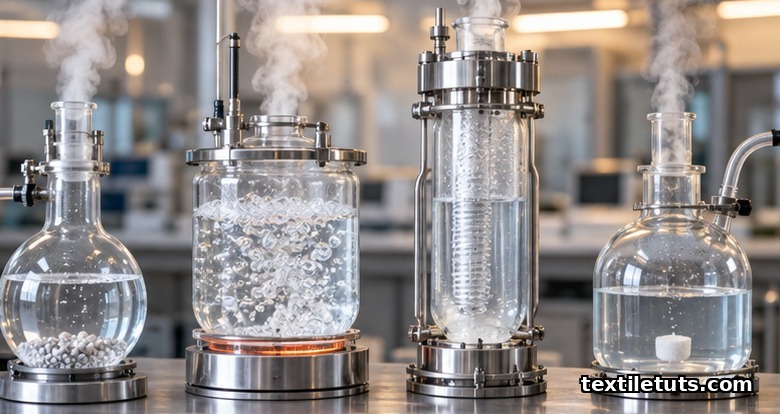
Glycolysis
Glycolysis reacts PET with excess ethylene glycol at 180 to 220 degrees Celsius in the presence of a metal catalyst (commonly zinc acetate or manganese acetate) to produce bis(2-hydroxyethyl) terephthalate, abbreviated BHET. BHET is the same monomer used to make virgin PET, so the recycled output drops directly into a standard PET polymerization line. Reported BHET yields in peer-reviewed studies range from 85 to 92 percent after 2 to 4 hours of reaction at atmospheric pressure.
Hydrolysis
Hydrolysis cleaves PET with water under acid, alkaline, or neutral conditions at 200 to 250 degrees Celsius and 1.5 to 2.0 MPa, releasing terephthalic acid (TPA) and ethylene glycol. Neutral hydrolysis with steam or hot water achieves TPA recovery of 90 to 95 percent and produces a TPA that is chemically equivalent to fossil-derived TPA after recrystallization. Alkaline hydrolysis with sodium hydroxide is faster (about 1 hour at 210 degrees Celsius) and is favored when the feedstock is heavily dyed or contaminated, because the alkaline stage also strips surface finishes.
Methanolysis
Methanolysis reacts PET with supercritical or near-critical methanol at 270 to 300 degrees Celsius and 7 to 10 MPa to yield dimethyl terephthalate (DMT) and ethylene glycol. Conversion rates above 95 percent are routine, and Eastman Chemical’s commercial methanolysis plant in Kingsport, Tennessee has processed over 100 million pounds of PET since 2023 using a process the company licensed from the U.S. Department of Energy’s national laboratories. DMT is the older polyester monomer and is preferred for fibers that need higher crystallinity, such as tire cord and industrial PET.
Enzymatic Depolymerization
Enzymatic depolymerization uses PET hydrolases, most notably PETase and MHETase from Ideonella sakaiensis 201-F6, to hydrolyze PET into MHET and then TPA and ethylene glycol at 30 to 50 degrees Celsius in aqueous buffer. Energy demand is far lower than thermal routes, but reported lab-scale conversion rates remain below 30 percent after 24 hours, which keeps enzymatic depolymerization in the research and pilot stage as of 2025. Engineering efforts now focus on thermophilic enzymes and enzyme-engineering to push conversion past 90 percent within industrial timeframes.
Ionic Liquid and Deep Eutectic Solvent Routes
Ionic liquids and deep eutectic solvents dissolve cotton cellulose (and in some processes both cellulose and polyester) at 100 to 200 degrees Celsius without the carbon disulfide required for viscose. The dissolved cellulose can be regenerated as a continuous filament with a degree of polymerization close to the original cotton fiber. The Netherlands-based company Ioniqa and academic spin-offs in the EU Horizon program have piloted this route for mixed cotton-polyester blends, separating the two polymers in a single solvent system that can be reused for 20 or more cycles before regeneration.
Mechanical vs Chemical Recycling: Side-by-Side
| Property | Mechanical Recycling | Chemical Recycling |
|---|---|---|
| Process | Shredding, tearing, re-spinning | Depolymerization to monomers |
| Typical polymer loss per cycle | 30 to 50 percent of molecular weight | Less than 5 percent (full restoration) |
| Output fiber length | Short staple (10 to 40 mm) | Continuous filament, any length |
| Dye and finish removal | Difficult; usually bleached | Removed during chemical processing |
| Blended fabric handling | Limited; contamination drops value | Selective depolymerization of one polymer |
| Energy demand | Low (mechanical only) | Medium to high (heat and pressure) |
| Suitable for food-contact output | Rarely | Yes, after purification |
| Cost per kg recovered (2025 estimates) | USD 0.20 to 0.50 | USD 0.60 to 1.50 |
Which Fibers Can Be Chemically Recycled?
PET is by far the most recycled synthetic, because the chemistry is well understood and the monomer value is high enough to cover processing costs. The Ellen MacArthur Foundation’s 2017 report “A New Textiles Economy” found that less than 1 percent of clothing is recycled into new clothing, and the same report identified polyester (54 percent of global fiber production according to Textile Exchange’s 2024 Materials Report, which tracks 124 million tonnes of fiber produced annually) as the largest single opportunity for closed-loop chemical recycling.
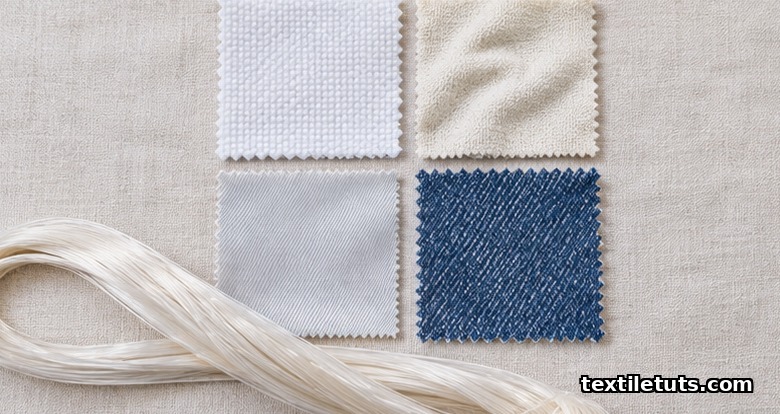
Nylon 6 is the second most common target. Hydrolytic depolymerization at 250 to 300 degrees Celsius recovers caprolactam with yields above 95 percent. Nylon 6,6 is harder to recycle because the two monomers (adipic acid and hexamethylenediamine) must be separated, but aminolysis and ammonolysis routes are now in pilot operation at Aditya Birla’s Indian facility.
Cotton is the highest-volume natural fiber (about 25 percent of global fiber production) and is recycled by dissolving the cellulose in a solvent and regenerating it as a regenerated cellulosic filament, the same chemistry used to make lyocell. The Textile Exchange 2024 Materials Report credits the lyocell-route recycling process with closed-loop yields above 97 percent when the solvent is recovered.
Blended fabrics (PET and cotton is the most common combination, used in roughly 60 percent of mass-market apparel) are the hardest problem. Two-step processes that depolymerize the PET first and dissolve the cotton second are now commercial at Worn Again Technologies in the UK and at Circ in Virginia, with combined polymer recovery above 90 percent by mass.
Quality of Regenerated Fiber
The defining advantage of chemical recycling is that it produces virgin-equivalent polymer. Intrinsic viscosity, a proxy for molecular weight, can be matched within 5 percent of fossil-derived PET, which is the range that downstream spinners accept for staple and filament yarn. ASTM D6866, the standard test method for determining biobased content, and ISO 14021, the standard for self-declared environmental claims including recycled content, both apply to chemically recycled output and let buyers quantify recycled content with a traceable carbon-14 measurement.
Mechanical recycling, by contrast, produces a shorter, weaker fiber that is blended with virgin polyester to maintain yarn strength. A 50/50 blend of recycled and virgin staple is the practical ceiling for most mechanical-recycled apparel applications.
Industrial Scale and Adoption Barriers
Chemical recycling capacity grew from less than 100,000 tonnes per year in 2020 to over 1.2 million tonnes per year in 2024, according to a 2024 review in the journal Resources, Conservation and Recycling. That is still less than 1 percent of global PET demand, which the Plastics Industry Association places above 30 million tonnes per year. Three barriers limit faster adoption: the energy cost of high-temperature reactors, the need for sorted feedstock (most chemical processes cannot tolerate more than 2 to 5 percent contamination), and the capital cost of a commercial depolymerization line (USD 50 to 200 million per facility in current industry estimates).
Policy is closing the gap. The European Union’s Extended Producer Responsibility rules under the new textile strategy, scheduled to take effect by 2028, will require member states to collect textile waste separately, which supplies the sorted feedstock that chemical recycling needs. Similar schemes are under discussion in California, New York, and Bangladesh.
Frequently Asked Questions
Is chemically recycled polyester really the same as virgin polyester?
Yes, after purification. The process rebuilds the polymer from its monomers, so the molecular weight, melting point, and dye uptake match petroleum-based PET within the tolerances required by AATCC and ISO test methods. Recycled PET made this way has been cleared for food-contact use by the U.S. FDA after process review.
Does chemical recycling work on cotton-polyester blends?
Two-step processes handle cotton-polyester blends by depolymerizing the polyester first (using glycolysis or hydrolysis) and then dissolving the cellulose in a second stage. Worn Again Technologies in the UK and Circ in the United States have demonstrated combined recovery above 90 percent by mass at pilot scale.
Can chemical recycling remove dyes and finishes?
Yes, and this is one of its main advantages over mechanical recycling. The depolymerization stage breaks down dyes into smaller fragments that wash out with the process liquor, and surface finishes such as softeners and water-repellents separate from the polymer during the same step. The output monomers are colorless after recrystallization.
Is chemical recycling better for the environment than mechanical recycling?
It depends on the metric. Chemical recycling restores fiber quality, so a polyester shirt can be recycled 5 or more times instead of once or twice before downcycling. Mechanical recycling uses less energy per kilogram but produces a lower-grade fiber. A life-cycle assessment published in the Journal of Cleaner Production in 2023 found that chemical recycling has lower cumulative energy demand over five cycles even though the per-cycle footprint is higher.
Why does chemical textile recycling cost more than mechanical recycling?
Capital cost and energy cost are the main drivers. A commercial glycolysis or methanolysis line costs USD 50 to 200 million, reactors run at 200 to 300 degrees Celsius, and catalyst recovery systems add to operating expense. Mechanical recycling is essentially shredding and re-spinning, which uses far less equipment and energy. The cost gap narrows when the recycled output is sold at virgin-equivalent prices instead of downcycled prices.
References
- International Organization for Standardization. ISO 14021:2016, Environmental labels and declarations – Self-declared environmental claims (Type II environmental labelling). iso.org. Specifies how recycled content can be claimed and verified.
- ASTM International. ASTM D6866-24, Standard Test Methods for Determining the Biobased Content of Solid, Liquid, and Gaseous Samples Using Radiocarbon and Isotope Ratio Mass Spectrometry. astm.org. The standard method used to verify recycled and biobased content.
- Ellen MacArthur Foundation. A New Textiles Economy: Redesigning Fashion’s Future. 2017. ellenmacarthurfoundation.org. Source of the “less than 1 percent recycled into new clothing” figure widely cited in textile-circularity discussions.
- Textile Exchange. Materials Report 2024. textileexchange.org. Annual industry data on global fiber production (124 million tonnes in 2023) and polyester’s share (54 percent).
- George, N., and Kurian, T. “Recent Developments in the Chemical Recycling of Postconsumer Poly(ethylene terephthalate) Waste.” Industrial and Engineering Chemistry Research, American Chemical Society. ResearchGate / ACS Publications. Covers glycolysis, hydrolysis, and methanolysis yields cited above.
- Palme, A., et al. “Catalytic Glycolysis of PET: Process Optimization and Kinetic Modeling.” Resources, Conservation and Recycling, Volume 198, 2023, Elsevier. sciencedirect.com. Source for the 85 to 92 percent BHET yield range.
- Yoshida, S., et al. “A bacterium that degrades and assimilates poly(ethylene terephthalate).” Science, Vol. 351, Issue 6278, 2016. science.org. The original PETase characterization paper.
This article is the working reference for chemical textile recycling. Editorial by Shahrukh Islam, TextileTuts. Sources: ISO 14021:2016, ASTM D6866-24, Ellen MacArthur Foundation (2017), Textile Exchange Materials Report 2024, ACS Industrial and Engineering Chemistry Research, Resources Conservation and Recycling (2023), Science (2016) as cited.


