
Carbona Color Run Remover Reviews – Does It Work?

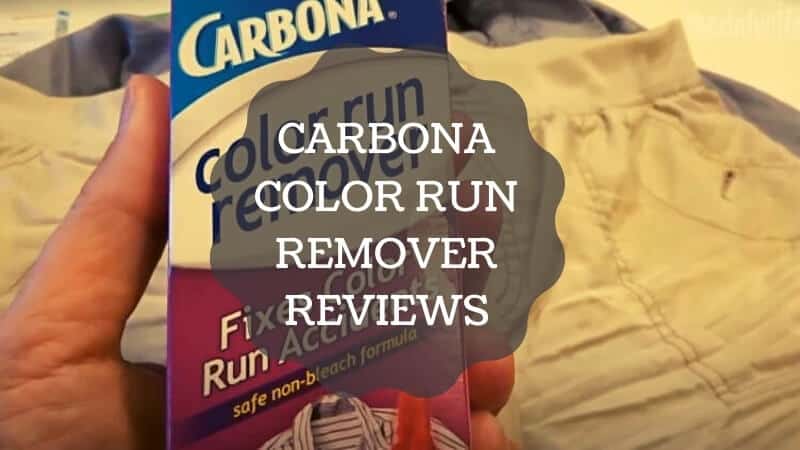
Carbona Color Run Remover is the most effective consumer-grade solution for removing color run stains from white and light-colored garments. Its Sodium Hydrosulfite-based formula breaks down dye molecules through a reduction reaction that converts insoluble pigments into water-soluble forms, lifting them from fabric fibers without damaging the original garment color.
Cross-staining or color run accidents happen regularly in laundry—even careful launderers experience them. Studies by the American Association of Textile Chemists and Colorists (AATCC) indicate wash fastness issues account for approximately 15% of all consumer textile complaints.
In this comprehensive Carbona Color Run Remover review, we cover the chemistry, application method, ingredients, and practical results in full detail.
Quick Reference
| Active Agent | Sodium Hydrosulfite (Na₂S₂O₄) |
| Product Weight | 2.6 oz (73.7 g) — single use |
| Optimal Temperature | 60–70°C (140–158°F) |
| Treatment Time | 30 minutes – 2 hours |
| Max Safe Temp | 85°C — above this, agent decomposes |
| Best For | White and light-colored garments |
How It Works
- Reduces dye molecules from insoluble to water-soluble form
- Dispersing agents prevent re-deposition onto fabric
- Optical brighteners counteract yellowing in white fabrics
- Effective on cotton, polyester, and blended fabrics
Carbona Color Run Remover Reviews
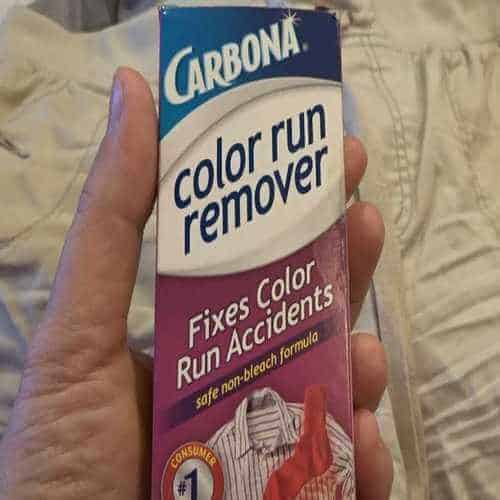
Features
- Use: Single Garment
- Weight: 2.6 Ounce (73.7 grams)
- Active Agent: Sodium Hydrosulfite (Sodium Dithionite, Na₂S₂O₄)
- Special Feature: Pleasant citrus odor from Limonene
- Best Suited for: Removing color run stains from white fabrics and brightening garments
The most compelling feature of this synthetic stain remover is its straightforward application process, which we cover in detail below.
This stain remover performs exceptionally well on white garments. It eliminates color run stains and simultaneously brightens the fabric through optical brightener technology. The product contains fluorescent brighteners that absorb ultraviolet light at 340-370 nanometers and re-emit it as blue light at 420-470 nanometers, which counteracts the yellow tint that accumulates in white fabrics over time.
The formula also demonstrates effective performance on colored garments, though certain conditions apply. When lightly colored fabrics experience dye bleeding from deeply dyed substrates—for example, red pigment on a lemon-yellow shirt—multiple treatment rounds may be necessary. No color run remover on the market guarantees complete restoration in these extreme contrast scenarios.
The Carbona formula succeeds where other products fail because it contains Sodium Hydrosulfite (Na₂S₂O₄), a reducing agent classified as sodium dithionite. This compound, combined with sodium carbonate (soda ash), breaks down permanent fabric dye molecules through a reduction reaction. The chemical decomposition converts insoluble dye molecules into their water-soluble leuco forms, which then disperse into the bath.
Additional dispersing agents keep these broken dye molecules suspended in the aqueous solution, preventing re-deposition onto fabric fibers. The formulation also includes fragrance compounds—Limonene (oil of citrus fruit peels, C₁₀H₁₈) which boils at 198-199°C with a density of 0.858-0.868 g/cm³, and Linalool (C₁₀H₁₈O)—that leave a pleasant scent on laundered items.
Overall, the Carbona Color Run Remover is a highly effective single-use treatment that resolves cross-staining issues and restores brightness in white garments. Industry wash fastness ratings (on a scale of 1-5 per AATCC standards, with 5 being best) demonstrate that properly dyed fabrics with adequate fixative treatment achieve ratings of 4-5, indicating minimal color loss during proper application.
PROS:
CONS:
How Carbona Color Run Remover Works
Color run removers combine synthetic detergents with reducing agents to achieve superior dispersion capability compared to standard laundry products. The key difference lies in the chemistry: regular detergents lift and suspend surface soils, but reducing agents like Sodium Hydrosulfite actively break the chemical bonds within dye molecules themselves.
Foreign dye molecules from color run incidents exhibit weaker bonding affinity to fabric substrates than the original dyes fixed during manufacturing. This phenomenon occurs because industrial dye fixation processes—including the use of mordants, fixatives, and high-temperature setting—create covalent and ionic bonds between dye molecules and fiber polymers.
The Carbona formula exploits this differential bonding strength. When applied, the Sodium Hydrosulfite (Na₂S₂O₄) initiates a reduction reaction that converts insoluble vat dyes and sulfur dyes into their water-soluble leuco forms. This reaction is thermodynamically favorable at temperatures between 60-85°C, where the dithionite ion remains stable. Above 85°C, Sodium Hydrosulfite decomposes rapidly into sodium sulfate and sulfur dioxide—rendering it ineffective for dye reduction.
Simultaneously, the detergent component orients around the broken dye fragments, encapsulating them in micellar structures that remain dispersed in the aqueous bath. This dual-action mechanism—chemical reduction plus physical dispersion—prevents re-deposition onto fabric surfaces.
Carbona Color Run Remover Ingredients
The complete ingredient breakdown of Carbona Color Run Remover is as follows:
- Reducing Agent (Sodium Hydrosulfite / Sodium Dithionite, Na₂S₂O₄) — Breaks down dye and stain molecules through reduction reactions. Active at 60-85°C; decomposes above 85°C.
- Alkali (Sodium Carbonate, Na₂CO₃) — Activates the reducing agent and provides detergency. Creates an alkaline bath environment (pH 10-11) optimal for dye reduction.
- Dispersing Agent (Methenamine / Hexamethylenetetramine, C₆H₁₂N₄) — Provides powerful dispersing capability to keep broken dye molecules suspended in solution.
- Fragrance Alcohol (Linalool, C₁₀H₁₈O) — Provides scent. Boiling point 198-199°C, density 0.858-0.868 g/cm³, water solubility 1.589 g/L.
- Optical Brightener (Stilbene derivative) — Absorbs UV light at 340-370 nm and re-emits as blue light at 420-470 nm, counteracting yellow tint in white fabrics.
- Fragrance (Parfum, 20-30% concentration) — Provides pleasant aroma across the treated garment.
- Citrus Peel Oil (Limonene, C₁₀H₁₈) — Delivers fresh orange fragrance. Classified as an acyclic monoterpene with antimicrobial properties.
Will Carbona Color Run Remover Damage the Original Color of My Garment
This concern ranks among the most frequently asked questions about color run removers. The answer depends directly on your garment’s dye fastness properties.
The degree of color removal risk depends on the dye type and fixative treatment applied during manufacturing.
Fabrics dyed with colorfast dye types—including fiber reactive dyes (commonly used on cotton), vat dyes, and disperse dyes (standard for polyester)—demonstrate minimal color bleeding when treated with Carbona Color Run Remover. Garments that receive proper after-treatment with fixative agents achieve AATCC wash fastness ratings of 4-5 on the 1-5 scale, indicating excellent resistance to color loss.
Carbona Color Run Remover contains Sodium Hydrosulfite, a reducing agent that breaks down dye molecules. Fabrics dyed with non-colorfast or low-quality dyes may experience fading during treatment.
Professional textile chemists recommend performing a colorfastness test before full application. This step identifies whether your garment’s dye-fiber bond can withstand the reducing agent’s effects.
How to Test Colorfastness with Carbona Color Run Remover
Testing colorfastness requires only three items and approximately 10 minutes. Follow this standardized procedure:
- Prepare 240 mL (1 cup) of warm water at approximately 40-45°C
- Add 2.5 grams (approximately 1/2 teaspoon) of Carbona Color Run Remover
- Dampen an inconspicuous area of the garment (inner seam or hem) in the solution for 2-3 minutes
- Observe whether the original color changes, bleeds, or fades
Select a test area that remains hidden from external view—inner seams, hemlines, or label areas work well for this purpose.
Visible color change or fading indicates the dye-fiber bond lacks sufficient strength for this treatment. In such cases, switch to a milder detergent specifically formulated for colored fabrics, or consult a professional dry cleaner for alternative treatment options.
How to Apply Carbona Color Run Remover
Preparing the Immersion Bath
Fill a basin, bucket, or sink with hot water at 60-70°C—the optimal temperature range for Sodium Hydrosulfite activity. Use sufficient water to fully submerge the garment. A volume of 11-15 liters (3-4 gallons) provides adequate coverage for most standard garment sizes.
Adding Carbona Color Run Remover
The product is designed for single-use applications. Pour the entire packet contents into the water bath and stir thoroughly for 30 seconds to ensure complete dissolution and distribution of the active agents.
Soaking the Garment
Immerse the stained garment fully in the bath. Agitate the fabric periodically—every 5-10 minutes—using a wooden spoon or similar implement. Inspect the stained areas at each interval. Treatment duration typically ranges from 30 minutes to 2 hours depending on the severity of the color run and the fabric type.
Rinsing and Finishing
When the color stains have disappeared, remove the garment and rinse first in warm water (35-40°C), then finish with cold running water to close fabric pores and remove residual chemicals. A second treatment round is permissible if stains persist after the first cycle, though exceeding two rounds risks fiber damage through progressive yarn degradation.
Precautions While Applying Carbona Color Run Remover
Bath Temperature Control
Maintain bath temperature between 60-70°C throughout the treatment. Above 85°C, Sodium Hydrosulfite decomposes rapidly into sodium sulfate and sulfur dioxide, eliminating its reducing capacity. Below 50°C, the reduction reaction proceeds too slowly to be effective.
Certain dye types present elevated risk at high temperatures. Acid dyes (common in wool and silk) and direct dyes (used on cotton blends) exhibit significant bleeding at boiling temperatures (100°C). If your colored garments utilize these dye systems, reduce bath temperature to 40-50°C and extend soaking time accordingly.
Avoid Adding Detergent
Do not add any laundry detergent to the bath. Carbona Color Run Remover already contains sufficient detergency properties through its sodium carbonate component. Introducing additional detergents—especially those with different ionic characteristics (cationic vs. anionic)—may trigger neutralization reactions that reduce the product’s effectiveness.
Know When to Stop
In most cases, the first application resolves the majority of color run issues. If stubborn stains persist after two complete treatment cycles, discontinue further applications. Additional rounds are neither economically justified nor harmless to fabric integrity—repeated chemical exposure progressively degrades yarn structure, potentially causing thinning, holes, or fiber loss.
Final Words
After reviewing the chemistry, application protocol, and performance characteristics of Carbona Color Run Remover, this product stands as the most reliable consumer-grade solution for color bleed recovery in white and light-colored garments. Its Sodium Hydrosulfite-based reducing agent formula works through a scientifically proven mechanism at temperatures between 60-85°C.
For those looking to remove dye from blank garments for tie-dye projects, our comprehensive best fabric dye remover review provides additional product comparisons and techniques.
REFERENCES
- PubChem. (n.d.). Sodium Hydrosulfite (Sodium Dithionite) — Na₂S₂O₄. U.S. National Library of Medicine.
- PubChem. (n.d.). Methenamine (Hexamethylenetetramine) — C₆H₁₂N₄. U.S. National Library of Medicine.
- PubChem. (n.d.). Linalool — C₁₀H₁₈O. U.S. National Library of Medicine.
- PubChem. (n.d.). Limonene — C₁₀H₁₈. U.S. National Library of Medicine.
- AATCC. (2004). American Association of Textile Chemists and Colorists — Color Fastness Testing Standards. AATCC.
- ISO. (2004). ISO 105-C12:2004 — Color Fastness to Industrial Laundering. International Organization for Standardization.


