
Process Mechanics: Drafting and Twist Insertion

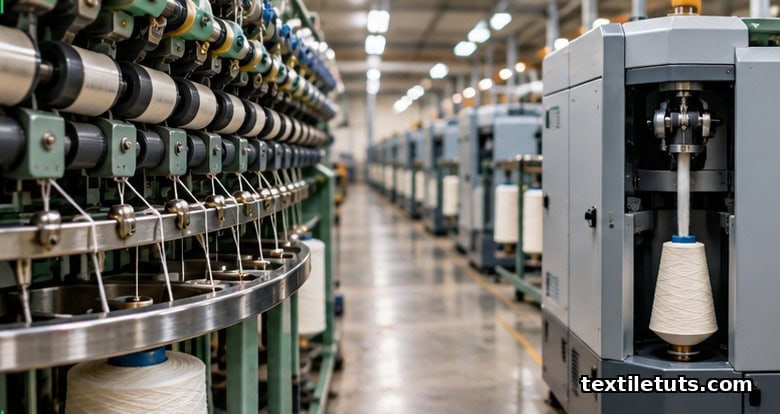
Ring spinning and rotor spinning are the two workhorse short-staple yarn formation systems used worldwide. Together they account for the majority of cotton and cotton-blend yarn produced on ring- and rotor-equipped mills, and most fabric engineers specify one or the other long before they choose a weave structure. Understanding how the two systems differ in mechanics, yarn structure, and measured properties is essential for selecting the right yarn for a given end use, whether that is a combed woven shirting, a heavyweight denim warp, a single-jersey knit, or a high-pile towel.
Process Mechanics: Drafting and Twist Insertion
Both systems start from drawn sliver and end with a wound package, but the path the fiber takes is fundamentally different. In ring spinning, the sliver is drafted by a roller drafting system into a thin fiber stream at the front drafting rollers. The strand then passes through a traveler mounted on a ring, which rotates around a stationary bobbin at speeds up to 25,000 rpm on modern machines. The traveler drags the yarn around the bobbin and inserts twist at the point of formation, while the bobbin lifts and lowers to build a cop. The twist travels upward into the drafted fiber stream, locking fibers together through lateral pressure.
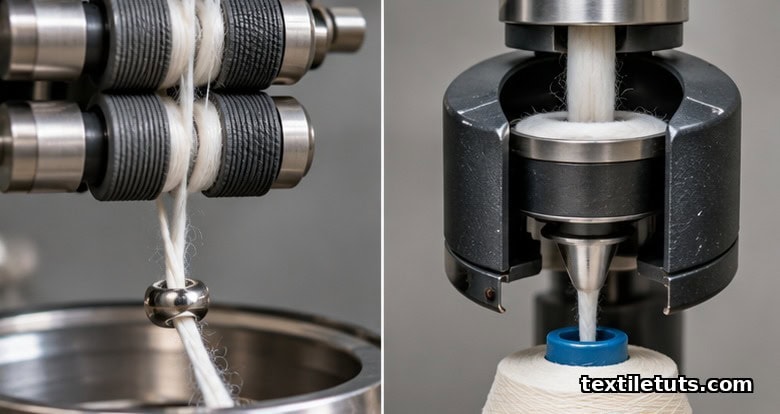
Rotor spinning (open-end rotor spinning) replaces the roller-and-ring twist zone with a rotor. The sliver is fed into a feed roller and then a combing roller, which individualizes fibers. The opening roller strips fibers from the feed stock by centrifugal force, and an airflow stream carries them through a transport tube into a rapidly rotating rotor (typically 60,000 to 150,000 rpm). Inside the rotor, fibers accumulate in the rotor groove and are peeled off as a continuous yarn by the take-up rollers. Twist is inserted by the rotation of the rotor groove itself, propagating back into the fiber ring inside the rotor.
The mechanical consequence is significant: ring spinning is a “twist-after-drafting” system with a very short, controlled twist zone, whereas rotor spinning is a “fibers-into-yarn” system with a much longer twist propagation path. This difference governs everything that follows, from yarn structure to tensile behavior.
Yarn Structure: What the Cross Section Actually Looks Like
Ring-spun yarn is built from a parallel core of drafted fibers that receive twist along the entire running length. Under ISO 2061 (determination of twist in yarns by the untwist-retwist method), the twist is uniform and the helix angle increases monotonically from the surface to the core. This produces a compact, well-oriented structure with most fibers lying close to the yarn axis. Fiber migration, the gradual movement of fibers between surface and core positions, occurs in ring yarns and contributes to fiber cohesion and strength.
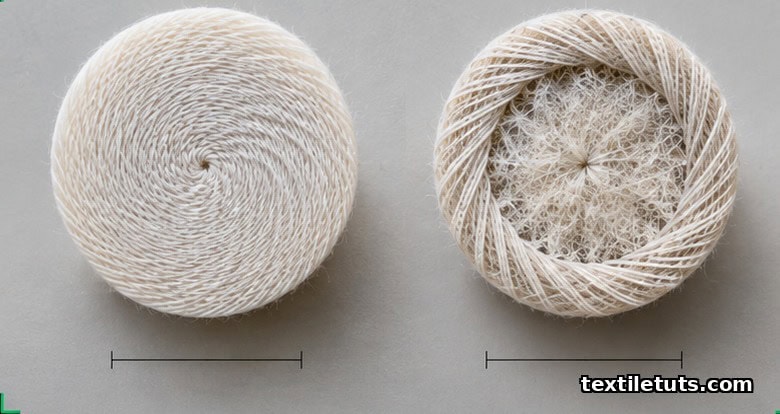
Rotor-spun yarn has a fundamentally different structure. It consists of a core of wrapper fibers (sometimes called “binding fibers” or “belt fibers”) surrounded by a more random arrangement of fibers that were deposited against the rotor groove wall. The wrapper fibers form a helical binding pattern around the core because the trailing end of each newly deposited fiber is caught by the take-up and twisted around the previously deposited fibers. The result is a yarn with two distinct zones: an inner “core” of more randomly oriented fibers and an outer zone of true wrapper fibers.
This structural difference has a name in the literature: the “two-zone” or “core-wrapper” structure of rotor yarn, documented in classic studies of open-end spinning and confirmed by tracer fiber analysis. It directly explains the property differences discussed below.
Yarn Properties: Strength, Evenness, Hairiness, and Count Range
Tensile strength and tenacity
Ring-spun yarn consistently shows higher tensile strength than rotor-spun yarn of the same fiber blend, count, and twist multiplier. The aligned core and uniform helix angle transfer load efficiently along the yarn axis. Rotor yarn loses strength because the wrapper fibers do not contribute to load-bearing capacity in the same way. Published comparisons using Uster Tensojet and ISO 2062 (yarn from packages, determination of single-end breaking force and elongation at break using constant rate of extension) typically show rotor tenacity 10 to 25 percent below ring yarn of the same nominal count and twist, depending on fiber blend and rotor type.
Evenness and imperfections
Rotor spinning has improved substantially in evenness over the past two decades, but ring spinning still holds an edge in yarn regularity when measured on an Uster Evenness Tester per ISO 16549 (determination of yarn evenness and approximation of yarn fineness by capacitance method). Rotor spinning, however, produces fewer thick places, thin places, and neps per kilometer because the opening roller removes short fibers and trash particles that would otherwise become defects. This is one reason rotor yarn remains attractive for knit apparel.
Hairiness
Rotor-spun yarn is significantly less hairy than ring-spun yarn. The wrapper fibers lie along the yarn body, and the absence of a long, thin spinning triangle in rotor spinning means fewer protruding fiber ends. Hairiness measured per ISO 7211-5 (textiles, determination of number of hairs per unit length) is typically 50 to 70 percent lower for rotor yarn of comparable count. Lower hairiness translates to better pilling resistance, less fly during weaving, and cleaner printing surfaces.
Count range and productivity
Ring spinning produces finer counts than rotor spinning. Practical ring counts extend down to approximately 4 tex (60s Ne) for cotton and finer with compact or siro-spun variants. Rotor spinning is economical from about 10 tex (60s Ne) coarser and upward, with most commercial rotor installations running 20 to 60 tex (10s to 30s Ne). On the other side, ring frames are limited by traveler speed and traveler life to about 25,000 to 30,000 rpm, while rotor speeds above 150,000 rpm are routine, giving rotor spinning a 4 to 6 times productivity advantage per delivery.
End Uses: Where Each Yarn Wins
Ring-spun yarn remains the first choice for woven warp yarns (because of higher strength and better abrasion resistance), combed shirting, fine knits, sewing thread, and any application demanding high tenacity or fine count. The wrapper structure of rotor yarn, combined with lower hairiness and better dye uptake uniformity, makes rotor yarn the standard for single-jersey knit apparel, denim weft (paired with ring-spun warp for slub effects), home furnishing towels, and technical textiles where surface uniformity matters more than maximum tenacity.
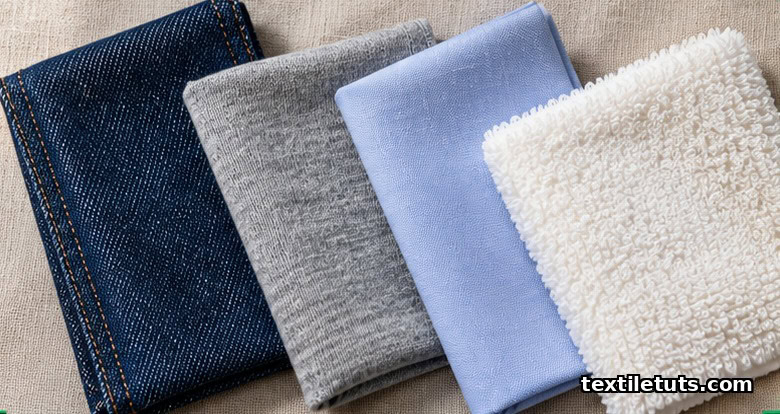
Many mills run hybrid products: a ring-spun warp paired with a rotor-spun weft for denim, or rotor-spun bodies with ring-spun collars on knit polos. The choice is rarely “either-or” in a modern fabric spec.
Market Position and Modern Trends
Rotor spinning represents a meaningful share of global short-staple yarn production, particularly in countries with a strong knitwear export industry. Ring spinning retains a larger volume share globally, especially for woven fabrics, because of its flexibility in count and blend. Compact spinning (a modified ring system that condenses the fiber strand before twist insertion), siro-spun, and vario-spun variants have narrowed some of the property gaps with rotor yarn, while modern rotor machines with longer rotor grooves and improved opening rollers have closed the count gap from the coarse side.
For the textile engineer, the practical question is not which system is “better” but which combination of properties, tenacity, evenness, hairiness, count, cost, and surface appearance, the target fabric requires. ISO 2061, ISO 2060, ISO 2062, and ISO 16549 together provide the standardized test methods needed to make that comparison with real numbers rather than supplier brochures.
Frequently Asked Questions
Which spinning system produces stronger yarn?
Ring-spun yarn is consistently stronger than rotor-spun yarn of the same fiber, count, and twist multiplier. The aligned fiber core and uniform helix angle of ring yarn transmit tensile load efficiently along the yarn axis. Typical tenacity differences range from 10 to 25 percent depending on the test method (ISO 2062) and the specific rotor design.
Why is rotor-spun yarn less hairy?
Rotor spinning lacks the long spinning triangle found at the front drafting rollers of a ring frame. Without a long, thin unsupported fiber strand, far fewer fiber ends protrude from the yarn surface. Measurements per ISO 7211-5 typically show 50 to 70 percent lower hairiness counts for rotor yarn compared to ring yarn of the same count.
Can rotor spinning produce fine counts?
Practical rotor counts for cotton typically start around 10 tex (60s Ne) and most production falls in the 20 to 60 tex (10s to 30s Ne) range. Finer counts are possible on newer rotor machines with optimized opening rollers but remain uneconomical compared to ring or compact ring systems below about 7 tex (80s Ne).
Which yarn is better for knitwear?
Rotor-spun yarn is widely favored for single-jersey knit apparel because of its lower hairiness, fewer imperfections, and softer hand. Ring-spun yarn is preferred when maximum strength, finer counts, or smoother surface for printing is required, such as in combed knit shirting or fine-gauge knit fabrics.
What standards govern yarn twist and count testing?
ISO 2061 covers the determination of yarn twist by the untwist-retwist method. ISO 2060 defines yarn count by the linear density method (tex system). ISO 2062 covers single-end tensile testing, and ISO 16549 covers yarn evenness testing using capacitance methods. ASTM D1422 and ASTM D1907 provide equivalent methods under U.S. standards.
References
- ISO 2061:2015. Textiles, Determination of twist in yarns, Untwist/retwist method. International Organization for Standardization, Geneva.
- ISO 2060:1994. Textiles, Yarn from packages, Determination of linear density (mass per unit length) by the skein method. International Organization for Standardization, Geneva.
- ISO 2062:2009. Textiles, Yarns from packages, Determination of single-end breaking force and elongation at break using constant rate of extension (CRE) tester. International Organization for Standardization, Geneva.
- ISO 16549:2004. Textiles, Determination of yarn evenness and approximation of yarn fineness by capacitance method. International Organization for Standardization, Geneva.
- ISO 7211-5:2020. Textiles, Methods for analysis of woven fabrics, Part 5: Determination of number of hairs per unit length. International Organization for Standardization, Geneva.
- Klein, W. (1987). A Practical Guide to Opening, Carding and Cleaning of Cotton. The Textile Institute, Manchester.
- Lawrence, C.A. (2003). Fundamentals of Spun Yarn Technology. CRC Press, Boca Raton. ISBN 978-1566768138.
Editorial by Iftay Khairul Alam, TextileTuts


