
Recycled Polyester (rPET): Process, Properties, Applications

What is recycled polyester (rPET)?
Recycled polyethylene terephthalate, abbreviated rPET, is PET that has been recovered from post-consumer or post-industrial waste and reprocessed into new fiber, film, or resin. In textiles, rPET is the dominant recycled synthetic fiber, accounting for the majority of recycled polyester used in apparel, home textiles, and technical textiles as of 2026. The driving force is the lower environmental footprint of rPET versus virgin PET: rPET fiber production uses roughly 30–50% less energy and reduces greenhouse-gas emissions by 30–60% compared to virgin polyester, depending on the source stream and processing route.
The post-consumer waste stream for rPET is primarily PET beverage bottles, which are collected through municipal recycling, deposit-return schemes, and brand-sponsored take-back programs. Post-industrial waste (pre-consumer) includes fiber and yarn waste from spinning mills, fabric waste from cutting rooms, and overstock fabric. Both streams are mechanically or chemically reprocessed into rPET chips, which are then melt-spun into fiber, extruded into film, or injection-molded into rigid packaging.
Why rPET matters
Virgin polyester is derived from fossil-fuel feedstocks (paraxylene → purified terephthalic acid + monoethylene glycol → PET). The textile industry consumes roughly 50–60 million metric tons of polyester fiber per year, making PET the single largest produced fiber globally. Replacing even a portion of this with rPET cuts the embedded carbon and reduces plastic waste in landfills and oceans. Major brands and retailers, including the EU’s mandatory recycled-content rules under the ESPR textile strategy, have set rPET targets ranging from 50% to 100% recycled content for polyester in their products by 2030.
Beyond the environmental case, rPET has a circularity argument: a PET bottle can become a polyester shirt, which can be recycled again at end-of-life, closing the loop. In practice, fiber-to-fiber recycling (recycling old garments into new fiber) is technically possible but commercially limited because of fiber-degradation issues (the polymer chains shorten with each thermal cycle, reducing strength and processability). The dominant rPET stream is still bottle-to-fiber, which is essentially a downcycling: the bottle becomes a fiber, not another bottle.
Manufacturing process
The bottle-to-fiber rPET process has four main stages.
1. Collection and sorting
Post-consumer PET bottles are collected through municipal recycling programs (curbside bins, deposit-return schemes) or brand-sponsored collection points. The bottles are then sorted by color (clear, green, blue, mixed), by resin type (PET vs other plastics), and by contamination level. Manual sorting is the standard; automated sorting using near-infrared (NIR) spectroscopy is increasingly common and allows high-throughput identification of PET vs other polymers.
Pre-consumer (post-industrial) waste is cleaner and more consistent because it comes from a known source (e.g., a specific yarn or fabric type). It typically doesn’t require the same level of sorting but still needs cleaning to remove size, oil, and other finishing residues.
2. Washing and shredding
Sorted bottles are washed in hot caustic solution to remove labels, adhesives, food residue, and other contaminants. The washed bottles are then shredded into small flakes (typically 4–8 mm), which are inspected for color (clear flakes for fiber, mixed colors for lower-grade applications) and further cleaned by float-sink separation (PET sinks, PP/PE caps and labels float).
3. Extrusion and chip formation
The clean flakes are dried and melted in an extruder at 260–280 °C. The molten polymer is filtered through fine screens to remove any remaining particulates, then extruded through a die to form strands, which are cooled and cut into chips. The chips are the feedstock for fiber spinning (rPET fiber), film extrusion (rPET film), or bottle re-blow-molding (rPET resin for new bottles).
For food-contact applications, the rPET chips must meet strict purity standards (typically < 0.1 ppm contaminants in the EU and US FDA regulations). For textile applications, the standards are less strict but still require consistent viscosity, low contamination, and freedom from yellowing.
4. Fiber spinning
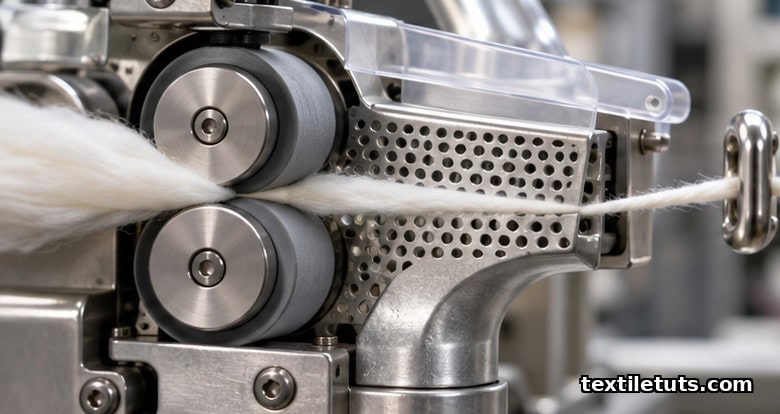
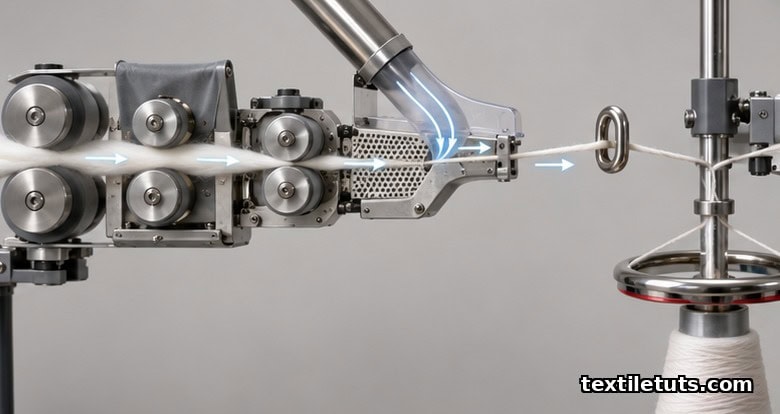
The rPET chips are melt-spun using the same equipment as virgin PET: chips are fed into a screw extruder, melted, filtered, and extruded through a spinneret. The molten filaments are cooled, drawn (to orient the polymer chains and develop tensile strength), and wound onto bobbins. The fiber can be produced as filament (continuous filament yarn) or as staple (cut to 32–102 mm lengths for spinning into yarn on cotton or wool spinning systems).
Recycled PET chips can be processed on the same spinning lines as virgin PET, but several process adjustments are typically needed: melt temperature may be slightly lower (to reduce thermal degradation), spinning speeds may be reduced (to maintain fiber uniformity), and additional filtration may be required (to remove any residual contamination from the recycling process).
Properties of rPET fiber
rPET fiber is chemically identical to virgin PET fiber (both are polyethylene terephthalate). The properties are very similar but with some characteristic differences.
Compared to virgin PET fiber at the same denier, rPET typically has: (1) slightly lower tensile strength (5–10% lower) due to reduced average molecular weight from thermal reprocessing; (2) slightly higher elongation at break, which is a partial compensation for the strength loss; (3) similar moisture regain (0.4%, low, both PET variants are hydrophobic); (4) similar dye uptake with disperse dyes (the standard polyester dye class), though the dye shade may shift slightly toward yellow at high recycled content due to residual contaminants and thermal degradation; (5) similar UV resistance, lightfastness, and chemical resistance to most acids and alkalis.
The mechanical properties (strength, elongation) of rPET are typically sufficient for most apparel and home-textile end uses. They may be marginal for high-performance technical applications (tire cord, conveyor belt fabric) where virgin PET’s higher strength is preferred.
End-use applications
rPET is used across the textile industry wherever virgin polyester is used, with the highest volumes in: (1) apparel, activewear, casual wear, outerwear shell fabrics, fleece; (2) home textiles, carpets, rugs, bedding, curtains, upholstery; (3) technical textiles, geotextiles, automotive interior fabrics, filtration media, nonwovens; (4) packaging, shopping bags, reusable bags, strapping.
The largest single end use for rPET fiber is carpet. Residential and commercial carpet is typically made from bulked continuous filament (BCF) nylon or PET, and the PET version is increasingly rPET. Major carpet brands (Shaw, Mohawk, Interface) have committed to 100% rPET content in their BCF PET products by 2030, driving a substantial demand for clean post-consumer bottle flake.
For apparel, rPET is most common in performance and outdoor wear (Patagonia, H&M, Adidas have all launched rPET product lines). In everyday apparel, rPET is less common because the visual and tactile properties of rPET fiber are slightly different from virgin, and the price premium for rPET is harder to justify for low-margin products.
Sustainability and certification
The two main certification schemes for rPET are the Global Recycled Standard (GRS) and the Recycled Claim Standard (RCS), both run by Textile Exchange. GRS is the more comprehensive: it covers chain-of-custody, environmental and social criteria, and a minimum recycled content (typically 20% for GRS products, 50% for GRS-label products). RCS covers chain-of-custody and recycled-content claims only, without the social/environmental add-ons.
For food-contact rPET (new bottles), the regulatory framework is more demanding: EFSA in the EU and FDA in the US have established specific migration limits and require functional barriers for sensitive applications. For textile rPET, no such barriers exist, but the GRS/RCS certification provides a market signal of genuine recycled content.
Frequently Asked Questions
Is rPET as durable as virgin polyester?
For most textile end uses, yes, the durability of rPET is within 5–10% of virgin PET, which is well within the safety margin for apparel and home textiles. The slight reduction in tensile strength is offset by higher elongation. For high-stress technical applications (tire cord, industrial fabrics), virgin PET is still preferred because the small strength difference compounds over many cycles of stress.
Does rPET shed microplastics like virgin polyester?
Yes, the shedding behavior of rPET is essentially identical to virgin PET, because both are the same polymer with the same fiber structure. The microplastic-shedding issue is a property of the polymer, not of whether it was recycled. Mitigations (tighter fabric construction, finishing treatments, washing-machine filters) apply equally to both.
Can rPET be recycled again after the textile’s end of life?
Technically yes, but commercially limited. Fiber-to-fiber recycling (taking an old rPET shirt and making a new rPET fiber from it) is possible but produces fiber with lower molecular weight, which limits the applications. The dominant recycling path for rPET textiles is still downcycling (textile-to-carpet, textile-to-insulation) rather than closed-loop recycling. Closed-loop textile-to-textile recycling is an active area of research and investment, with chemical-recycling processes (enzymatic depolymerization, glycolysis) being the most promising technology.
How much energy does rPET production save?
Compared to virgin PET, rPET fiber production saves approximately 30–50% of the energy and reduces greenhouse-gas emissions by 30–60%. The exact savings depend on the source stream (bottle-to-fiber vs fiber-to-fiber) and the energy mix in the production country (renewable energy reduces the carbon footprint further).
What is the difference between rPET and recycled cotton?
rPET is a synthetic fiber recycled from plastic bottles; recycled cotton is a natural fiber recycled from textile waste. rPET has consistent fiber length and quality (because the recycling process resets the fiber); recycled cotton has shorter, more variable fibers (because mechanical recycling tears the existing fibers). rPET can be processed on standard polyester spinning lines; recycled cotton typically requires blending with virgin cotton for spinnability. Both are more sustainable than their virgin counterparts, but in different ways and with different property trade-offs.
References
- QIMA (accredited third-party testing lab). Recycled Polyester Fabric: Transforming the Textile Industry. https://www.qima.com/blog/sustainability/recycled-polyester-fabric-transforming-textile-industry, sustainability and certification of rPET in textile applications.
- Sandin, G., & Peters, G. M. (2018). Environmental impact of textile reuse and recycling, A review. Journal of Cleaner Production, 184, 353-365. (PMC9003056) – peer-reviewed comparison of textile recycling pathways including bottle-to-fiber rPET.
- IntechOpen (peer-reviewed open-access publisher). Recycled Polyester: Manufacturing, Properties, and Applications. https://www.intechopen.com/online-first/1245607, comprehensive chapter on rPET processing routes, fiber properties, and end uses.
- Textile Exchange (2023). Global Recycled Standard (GRS) – Version 4.0. https://textileexchange.org, certification requirements for recycled-content claims in textiles.
- ISO 16150:2021, Plastics, Determination of viscosity number of poly(ethylene terephthalate) (PET) and poly(butylene terephthalate) (PBT) in dilute solution.
This article is the working reference for recycled polyester (rPET). Editorial by Iftay Khairul Alam, TextileTuts. Sources: QIMA (third-party testing methodology), peer-reviewed journal article (Sandin & Peters 2018), IntechOpen chapter, Textile Exchange GRS standard, ISO 16150 as cited.


