
What is recycled cotton?

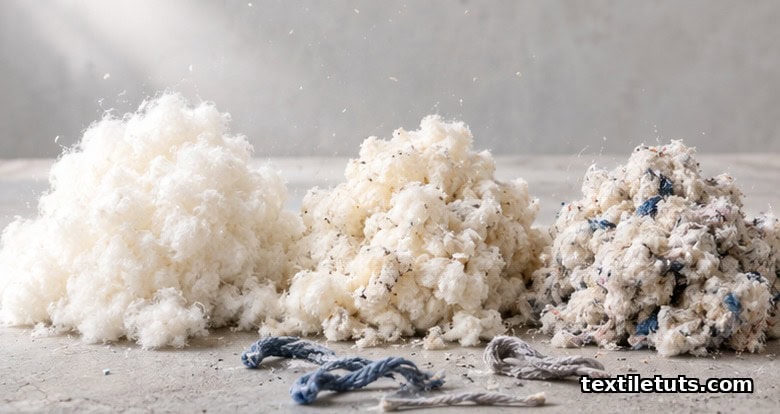
Recycled cotton is cotton fiber recovered from pre-consumer or post-consumer textile waste and re-spun into new yarn. The waste streams are: (1) pre-consumer waste, manufacturing offcuts, yarn waste, fabric waste, selvage, and overstock; (2) post-consumer waste, used textiles recovered from collection, sorting, and recycling programs. The dominant use is pre-consumer waste, because it is cleaner, more consistent in fiber composition, and more readily available in large volumes from manufacturing hubs.
Recycled cotton accounts for roughly 1-2% of global cotton fiber production, but the share is growing rapidly as brands commit to recycled content targets and as the textile-to-textile recycling industry scales up. The 2025 EU ESPR textile strategy mandates increasing recycled content in textiles, which is driving investment in cotton recycling infrastructure.
Why recycled cotton matters
Virgin cotton production has a high environmental footprint: it is water-intensive (10,000+ liters per kg of fiber in some regions), pesticide-intensive (16% of global insecticide use, despite occupying 2.5% of agricultural land), and land-intensive. Recycling cotton reduces water use by 70-90% compared to virgin production and avoids the pesticide and land-use burden entirely.
Recycled cotton is also a circularity argument. The dominant cotton recycling path is textile-to-textile (old garment to new yarn), which keeps the cotton fiber in use for multiple lifecycles and reduces the demand for virgin cotton. In practice, current cotton recycling is mostly pre-consumer waste (cleaner, more consistent), with post-consumer textile-to-textile recycling still in early commercial scale-up.
Manufacturing process
Cotton recycling has two main process routes: mechanical recycling (the dominant technology today) and chemical recycling (emerging, with significant investment from 2023 onwards).
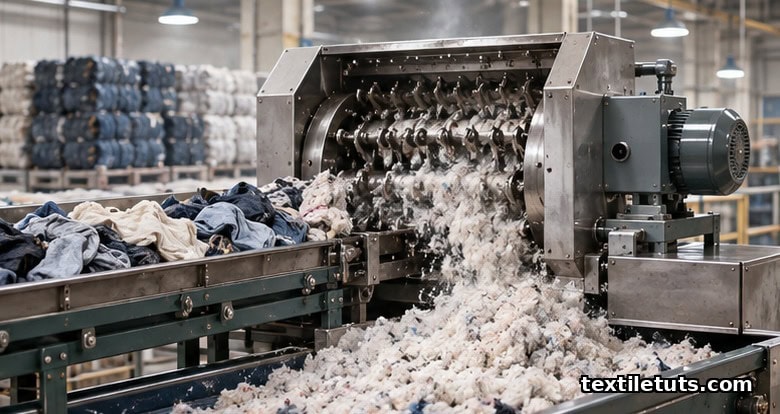
Mechanical recycling
Mechanical recycling tears the textile waste back into individual cotton fibers, which can then be re-spun into yarn. The steps are: (1) sorting and grading (by fiber composition, color, and condition); (2) cutting and tearing (mechanical shredding that separates the yarn into fibers); (3) cleaning (mechanical beating, aqueous washing, optional solvent extraction for post-consumer waste); (4) carding (aligning the fibers and removing residual vegetable matter); (5) spinning (on the same cotton spinning systems used for virgin cotton, though with process adjustments for the shorter fiber length).
Each tear pass shortens the fibers. Cotton fibers lose 30-50% of their length per pass, so after 2-3 passes the fibers are too short to spin on their own. The result is that recycled cotton is almost always blended with longer fibers (virgin cotton, polyester, or acrylic) to make a spinnable yarn. Pure recycled cotton is rare in apparel for this reason; it is more common in lower-grade applications like wiping cloths and industrial textiles where strength is less critical.
Chemical recycling
Chemical recycling dissolves the cotton fiber back into its molecular components (cellulose) and re-spins the cellulose into new fiber. The advantage is that the resulting fiber has nearly the same length as virgin cotton, so it can be used in the same spinning systems and end uses without blending. The disadvantage is the cost: chemical recycling requires specialized solvents (often ionic liquids or deep eutectic solvents), high energy, and careful solvent recovery and recycling.
As of 2026, several commercial-scale chemical cotton recycling plants are operating or under construction, including Renewcell (Sweden, now bankrupt but technology continues), Infinited Fiber (Finland), and Circ (US/Belgium). The technology is real and commercial but is not yet at the scale or cost parity needed to displace mechanical recycling for most applications.
Properties of recycled cotton
Recycled cotton has shorter fibers (20-40 mm) than virgin cotton (25-35 mm for typical upland, longer for pima and Egyptian), which is the primary driver of other property differences. Compared to virgin cotton at the same yarn count, recycled cotton has lower tensile strength, lower abrasion resistance, higher pilling tendency, and lower dye uptake uniformity. The fabric hand is typically stiffer and more variable than virgin cotton.
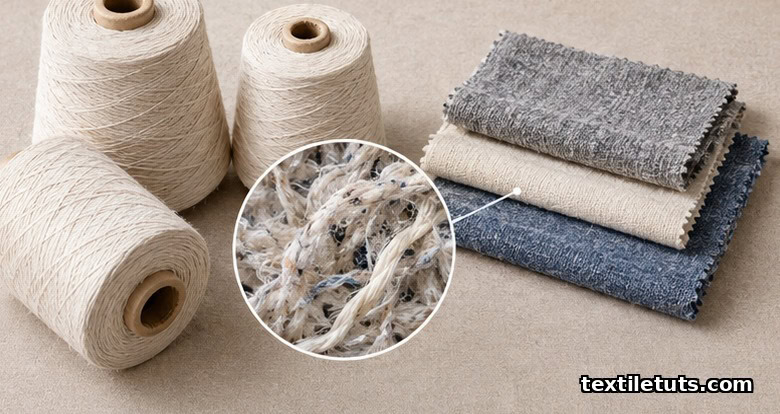
The property degradation is most pronounced for post-consumer waste (which has been through many wear-and-wash cycles) and less pronounced for pre-consumer waste (which has not been through use). Pre-consumer recycled cotton is the dominant product because the property trade-off is acceptable for most end uses; post-consumer recycled cotton is still in early commercial development.
Recycled cotton is most commonly blended with virgin cotton (typical blend ratios 30/70 to 50/50 recycled/virgin) or with polyester (typical 50/50) to bring the property profile back to acceptable levels. The blend ratio depends on the end use and the brand’s sustainability targets.
End-use applications
Recycled cotton is used across the textile industry wherever cotton is used, with the highest volumes in:
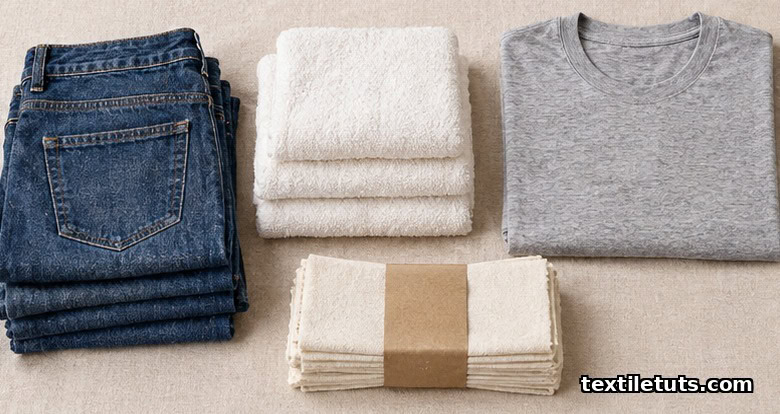
- Apparel, basic t-shirts, casual shirts, denim weft yarn, sweatshirts and fleece
- Home textiles, towels, bed linens, curtains, upholstery
- Nonwovens, wipes, filtration media, hygiene products
- Industrial, wiping cloths, polishing cloths, absorbent materials
The largest end use is the apparel weft yarn in denim. Recycled cotton weft is now standard in many mid-market and premium denim products, where the recycled content claim is in the weft while the warp remains virgin cotton for the indigo dye performance.
For home textiles, recycled cotton towels and bed linens are increasingly common at the mid-market and premium segments. The slightly stiffer hand of recycled cotton is acceptable for towels (where absorbency is the key property) and for bed linens (where durability and softness are both important and improved finishing can compensate for the recycled fiber’s hand).
Sustainability and certification
The two main certification schemes for recycled cotton are the Global Recycled Standard (GRS) and the Recycled Claim Standard (RCS), both run by Textile Exchange. GRS is the more comprehensive: it covers chain-of-custody, environmental and social criteria, and a minimum recycled content (typically 20% for GRS products, 50% for GRS-label products). RCS covers chain-of-custody and recycled-content claims only.
The GOTS (Global Organic Textile Standard) also covers recycled cotton but in a different way. GOTS is primarily an organic cotton standard, but GOTS 6.0 (2021+) allows blends of organic cotton with recycled cotton. A GOTS-certified blended product can claim both organic and recycled content, which is increasingly common in the premium apparel segment.
Frequently Asked Questions
Is recycled cotton as soft as virgin cotton?
Generally no, recycled cotton is slightly stiffer than virgin cotton because the fibers are shorter and have more damaged surfaces. The hand can be improved by blending with virgin cotton or by additional finishing (mercerizing, enzyme treatment, softener application), but a pure recycled cotton fabric will feel slightly stiffer than a pure virgin cotton fabric at the same yarn count and construction.
Can recycled cotton be dyed with the same dyes as virgin cotton?
Yes, recycled cotton can be dyed with the same dye classes as virgin cotton (reactive, direct, vat). The dye uptake is generally less uniform because the fiber surfaces are more variable, which can result in slight shade variation. This is usually acceptable for heathered or melange effects, but for solid shades the dye process may need to be adjusted (longer dyeing time, higher temperature, or pre-treatment) to achieve the same uniformity as virgin cotton.
Is recycled cotton more sustainable than recycled wool?
Recycled cotton and recycled wool have different sustainability profiles. Recycled cotton has a higher water and pesticide footprint in the virgin-cotton-avoided component, but the recycling process itself is lower-impact than wool recycling. Recycled wool avoids the methane emissions and land use of sheep farming, but the wool recycling process (mechanical tearing) is more energy-intensive than cotton recycling. Both are more sustainable than their virgin counterparts, but neither is unambiguously better than the other, the choice depends on which impact category matters most for a given brand.
What is the difference between recycled cotton and upcycled cotton?
Recycled cotton is processed (teared back to fiber, re-spun into yarn, re-woven) – the fiber is broken down and reformed. Upcycled cotton is reused without fiber-level processing, for example, an old cotton shirt is cut up and sewn into a new garment without re-spinning the fiber. Upcycling preserves the fiber’s original properties (length, strength, dye) but is limited by the available waste stream; recycling is more flexible but degrades the fiber.
What is the future of cotton recycling?
The future is chemical recycling. Mechanical recycling will continue to be the dominant technology for the next 5-10 years, but it has a fiber-degradation ceiling that limits the quality of recycled cotton. Chemical recycling (which dissolves the fiber to cellulose and re-spins it) preserves the fiber length and quality and is the only technology that can produce recycled cotton at the same quality as virgin. As chemical recycling plants scale and costs come down, the recycled cotton market is expected to grow significantly, from roughly 1-2% of cotton fiber today to 10-20% by 2035.
References
- ScienceDirect (peer-reviewed). Recycled fibers from pre- and post-consumer textile waste for the production of textile applications. https://www.sciencedirect.com/science/article/pii/S2405844022025634, peer-reviewed review of recycled cotton processing routes, fiber properties, and end uses.
- Textile Exchange (2023). Global Recycled Standard (GRS) – Version 4.0. https://textileexchange.org, certification requirements for recycled-content claims in textiles.
- ISO 2647:1978, Wool, Determination of fibre length (barbe and hauteur) using a fibre diagram apparatus. – fiber length measurement method applicable to recycled cotton fiber.
This article is the working reference for recycled cotton. Editorial by Iftay Khairul Alam, TextileTuts. Sources: peer-reviewed ScienceDirect article, Textile Exchange GRS standard, ISO 2647 as cited.


