
Different Types of Dyes and Their Properties

What is Dye?
What is Dye?
A dye is a colored substance that chemically binds to textile fibers, imparting permanent color through covalent, ionic, or Van der Waals bonds. Unlike pigments, which remain insoluble in virtually all solvents, dyes dissolve in a carrier solvent—typically water—and form covalent, ionic, or Van der Waals bonds with fiber molecules. The global textile dye industry produces approximately 700,000 metric tons of dyestuffs annually, with synthetic dyes dominating the market since the discovery of mauveine by William Henry Perkin in 1856. The Colour Index International catalog references over 10,000 distinct dye products, of which azo dyes constitute more than 50% of all listed colorants.
The textile industry classifies dyes into four primary categories based on their source, ionic character, chromophoric chemistry, and application method. Each classification serves specific fiber types and delivers distinct performance characteristics.
Types of Dyes
Based on the Source
- Natural dyes — derived from plant, animal, or mineral origins (e.g., indigo extracted from Indigofera tinctoria, madder from Rubia tinctorum)
- Synthetic dyes — manufactured from petrochemical intermediates, offering reproducible color consistency and broader shade range
Based on Ionic Nature
- Anionic dyes — carry a negative charge; includes reactive dyes, acid dyes, and direct dyes
- Cationic dyes — carry a positive charge; includes basic (or cationic) dyes
- Non-ionic dyes — carry no charge; includes disperse dyes used for hydrophobic synthetic fibers
Based on Chromophoric Groups
- Azo dyes — the largest class, containing –N=N– linkages; represent more than 50% of all commercial dyes
- Anthraquinone dyes — provide colors ranging from yellow to red and blue to green; common in disperse and vat dyes
- Nitro and nitroso dyes — exhibit yellow to brown hues with notably high light fastness
- Triarylmethane dyes — produce intense, brilliant colors, particularly in basic and acid dye classes
- Indigo dyes — include natural and synthetic indigo, historically one of the most important textile dyes
Based on Chemical Structure
Ready-made Dyes
- Water-soluble dyes — reactive dyes, direct dyes, and acid dyes contain sodium sulphonate (–SO₃⁻Na⁺) or carboxylic acid groups that enable aqueous dissolution
- Water-insoluble dyes — vat dyes and sulphur dyes require reduction (vatting) or solubilization before application
Ingrain Dyes
- Mineral colors — inorganic pigments formed directly on fiber through chemical precipitation
- Azoic colors — produced in situ on the fiber through diazonium coupling with naphthol intermediates
- Oxidation colors — formed by oxidizing aromatic amines directly on or within the fiber
Basic Theory of Dyeing
In textile dyeing, color is transferred from a dyebath to a fabric or yarn, producing a permanent coloration. The industry accomplishes this through specialized machinery including winch dyeing machines, jet dyeing machines, jig dyeing machines, and package dyeing machines capable of operating at temperatures up to 130°C under pressure. The Colour Index classifies textile colorants using a standardized nomenclature that identifies dye classes by their chemical constitution and application properties.
The interaction between dyes and textile fibers involves three sequential stages, each governed by specific physio-chemical principles.
- Adsorption — dye molecules migrate from the dyebath solution to the fiber surface, driven by concentration gradient and substantivity
- Absorption (Diffusion) — dye molecules penetrate the fiber interior through amorphous regions and pores, with diffusion rate dependent on temperature, pH, and fiber swelling
- Fixation — dyes are retained within the fiber through covalent bonds (reactive dyes), ionic bonds (acid dyes), hydrogen bonds and Van der Waals forces (direct dyes), or mechanical entrapment (vat and disperse dyes)
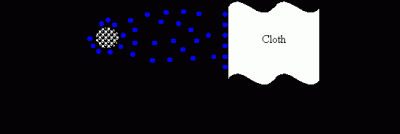
Textile coloration methods include seven distinct processes suited to different product forms and quality requirements.
- Direct dyeing — simplest method, dye applied directly to fiber in aqueous bath
- Yarn dyeing — yarns dyed prior to weaving/knitting, allowing color pattern control
- Garment dyeing — finished garments dyed as assembled units for fashion flexibility
- Stock dyeing — loose fiber stock dyed before spinning
- Top dyeing — combed wool top (roving) dyed before blending
- Piece dyeing — woven or knitted fabric dyed after construction
- Dope dyeing — colorant mixed with polymer solution before extrusion, producing solution-colored fibers with exceptional wash fastness
Different Dyes with Their Properties
Each dye class exhibits distinct chemical properties, application requirements, and performance characteristics that determine its suitability for specific fiber types and end-use applications.
Direct Dyes
Direct dyes—also called substantive dyes—possess an affinity for cellulose fibers and can be applied directly without a mordant. These dyes are sodium salts of sulphonic acid or carboxylic acid, with the azo group (–N=N–) serving as the primary chromophore. The global textile industry uses direct dyes extensively for cotton, viscose rayon, and linen due to their cost-effectiveness and application simplicity.
Properties of Direct Dyes
- Water-soluble and anionic in nature, with substantivity for cellulosic fibers
- The dyeing process requires electrolytes (typically sodium chloride or sodium sulphate at 5–80 g/L) and alkaline conditions maintained at pH 10–11
- Primarily applied to cellulosic fibers; limited substantivity for protein fibers
- Wet fastness ratings range from 1 to 3 on the 5-point ISO scale, classified as poor to moderate; after-treatment with cationic fixing agents improves wash fastness to rating 3–4
- Attachment to fiber occurs through weak hydrogen bonds and Van der Waals forces of attraction
- Cost-effective compared to reactive and vat dyes; widely used in developing economies
Primary Mechanism of Direct Dyes
When direct dyes dissolve in water, they dissociate into anionic dye molecules and sodium ions. Cellulosic fibers absorb water and swell, developing a negative surface charge due to ionization of hydroxyl groups (Cell–OH → Cell–O⁻ + H⁺). Electrolytes added to the dyebath neutralize this surface charge, reducing repulsion between the anionic dye and the fiber. The opened pores in the amorphous regions of swollen cellulose allow dye molecules to diffuse inward, where fixation occurs through physical adsorption forces—hydrogen bonding and Van der Waals forces. Because these bonds are weak, wash fastness remains the primary limitation of direct dyes.
Primary Applications: Cotton, linen, viscose rayon, and blended cellulosic fabrics.
Reactive Dyes
Reactive dyes contain a halogen-containing reactive group (such as dichlorotriazine, monochlorotriazine, or vinyl sulphone) that forms a covalent bond with fiber hydroxyl groups, becoming an integral part of the polymer chain. This covalent bonding mechanism delivers superior wash fastness compared to direct dyes. Reactive dyes represent the most widely used class for dyeing cotton globally, accounting for approximately 60–70% of all cellulosic fiber coloration.
Properties of Reactive Dyes
- Water-soluble and anionic; contain one or more reactive groups per molecule
- Wash fastness rated 4–5 on the ISO 5-point scale; light fastness rated 5–7 on the 8-point ISO scale
- Covalent bond formation with cellulose hydroxyl groups (Cell–OH) ensures excellent durability
- Available in powder, liquid, and paste forms; liquid formulations offer faster dissolution
- Dyeing requires alkaline conditions (pH 10–12) using caustic soda (NaOH) or soda ash (Na₂CO₃), and electrolytes (40–80 g/L NaCl or Na₂SO₄)
Primary Mechanism of Reactive Dyes

The reactive dye dyeing process consists of three distinct stages:
- Exhaustion — electrolyte (NaCl or Na₂SO₄ at 40–80 g/L) promotes dye adsorption onto the fiber surface
- Fixation — alkali (soda ash or caustic soda) raises dyebath pH to 10.5–12, deprotonating cellulose (Cell–OH → Cell–O⁻) and activating the nucleophilic substitution reaction where the reactive group (e.g., –Cl in dichlorotriazine) is displaced by Cell–O⁻
- Washing-off — hot water and soaping agent removes unfixed (hydrolyzed) dye from the fiber surface
Reactive dyes form two primary reaction types with cellulose:
Nucleophilic Substitution Reaction (e.g., Dichlorotriazine Systems)
Cell–OH + OH⁻ ⇒ Cell–O⁻ + H₂O
Cell–O⁻ + Dye–Cl ⇒ Cell–O–Dye + Cl⁻
Nucleophilic Addition Reaction (e.g., Vinyl Sulphone Systems)
Cell–O⁻ + Dye–SO₂–CH=CH₂ ⇒ Dye–SO₂–CH=CH₂–O–Cell
The dyeing temperature depends on the reactive group: dichlorotriazine systems exhaust optimally at 30°C; vinyl sulphone systems at 40°C; monochlorotriazine systems at 80°C; and trichloropyrimidine systems at 80–98°C. Bifunctional reactive dyes—containing two reactive groups per molecule—achieve higher fixation efficiency (up to 90%) and greater tolerance to temperature deviations during processing.
Primary Applications: Cotton, linen, viscose, and to a lesser extent wool, silk, and polyamide fibers.
Acid Dyes
The application of acid dyes requires an acidic dyebath (pH 2–6, typically maintained with sulphuric acid or formic acid). These dyes are sodium salts of sulphonic acid or carboxylic acid and are applied primarily to protein fibers and polyamide substrates.
Properties of Acid Dyes
- Highly water-soluble and anionic in nature
- Substantivity for protein fibers (wool, silk) and synthetic polyamide (nylon) through ionic bonding with protonated amino groups
- Primary bond formation is ionic (salt linkage) between dye anion (R–SO₃⁻) and protonated amino groups (–NH₃⁺) on the fiber; Van der Waals forces and hydrogen bonding contribute secondarily
- Light fastness rated 4–7 on the 8-point ISO scale; wet fastness rated 1–4 on the 5-point ISO scale
- Acidic dyebath conditions (pH 2–6) are essential for protonating fiber amino groups to enable ionic bonding
Primary Mechanism of Acid Dyes
Protein fibers such as wool contain both amino (–NH₂) and carboxylic acid (–COOH) groups. At the isoelectric point (pH ~4.5–5.5 for wool), these groups exist predominantly as zwitterions (H₃N⁺–W–COO⁻). Below the isoelectric point (acidic conditions), the carboxylic acid groups become protonated (–COOH), giving the fiber an overall positive charge:
H₂N—W—COOH ⇌ H₃N⁺—W—COO⁻ (at pH ≈ isoelectric point)
H₃N⁺—W—COO⁻ + H⁺ + Cl⁻ ⇌ Cl⁻ + H₃N⁺—W—COOH (below isoelectric point)
When acid dye is added:
H₃N⁺—W—COOH + R–SO₃⁻Na⁺ ⇌ R–SO₃⁻—H₃N⁺—W—COOH + NaCl
Wool (Acid Medium) + Acid Dye ⇌ Dyed Wool + Salt
Primary Applications: Wool, silk, nylon, and other polyamide fibers.
Basic Dyes
Basic (cationic) dyes are salts of organic bases, where the cationic part of the dye molecule—typically a triphenylmethane, azine, or acridine derivative—carries the chromophore responsible for color. These dyes produce exceptionally vivid and brilliant shades on appropriate substrates.
Properties of Basic Dyes
- Cationic (positively charged) in solution
- Soluble in alcohol and methylated spirit; require acetic acid or similar co-solvents for aqueous application
- Exhibit brilliant shades with high tinctorial strength but moderate leveling properties
- Primarily applied to acrylic (polyacrylonitrile) fibers and modified cationic-dyeable polyesters
- Wash fastness rated 3–4 on the ISO 5-point scale when applied correctly; light fastness rated 4–6 on the 8-point ISO scale
Primary Mechanism of Basic Dyes
Acrylic fibers contain anionic sites introduced during copolymerization with ionic monomers (such as sodium styrene sulphonate). These anionic sites (–SO₃⁻) provide substantivity for cationic dye molecules through ionic attraction. The dyeing of acrylic fiber requires a weakly acidic bath (pH 4–5) maintained with acetic acid and sodium acetate, along with a wetting agent, dispersing agent, and sequestering agent.
Acrylic fibers exhibit rapid initial dye uptake, making a retarding agent (such as a non-ionic surfactant or a cationic competitor) essential for achieving level dyeing. The standard dyeing temperature is 98–100°C, maintained for 60–90 minutes, followed by controlled slow cooling to prevent creasing and ensure uniform color distribution. After-treatment with a non-ionic detergent, acetic acid, and a softening agent improves handle and wash fastness.
Primary Applications: Best suited for dyeing acrylic yarn and fabric; limited use on jute.
Vat Dyes
Vat dyes contain a carbonyl group (C=O) in their structure that undergoes reversible reduction to a water-soluble leuco form using a reducing agent in alkaline conditions. This vatted form penetrates the fiber before oxidation converts it back to the insoluble pigment within the textile material. Vat dyes produce colors with exceptional wash and light fastness, making them the preferred choice for heavy-duty workwear fabrics such as denim and canvas.
Properties of Vat Dyes
- Water-insoluble in their final state; require reduction (vatting) to the leuco form for application
- Vatting requires alkaline conditions (pH 11–13) with sodium dithionite (Na₂S₂O₄) as the primary reducing agent and caustic soda (NaOH) as the alkali
- Produce a wide range of colors including indigo blues, greens, browns, and blacks with brilliant shades
- Wash fastness rated 4–5 and light fastness rated 6–8 on the ISO scales — among the highest of all dye classes
- Available in powder and paste forms; some formulations contain dispersing agents for improved handle
- Higher cost than direct, reactive, or sulphur dyes; limited to premium and technical textile applications
Primary Mechanism of Vat Dyes

- Vatting — sodium dithionite (Na₂S₂O₄) reduces the insoluble carbonyl group (C=O) to the water-soluble leuco form (–OH) in alkaline solution (pH 11–13) at 50–60°C
- Exhaustion — the soluble leuco anions migrate and diffuse into the amorphous regions of the cellulosic fiber
- Oxidation — exposure to air (aeration) or chemical oxidants (such as hydrogen peroxide or perborate) re-converts the leuco form to the insoluble dye pigment, permanently trapping it within the fiber
- Washing-off — hot water removes any unfixed surface dye, improving rub fastness and color clarity
Indigo—the most historically significant vat dye—transitions through a distinctive color sequence during the oxidation stage: the reduced leuco form in the dyebath appears yellow to greenish-yellow, turns green upon exposure to air, and finally develops to the characteristic deep blue as oxidation completes.
Primary Applications: Cotton denim (jeans), workwear, canvas, and technical textiles requiring maximum wash and light fastness.
Sulfur Dyes
Sulfur dyes share structural and application characteristics with vat dyes, containing disulfide (–S–S–) linkages in their macromolecular structure. These dyes are extensively used for producing deep black and brown shades on cotton at low cost.
Properties of Sulfur Dyes
- Water-insoluble; require reduction with sodium sulphide (Na₂S) or cheaper alternatives in alkaline conditions (pH 10–12) to form soluble hydrosulphide derivatives
- Applied under alkaline conditions with electrolyte (common salt or Glauber’s salt) to promote exhaustion
- Oxidation is required for color development; exposure to air or treatment with hydrogen peroxide converts the reduced form to the insoluble pigment
- Wash fastness rated 3–4 on the ISO 5-point scale; light fastness rated 4–6 on the 8-point ISO scale
- Shade range is limited to blacks, browns, navies, olives, and dull greens; bright shades are not achievable
- One of the most cost-effective dye classes for heavy-shade cellulosic dyeing
Primary Mechanism of Sulfur Dyes
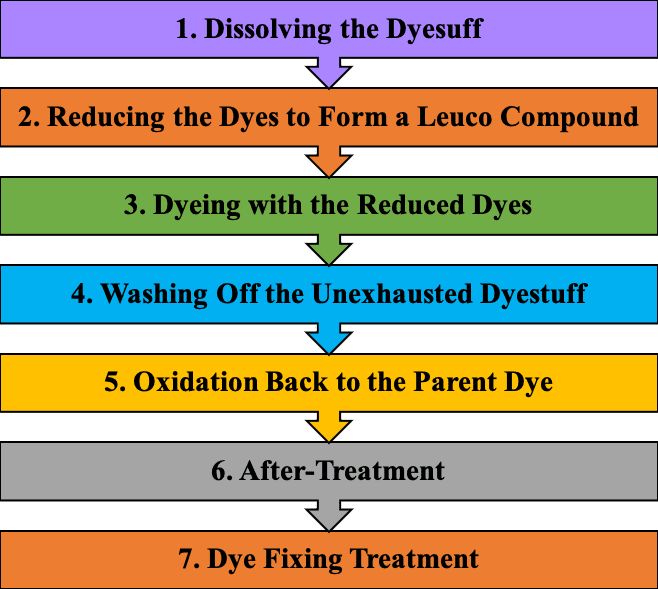
Primary Applications: Cotton and viscose, predominantly for black, dark brown, and olive shades in workwear and home textiles.
Disperse Dyes
Disperse dyes are non-ionic, sparingly water-soluble dyes designed specifically for hydrophobic thermoplastic fibers. Approximately 85% of commercial disperse dyes belong to the azo or anthraquinone chemical classes. These synthetic fabric dyes are the dominant class for polyester coloration, with global consumption exceeding 250,000 metric tons annually.
Properties of Disperse Dyes
- Low molecular weight (typically 300–500 g/mol), non-ionic, and sparingly water-soluble (0.1–10 mg/L solubility)
- A dispersing agent (such as sodium lignosulphonate or polyphosphate) is essential for maintaining stable dispersion in the aqueous dyebath
- Sublime without decomposition at elevated temperatures; this property enables heat-transfer printing and causes gas fume fading in certain conditions
- Available in powder, liquid, and paste forms; liquid dispersions offer better dispersion stability and filter uniformity
- No strong solubilizing groups in their structure; substantivity for hydrophobic fibers arises from Van der Waals and dipole forces between dye and polymer
- Dye molecules are physically trapped within the pores and micro-voids of polyester and other hydrophobic fibers
Primary Mechanism of Disperse Dyes
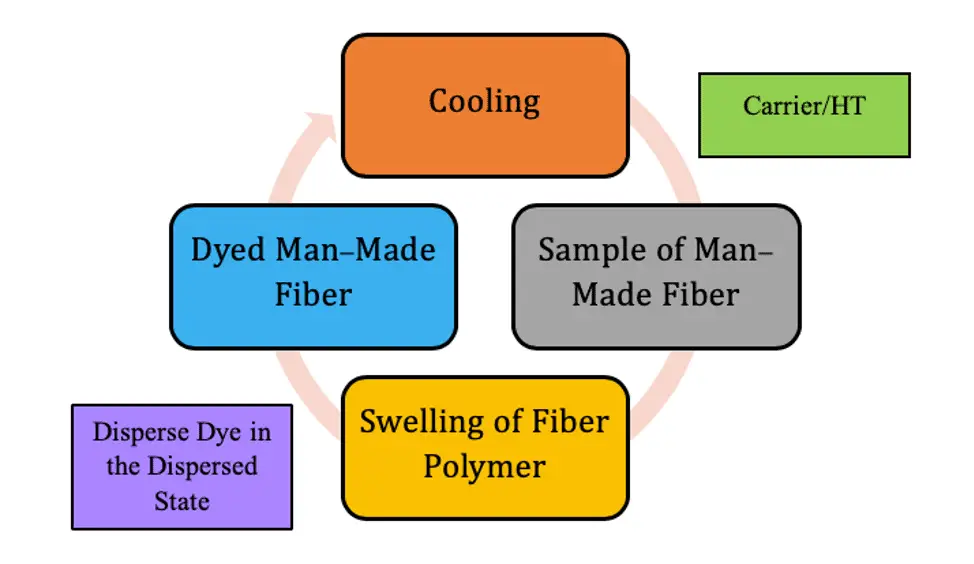
- Dissolution/dispersion — dye particles are mechanically dispersed in water by surfactant, forming a stable colloidal suspension
- Adsorption — dye molecules adsorb onto the surface of the hydrophobic fiber from the aqueous dispersion
- Diffusion — high temperature (130–140°C under pressure in HT-HP machines) increases fiber polymer chain mobility, opening micro-voids and enabling dye diffusion into the fiber interior; diffusion rate approximately doubles for every 20°C temperature increase
The standard dyeing temperature for polyester with disperse dyes is 130–135°C under pressure (HT-HP dyeing), achieved in pressurized dyeing machines. At temperatures below 100°C (carrier dyeing), chemical carriers (such as o-phenylphenol, methyl salicylate, or biphenyl) are used to swell the fiber and accelerate dye diffusion. Wash fastness rates 4–5 on the ISO 5-point scale; light fastness rates 5–7 on the 8-point ISO scale for well-chosen dye combinations.
Primary Applications: Polyester, cellulose acetate, cellulose triacetate, nylon, and acrylic fibers.
Azoic Dyes
Azoic dyes are not pre-formed colorants—they are generated in situ within the fiber through a two-component coupling reaction between a diazonium salt and a coupling component (typically a naphthol derivative). This on-fiber synthesis produces intensely bright orange, red, scarlet, and crimson shades with excellent fastness properties.
Properties of Azoic Dyes
- Water-insoluble azo pigments formed by diazonium coupling; contain the –N=N– chromophore within their final structure
- Application requires two separate baths: an impregnation bath (naphthol solution) and a developing/diazotization bath (diazonium salt solution)
- Produce intense, bright orange, red, scarlet, and crimson shades unattainable with many other dye classes
- Wash fastness rated 4–5 on the ISO 5-point scale; light fastness rated 4–6 on the 8-point ISO scale
- The final hue is determined by both the diazonium component (Naphthol AS series) and the coupling component (varied diazotized bases)
- Cost-effective for bright shade production on cellulosic fibers
Primary Mechanism of Azoic Dyes
Azoic dye formation involves two sequential chemical processes:
- Coupling component (Naphtholation) — the fabric is impregnated with an alkaline solution of a naphthol (such as Naphthol AS, AS-BR, or AS-OL), which saponifies and becomes water-soluble, then dried to a damp state for coupling
- Diazonium salt (Diazotization) — a primary aromatic amine is diazotized with sodium nitrite and hydrochloric acid at 0–5°C to form a diazonium chloride
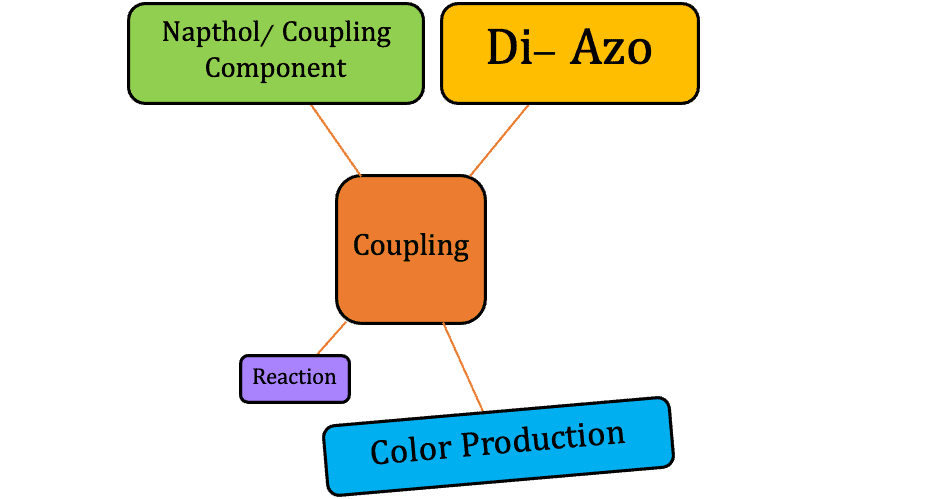
- Naphtholation — the insoluble naphthol derivative is made soluble in alkaline solution, applied to the fabric, and dried to a controlled moisture content
- Diazotization — sodium nitrite (NaNO₂) reacts with the primary aromatic amine in the presence of hydrochloric acid (HCl) at 0–5°C to produce a diazonium chloride
- Coupling — the fabric impregnated with naphthol is immersed in the diazonium bath at pH 7–9 and 0–15°C; the diazonium cation attacks the electron-rich naphthol ring, forming the azo (–N=N–) linkage and producing the final insoluble colored pigment within the fiber
Primary Applications: Cotton, nylon, polyester (modified), and cellulose acetate for bright scarlet, red, orange, and crimson shades.
Mordant Dyes
Mordant dyes—also called chrome dyes—lack direct substantivity for textile fibers and require a metal-based binding agent (mordant) to form a metal-dye complex that adheres to the substrate. The mordant is typically an inorganic chromium compound (hence the name “chrome dyes”), though aluminum, iron, and copper salts are also used.
Properties of Mordant Dyes
- No inherent affinity for textile fibers; metal ion mordant is essential for fixation
- Chrome mordant (potassium dichromate, K₂Cr₂O₇) forms a 1:2 or 1:3 metal-dye complex with two or three dye molecules per chromium ion, producing shades with exceptional wash fastness (rating 4–5) and light fastness (rating 5–7)
- Primary bond formation is strong coordinate covalent bonding between the chromium ion and the dye molecule’s donor groups
- Good leveling and penetration properties when applied correctly
- Metal-dye complex produces darker, more muted shade ranges compared to unmetallized dyes
- Soluble in hot water; requires acid conditions for application
Primary Mechanism of Mordant Dyes
When potassium dichromate is added to an acidic bath containing the dye, the chromium (VI) is reduced to chromium (III), which then forms a coordination complex with the dye molecules. This complex is water-insoluble and precipitates within the fiber:
2 Dye–SO₃H + K₂Cr₂O₇ + 4H₂SO₄ → [Cr(Dye–SO₃)₃] + K₂SO₄ + 4H₂O
Three application methods are used:
- Pre-mordanting (Chrome mordant) — fiber is first treated with the mordant solution, then dyed with the dye bath
- Meta-mordanting (Metachrome) — mordant and dye are applied simultaneously from the same bath; potassium dichromate and the dye are mixed in the same solution
- Post-mordanting (Afterchrome) — fiber is first dyed, then treated with a mordant bath to form the metal-dye complex in situ on the fiber
Primary Applications: Wool, silk, and other natural protein fibers; nylon and modacrylic fibers for high-fastness technical and fashion applications.
Dye Fastness Comparison
The following table provides a consolidated comparison of wash fastness and light fastness ratings across all major dye classes, based on ISO 5-point (wash) and ISO 8-point (light) rating scales. Use this as a quick reference for selecting the appropriate dye class when fastness performance is a primary consideration.
| Dye Class | Wash Fastness (ISO 1–5) | Light Fastness (ISO 1–8) | Key Limitation |
|---|---|---|---|
| Direct | 1–3 (Poor–Moderate) | 4–6 (Moderate–Good) | Weak physical bonding; after-treatment with fixing agents required for improved wash fastness |
| Reactive | 4–5 (Excellent) | 5–7 (Good–Very Good) | Hydrolysis during fixation reduces efficiency to 50–90%; dye wastage |
| Acid | 1–4 (Poor–Good) | 4–7 (Moderate–Very Good) | Wet fastness varies significantly with dye selection and application pH |
| Basic | 3–4 (Good) | 4–6 (Moderate–Good) | Limited to acrylic fibers; requires retarding agents for level dyeing |
| Vat | 4–5 (Excellent) | 6–8 (Very Good–Excellent) | High cost; requires airtight equipment for vatting and oxidation control |
| Sulfur | 3–4 (Good) | 4–6 (Moderate–Good) | Limited shade range (blacks, browns, olives); no bright colors achievable |
| Disperse | 4–5 (Excellent) | 5–7 (Good–Very Good) | High temperature/pressure required for polyester; potential for gas fume fading |
| Azoic | 4–5 (Excellent) | 4–6 (Moderate–Good) | Two-bath process adds complexity; restricted to bright orange, red, and crimson shades |
| Mordant | 4–5 (Excellent) | 5–7 (Good–Very Good) | Requires chromium mordant; environmental concerns with chromium disposal |
Summary of the Property & Uses of Dyes
The following comparison table consolidates the key properties, ionic character, application pH ranges, fixation mechanisms, and primary fiber applications for each major dye class discussed above.
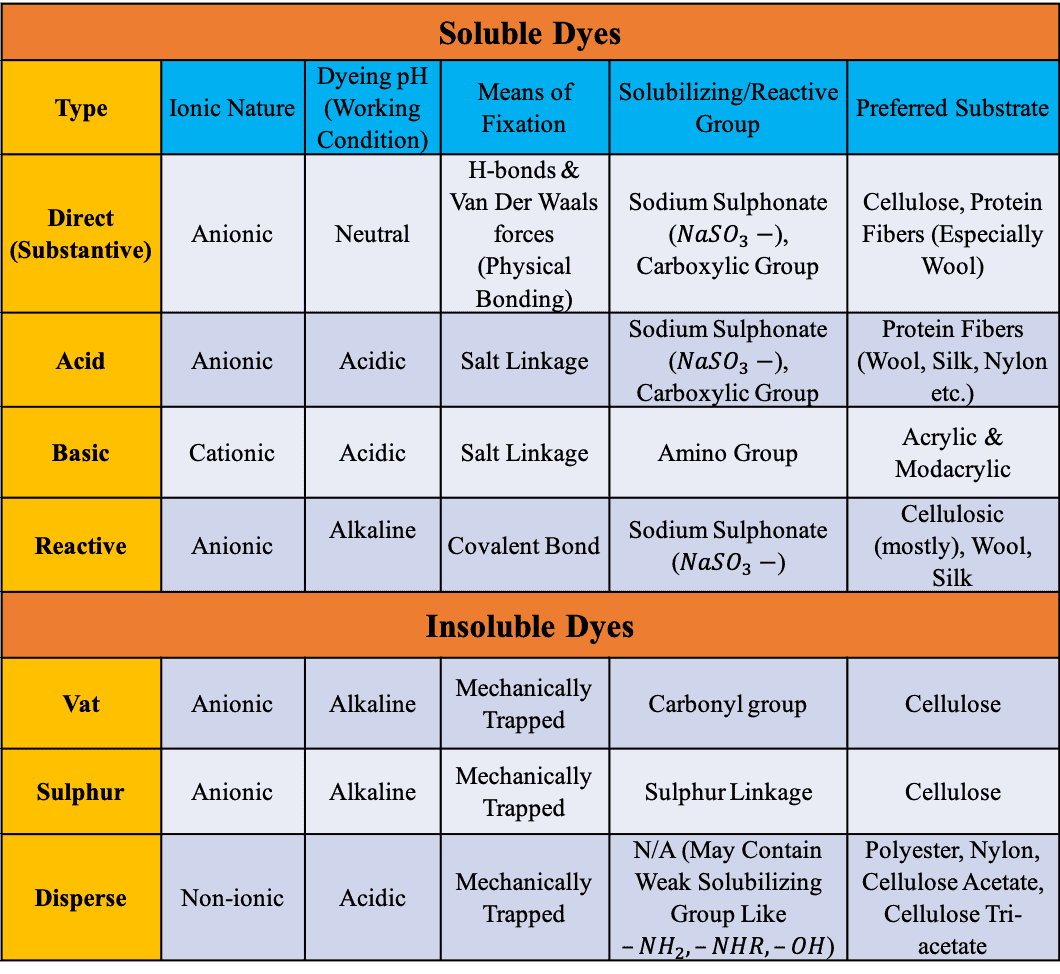
|
Soluble Dyes |
|||||
|
Types of Dyes |
Ionic Nature |
Dyeing pH |
Means of Fixation |
Solubilizing/Reactive Group |
Primary Fiber Applications |
|
Direct |
Anionic |
Alkaline |
H-bonds & Van Der Waals forces |
Sodium Sulphonate |
Cellulose (Cotton, Linen, Viscose), Protein Fibers |
|
Acid |
Anionic |
Acidic |
Ionic Salt Linkage |
Sodium Sulphonate |
Protein Fibers (Wool, Silk), Nylon, Polyamide |
|
Basic |
Cationic |
Weakly Acidic |
Ionic Salt Linkage |
Amino Group |
Acrylic (Polyacrylonitrile), Modified Polyester |
|
Reactive |
Anionic |
Alkaline |
Covalent Bond |
Sodium Sulphonate |
Cellulosic (Cotton, Linen, Viscose), Wool, Silk, Polyamide |
|
Insoluble Dyes |
|||||
|
Vat |
Anionic |
Strongly Alkaline |
Mechanically Trapped |
Carbonyl Group |
Cellulose (Cotton, Linen) |
|
Sulfur |
Anionic |
Alkaline |
Mechanically Trapped |
Disulfide Linkage |
Cellulose (Cotton, Viscose) |
|
Disperse |
Non-ionic |
Near Neutral |
Mechanically Trapped |
N/A (Weak Solubilizing Groups |
Polyester, Nylon, Cellulose Acetate, Cellulose Triacetate |
Direct Dye vs Reactive Dye
Direct dyes and reactive dyes represent two fundamentally different approaches to cellulose coloration, with significant implications for color fastness, processing cost, and application method.
| Property | Direct Dye | Reactive Dye |
|---|---|---|
| Type of Bond | Physical adsorption only — Van der Waals forces and hydrogen bonds; no chemical bond formation | Covalent chemical bond with cellulose hydroxyl groups |
| Dyeing pH | Alkaline (pH 10–11) with electrolytes (NaCl 5–80 g/L) | Alkaline (pH 10.5–12) with electrolytes (NaCl/Na₂SO₄ 40–80 g/L) |
| Wash Fastness (ISO) | Poor to Moderate (ratings 1–3); requires after-treatment with fixing agents to reach 3–4 | Excellent (ratings 4–5) |
| Dyeing Temperature | 60–100°C depending on depth of shade | 30–98°C depending on reactive group (see specific dye type) |
| Fixation Efficiency | 90–95% (no hydrolysis side reaction) | 50–90% (hydrolysis of reactive group competes with fiber fixation) |
| Primary Applications | Cotton, linen, viscose rayon — economical shading and where moderate fastness is acceptable | Cotton, linen, viscose — where wash fastness is essential (garments, home textiles) |
| Example CI Name | CI Direct Black 38 | CI Reactive Blue 19 |
Vat Dye vs Reactive Dye
Vat dyes and reactive dyes both achieve high wash fastness on cellulosic fibers but through entirely different chemical mechanisms, resulting in distinct processing requirements, cost profiles, and end-use performance characteristics.
| Properties | Reactive Dyes | Vat Dyes |
|---|---|---|
| Preparatory Process | No vatting required; direct application from aqueous alkaline bath | Requires vatting — reduction with sodium dithionite (Na₂S₂O₄) in alkaline solution at 50–60°C |
| Dyeing Vessel Requirement | Standard open or pressurized dyeing equipment; no air-tight requirement | Air-tight or oxygen-free vessel required during reduction and exhaustion stages to prevent re-oxidation of leuco dye |
| Dye-Fiber Bond Type | Covalent chemical bond | Insoluble pigment physically trapped within fiber pore structure |
| Hydrolysis/Wastage | Prone to hydrolysis — reactive group bonds with water instead of fiber; typically 10–50% dye wastage | No hydrolysis; all exhausted dye converts to insoluble pigment; minimal wastage |
| Wash Fastness (ISO) | Very Good to Excellent (4–5) | Excellent (4–5, sometimes 5) |
| Cross-Staining Fastness | Moderate; not as resistant as vat dyes | Excellent; even at high temperatures |
| Cost | Moderate; widely used for general cotton coloration | High; premium dye class reserved for denim, workwear, and technical textiles |
| Example CI Name | CI Reactive Blue 19 | CI Vat Blue 1 (Indigo) |
Reactive Dye vs Disperse Dye
Reactive and disperse dyes serve entirely different fiber types—reactive dyes for natural and regenerated cellulosic fibers, and disperse dyes for hydrophobic synthetic fibers—with fundamentally incompatible dyeing chemistries and processing requirements.
| Properties | Reactive Dyes | Disperse Dyes |
|---|---|---|
| Solubility | Fully water-soluble anionic dyes; no dispersing agent needed | Sparingly water-soluble non-ionic dyes (0.1–10 mg/L); require dispersing agents for aqueous application |
| Target Fibers | Natural and regenerated cellulosics (cotton, linen, viscose) | Hydrophobic synthetics (polyester, nylon, acetate, acrylic) |
| Dye-Fiber Bond Type | Covalent chemical bond with –OH groups on cellulose | Physical entrapment — Van der Waals forces and dipole interactions trap dye within fiber micro-voids |
| Dyeing Temperature | 30–98°C depending on reactive group type; atmospheric pressure equipment sufficient for most systems | 130–135°C under pressure (HT-HP machines) for polyester; carrier dyeing at 98–100°C with chemical carriers |
| Dyeing pH | Alkaline (pH 10–12) with caustic soda or soda ash | Near neutral (pH 5–7); acid conditions may cause dye aggregation |
| Hydrolysis/Wastage | Significant hydrolysis occurs — reactive group competes between fiber and water; typical fixation 50–90% | No hydrolysis; dye particles in dispersion are consumed completely; minimal wastage |
| Wash Fastness (ISO) | Excellent (rating 4–5) | Excellent (rating 4–5) |
| Light Fastness (ISO) | Good to Very Good (rating 5–7) | Good to Very Good (rating 5–7) |
| Example | CI Reactive Blue 19 | CI Disperse Blue 6 |
Frequently Asked Questions
1. Which types of colorants have the best wash fastness?
Vat dyes and reactive dyes achieve the highest wash fastness ratings on cellulosic fibers. Vat dyes consistently achieve ISO wash fastness ratings of 4–5 (very good to excellent) on cotton, with indigo-dyed denim rated 4–5 even after 50 home laundering cycles. Reactive dyes achieve ISO wash fastness ratings of 4–5 on cellulosic fibers due to the permanence of the covalent dye-fiber bond. On protein fibers, mordant (chrome) dyes achieve wash fastness ratings of 4–5, with the chromium-dye coordinate complex providing exceptional durability through multiple wash cycles.
2. What is the most suitable kind of dyes for dyeing cotton?
Reactive dyes are the most widely used class for cotton dyeing globally. They deliver a combination of bright shade range, excellent wash fastness (ISO rating 4–5), moderate light fastness (rating 5–7), and relatively straightforward application on standard dyeing equipment. Covalent bond formation between the dye reactive group (such as dichlorotriazine or vinyl sulphone) and cellulose hydroxyl groups ensures the color remains permanently fixed through repeated laundering. For heavy-duty applications requiring maximum wash and light fastness—such as workwear, denim, and industrial textiles—vat dyes are preferred despite their more complex application process and higher cost. Reactive dyes represent approximately 60–70% of all cotton coloration globally due to their favorable cost-to-performance ratio.
3. What are the best types of dyes for dyeing polyester?
Disperse dyes are the standard and most effective class for polyester coloration. Approximately 85% of commercial disperse dyes are azo or anthraquinone compounds with molecular weights between 300–500 g/mol, providing optimal diffusion into polyester fibers at high temperatures. The standard HT-HP (High-Temperature High-Pressure) dyeing process at 130–135°C under 2–3 bar pressure delivers ISO wash fastness ratings of 4–5 and light fastness ratings of 5–7. For polyester-wool blends, disperse dyes are combined with reactive dyes for wool or acid dyes, applied in a single-stage process at 100–110°C using a suitable carrier or low-temperature disperse dye formulation.
References
- Encyclopedia Britannica. (2024). Dyeing and Printing. https://www.britannica.com/topic/textile/Dyeing-and-printing
- Chakraborty, J.N. (2014). Fundamentals and Practices in Colouration of Textiles. Woodhead Publishing India. https://www.sciencedirect.com/book/9789380308463/fundamentals-and-practices-in-colouration-of-textiles
- Wikipedia. (2024). Dye. https://en.wikipedia.org/wiki/Dye
- Wikipedia. (2024). Reactive dye. https://en.wikipedia.org/wiki/Reactive_dye
- Wikipedia. (2024). Disperse dye. https://en.wikipedia.org/wiki/Disperse_dye
- Wikipedia. (2024). Vat dye. https://en.wikipedia.org/wiki/Vat_dye


