
Disperse Dyes – Classification | Properties | Dyeing Mechanism

Disperse Dyes
Disperse dyes are synthetic, non-ionic colorants engineered specifically for dyeing hydrophobic synthetic fibers—most notably polyester. These non-water-soluble dyes work by forming a monomolecular dispersion in water, allowing dye molecules to diffuse into fiber interiors under controlled temperature and pressure conditions. The global market exceeds 400,000 metric tons annually, spanning fashion apparel, technical textiles, and automotive fabrics.
Chemically, approximately 85% of commercial disperse dyes are azo or anthraquinone derivatives, with smaller proportions from diphenylamine, nitroarylamino, coumarin, methine, naphthostyryl, quinophthalone, formazan, and benzodifuranone compound classes. Their electrically neutral, low molecular weight structure (200–600 g/mol) enables Van der Waals and dipole force interactions within synthetic fiber matrices, creating durable color bonds.
Short History
- 1922: Green and Saunders—developed Ionamines colors specifically for cellulose acetate, marking the first commercial disperse dye application
- 1923: Baddiley and Shepherdson—introduced S.R.A (Sulpho ricinoleic acid) colors as an alternative dispersible dye system
Both early dye families showed applicability to polyester fibers. However, polyester’s highly compact crystalline structure—characterized by a glass transition temperature (Tg) of 67–77°C and a melting point of 260–265°C—required significant modification of the original cellulose acetate formulations to achieve acceptable color fastness and dyeing uniformity.
The breakthrough came through applying insoluble dyes in micro-fine aqueous dispersions, a formulation approach that commercialized the “disperse dye” classification and enabled modern polyester coloration at industrial scale.
Classification of Disperse Dyes
Textile chemists classify disperse dyes using two complementary systems: field of application and chemical structure. Both classification schemes guide dye selection for specific fiber types and dyeing processes.
Field of Application
- ‘No suffix’ dye: Unsuitable for polyester due to low sublimation fastness. Ideal substantivity for cellulose acetate and nylon 6,6 fibers.
- Group A dye: Sublimation fastness of approximately Grade 2 (ISO 105-C06). Suitable for acetate and nylon; limited polyester applicability.
- Group B dye: Sublimation fastness of approximately Grade 2–3. Provides well-leveled shades on polyester with excellent ‘configurational barre’ coverage. Preferred for textured polyester filament dyeing.
- Group C dye: Sublimation fastness of approximately Grade 3–4. Compatible with all polyester dyeing methods: carrier (100°C), HTHP (130°C), thermosol (180–220°C), and exhaust dyeing processes.
- Group D dye: Maximum sublimation fastness of approximately Grade 5 (ISO 105-C06). Exclusively formulated for HTHP and thermosol techniques where high-temperature exposure is guaranteed. Incompatible with carrier dyeing methods due to carrier-dye interactions at elevated temperatures.
Chemical Nature
- Azo disperse dyes (approximately 60% of commercial products)—monoazo compounds offering widest color gamut from yellow through violet
- Anthraquinone disperse dyes (approximately 25% of commercial products)—deliver bright reds, blues, and greens with excellent light fastness
- Other disperse dye classes:
- Nitroarylamino disperse dyes
- Coumarin disperse dyes
- Methine disperse dyes
- Naphthostyryl disperse dyes
- Quinophthalone disperse dyes
- Formazan disperse dyes
- Benzodifuranone disperse dyes
Different Properties (Polyester Dyeing)
| Classification | Molecular Weight | Polarity | Dyeing Rate | Sublimation Fastness |
|---|---|---|---|---|
| Low energy | <300 g/mol | Low | High | Grade 1–2 |
| Medium energy | 300–450 g/mol | Moderate | Moderate | Grade 2–3 |
| High energy | >450 g/mol | High | Low | Grade 4–5 |
Properties of Disperse Dyes
Understanding disperse dye chemistry enables predictably successful dyeing outcomes across different fiber types and processing conditions.
- Low molecular weight substances (typically 200–600 g/mol), predominantly derived from azo, anthraquinone, and diphenylamine compound classes.
- Crystalline materials with high melting points exceeding 150°C, ensuring thermal stability during high-temperature dyeing processes.
- Marketed in both powder (granular or micronized) and liquid dispersion formulations to suit different dosing systems.
- Electrically neutral, non-ionic character. Absence of strong solubilizing groups (sulphonic –SO₃H or carboxyl –COOH) prevents ionic bonding to fibers. Weak solubilizing groups (aromatic –NH₂, –NHR, or –OH) may be present without creating fiber affinity.
- Sparingly water-soluble (0.01–10 mg/L at 80°C), requiring mechanical dispersion using anionic or non-ionic surfactants for application.
- Application from aqueous dispersions with dispersing agents (e.g., lignosulfonates, naphthalene sulfonates) or carrier compounds that temporarily plasticize the fiber.
- High fiber saturation values ranging from 30–200 mg of dye per gram of polyester fiber, depending on dye molecular weight and dyeing conditions.
- Absence of ionizable groups causes these dyes to sublime without decomposition when heated above 150°C, potentially causing color fading in pressed or ironed polyester fabrics.
- Certain azo-type disperse dyes are susceptible to gas fume fading when exposed to nitrogen oxide emissions from gas heating appliances, resulting in shade changes particularly in blue and violet hues.
- Dye molecules with identical chromophores (indicated by C.I. number) from different manufacturers may produce different shades. Crystal morphology (shape, size, volume), colored impurities or isomers, dispersing agent type and concentration, and standardization additives all influence final shade formation.
Fastness Properties of Disperse Dyes
Fastness performance varies by fiber substrate and exposure conditions. Industry standard ISO 105-C06 testing determines wash fastness, while ISO 105-B02 measures light fastness under controlled xenon arc exposure.
| Fastness Property | Rating (ISO Scale) | Comment |
|---|---|---|
| Washing | Grade 4–5 | Good to excellent wash fastness on polyester |
| Light | Grade 4–6 | Good to very good depending on dye class |
| Crocking/Rubbing | Grade 3–4 | Moderate to good dry and wet rub fastness |
| Gas Fume Fading | Grade 3–4 | Moderate resistance to NOx exposure |
Chemical Constitutions of Disperse Dyes
The structural diversity of disperse dyes reflects both the variety of chromophoric systems and the numerous possible substitution patterns across diazonium and coupling components.
- Low molecular weight monoazo and anthraquinone derivatives dominate the commercial disperse dye range.
- The prevalence of azo disperse dyes stems from the high number of possible substitution combinations across diazonium ion and coupling component structures, enabling precise color tuning.
- Anthraquinone disperse dyes are typically 1-hydroxy or 1-amino derivatives producing bright colors spanning red through blue spectral regions. Notable examples include C.I. Disperse Red 11 (1,4-diamino-2-methoxy anthraquinone, C.I. 62015) and C.I. Disperse Blue 14 (1,4-dihydroxyanthraquinone).
Polyester Dyeing with Disperse Dyes
Polyester’s hydrophobic nature and crystalline structure necessitate specialized dyeing conditions that distinguish it from all other textile fiber types.
| Dyeing Method | Temperature | Pressure | Carrier Required | Best For |
|---|---|---|---|---|
| HTHP (High-Temperature High-Pressure) | 130°C (266°F) | 2.4–3.0 bar | No | Most uniform dye penetration; autoclave dyeing |
| Carrier | 100–110°C (212–230°F) | Atmospheric | Yes (2–5% owf) | Atmospheric equipment; plasticizes fiber to reduce Tg to 50–60°C |
| Thermosol | 180–220°C (356–428°F) | Atmospheric | No | Highest productivity for woven polyester blends; pad-dry-thermosol process |
- Polyester becomes dyeable only above its glass transition temperature (Tg) of 67–77°C. Below 100°C, the rate of dye diffusion into polyester is commercially insignificant.
- HTHP Method: Autoclave dyeing at 130°C (266°F) under 2.4–3.0 bar pressure provides the most uniform and level dye penetration. Requires pressure-resistant stainless steel equipment (Type 316L stainless).
- Carrier Method: Atmospheric dyeing at 100–110°C in the presence of carrier compounds (e.g., o-phenylphenol, methyl naphthalene, butyl benzoate) at 2–5% owf (on weight of fabric). Carriers plasticize the fiber, reducing Tg to 50–60°C and enabling dye diffusion at atmospheric pressure.
- Thermosol Method: Pad-dry-thermosol process at 180–220°C for 30–90 seconds. Highest productivity for woven polyester blends.
- Disperse dyes are applied from aqueous dispersions with non-ionic dispersing agents (critical micelle concentration 0.01–0.1 g/L) to maintain dye particle stability.
- Exhaustion requires slight acidity (pH 4.0–4.5, adjusted with acetic acid or formic acid) to optimize dye adsorption kinetics and prevent hydrolysis.
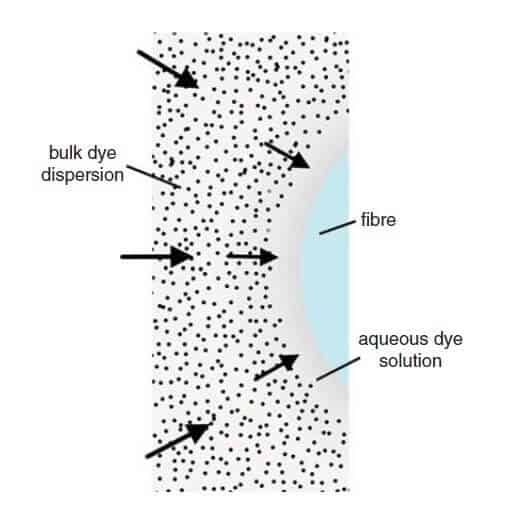
Mechanism
The disperse dyeing mechanism follows five sequential stages, each representing a physical-chemical process that collectively determine final color yield and uniformity.
Reduction Clearing
Reduction clearing is a post-dyeing treatment essential for removing surface-adhered dye particles and achieving acceptable fastness on polyester.
- Particulate dye deposits accumulate at the fiber surface due to the dye’s low aqueous solubility during dyeing
- Auxiliary chemicals (dispersing agents, carrier residues) may also remain adsorbed on the PES material surface
The reduction clearing process employs alkaline reduction to chemically degrade and remove surface contaminants:
- Aqueous alkaline bath: Sodium hydroxide (NaOH) at 2–5 g/L combined with sodium hydrosulfite (Na₂S₂O₄) at 2–4 g/L
- Non-ionic surfactant (e.g., ethylene oxide adducts) at 1–2 g/L for wetting and soil suspension
- Temperature: 50–80°C maintained for 10–20 minutes
- Neutralization: Subsequent dilute acetic acid (CH₃COOH) rinse at 1–2 mL/L to remove alkali residues
Mechanism of Reduction Clearing
The reductive clearing mechanism differs by dye chemical class, with azo and anthraquinone dyes following distinct degradation pathways.
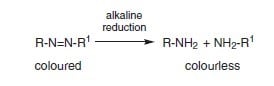
For azo disperse colorants, the alkaline reducing environment cleaves the azo bond (–N=N–), producing colorless aromatic amine compounds that rinse from the fiber surface. This reduction is irreversible and destroys the chromophoric system completely.
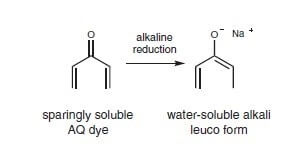
For anthraquinone disperse dyes, reduction converts the quinone system to the leuco (colorless) variant. This water-soluble form contains hydroxyl groups that provide good wash-off removal. Re-oxidation during subsequent rinsing restores some color but at significantly reduced tinctorial strength on the fiber surface.
References
- M. Burkinshaw. (2016). Physico-chemical Aspects of Textile Coloration. Society of Dyes and Colorists.
- O. Glenz, W. Beckmann, W. Wunder. (1959). The Mechanism of the Dyeing of Polyester Fibres with Disperse Dyes. Journal of the Society of Dyers and Colourists, 75, 141–147.


