
Fabric Finishing Technologies: How Coatings and Treatments Change Fabric Performance

Fabric Finishing Technologies: Complete Technical Guide
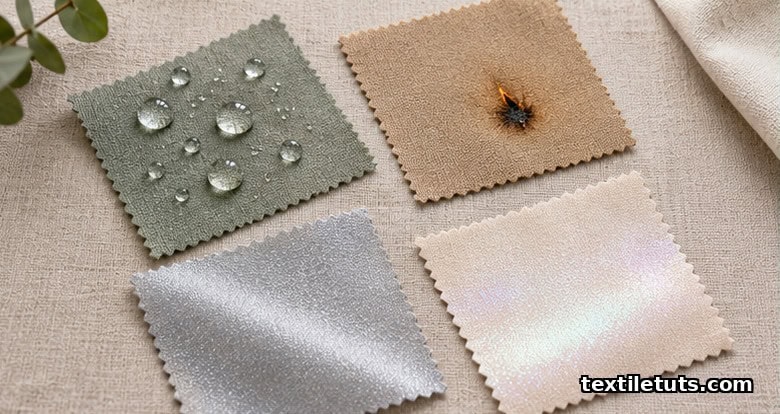
Fabric finishing technologies are post-weaving chemical and physical treatments. These treatments modify fiber surfaces to impart water repellency, flame resistance, antimicrobial protection, or UV blocking. Performance gains of 50–500% over untreated fabrics are achievable while maintaining hand feel and breathability.
Three primary mechanisms drive fabric finishing: chemical bonding through covalent attachment, surface coating via polymer film deposition, and nano-scale encapsulation using microcapsule release systems. These mechanisms alter fabric performance characteristics permanently through the finishing process.
What Are Fabric Finishing Technologies? Definition and Scope
Finishing treatments represent the final stage of textile manufacturing. Applied after weaving, dyeing, or printing, they transform raw fabric into a high-performance material. While fiber-level finishes modify individual fibers before spinning, fabric finishes modify the surface chemistry of assembled textiles. This creates functional properties that raw fabric does not inherently possess.
Chemical finishes and mechanical finishes represent the two broad categories. Chemical finishes bond covalently to fibers or coat the fiber surface with functional polymers. Mechanical finishes alter fabric surface geometry through physical processing. Both approaches deliver measurable performance improvements validated by standardized tests. The AATCC 22 spray rating measures water repellency. NFPA 701 evaluates flame spread. Martindale abrasion testing determines mechanical durability under repeated friction.
The Chemistry Behind Fabric Finishing Technologies
Covalent Chemical Bonding
Finishes containing reactive groups form covalent bonds with cellulose fibers in cotton and linen. Hydroxyl (-OH) or amine (-NH₂) groups enable this chemical attachment. The treatment remains permanently bonded to the fiber. Wash-out resistance through repeated launderings is guaranteed. The reaction typically occurs under controlled temperature and pH conditions that activate reactive groups without degrading the fiber.
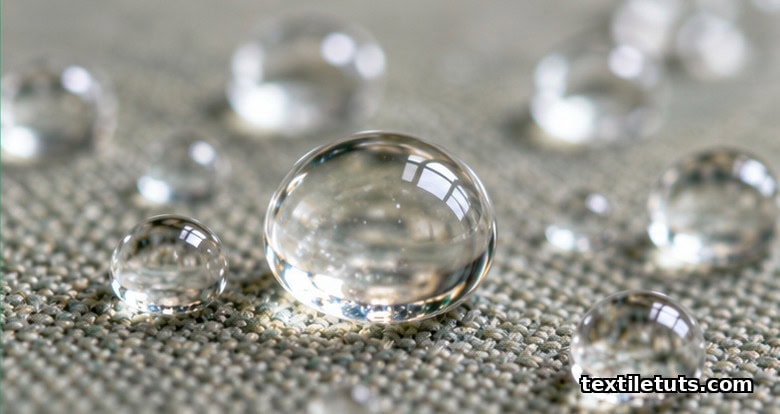
DWR (Durable Water Repellent) finishes use fluorocarbon resins. Perfluorinated compounds lower fabric surface energy to just 5–15 mN/m. Water contact angles exceed 150°. Water beads up and rolls off like mercury. Cross-linking agents such as DMDHEU (dimethylol dihydroxy ethylene urea) create a polymer network within fiber pores. This locks the treatment into the fabric structure. Cure conditions for these reactive systems typically require 150–180°C for 30–120 seconds for full thermal activation.
Surface Coating vs. Fiber Penetration
Surface coatings deposit a polymer film on the fiber exterior. This creates a barrier that repels water or other liquids. Fluorocarbon finishes applied at 0.5–3% by weight add-on achieve effective water repellency. Higher add-on levels increase durability to laundering. However, surface coatings may alter fabric hand feel. The textile may feel stiffer or plasticky.
Penetration finishes diffuse into fiber interstices. This provides better durability with less impact on fabric aesthetics. The key formulation challenge is balancing treatment uniformity with fabric handle. Maximum performance must be achieved without sacrificing the soft hand feel that consumers expect. The skilled formulation chemist must navigate this trade-off for each specific end-use application.
Types of Performance Finishes
Water-Repellent and Waterproof Finishes
Modern water-repellent finishes range from traditional wax emulsions to advanced fluorocarbon chemistries. The choice depends on the required performance level, durability expectations, and environmental regulations governing chemical composition.
| Finish Type | Chemistry | Durability (launderings) | Breathability | Wash-off Risk |
|---|---|---|---|---|
| Fluorocarbon DWR | Perfluorinated polymers | 20–50 | High | Low |
| Silicone-based | Polydimethylsiloxane | 10–30 | Very high | Medium |
| Hydrophobic wax emulsions | Carnauba/wax compounds | 5–15 | Medium | High |
| PU coated membranes | Polyurethane laminate | 50–100 | Low–Medium | Very low |
PU (polyurethane) coated membranes laminated to fabric face stocks represent the gold standard for high-performance outdoor apparel. These constructions require both waterproofing and breathability. They separate the waterproofing function from the breathable function. Moisture vapor escapes while liquid water entry is blocked. This prevents the clamminess associated with fully waterproof garments.
Flame Retardant Finishes
Flame retardant finishes work through several chemical mechanisms. Intumescent coatings expand under heat exposure. They form a protective char barrier that insulates the underlying fabric from flame propagation. This mechanism is particularly effective for cellulose fibers like cotton and linen.
Phosphorus-based FR systems use THPC (tetrakis hydroxymethyl phosphonium chloride). This compound reacts chemically with cellulose to create a thermal barrier that resists ignition. Melamine-based FR chemistries leverage nitrogen-phosphorus synergy. This disrupts flame propagation chemistry at the molecular level. Aramid fabrics like Nomex possess inherent flame resistance from their aromatic polymer structure. No topical treatment is required. This is a significant advantage for protective apparel applications.
Regulatory standards govern flame retardant textiles. CPSC 16 CFR 1610 governs clothing textiles. NFPA 701 addresses flame spread on textiles in public spaces and furniture. UK standard BS 5852 evaluates cigarette and match ignition resistance for furniture upholstery.
Antimicrobial and Odor-Control Finishes
Antimicrobial fabric treatments have become essential. Applications span medical textiles, athletic apparel, and everyday garments where odor control is valued. Silver ion technology represents the most commercially successful approach. Ag⁺ ions release from zeolite carriers. They bind to bacterial cell walls at concentrations of 5–20 ppm. This effectively kills 99.9% of bacteria without affecting human skin flora.
Chitosan is a natural antimicrobial derived from crustacean shells. It functions as a cationic polymer that disrupts bacterial membranes through electrostatic interaction. Unlike silver ion technology, chitosan is fully bio-based and biodegradable. This makes it attractive for baby textiles and applications where non-toxic formulations are paramount. Professional validation shows chitosan treatments maintain bacterial reduction effectiveness through 30+ home launderings.
Phase-change microencapsulation technology enables temperature-responsive active release. Antimicrobial agents are trapped in microscopic capsules. These capsules rupture under warmth or friction. This provides sustained antimicrobial action over the garment’s lifetime. For odor control specifically, activated charcoal microcapsules embedded in fabric adsorb odor molecules electrostatically. This provides effective odor control for 50+ wash cycles. This is particularly valuable in workwear and athletic applications.
Triclosan was once widely used for broad-spectrum antibacterial action through enzyme inhibition. The European Union has restricted or banned triclosan due to environmental persistence concerns. This regulatory action has accelerated the industry transition toward safer alternatives like silver zeolite and chitosan. Visit the stain removal guide for related fabric protection information.
UV-Protective Finishes (UPF)
UV-protective finishes use UV-absorber molecules. These are primarily benzotriazole and triazine derivatives. Applied at 1–3% add-on to fabric, these chemistries absorb ultraviolet radiation. They re-emit it as harmless heat energy. This prevents UV degradation of both the fabric and the wearer’s skin. Some UPF treatments also increase fabric density through resin treatment. This adds a physical UV-blocking mechanism alongside the chemical absorption.
A UPF 50+ rating indicates less than 2% UV transmission. The fabric blocks 98%+ of both UVA and UVB radiation. This represents the highest rating category defined by ISO standards for ultraviolet protection. Wash durability testing shows UPF treatments retain approximately 80% of their initial effectiveness after 20–30 home launderings at 40°C. Professional dry cleaning extends functional life compared to home washing due to reduced mechanical agitation.
Mechanical Finishes: Calendering, Sanforizing, and Emerizing
Mechanical finishes modify fabric appearance and handle through physical processing rather than chemical application. This offers performance improvements without introducing chemical residues. Calendering uses heated rollers to compress fabric. It creates sheen and smooth surfaces. The process does not change fiber structure but produces the lustrous appearance associated with polished cottons and sateen weaves. Fabric types respond differently to this treatment.
Sanforizing is a pre-shrinkage treatment critical for cotton workwear and garments requiring dimensional stability. The process controls residual shrinkage to 2–3% maximum. This is a critical specification for workwear undergoing repeated industrial laundering. Uncontrolled shrinkage would render garments unserviceable. Unlike chemical finishes, sanforizing is a permanent mechanical process that cannot wash out.
Emerizing uses sandpaper-covered rolls to abrade the fabric surface. This creates the suede-like peach-skin hand feel popular in athleisure and luxury apparel. Raising or napping employs wire-covered rollers to lift individual fiber ends from the fabric body. This creates fleece warmth without adding fiber mass. These mechanical processes typically change fabric weight (GSM) by 5–15%. This affects fabric body and drape characteristics.
How Coatings Change Fabric Performance: The Measurable Effects
Repellency Performance
Quantitative testing reveals dramatic differences between treated and untreated fabrics. Untreated cotton achieves a spray rating of 0 on the AATCC 22 scale. Complete wetting of the fabric surface occurs. Fluorocarbon DWR treated cotton achieves a spray rating of 100. No wetting happens even after 20 seconds of water spray exposure. Silicone-treated fabrics typically score 80–90 on the same scale.
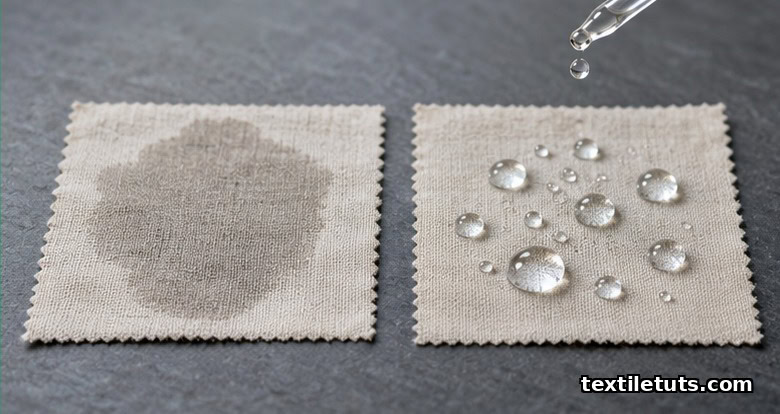
Contact angle measurements provide granular characterization of repellency. Untreated cotton shows 0° contact angle. Water spreads immediately and completely. DWR-treated cotton achieves contact angles of 140–155°. This demonstrates nearly perfect spherical bead formation that characterizes effective water repellency. These measurements via standardized goniometry confirm the surface energy reduction achieved by fluorocarbon chemistry.
Durability Metrics
Martindale abrasion testing subjects fabrics to repeated circular rubbing against a standard wool substrate. Untreated cotton typically fails at approximately 10,000 cycles. Visible wear, thinning, or pilling appears. DWR-treated fabrics may show slight improvement in abrasion resistance. The polymer film coating individual fibers provides this. However, the primary function of DWR is repellency rather than abrasion enhancement.
Laundered durability testing documents how finishes survive repeated home washing. Fluorocarbon DWR finishes retain 70–80% of their initial repellency after 30 washes at 40°C. This represents meaningful durability for consumer garments. Some coating treatments provide an unexpected benefit. Increased seam strength of 15–25% results from the polymer coating bonding adjacent fibers at seam intersections. Seam slippage in shear-loading conditions is reduced.
Comfort Trade-offs
Breathability — measured as moisture vapor transmission rate — represents the primary comfort consideration for coated fabrics. Silicone-based finishes maintain 85–95% of untreated fabric’s breathability. This makes them ideal for next-to-skin applications where comfort is paramount. Fluorocarbon finishes reduce moisture vapor transmission by 10–30%. This depends on add-on level. Higher add-on delivers better repellency at the cost of reduced breathability.
Thermal resistance testing reveals a 5–15% increase in thermal insulation for coated fabrics. This occurs without any added fabric weight (GSM). The polymer coating layer traps air within the fabric structure more effectively than uncoated fibers. Marginal warmth improvement results. This effect is particularly valued in winter outerwear where small temperature differentials significantly impact thermal comfort.
Application Methods in Textile Manufacturing
Batch Processing (Exhaustion)
Batch processing using jigger machines represents the most common application method for chemical finishes. Fabric is rolled onto a centered roller. It passes through a treatment bath repeatedly — forward and backward — until the desired add-on is achieved. Exhaustion efficiency ranges from 70–95%. This means 70–95% of the treatment chemical in the bath is absorbed by the fabric. The remainder is discarded in wastewater.
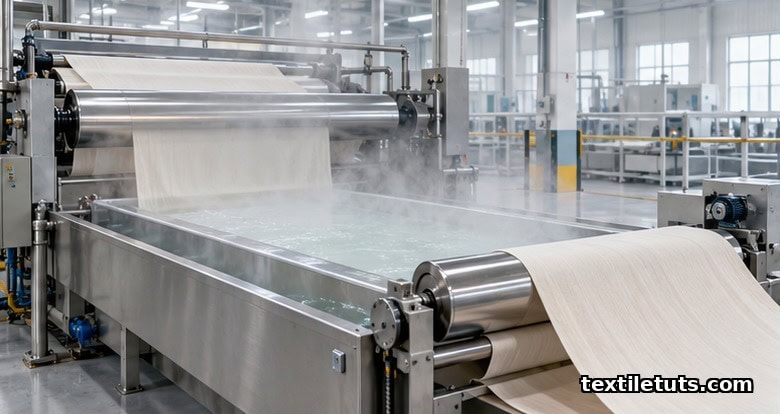
Exhaustion bath temperature typically ranges from 40–80°C. This depends on the chemical system being applied. Higher temperatures generally improve exhaustion efficiency for most chemical systems. Energy costs increase proportionally. Liquor ratio — the ratio of fabric weight to bath volume — typically ranges from 1:5 to 1:20. Lower ratios require smaller bath volumes but may produce less uniform treatment distribution across the fabric length. Textile manufacturing processes include finishing as a critical final step.
Continuous Padding
Continuous padding offers advantages for high-volume production. Fabric passes through a treatment bath in a single pass rather than repeated immersion. A padder machine uses two rubber rollers under precisely controlled pressure. This squeezes treatment liquor into fabric. Nip pressure of 2–4 bar directly determines add-on percentage. Higher pressure forces more liquid from the fabric.
Production line speeds of 20–60 meters per minute enable continuous finishing operations. This dramatically outpaces batch jigger processing for high-volume orders. Following padding, reactive finishing systems require cure at 150–180°C for 30–120 seconds. This activates cross-linking chemistry. The challenge with continuous processing lies in maintaining uniform add-on across the fabric width. Variations in roller pressure or fabric tension can produce measurable performance differences between fabric edges and center.
Coating and Lamination
Heavy coating applications use knife-over-roll technology. A blade precisely controls the amount of coating compound applied to fabric as it passes underneath. This method achieves add-on levels of 2–20%. It is appropriate for waterproof bags, tarpaulins, and industrial textiles. Extreme water resistance takes priority over fabric handle in these applications. The applied coating forms a continuous polymer film completely covering the fabric face.
Hot-melt coating applies adhesive films using heat and pressure. This is suitable for bonding decorative or functional films to fabric substrates. Membrane lamination bonds breathable waterproof membranes. Expanded PTFE (ePTFE) — the technology behind Gore-Tex — is bonded to fabric face stocks using dot-pattern adhesive application. Air permeability is maintained while creating a waterproof barrier. The resulting laminate construction separates waterproofing from breathability. Performance levels of 10,000+ mm water column and 15,000+ g/m²/24hr moisture vapor transmission are achieved simultaneously.
Industry Applications of Fabric Finishing Technologies
Different end-use applications demand specific combinations of finishing technologies. Performance requirements vary dramatically based on functional demands placed on the finished textile.
| End Use | Primary Finish | Performance Requirement |
|---|---|---|
| Outdoor apparel (rain gear) | Fluorocarbon DWR + breathable membrane | 10,000+ mm water column, 15,000+ g/m²/24hr breathability |
| Military/first-responder | Flame retardant + IR-reduce | NFPA 701, NIR signature management |
| Medical textiles | Antimicrobial silver ion | 99.9% bacterial reduction, wash durable 50+ |
| Upholstery/furniture | Stain-resistant + flame retardant | ACT fire codes, stain resistance to coffee/ink |
| Workwear (oil/gas) | Oil-repellent fluorocarbon | ISO 14419 (oil repellency 6+ rating) |
| Baby textiles | Natural antimicrobial (chitosan) | Non-toxic, skin-safe, 30+ wash durable |
Military and first-responder applications demand the most demanding performance specifications. These combine flame resistance with infrared signature reduction for tactical concealment. These specialized requirements drive development of multi-functional finish systems. These layer incompatible chemistries into a coherent protective textile.
Environmental and Health Considerations
PFAS Regulatory Landscape (2024–2026)
The textile industry’s relationship with perfluorinated chemistry faces unprecedented regulatory pressure. The EU PFAS restriction proposal — adopted in 2023 — targets all PFAS compounds for elimination by 2027. The restriction covers over 10,000 individual per- and polyfluoroalkyl substances. The US EPA has set drinking water standards at 4 parts per trillion (ppt) for PFOA and PFOS. These are the two most extensively studied PFAS compounds. This effectively drives near-elimination from municipal water sources near manufacturing facilities.
The textile industry has been transitioning from long-chain (C8) to short-chain (C6) fluorocarbons. C6 chemistries offer comparable water repellency with slightly reduced environmental persistence. However, even C6 compounds remain persistent in the environment. Researchers have detected them in remote Arctic ecosystems far from any textile manufacturing. This has accelerated development of fluorine-free alternatives.
Fluorine-free DWR (FFDWR) technologies use hydrocarbon or silicone-based polymers. These have reached commercial availability but currently achieve only 60–70% of fluorocarbon performance in standardized spray rating tests. For consumer apparel where moderate water repellency is acceptable, FFDWR represents a viable near-term solution. For technical outerwear requiring guaranteed performance in extreme conditions, the regulatory timeline for fluorocarbon phaseout remains the critical uncertainty.
Sustainability Approaches
The sustainable finishing movement encompasses multiple parallel approaches. These address different environmental impact vectors. Bio-based antimicrobial finishes — particularly chitosan derived from crustacean shells and plant essential oil microcapsules (eucalyptus, tea tree) — offer effective odor control. The active ingredients are fully biodegradable. These natural chemistries typically show lower wash durability than silver ion technology. This limits their application to consumer apparel rather than industrial textiles.
Plasma treatment activates fabric surfaces using directed ionized gas rather than chemical baths. This enables waterless application of finishes that would otherwise require aqueous processing. Water consumption drops to near-zero for surface activation by replacing the aqueous bath with a plasma excitation stage. Subsequent finishing steps may still require conventional bath application. Bluesign certification and OEKO-TEX restricted substance lists have driven formulation changes. Many older finishing chemicals still in commercial use are now prohibited.
Closed-loop treatment systems capture and recycle process chemicals. These would otherwise enter wastewater streams. Chemical discharge is reduced by 80–90% compared to conventional open-bath processing. While capital-intensive to implement, closed-loop systems eliminate a major environmental liability. They often pay back their additional investment within 3–5 years. Chemical purchase and wastewater treatment costs are reduced.
Frequently Asked Questions
What are fabric finishing technologies?
Fabric finishing technologies are post-production treatments that impart water repellency, flame resistance, antimicrobial protection, or UV blocking. They include chemical finishes (fluorocarbons, silicones, antimicrobials) and mechanical finishes (calendering, sanforizing, napping).
How long do fabric finishes last?
Fluorocarbon DWR finishes last 20–50 home launderings before significant water-repellency loss. Antimicrobial silver ion treatments maintain effectiveness for 50–100 washes. Mechanical finishes like sanforizing are permanent. Professional dry cleaning can extend chemical finish life.
Do fabric coatings affect breathability?
Modern fabric finishing technologies maintain breathability while adding performance. Silicone-based finishes maintain 85–95% of untreated fabric breathability. Fluorocarbon DWR reduces moisture vapor transmission by 10–30%. High-performance breathable membranes separate waterproofing from breathability function.
Are there environmentally friendly fabric finishing alternatives?
Yes. The industry is transitioning away from PFAS chemistry. Fluorine-free DWR (FFDWR) using hydrocarbon or silicone-based polymers are commercially available with 60–70% effectiveness of fluorocarbon finishes. Bio-based antimicrobials like chitosan (from crustacean shells) provide odor control. Plasma treatment activates fabric surfaces without water or chemicals. Bluesign and OEKO-TEX certified finishes ensure restricted substance lists are followed.
References
- AATCC. (2024). AATCC 22 — Water Repellency: Spray Test Method. American Association of Textile Chemists and Colorists. https://www.aatcc.org/testing/fiber-yarn-fabric/
- European Chemicals Agency. (2023). PFAS Restriction Proposal. ECHA. https://echa.europa.eu/pfas
- NFPA. (2024). NFPA 701: Standard Methods of Fire Tests for Flame Propagation of Textiles and Films. National Fire Protection Association. https://www.nfpa.org/codes-and-standards/nfpa-701-standard-development/701
- U.S. Consumer Product Safety Commission. (2024). 16 CFR Part 1610 — Standard for the Flammability of Clothing Textiles. CPSC. https://www.cpsc.gov/Regulations-Laws–Standards/Rulemaking/FinalRuleProceeding/16-CFR-1610
- Cotton Incorporated. (2024). Textile Finishing Technologies. CottonWorks. https://www.cottonworks.com/topics/textile-manufacturing/finishing/
- Bluesign Technologies. (2024). Bluesign Standard and Restricted Substance List. https://www.bluesign.com/standards
- OEKO-TEX Association. (2024). OEKO-TEX Standard 100 — General and Special Conditions. https://www.oeko-tex.com/en/
- ISO. (2024). ISO 137 — Wool — Determination of Fiber Diameter — Projection Microscope Method. International Organization for Standardization. https://www.iso.org/


