
Pigment vs Dye | Pigment Dyeing | Classification of Pigments | Characteristics of Pigments

What Are the Differences Between Pigment and Dye?
Pigments and dyes differ fundamentally in how they color textiles: pigments are insoluble materials that require binder films to adhere to fabric surfaces, while dyes are soluble colorants that penetrate fiber structures through chemical affinity. This distinction determines every aspect of the coloration process—from application method and equipment requirements to the final fabric handle and fastness properties. In textile manufacturing, pigments are the primary choice for achieving light to pastel shades across all fiber types, whereas dyes are preferred when deep, durable color penetration is required.
The word “Pigment” comes from the Latin pingue, meaning “to paint.” Pigments consist of molecular aggregates that remain insoluble in the application medium, and they must be fixed to fabric using binder film-forming polymers—analogous to how coating substances adhere to surfaces in paint systems. Dyes, by contrast, dissolve in water or solvents and have an inherent affinity for specific textile fibers, allowing them to penetrate and color fiber interiors.
What Are the Differences Between Pigment and Dye in Textile Coloration?
The table below summarizes the key differences between pigments and dyes used in textile coloration:
| Property | Pigment | Dye |
|---|---|---|
Solubility | Insoluble in water and most solvents | Soluble in water or solvents |
| Particle Size | 0.01–25 microns (commercial range 0.1–0.5) | Molecular-level (typically below 0.001 microns) |
| Affinity | No affinity for textile fibers | Chemical affinity for specific fiber types |
| Application Form | Applied in original manufactured physical form | Dissolved in aqueous bath; physical form destroyed |
| Binder Requirement | Binder is essential for adhesion | No binder required |
| Hand Feel | Generally harsh (stiff handle) | Smooth surface finish |
| Effluent Load | High — binder systems add to BOD/COD | Lower in most conventional dyeing systems |
The critical distinction is that pigments have no affinity for textile fibers and must be fixed to the fabric surface using binder film-forming polymers, whereas dyes penetrate fiber structures through chemical affinity. This fundamental difference shapes every aspect of the application process, from equipment requirements to fastness properties.
- Dyes are soluble in water or different solvents, but pigments are insoluble in water and most solvents used in textile processing.
- The particle size of pigments ranges from 0.01 to 25 microns. Most commercial pigments range from 0.1 to 0.5 microns in size, according to industry specifications.
- Pigments exhibit no affinity toward textile fibers and rely entirely on mechanical bonding through binder films.
- Pigments are applied in their manufactured physical form — preserving crystal structure and particle size distribution — but dyes are dissolved in water, destroying their original physical form during application.
- Pigment-printed fabric delivers a harsh hand feel due to the binder film on the fabric surface. Dyes produce smooth, flexible surface characteristics.
- Metallic pigments are particularly impactful on the environment due to heavy metal content and high binder demand, contributing significantly to effluent chemical oxygen demand (COD).
As pigments have no affinity toward fiber, they are fixed to the fiber surface with the help of binders. These binders form a continuous film containing the pigment particles and adhesive polymers, analogous to how coating substances adhere to surfaces in paint systems.
You can also check this video –
Pigment Dyeing Process Overview
Physical Characteristics of Textile Pigments
Particle Size
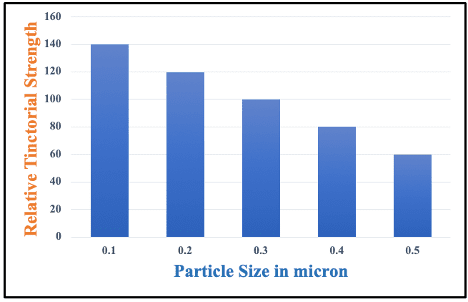
The physical size of pigments ranges from 0.01 micron to 25 microns. Commercial pigments typically fall within the 0.1–0.5 micron range. The critical relationship between particle size and tinctorial strength follows Euler’s rule: covering power increases as particle size decreases, reaching an optimal value when particle diameter approaches the wavelength of light being absorbed or reflected. Above this optimal size, translucency increases and color strength diminishes. The hue and tinctorial strength of pigments are both directly affected by particle size distribution and particle shape.
Particle Shape
Pigment particles occur in five primary morphologies, each influencing the optical properties and application performance of the final product:
- Spheroidal — rounded particles providing uniform color development
- Cubical — angular particles offering high tinting strength
- Nodular — irregular clusters affecting opacity and viscosity
- Acicular (needle-like) — elongated particles providing unique optical effects and reinforcement
- Lamelar (flakes) — plate-like particles delivering high hiding power and pearlescent effects
Covering Power
Covering power is the most crucial characteristic of a pigment for textile application. According to Euler’s rule, covering power increases as particle size decreases, reaching an optimum when the particle diameter approaches the wavelength of light absorbed or reflected by the pigment. Further increases in particle size beyond this threshold result in translucency. The critical relationship between particle size and tinctorial strength means that both the hue and color strength of pigments are directly influenced by the size and shape distributions established during manufacturing.
The properties of pigments are significantly affected by small changes in the pigment manufacturing process, including precipitation conditions, crystallite size, and surface treatment. A minor adjustment in synthesis parameters can shift the color coordinates, dispersibility, and fastness properties substantially.
The graph below illustrates the relationship between particle size and relative tinctorial strength:
Chemical Nature of Textile Pigments
Chemically, pigments are classified into two categories: inorganic and organic. Each category has distinct properties, applications, and environmental profiles in textile coloration.
1. Inorganic Pigments
Only a limited number of inorganic pigments are available for textile use. They are primarily employed for metallic colors, white, and black shades. The three main inorganic white pigments are:
- Barium sulfate (BaSO₄) — provides excellent chemical stability and opacity
- Zinc oxide (ZnO) — offers UV resistance and antimicrobial properties
- Titanium dioxide (TiO₂) — delivers the highest hiding power among white pigments, with a refractive index of 2.7
Black pigments are manufactured primarily from carbon black and iron oxide (Fe₃O₄). Carbon black particles typically measure 0.01–0.5 microns and provide excellent UV protection. Metallic pigments include aluminum and bronze, with aluminum pigments providing bright silvery metallic effects widely used in automotive textiles and decorative fabrics.
2. Organic Pigments
Organic pigments are abundant in number and varied in chemical structure. They constitute the majority of pigments used for textile applications due to their broad color gamut and high color strength. Key organic pigment structures include:
- Azo pigments — the largest class, accounting for approximately 60% of all organic pigments produced globally
- Anthraquinone — valued for excellent lightfastness and red to violet hues
- Indigo — historically significant, still widely used for denim dyeing
- Thioindigo — provides deep red shades with good fastness properties
- Phthalocyanine and copper phthalocyanine — deliver bright, stable blue and green shades with exceptional chemical resistance
Modern high-performance organic pigment classes include Quinacridone (providing magenta and violet shades with outstanding lightfastness), Dioxazine (offering deep violet hues), Perylene (delivering excellent heat stability and red shades), and Perylene perinone (providing orange to red shades with superior fastness).
Classifications of Textile Pigments
In the United States, pigment colorants for textiles are classified into four categories by the Colour Index (C.I.) system, a joint publication of the Society of Dyers and Colourists and the American Association of Textile Chemists and Colorists:
1. Pure Pigments (C.I. Pigment)
Pure pigments are full-strength colorants free from all added diluents. They are intrinsically colored and chemically unaffected by alkali. They exhibit the highest tinctorial strength among the four categories and are the only type specified for use in textile pigment dyeing systems, per AATCC and SDC guidelines.
2. Toners (C.I. Toner)
Toners are insoluble salts of acid and basic dyes. They produce vivid, intense shades and are used at low concentrations to modify the hue of base pigments. Toners exhibit some instability under alkaline conditions and may exhibit metamerism — the phenomenon where two colored samples match under one light source but not another.
3. Lakes (C.I. Lake)
Lakes are precipitates of dyes with metallic salts (such as alumina) and black fixer. Unlike toners, the dye component is an integral part of the lake structure. They are formed by precipitating acid dyes onto an inorganic substrate, producing pigments with unique hue and transparency characteristics.
4. Extended Pigments (C.I. Extended)
Extended pigments consist of pigments or toners that have been diluted with extenders such as alumina or blanc fixe (barium sulfate). Unlike lakes, the extender is not an integral part of the product — it is mechanically blended to reduce tinting strength and lower cost. Extension ratios typically range from 1:1 to 1:5.
In textiles, only pure pigments are used, as they provide the consistent fastness properties and chemical stability required for commercial textile applications.
Since binder is essential for pigment application, understanding binder chemistry is fundamental to achieving optimal pigment dyeing results in textile processing.
Binder Chemistry
Binders are film-forming substances composed of copolymers. The copolymer structure contains comonomers that produce both hard and soft homopolymers, determining the final film properties. Hard homopolymers are derived from styrene, acrylonitrile, methyl methacrylate, and vinyl acetate monomers, providing film hardness and adhesion. Soft homopolymers are derived from butadiene and butyl acrylate monomers, providing flexibility and film elasticity. The ratio of hard to soft monomers typically ranges from 60:40 to 40:60 for balanced performance.
Binders must adhere firmly to textile substrates while maintaining sufficient film integrity without becoming overly flexible. A reactive comonomer bearing functional groups forms chemical bridges between binder molecules, improving wash fastness and cohesion. Acrylamide and methyl acrylamide are commonly used reactive comonomers that participate in crosslinking reactions during curing, elevating the glass transition temperature (Tg) of the final film and improving mechanical resistance.
Pigment Dyeing Methods in Textile Processing
Pigment dyeing — also called pigmentation — is a method of textile coloration applicable to all fiber types and fiber blends. It is accomplished through three primary methods:
- Mass pigmentation — coloration of synthetic polymer fibers during spinning from polymer to fiber
- Exhaust method — batchwise garment and fabric dyeing using modified laundry equipment
- Continuous padding method — continuous fabric coloration through aqueous pigment-binder solution
Mass pigmentation is limited to coloration of synthetic fibers during melt-spinning or solution-spinning, where pigment particles are compounded into the polymer melt or dope before extrusion. This method provides exceptional colorfastness and color uniformity because the pigment is distributed throughout the fiber cross-section.
Pigment Dyeing by the Exhaust Method
The exhaust method is widely used for commercial garment dyeing of cotton, polyester, and blended fabrics. A modified industrial washing machine (winch or jet machine) is employed. The process consists of four sequential stages:
1. Fabric Cationization
The fabric or garments are first wetted out in the machine. A cationic agent (typically a quaternary ammonium compound) is then added to the bath at a concentration of 2–5 g/L. The fabric is impregnated at 70°C for 20 minutes, which imparts a slight positive surface charge. This provides anionic pigment particles with electrostatic attraction toward the fabric surface, improving deposition efficiency. A nonionic wetting agent (0.5–1 g/L) reduces surface tension, and acetic acid is added to maintain the bath pH at 5.0–6.0 for optimal cationic agent performance.
2. Pigment Exhaustion
Pigment dispersion is prepared by mixing pigment with water and anionic dispersing agents (such as lignosulfonates or synthetic dispersants), which impart a negative charge to the pigment particles, preventing aggregation. The dispersion is gradually metered into the dyeing machine bath. The bath temperature is increased to 50–100°C and held for 10–40 minutes depending on the fiber type. For cotton garments, exhaustion is typically conducted at 80–100°C for 20–30 minutes to maximize pigment adsorption onto the cationized surface.
3. Binder Application
After the exhaustion stage, the binder (typically an acrylic or polyurethane copolymer at 20–60 g/L) is added directly to the bath. The bath is circulated for 15–20 minutes at 50–60°C to allow binder adsorption onto the fabric and pigment surfaces. The machine is then drained and a cold rinse is performed to remove unfixed material.
4. Drying and Curing
The treated garments are transferred to a commercial tumble dryer and dried at 90–120°C for 10–15 minutes. Curing is subsequently carried out at 160–180°C for 60–120 seconds in a tumble dryer or curing chamber, depending on the binder system. For most acrylic binder systems, curing at 170°C for 90 seconds is sufficient to achieve full crosslinking and optimum wash fastness. The curing step converts the binder film from a flexible latex into an insoluble, crosslinked polymer network that mechanically entraps pigment particles within the fabric surface.
Pigment Dyeing by the Continuous Padding Method
Continuous pigment padding is the most widely used method for woven and knitted fabric coloration. The process consists of fabric passage through an aqueous bath containing pigment and binder (padding), followed by mechanical removal of excess liquor (mangling), drying, and curing. During the curing step, the binder converts into an insoluble crosslinked film that mechanically entraps pigment particles within the fabric interstices.
Process parameters for continuous padding are precisely controlled to achieve uniform coloration:
| Process Stage | Temperature | Time / Speed | Key Parameters |
|---|---|---|---|
| Padding bath | 20–40°C | Continuous | Pigment: 5–50 g/L; Binder: 20–80 g/L; Pick-up: 60–80% |
| Drying | 90–120°C | 60–120 seconds | Overfeed: 5–10% for knits;td> |
| Fixation/Curing | 160–180°C | 60–120 seconds | Depends on binder Tg; dwell time determined by fabric weight |
The fixation temperature depends on the binder’s glass transition temperature (Tg) and the fabric substrate. Lightweight fabrics require lower curing temperatures (150–165°C) to prevent thermal damage, while heavier fabrics tolerate 170–180°C for full crosslinking. After the curing stage, no afterwash is required, which is a significant advantage of the pigment padding process in terms of water and energy consumption.
Reduction Clearing and Oxidation
For heavily pigmented or dark shades, a post-treatment reduction clearing or oxidation step may be applied to improve rub fastness and remove surface deposits:
- Reduction Clearing: Conducted using caustic soda (3–5 g/L) and thiourea dioxide (1–2 g/L) at 60–80°C for 20 minutes. This reduces any surface pigment oxidation products and improves crocking fastness by 1–2 grades on the AATCC Crockmeter scale.
- Oxidation Process: Calcium hypochlorite (2–4 g/L available chlorine) followed by treatment with sodium bisulfite (2–3 g/L) for desizing and bleaching auxiliary removal. This step ensures complete removal of reduction clearing agents and prevents oxidative degradation of the fabric.
Commercial Pigment and Binder Products
Commercially available pigment and binder product ranges are marketed under established brand names by major textile chemical suppliers. The most widely used products in the industry include:
Pigments
- Aridye — broad color range, high tinting strength, suitable for padding and exhaust methods
- Acramin — widely used for textile pigment printing and padding, good lightfastness
- Helizerin — high-performance organic pigments for demanding applications
- Microfix — microencapsulated pigments providing improved wash fastness
- Sherdye — cost-effective pigment range for standard textile applications
Binders
- Helizerin — acrylic copolymer binders with excellent wash fastness
- Acramin — polyurethane-acrylic hybrid binders for high-flexibility applications
- Primal — acrylic emulsions providing good balance of hand feel and fastness
- Perapret — low-formaldehyde binder systems meeting OEKO-TEX Standard 100 requirements
- Neopralac — urethane-based binders delivering soft hand and high elasticity for stretch fabrics
Advantages and Disadvantages of Textile Pigments
Pigment coloration offers distinct benefits and limitations compared to traditional dye systems. The choice between pigments and dyes depends on the specific end-use requirements, fabric type, and performance standards.
Advantages of Using Pigments
- Universal applicability — pigments are applicable to all kinds of fibers and fiber blends, including cotton, polyester, nylon, and polycotton, without requiring fiber-specific dye chemistry
- Complete color gamut — the full color spectrum is available, including bright shades difficult to achieve with certain fiber-reactive dyes
- Easy compound shade matching — mixing pigments to achieve target shades is straightforward, with reproducible results across batches
- Simple shade matching — adjustments are made by adding more pigment or binder, with immediate visual feedback
- Economical process — no salt or alkali requirements, lower water consumption than conventional exhaust dyeing, and no need for afterwash in continuous processing
- Environmental profile — eliminates effluent salt loading from conventional dyeing; however, binder BOD/COD in effluent remains a consideration requiring treatment
Disadvantages of Using Pigments
- Fastness limitations — wash fastness and rub fastness can be inadequate for heavy-wear applications; typical wash fastness ratings of 3–4 on the AATCC scale compared to 4–5 for reactive dyes
- Shade depth restriction — depth of shade is typically limited to light and medium depths; achieving deep shades requires multiple passes or is economically impractical
- Handle degradation — binder films stiffen the fabric, reducing drape and hand feel, particularly noticeable in lightweight cotton and silk fabrics where handle is a key quality parameter
Pigment vs. Reactive Dye: Performance Comparison
| Property | Pigment Coloration | Reactive Dyeing |
|---|---|---|
| Wash Fastness (AATCC) | 3–4 grade | 4–5 grade |
| Rub Fastness (Dry) | 4 grade | 4–5 grade |
| Light Fastness (Xenon) | 4–7 grade (varies by pigment) | 4–8 grade (varies by dye) |
| Water Consumption | Low (no afterwash) | High (multiple rinse/soaps) |
| Energy Consumption | Moderate | High (fixation requires 100–140°C) |
Understanding these trade-offs helps textile engineers select the appropriate coloration method based on the fabric’s end-use, performance requirements, and sustainability goals. For fast-fashion garments where wash frequency is low and cost is the primary driver, pigment coloration offers clear advantages. For workwear, outdoor textiles, and products requiring long-term color retention, reactive or vat dyes deliver superior durability.
That’s it, folks! I hope after reading this article you have gained sufficient knowledge to explain the differences between pigment and dye to others, as well as the pigment dyeing methods used in textile processing. Learning these fundamentals in detail will help you understand entry-level t-shirt printing machines more easily. Understanding pigments and dyes will also help you make more informed decisions when selecting the best paint for clothes to achieve vibrant, lasting results in your textile projects. Stay safe and keep exploring the world of textile coloration!
References
- Society of Dyers and Colourists. (n.d.). Colour Index International. https://colourindex.com. Published jointly by SDC and AATCC.
- Broadbent, A. D. (2001). Basic Principles of Textile Coloration (2nd ed.). Bradford, West Yorkshire: Society of Dyers and Colourists.
- Shore, J., & Society of Dyers and Colourists (Eds.). (1995). Cellulosics Dyeing. Bradford, West Yorkshire: Society of Dyers and Colourists.
- American Association of Textile Chemists and Colorists. (2022). AATCC Technical Manual. Research Triangle Park, NC: AATCC.
- International Organization for Standardization. (2019). ISO 105-C06: Textiles — Tests for colour fastness — Part C06: Colour fastness to domestic and commercial laundering. Geneva: ISO.
- Textile Exchange. (2023). Preferred Fiber & Materials Market Report. https://textileexchange.org.


