
How to Wash Embroidered Clothes Without Damaging the Design

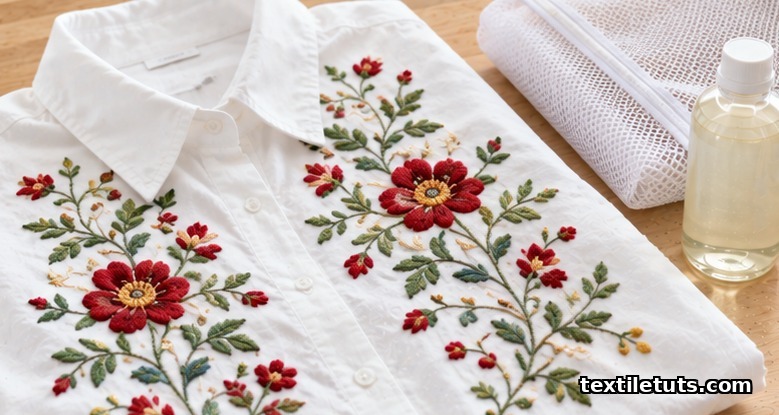
Embroidered clothes must be washed inside out in cold water under 30°C using a gentle or delicate cycle with a mesh laundry bag — agitation and heat are the two forces that snag embroidery threads, bleed thread dyes, and warp or shrink the stabilizer backing beneath the design. Hand washing in cold water with a pH-neutral detergent is the safest method and eliminates all agitation risk entirely. Always air-dry flat; tumble dryers apply heat and mechanical tumbling that can distort the embroidered panel, cause pilling around the stitches, and permanently pucker the base fabric.
Why Embroidered Clothes Need Special Washing Care
Embroidery is not a single material — it is a layered structure composed of three distinct components that each react independently to water, agitation, and heat. The base fabric (cotton, polyester, linen, or a blend) forms the foundation. Above it sits the stabilizer backing — a temporary or permanent layer that provides rigidity during stitching and prevents the fabric from pulling or distorting as the needle passes through. On top sits the decorative thread layer: cotton, rayon, polyester, silk, or metallic fibers stitched into the design.
Each of these three layers has a different thermal expansion coefficient and moisture absorption rate. When you wash an embroidered garment, you are exposing three materials simultaneously to the same conditions, and they do not respond uniformly. This mismatch is the root cause of every common embroidery damage problem.
Agitation, Heat, and Mechanical Tumbling Damage Embroidered Garments in Distinct Ways
Agitation is the first and most immediate threat to embroidered designs. The mechanical back-and-forth motion of a washing machine drum creates friction between the embroidered surface and the drum walls, other garments, and the bag itself. This friction snags or pulls decorative threads, particularly at the edges of the design where anchor stitches are most vulnerable. According to the American Cleaning Institute’s Fabric Care Guide, agitation is responsible for the majority of embroidery damage in machine-washed garments — specifically thread snagging, partial unraveling at design borders, and loss of stitch density in high-motion areas.
Heat acts on two layers simultaneously. At temperatures above 30°C, the stabilizer backing — which is typically a water-soluble or heat-sensitive material — can shrink by 3–7% or warp from uneven heat distribution. This shrinkage puckers the surrounding base fabric and creates ridging around the embroidery design perimeter. Heat also poses a direct threat to the thread itself: non-colorfast rayon and silk threads bleed dye at elevated temperatures, and prolonged exposure to warm water weakens rayon embroidery thread by up to 20% per wash cycle, according to Cotton Incorporated’s textile testing data.
Mechanical tumbling in a tumble dryer compounds both of these problems. The dryer heat shrinks stabilizer backing through sustained warmth rather than a single wash phase, and the tumbling action creates continuous friction against raised stitch surfaces. Dimensional embroidery elements — raised satin stitch, French knots, and beaded accents — are particularly vulnerable. These elements rely on their three-dimensional structure for visual impact, and the combination of heat and tumbling flattens them permanently in a single drying cycle.
Rayon, Metallic, and Polyester Embroidery Threads Have Different Wash Tolerances
Rayon embroidery thread is the most commonly used decorative thread in consumer embroidery and the most vulnerable to washing damage. Made from regenerated cellulose fibers, rayon has high absorbency and low wet strength relative to its dry tensile properties. When wet, rayon thread loses approximately 20–30% of its dry tensile strength, making it susceptible to breakage during even gentle agitation. Rayon is also inherently non-colorfast — its dyes are susceptible to bleeding and migration in temperatures above 30°C.
Metallic or lurex embroidery thread presents the most extreme care sensitivity. These threads consist of a metallic foil wrapped around an adhesive core yarn, or a synthetic filament with a metallic coating applied through vacuum deposition. Hot water dissolves or softens the adhesive binding, causing the metallic foil to separate from the core and the thread to unravel. Even warm water (above 30°C) can initiate this degradation process over repeated wash cycles.
Polyester embroidery thread is the most wash-resistant option. Polyester is hydrophobic, absorbs minimal water, and maintains its tensile strength when wet. However, the base fabric and stabilizer must still be considered — a polyester thread on a rayon base fabric with a water-soluble stabilizer still requires cold water and gentle handling.
Reading the Care Label on Embroidered Garments
The care label attached to a garment applies to the base fabric, not to the embroidery. Manufacturers are required to label for the base material’s care requirements, but they are not obligated to account for decorative additions like embroidery, appliqués, or beading. This means a care label stating “machine wash warm” or “40°C” must be overridden when embroidery is present on the garment.
When you see a warm or hot water instruction on a care label and the garment has embroidery, always downgrade by one temperature setting. A 40°C label becomes a 30°C wash. A 60°C label for durable white cotton becomes 30–40°C if embroidery is present. The embroidery layer is always the limiting factor in wash temperature.
| Care Symbol | Standard Meaning | Embroidery Adjustment |
|---|---|---|
| 30°C tub | Machine wash cold | Safe — use gentle cycle + mesh bag |
| 40°C tub | Machine wash warm | Downgrade to 30°C for embroidered pieces |
| Hand wash symbol | Hand wash only | Follow exactly — no machine |
| Do not wring symbol | Do not wring | Critical — wringing distorts thread placement |
| Dry flat symbol | Lay flat to dry | Mandatory for all embroidered garments |
| Do not tumble dry | No dryer | Follow exactly regardless of fabric |
If the garment has no care label at all — which occurs in handmade, custom-embroidered, or vintage pieces — default to the safest protocol: hand wash in cold water (15–25°C maximum), use a pH-neutral delicate detergent, do not wring or twist, and dry flat on a clean towel.
Hand Washing Method (Safest for All Embroidered Garments)
Hand washing eliminates mechanical agitation entirely and is the only method that is unconditionally safe for all embroidery types — including rayon, silk, metallic, and wool-on-wool embroidery. The process requires no special equipment beyond a clean basin, a gentle detergent, and clean towels.
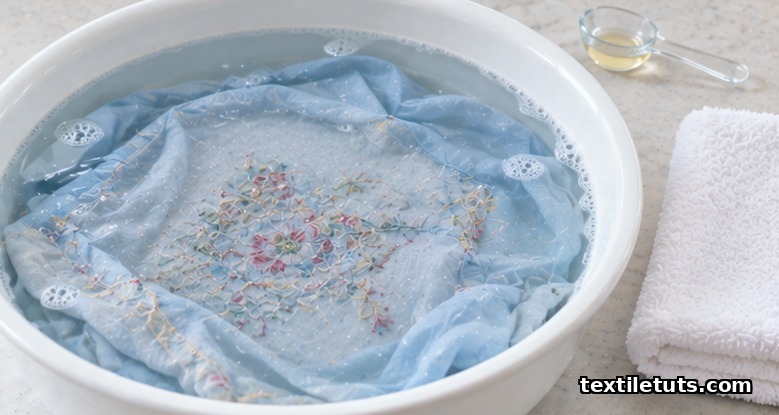
- Fill a clean basin or sink with cold water at 15–25°C maximum. Water temperature is the single most important variable — stay below 25°C to protect stabilizer backing and prevent dye bleeding from rayon or silk threads.
- Add 1 teaspoon (approximately 5 ml) of pH-neutral or gentle liquid detergent formulated for delicates — such as Woolite, Perwoll Gentle, or a silk-specific liquid detergent. Do not use biological (enzyme) detergents on rayon or silk embroidery threads, as protease enzymes degrade protein and cellulose fibers. Standard gentle liquid detergents are acceptable for polyester embroidery on synthetic base fabrics.
- Turn the garment completely inside out so the embroidered surface faces the interior of the garment. This positions the decorative stitches against the inner fabric face, protecting them from direct friction against the basin walls and your hands.
- Submerge the garment in the detergent solution and press gently to work the water through the fabric. Do not rub, scrub, or twist — these actions create focal points of mechanical stress that can snag threads or distort the design. Gentle pressing and squeezing motions through the fabric are the correct technique.
- Allow the garment to soak for 5–10 minutes maximum. Prolonged soaking — beyond 15 minutes — weakens wet thread fibers, particularly rayon, which absorbs water and becomes more vulnerable to breakage when repeatedly manipulated. A 5–10 minute soak is sufficient for soil release in normally worn garments.
- Lift the garment from the basin and gently squeeze water through the fabric, working from the top of the garment downward. Do not wring — twisting the fabric compresses and distorts the stitch layout.
- Drain the basin and refill with clean cold water at the same temperature range (15–25°C) for the first rinse.
- Rinse twice until the water runs completely clear. Residual detergent left in the fabric attracts incoming dirt and particulates, which become trapped in the dense stitch areas, stiffening the embroidery and dulling the thread’s luster over time.
- To remove excess water: lay the garment flat and roll it inside a clean dry towel, pressing gently to absorb moisture. Never twist, wring, or snap the garment. The mechanical stress of these actions distorts the embroidered panel.
- Reshape the embroidered area with your fingers while the fabric is still damp — align any displaced stitches gently back into their intended positions. Then lay the garment flat on a clean dry towel, embroidered panel facing up, and allow to air-dry completely away from direct sunlight.
Machine Washing Method (Conditional — Polyester Base Fabric Only)
Machine washing embroidered clothes is acceptable only under a specific and limited set of conditions. Before placing any embroidered garment in a washing machine, confirm all three of the following: the base fabric is polyester or stable cotton-polyester blend; the embroidery thread is 100% polyester; and there are no metallic, lurex, rayon, or silk decorative elements in the design. If any of these conditions are not met, revert to the hand washing method described above.
The following conditions are mandatory for machine washing embroidered clothes. Skipping any one of these steps significantly increases the risk of damage to the embroidered design.
- Turn garment inside out — This is non-negotiable. The embroidered surface must face the interior of the garment, protected from direct contact with the washing machine drum and other items in the load.
- Place inside a fine mesh laundry bag — The mesh bag closes the garment’s opening (preventing the embroidered panel from catching on the drum door or gasket), contains the item within a confined space that limits friction surfaces, and prevents the garment from tangling with other items. Use a fine mesh bag (not an open net bag) for items with dense stitch areas.
- Select gentle or delicate cycle only — Never use normal, cotton, heavy-duty, or permanent press cycles. These cycles use higher agitation speeds, longer wash times, and more aggressive tumbling than delicate fabrics can withstand. The gentle or delicate cycle uses a reduced agitation speed and shorter wash duration.
- Water temperature: 30°C maximum — Even with polyester embroidery, the stabilizer backing may be temperature-sensitive. Cold water (20°C or below) is preferable when the garment composition allows it.
- Spin speed: 400–600 RPM maximum — High-speed spin cycles (above 800 RPM) generate centrifugal forces that distort the stabilizer backing and stretch the embroidered panel. A slow spin (400–600 RPM) removes sufficient water with minimal mechanical stress.
- Wash separately or with only other delicates — Do not wash embroidered items with denim, towels, items with zippers, hook-and-loop fasteners, or any rough-textured garments. These items create abrasion points that can snag embroidery threads even inside a mesh bag.
- Use liquid detergent only — Powder detergents can leave undissolved residue trapped in dense stitch areas, particularly in designs with tight satin stitch fills. Liquid detergents dissolve completely in cold water and rinse clean without residue.
How to Dry Embroidered Clothes
Tumble drying is contraindicated for all embroidered garments regardless of the thread type, base fabric, or stabilizer composition. The combination of sustained heat and mechanical tumbling in a tumble dryer causes stabilizer shrinkage, thread distortion, flattening of dimensional stitch elements, and accelerated wear at friction points. According to the American Cleaning Institute, textile care organizations consistently identify tumble drying as a primary cause of preventable embroidery damage in consumer garments.
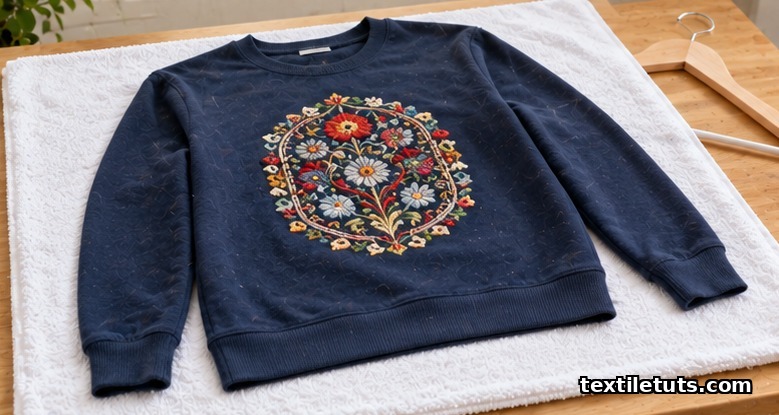
Air-drying flat is the only safe drying method for embroidered garments. This technique eliminates both heat and mechanical stress, allowing the garment to dry in the exact shape in which it was positioned.
- Lay a clean, dry cotton towel on a flat surface — a bed, table, or clean floor. Avoid pile fabrics that could imprint texture onto the damp embroidery.
- Place the garment right-side up on the towel with the embroidered panel facing upward. This orientation allows you to monitor the design as it dries and reshape it if needed.
- Gently reshape the embroidered area with your fingers while the fabric is still damp. Align any threads that may have shifted during washing. This is the critical window — once the fabric dries, displaced stitches are difficult to reposition without re-wetting.
- Allow to dry naturally away from direct sunlight. Ultraviolet radiation fades thread colors progressively with exposure, and rayon threads are particularly susceptible to UV-induced color loss. A shaded indoor area or a covered outdoor space with indirect light is ideal.
- Do not hang embroidered garments to dry. The weight of water-saturated fabric creates gravitational stress on the embroidered panel, stretching and distorting the design over time. Flat drying distributes the fabric’s weight evenly across the towel surface.
Drying time varies from 4 to 12 hours depending on fabric weight, ambient humidity, and air circulation. Heavier fabrics like cotton sweatshirts with dense embroidery may require the full 12 hours. Once the garment reaches approximately 90% dryness, any final ironing (if needed) should be completed before the fabric is completely stiff from being fully dry.
Ironing Embroidered Clothes Without Flattening the Design
Ironing an embroidered garment incorrectly flattens the dimensional stitch structure permanently. Once a raised satin stitch or French knot is compressed flat by direct iron contact, it cannot be restored to its original three-dimensional appearance. The correct technique is to iron only the reverse side of the garment, using the base fabric’s ironing temperature as your setting guide.
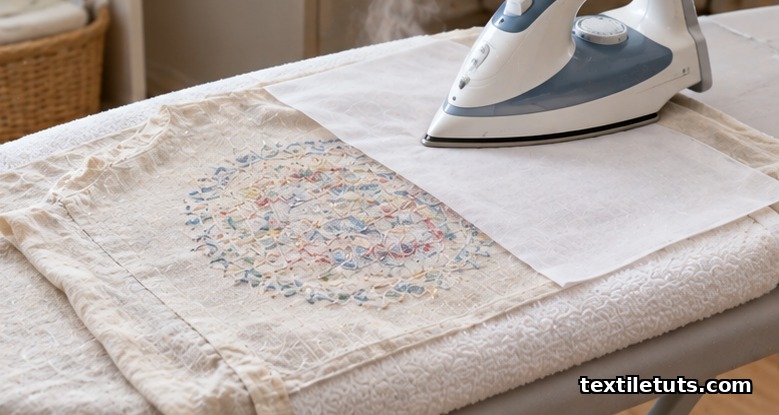
To iron embroidered clothes safely: turn the garment inside out so the embroidered surface faces downward against the ironing surface. Place a thick cotton towel beneath the garment as a cushion — this preserves stitch height by providing resistance under the fabric while you iron the reverse side. Set the iron temperature to the setting appropriate for the base fabric only. For polyester base fabrics, use low heat (synthetic setting, below 110°C). For cotton or linen, use medium heat (up to 150°C). For silk base fabrics, use the silk setting (below 110°C).
For delicate base fabrics, place an additional pressing cloth (a clean cotton muslin or dedicated pressing cloth) between the iron and the reverse side of the fabric. This distributes heat more evenly and prevents the iron’s soleplate from creating impressions on the fabric surface.
Stubborn creases that persist near the embroidery boundary can be addressed with a handheld garment steamer held 2–3 cm away from the fabric surface. The steam relaxes fabric fibers and releases wrinkles without direct contact, preserving stitch dimensions. However, never direct steam at metallic or lurex embroidery threads — the moisture and heat can dissolve the adhesive binding that holds the metallic coating to the core yarn.
Detergent and Product Guide for Embroidered Garments
Recommended Detergents
- pH-neutral delicates detergent — Formulations such as Woolite Delicates, Perwoll Gentle, or similar are specifically engineered for protein and cellulose fibers at neutral pH (6–7). These detergents clean effectively without the enzymatic activity or alkaline surfactants that degrade delicate threads.
- Silk-safe liquid detergent — For garments with rayon or silk embroidery threads, use a detergent specifically formulated for silk (such as ACTIVE Silk detergent or pH-neutral silk wash). These products omit protease enzymes and use gentle anionic surfactants that clean without damaging protein fibers.
- Standard gentle liquid detergent — For polyester embroidery on polyester base fabric, conventional gentle liquid detergents (free of bleach and optical brighteners) are acceptable and provide adequate cleaning.
Products to Avoid
- Enzyme (biological) detergents — Protease enzymes in standard biological detergents degrade protein-based fibers including silk and wool embroidery threads. These enzymes remain active in cool water and continue breaking down protein fibers during prolonged soaking. Avoid on all rayon, silk, and wool embroidery.
- Bleach or oxygen bleach — Both chlorine bleach and oxygen bleach (sodium percarbonate) strip dye from non-colorfast embroidery threads. Even “color-safe” oxygen bleach can cause dye migration in threads that are not individually colorfast. Spot-testing on an interior seam is required before any bleach product contacts an embroidered garment.
- Fabric softener — Fabric softeners coat fiber surfaces with a waxy cationic layer that attracts and traps lint, reduces thread luster, and builds up in the dense stitch areas of embroidery over repeated wash cycles. The build-up is difficult to remove and permanently dulls the embroidery’s visual appearance.
Useful Tools
- Fine mesh laundry bag (30 × 40 cm minimum for shirts; 40 × 50 cm for dresses or longer garments) — Essential for machine washing embroidered items. The mesh contains the garment and prevents the embroidered panel from catching on the drum mechanism.
- Soft toothbrush — Useful for spot-treating localized stains on the base fabric without making contact with the embroidery stitches. Apply a small amount of gentle detergent directly to the toothbrush bristles and work gently on the stain area, avoiding the stitch perimeter.
- Thick cotton towel — For flat drying. The towel absorbs moisture efficiently and provides a smooth, non-abrasive surface for the garment to rest on during drying.
Frequently Asked Questions
Can you put embroidered clothes in the washing machine?
Yes, with conditions — machine washing is safe for embroidered clothes on a cold, gentle or delicate cycle (30°C maximum, 400–600 RPM spin) when the garment is turned inside out and placed in a mesh laundry bag. Rayon, silk, or metallic embroidery thread requires hand washing only because machine agitation risks thread breakage and color bleeding.
Does washing damage embroidery?
Washing damages embroidery only when done incorrectly. Agitation snags or pulls anchor stitches; hot water shrinks the stabilizer backing and bleeds non-colorfast thread dyes; tumble drying distorts the embroidered panel through heat and mechanical tumbling. Cold water, gentle handling, and flat drying preserve the design through repeated washes.
How do you remove a stain from an embroidered area?
Blot the stain immediately with a clean damp cloth — do not rub, which can push the stain into thread fibers. Apply a small amount of gentle detergent to the stained base fabric around the embroidery with your finger or a soft toothbrush; work carefully to avoid pulling threads. Rinse with cold water. Never use stain removers containing bleach, acetone, or alcohol near embroidery thread.
Can embroidered clothes go in the dryer?
No — embroidered clothes should never go in a tumble dryer. Heat causes the stabilizer backing to shrink and warp, puckering the surrounding fabric; the mechanical tumbling motion creates friction that damages thread stitches and can distort dimensional embroidery elements such as raised satin stitch or French knots. Air-dry flat on a clean towel instead.
Sources
- American Cleaning Institute. (n.d.). Fabric Care Guide: Special Care Items. Retrieved from https://www.cleaninginstitute.org/
- Cotton Incorporated. (n.d.). Textile Care Guidelines: Delicate and Specialty Fabrics. Retrieved from https://www.cottoninc.com/
- International Wool Textile Organisation (IWTO). (n.d.). Wool Care Labelling Guidelines. Retrieved from https://www.iwto.org/
- ASTM International. (n.d.). Standard Guide for Care and Maintenance of Textile Articles. Retrieved from https://www.astm.org/


