
Does Polyester Shrink? How Much and Under What Conditions

Polyester does not shrink under normal washing conditions because it is a thermoplastic fiber with a structure set permanently during manufacturing. However, temperatures above 60°C in a dryer or direct high-heat ironing can cause permanent deformation — not shrinkage in the traditional sense, but irreversible distortion of the fiber structure. Here is exactly when and why polyester changes shape.
Why Polyester Resists Shrinkage (The Fiber Science)
Polyester — specifically PET (polyethylene terephthalate) — is a synthetic thermoplastic polymer. Its fibers are produced through a process called melt spinning, where PET pellets are heated until molten, extruded through fine spinnerets, and then rapidly cooled to form continuous filaments. During the subsequent drawing (stretching) phase, the fibers are heat-set at temperatures above their glass transition temperature (Tg) — approximately 67–70°C (153–158°F) for PET.
This heat-setting process is fundamental to understanding why polyester is dimensionally stable. When the fiber is heated above its Tg while under tension, the polymer chains are mobilized and then cooled in their elongated, aligned state. This locks in the fiber’s dimensions permanently. Water — whether cold, warm, or hot within normal wash temperatures — cannot unlock this thermal set. The polymer chains remain frozen in their extended configuration because they were never held in a relaxed state during cooling.
Contrast this with natural fibers such as cotton. Cotton yarns are spun under tension but are never subjected to a heat-setting process that would stabilize their dimensions. When water penetrates the cotton fiber, hydrogen bonds between cellulose chains are disrupted, allowing the fiber to swell and relax. As the fabric dries, the fiber contracts to a shorter dimension than before — this is what we measure as shrinkage. Polyester has no analogous mechanism under normal laundry conditions. The fiber’s dimensional stability is engineered in at the manufacturing stage, not dependent on the absence of water.
Key takeaway: polyester does not possess the mechanical tension release mechanism that drives cotton shrinkage. Within standard washing and drying temperatures (up to 40–60°C), 100% polyester fabric will retain its original dimensions wash after wash.
When Polyester DOES Change Shape: The Heat Deformation Risk
While polyester does not “shrink” in the conventional sense, it is susceptible to a distinct and irreversible phenomenon: thermal distortion. This occurs when the fabric is exposed to temperatures at or above the glass transition temperature of the polymer — approximately 67–70°C (153–158°F) for PET. At these temperatures, the polymer chains become mobile, and if the fabric is not held taut under tension, it will relax, distort, and potentially melt in localized areas.
What thermal distortion looks like in practice: the fabric becomes misshapen, pulling unevenly across panels; shiny or melted spots appear where the surface has partially fused; the handle becomes stiffer and boardy in affected areas; and in severe cases, the fabric welds itself together at seam intersections. Critically, this damage is permanent — there is no re-setting process that restores the original fiber structure once distortion has occurred.
It is essential to distinguish thermal distortion from shrinkage. True shrinkage in cotton involves the entire fabric contracting uniformly due to fiber relaxation. Polyester exposed to excessive heat does not shrink uniformly — it warps, twists, and deforms in unpredictable patterns. The dimensional change is neither controlled nor uniform, making it potentially more damaging to a garment’s fit and appearance than actual shrinkage would be.
High-risk scenarios for polyester thermal distortion:
- Tumble dryer on HIGH heat setting (often exceeds 70°C in some models)
- Direct ironing without steam at high temperature (iron plate can reach 200°C+)
- Leaving polyester garments in a hot car on a sunny day (interior can reach 80–90°C)
- Commercial dryers in laundromats or industrial facilities, which often run at 70°C or above
- Exposure to open flame or radiant heat sources
How Much Does Polyester Shrink?
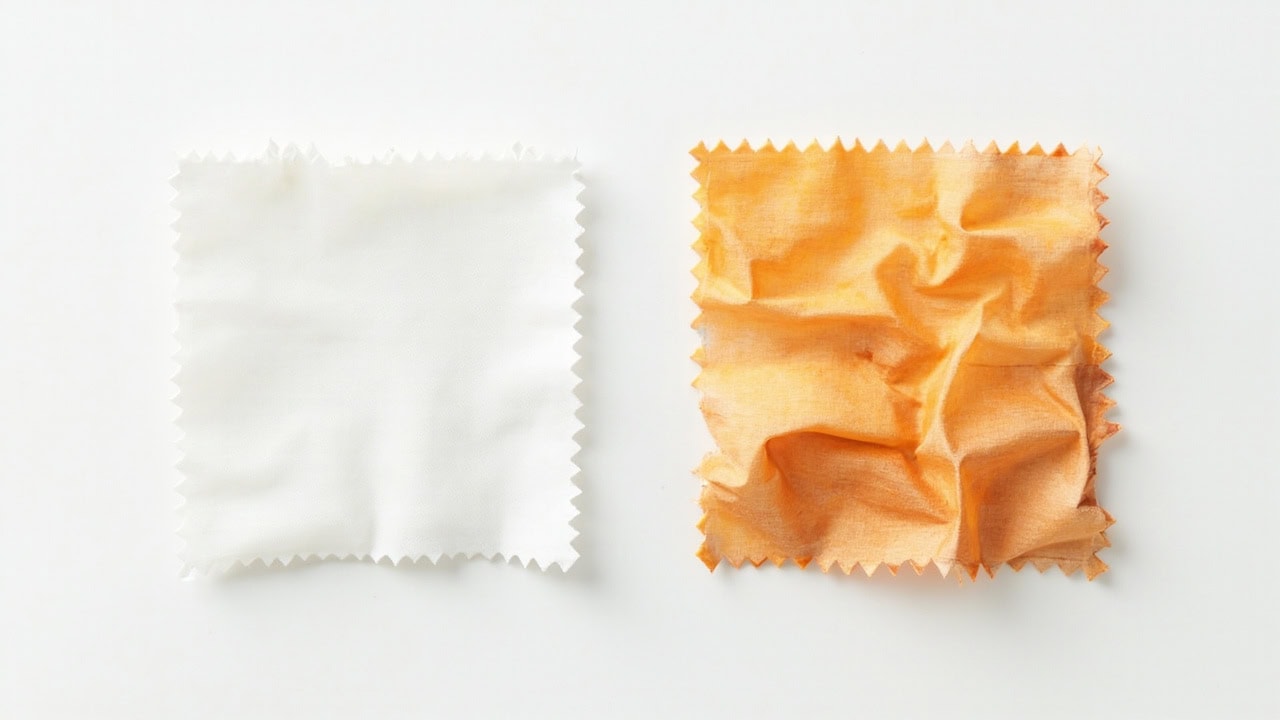
Because polyester resists true shrinkage so effectively, the more useful metric is dimensional change under various thermal conditions. Research and standard test methods such as ISO 6330 (Textiles — Domestic washing and drying procedures for textile testing) provide benchmarks for polyester dimensional stability across different wash and dry conditions.
In a cold or warm wash (up to 40°C): effectively 0% shrinkage. Multiple wash cycles at these temperatures produce no measurable dimensional change in 100% polyester fabrics. This is why polyester is classified as dimensionally stable within normal consumer laundry parameters.
In a hot wash (60°C): up to 1–2% shrinkage is possible, particularly in polyester-cotton blends. Pure polyester shows near-zero dimensional change even at 60°C, though some setting finishes applied during manufacturing may relax slightly at sustained elevated temperatures. The 1–2% figure for blends reflects the cotton component’s behavior, not the polyester’s.
In a high-heat dryer (exceeding 70°C): risk of distortion, not shrinkage. The distinction matters — the fabric may twist, pull, or develop shiny patches rather than simply contracting uniformly. This damage is irreversible and worsens with longer exposure time.
In direct ironing on high heat (iron temperature above 150°C / 300°F): localized melting and distortion begins within seconds. Iron soleplate temperatures on a “high” or “linen” setting routinely reach 200–215°C — well above PET’s melting point of approximately 260°C, meaning the fiber surface will fuse and glaze before reaching full melt.
| Fabric Type | Cold/Warm Wash (30–40°C) | Hot Wash (60°C) | High-Heat Dry | High-Heat Iron |
|---|---|---|---|---|
| 100% Polyester | ~0% | ~0–0.5% | Distortion risk above 70°C | Melting above 150°C |
| Polyester–Cotton (65/35) | ~0.5–1% | 1–2% | Distortion risk + shrinkage | Distortion risk |
| Polyester–Cotton (60/40) | ~1% | 1.5–2.5% | Distortion risk + shrinkage | Distortion risk |
| 100% Cotton | 3–5% | 5–8% | 3–6% | Safe at appropriate temp |
| 100% Wool | 3–6% (felting) | Severe felting | Not recommended | Steam only |
The table above illustrates why polyester’s dimensional stability is a genuine performance advantage. Where cotton and wool lose 3–8% of their dimensions across standard wash cycles, polyester holds its measurements within fractions of a percent — provided it is not exposed to temperatures above its glass transition threshold.
Recycled Polyester (rPET) — Same Rules?
Recycled polyester — commonly abbreviated as rPET or post-consumer recycled polyester — is produced by collecting and processing plastic bottles (primarily PET) into polyester fiber. Despite its different raw material source, rPET shares the same polyethylene terephthalate polymer chemistry as virgin polyester. The PET polymer itself is chemically identical whether it originated in a plastic bottle or a petroleum-derived terephthalic acid and ethylene glycol process.
This means the glass transition temperature of rPET is essentially identical to virgin PET — approximately 67–70°C. The heat-setting process used in rPET fiber manufacturing follows the same thermal profile, so the dimensional stability characteristics are equivalent. Shrinkage behavior in rPET fabrics is therefore indistinguishable from virgin polyester under the same wash and dry conditions.
Performance differences that do exist in rPET are unrelated to shrinkage or dimensional stability: slight variation in fiber uniformity due to the variability of collected bottle feedstock; potential differences in surface finish or luster depending on the recycling process; and in some cases, slightly reduced tenacity (breaking strength) in the recycled fiber. None of these affect shrinkage susceptibility or care requirements. rPET garments should be laundered under exactly the same guidelines as virgin polyester.
Polyester Blends and Shrinkage
Most “polyester” garments sold commercially are actually blends, combining polyester with natural or other synthetic fibers. The shrinkage behavior of these fabrics is governed by the blend partner, not the polyester component. Polyester itself does not shrink within normal laundry ranges — but the other fiber in the blend might.
Polyester–Cotton Blends
A 65/35 or 60/40 polyester–cotton blend will shrink less than 100% cotton but measurably more than 100% polyester. In a 60/40 polyester–cotton blend washed at 60°C, expect 1.5–2.5% shrinkage in the first several washes, with most of this occurring in the first wash. The cotton fibers contract when they absorb water and swell, pulling the polyester matrix with them — since polyester cannot relax in the same way, the blend shrinks by whatever amount the cotton component dictates, up to the constraint imposed by the polyester’s dimensional stability.
Polyester–Spandex (Activewear)
Polyester–spandex blends — common in activewear, leggings, and swimwear — present a different risk profile. Spandex (elastane) has a very low shrinkage risk across all wash temperatures, but heat is the primary threat to its elastic properties. Exposure to temperatures above 110°C can cause permanent loss of spandex elasticity, resulting in a garment that sags and loses its compression fit. Tumble drying on high heat and direct ironing are the main culprits. Always check the care label for the elastane component and err toward cooler settings.
Core principle for all blends: care for the garment according to the most heat-sensitive fiber in the blend. If a 65/35 polyester–cotton blend is washed at cotton’s preferred temperature (60°C), the polyester component is unaffected but the cotton shrinks. If washed at polyester’s preferred temperature (30–40°C), the polyester is safe and the cotton will experience only minimal shrinkage. When in doubt, choose the cooler, gentler option.
How to Safely Wash and Dry Polyester
100% polyester is among the easiest fabric types to launder successfully. Its dimensional stability means that, within normal wash temperatures, the garment’s fit and dimensions are essentially maintenance-free. The primary goal of polyester care is simply to avoid the specific thermal risks described above.
Washing
Machine wash polyester on a cold to warm cycle at 30–40°C. At these temperatures, the glass transition threshold of PET is not approached, so there is zero risk of thermal distortion. A standard or permanent press cycle is perfectly appropriate. Use any standard laundry detergent — polyester is not prone to protein stains and does not require specialized enzymes. For activewear made from polyester–spandex blends, a sports-specific detergent can be beneficial for removing odor-causing bacteria that lodge in synthetic fibers, but is not required for standard polyester garments.
Drying
Tumble dry polyester on a LOW heat setting only. Remove the garment while it is still slightly damp — this is good practice for all synthetic garments, as it reduces the risk of over-drying and any residual heat buildup in the drum. Never use a high heat dryer setting for polyester. If line drying, polyester can be hung to dry in the open air without issue — UV exposure does not degrade PET polyester as it does some natural dyes.
Ironing
Iron polyester at a low temperature setting — typically setting 1 or 2 on most household irons, corresponding to 110–150°C. Always use a pressing cloth (a clean cotton handkerchief or dedicated cloth) between the iron and the polyester fabric. Steam is safe to use on polyester and is actually preferable to direct dry heat — the moisture cools the fiber surface and reduces the risk of glazing. Never use a high-temperature iron setting on polyester without a pressing cloth; the soleplate in direct contact with polyester at high heat will create shiny patches within seconds.
What to Avoid
High dryer heat settings — the single most common cause of polyester thermal distortion in the home. Dry-cleaning solvents are generally safe for polyester (most are petroleum-based and do not attack the PET polymer), but check the care label before dry cleaning, as some specialty finishes on polyester may be sensitive to specific solvents.
Frequently Asked Questions
Q: Does polyester shrink in the dryer?
A: Polyester does not shrink in a dryer at low to medium heat settings. At high heat settings (above 60–70°C), polyester can become permanently distorted — not technically shrunken, but misshapen. Always use low heat when tumble drying polyester.
Q: Can you shrink polyester on purpose?
A: Very difficult — polyester is specifically designed to resist heat deformation within normal laundry ranges. Attempting to shrink polyester by applying high heat risks permanently damaging the fabric rather than producing a controlled size reduction.
Q: Does polyester stretch out instead of shrinking?
A: Loose-weave or knit polyester can stretch out of shape over time from wearing and washing, but this is not the same as shrinkage. The fiber itself is dimensionally stable; the fabric construction may relax.
Q: Is 100% polyester safe in the washing machine?
A: Yes — polyester is machine washable on any standard cycle with cold to warm water. The main risk is using a hot dryer, not the washing machine itself.
References
- ISO. (2021). ISO 6330:2021 — Textiles: Domestic washing and drying procedures for textile testing. International Organization for Standardization.
- AATCC. (2020). AATCC Test Method 135 — Dimensional Changes of Fabrics After Home Laundering. American Association of Textile Chemists and Colorists.
- Cotton Incorporated. (2023). Shrinkage Control in Cotton and Cotton Blends — Technical Bulletin. Cotton Incorporated.
- Textile Exchange. (2024). Recycled Polyester: Market Data and Sustainability Insights. Textile Exchange.
- ASTM International. (2022). ASTM D1776 — Standard Practice for Conditioning and Testing Textiles. ASTM International.


