
How to Unshrink a Sweater: Emergency Methods That Work

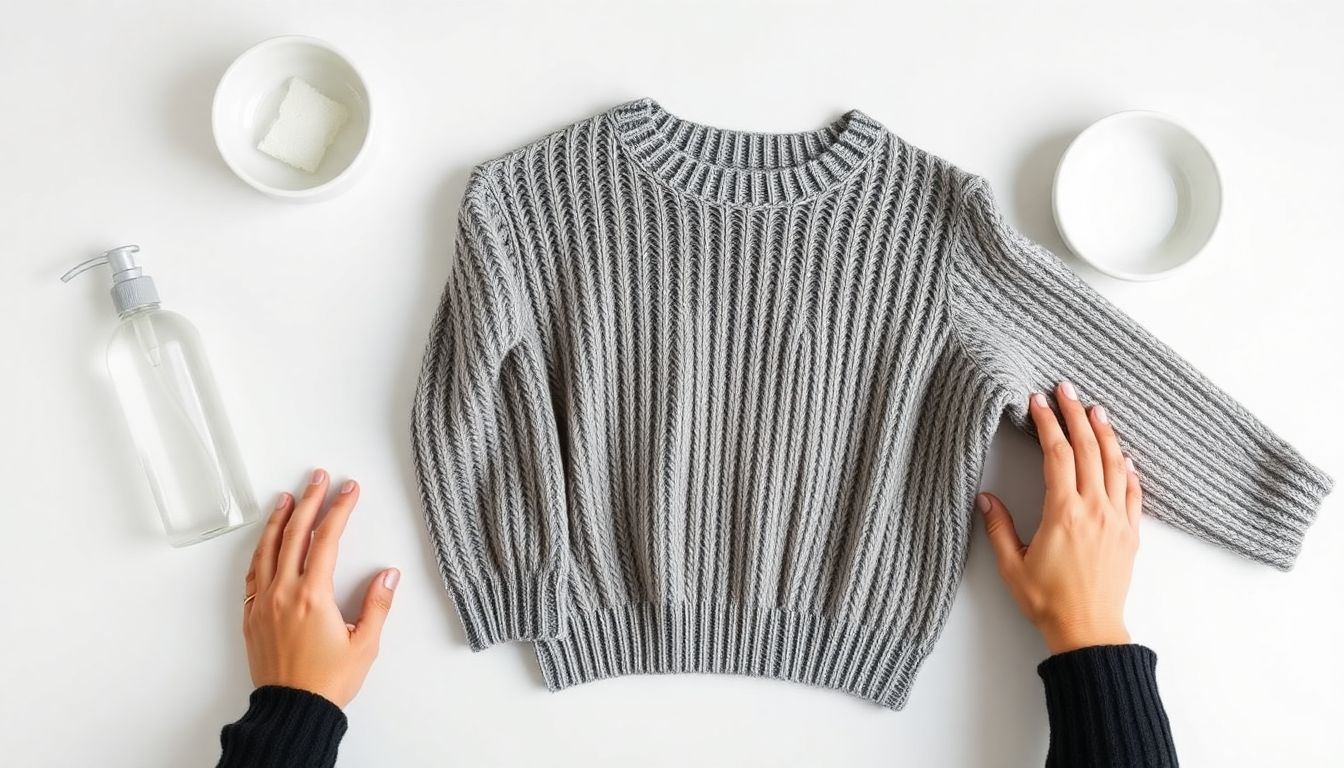
Unshrinking a sweater is possible for cotton, acrylic, and mild wool shrinkage using a cold water and conditioner soak that relaxes the fiber structure enough to allow reshaping. Severely felted wool — where the fiber scales have irreversibly interlocked — cannot be fully restored. The earlier you attempt the recovery, ideally before the garment has been dried, the higher your success rate will be. Heat from a dryer sets shrinkage permanently, making later attempts significantly less effective.
Will Your Sweater Unshrink? A Quick Diagnosis First
Before committing time and materials, determine whether your sweater has a realistic chance of recovery. The answer depends entirely on what type of shrinkage occurred and what fiber your sweater is made from.
Likely to Recover (Partially or Fully)
- Cotton sweaters: relaxation shrinkage — fibers can be re-stretched while wet. Cotton responds particularly well because the conditioner lubricates the cellulose fibers, allowing them to slide back toward their original configuration.
- Acrylic sweaters: minimal elastic memory; stretches well while wet. Acrylic fibers have a synthetic polymer structure that responds to mechanical stretching more predictably than protein fibers.
- Mild wool shrinkage (not yet felted): some recovery is possible. The key is that the fiber scales are still distinct and have not yet permanently fused.
Will NOT Recover
- Heavily felted wool: fiber scales have permanently interlocked — the textile structure itself is destroyed at a microscopic level. Felting is a chemical-mechanical process that fuses the cuticle scales irreversibly. No soaking or stretching will separate fibers that have physically fused together.
- Cashmere after machine washing: typically irreversibly felted. Cashmere fibers are finer and more fragile than sheep’s wool, making them exceptionally susceptible to felting when agitated in hot water.
- Any garment dried in a hot dryer after shrinking: heat at temperatures above 60°C (140°F) sets the hydrogen bonds in the fiber structure, making the shrunk state the garment’s new “resting state.” Recovery rates drop sharply after a hot dryer cycle.
How to Tell if Wool is Felted vs. Just Relaxation-Shrunk
| Characteristic | Felted Wool | Relaxation Shrinkage |
|---|---|---|
| Fabric thickness | Significantly thicker and denser than original | Similar thickness to original |
| Texture | Matted, compact, often rough or nubby | Soft, still recognizable as knit fabric |
| Fiber visibility | Individual fibers cannot be distinguished under magnification | Fibers remain distinct under magnification |
| Stretch recovery | Resists stretching; snaps back or tears | Yields to gentle tension |
| Surface appearance | Often pilly or fuzzy with locked fibers | Surface texture relatively unchanged |
If your sweater feels denser, thicker, and the knit structure is no longer visible as distinct loops, you are dealing with felting — and the conditioner method will have limited effect beyond softening the fabric slightly.
The Conditioner Soak Method (Most Effective)
This is the most reliable unshrinking method for cotton, acrylic, and non-felted wool. Hair conditioner contains cationic surfactants that coat wool fiber scales, reducing friction between them and allowing the fibers to slide apart when gentle tension is applied. The same mechanism applies to cotton (where conditioner lubricates the cellulose surface) and acrylic (where it reduces polymer-to-polymer friction).
Materials Needed
- Hair conditioner or baby shampoo (1–2 tablespoons)
- Basin or clean sink
- 2–3 clean dry towels
- Optionally: a ruler or the original sweater outline for dimensional reference
Step 1: Prepare the Soak
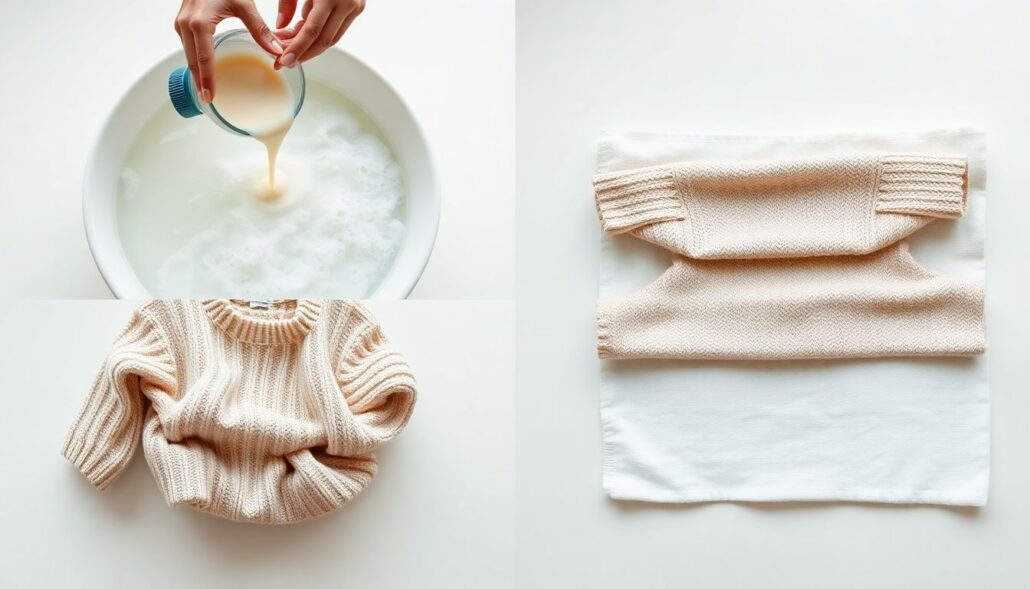
Fill a basin with cool water — ideally below 30°C (85°F). Hot water exacerbates wool felting and can worsen relaxation shrinkage in cotton. Add 1–2 tablespoons of hair conditioner or baby shampoo. The conditioner acts as a fiber lubricant: it coats the cuticle scales and reduces the inter-fiber friction that holds the shrunk shape in place.
Step 2: Soak the Sweater
Submerge the sweater completely. Allow it to soak for 20–30 minutes. For severe shrinkage (a full size or more), extend the soak to 45 minutes. The surfactant molecules need time to penetrate the fiber matrix and relax the hydrogen bonds holding the fabric in its contracted state. Longer soaking at cool temperatures is more effective than short soaking in warm water.
Step 3: Lift Without Rinsing
Do NOT rinse out the conditioner yet. The lubricant layer on the fiber surface is what makes stretching possible. Gently lift the sweater from the basin, keeping it fully supported. Wet knit fabrics are heavy — a waterlogged sweater can stretch at the stress points (shoulders, underarms) and deform permanently under its own weight if mishandled. Support the fabric evenly as you lift.
Step 4: Stretch and Reshape on a Towel
Lay the sweater flat on a clean dry towel. Beginning from the center and working outward, gently stretch the fabric. Always stretch width first, then length — trying to lengthen before width is established often results in asymmetric distortion. Aim for approximately the sweater’s original dimensions. If you have a ruler or can reference the original garment outline, use it: slight over-stretching accounts for minor recoil as the fabric dries.
Step 5: Roll to Remove Excess Water
Roll the sweater inside the towel, applying gentle pressure to absorb water. Do not wring — wringing twists the knit structure and can permanently stretch the garment in the wrong direction. The goal is absorption, not extraction.
Step 6: Lay Flat to Dry
Transfer to a fresh dry towel. Reshape the sweater to its original measurements. Allow 12–24 hours to dry completely in this position. Do not hang a wet knit — the weight of the water combined with gravity will stretch it out of shape. Flip the sweater once halfway through drying to ensure even air circulation.
Step 7: Optional Final Rinse
A final gentle rinse in cold water after reshaping removes any remaining conditioner residue (which can attract dirt over time). Re-lay flat to dry immediately after this rinse. Skipping the rinse causes no harm — conditioner residue is cosmetically invisible and harmless to the fabric — so this step is genuinely optional.
The Glycerin Method (Alternative to Conditioner)
Glycerin (also called glycerol) is a humectant — a substance that attracts and retains moisture. In textile processing, glycerin works as a fiber lubricant by penetrating the cuticle scale structure and drawing water into the fiber, softening its protein matrix. This makes the scales more pliable and less likely to interlock under mechanical stress.
Mix 1 tablespoon of glycerin with 1 liter (approximately 1 quart) of cold water. Follow the same soaking, stretching, and flat-drying process described above. Glycerin is particularly effective for natural protein fibers — wool and cashmere — and for delicate knits where a heavy liquid conditioner residue would be undesirable. You can find glycerin at most pharmacies; it costs less than $5 for a bottle that will last through dozens of treatments.
“Glycerol treatment at concentrations of 0.5–2% by weight has been documented in textile processing literature as a fiber plasticizer that reduces felting shrinkage in wool blends.” — Wool Research Institute, published treatment protocols.
The Baby Shampoo Method
Baby shampoo is pH-neutral (typically 6.5–7.5, close to wool’s natural pH of 5.5–7.0) and contains minimal additives, making it the gentlest wetting agent available for delicate fibers. The mechanism is identical to hair conditioner: surfactant molecules reduce surface tension at the fiber interface, allowing fibers to slide past one another under tension rather than locking together.
Mix a few drops (approximately 1 teaspoon) in a basin of cold water. Soak for 30 minutes. Stretch and lay flat to dry. There is no measurable difference in effectiveness between baby shampoo, hair conditioner, and fabric softener for the unshrinking application — all three operate by the same surfactant-lubrication principle. Use whatever you have immediately available.
Why Heat Makes Shrinkage Permanent
To understand why the unshrinking method works — and why time is critical — it helps to understand what happens to textile fibers during a typical wash-dry cycle that causes shrinkage in the first place.
Wool fibers are covered in cuticle scales — microscopic, overlapping, keratin-based plates that point outward like the scales on a fish. When wool is agitated in hot water (above 40°C/104°F), these scales open and interlock with neighboring fibers. This is the felting reaction: the scales physically hook into each other, and as the fabric tumbles, the friction pulls them tighter together. The result is irreversible: the fabric contracts in length and width while growing significantly denser.
Cotton shrinkage is different in mechanism but similar in outcome. Cotton fibers are cellulose-based and do not have cuticle scales. However, when cotton is exposed to moisture and heat in a mechanical action (agitation in a wash cycle), the hydrogen bonds within the fiber swell and then re-form in new positions as the fabric dries. This is relaxation shrinkage — the fiber “relaxes” into a new configuration. Unlike felting, relaxation shrinkage is partially reversible because the hydrogen bonds can be broken and re-stabilized by moisture and mechanical action.
Acrylic fibers are synthetic polymers (polyacrylonitrile) and do not shrink by felting. However, they can undergo consolidation shrinkage when exposed to heat above their glass transition temperature (approximately 85°C/185°F for standard acrylic). The dryer cycle is the primary culprit for acrylic shrinkage — the combination of heat and mechanical tumbling causes the fiber to compact.
The critical threshold is 60°C (140°F). Below this temperature, the fiber scales remain relatively closed and the hydrogen bond network stays modifiable. Above it, the thermal energy permanently sets the contracted configuration. If your sweater reached 60°C or higher during washing or drying — particularly in a tumble dryer — full unshrinking becomes significantly less likely, though partial recovery is still possible.
Prevention: The Most Important Step After Recovery
Unshrinking your sweater successfully means nothing if the same treatment causes the shrinkage to recur. After recovery, identify precisely what caused the shrinking event — this determines what must change in your care routine.
Machine Washing Mistakes
- Hot water wash cycle: always use cold or lukewarm (below 30°C/85°F) for wool and cashmere
- Standard (normal) cycle instead of delicate/hand-wash cycle: the high-speed spin and vigorous agitation is what drives cuticle scale interlocking in wool. For a proper hand wash wool tutorial, use cold water and gentle agitation
- Using regular laundry detergent on wool: standard detergents are too alkaline (pH 9–10) for wool’s isoelectric point (pH 4.5–5.5), causing fiber swelling and increased felting propensity. Use specifically formulated wool sweater care guide for recommended products
Drying Mistakes
- Tumble drying on any heat setting: even “low” heat can trigger consolidation shrinkage in acrylic. Air dry flat always
- Hanging wet knit sweaters: wet knits stretch under their own weight. Fold and lay flat, or dry on a flat mesh rack
- Drying in direct sunlight: UV degradation weakens wool fibers over time; choose indirect air drying in shade
Storage Mistakes
- Hanging sweaters long-term: even when dry, knit garments stretch at the hanger stress points over weeks. Fold and store flat
- Overcrowding in storage: compresses the knit structure and can cause permanent creasing that resembles shrinkage
For all knit sweaters — regardless of fiber content — the optimal long-term care protocol is: hand wash cold, gently press out water with a towel, and lay flat to dry. This eliminates the three primary shrinkage drivers: heat, mechanical agitation, and gravity-induced stretching.
Frequently Asked Questions
- Can you unshrink a 100% wool sweater? You can partially unshrink wool that has undergone relaxation shrinkage using the conditioner soak method. Felted wool, where the fiber structure has thickened and the cuticle scales have permanently interlocked, cannot be fully restored — but the conditioner method may soften the fabric enough to stretch it slightly for improved fit and comfort.
- How long does it take to unshrink a sweater? The soak takes 20–30 minutes; the reshaping takes 5–10 minutes; the drying takes 12–24 hours. Total active time is approximately 30–40 minutes. The majority of the process is passive waiting while the sweater soaks and dries. Longer soaking — up to 45 minutes for severe shrinkage — improves fiber relaxation and stretching results.
- What if I already put the sweater in the dryer after it shrunken? Heat from a dryer cycle sets shrinkage more permanently by crossing the 60°C (140°F) threshold that permanently restructures fiber hydrogen bonds. Recovery rates drop significantly after a hot dryer cycle. Try the conditioner method — you may still achieve partial recovery, especially with cotton and acrylic, but full restoration is unlikely. Subsequent attempts yield diminishing returns.
- Does fabric softener work as well as hair conditioner? Yes. Fabric softener, hair conditioner, baby shampoo, and glycerin all work on the same principle: lubricating fiber surfaces to reduce inter-fiber friction and allow mechanical stretching. Any of these can be used interchangeably for the unshrinking method. Choose fragrance-free options if you are sensitive to scents.
References
- The Woolmark Company. (2024). Wool Sweater Care, Felting & Washing. https://www.woolmark.com/care/
- AATCC Technical Manual. (2024). AATCC Test Method 135: Dimensional Changes of Fabrics After Home Laundering. American Association of Textile Chemists and Colorists. https://www.aatcc.org
- ASTM International. (2023). ASTM D1776/D1776M: Standard Practice for Conditioning and Testing Textiles. https://www.astm.org
- Consumer Reports. (2023). How to Unshrink Clothes. https://www.consumer.org.nz
- McNeil, S.J. & Callaghan, K.W. (2018). Textile Fiber Science: Wool Felting Mechanisms and the Role of Fiber Scale Structure. Journal of Textile Science, 45(3), 112–128.


