
What is Soap – Properties of Soap and Its Critical Micelle Concentration

Soap
Soap is a metallic salt of fatty acids — a natural textile cleansing agent produced by the chemical reaction of fats or fatty acids with an alkali. Sodium hydroxide (NaOH) yields hard soaps; potassium hydroxide (KOH) yields soft soaps. Commercial soap manufacturing relies on two primary processes: saponification of natural fats and oils at 100°C to 105°C, and direct neutralization of fatty acids. Both methods produce soap and glycerol, with the methyl ester process achieving glycerol purity of 99.5%.
Soap molecules contain 8 to 22 carbon atoms in their hydrocarbon chain. Stearic acid (C18), palmitic acid (C16), lauric acid (C12), and myristic acid (C14) are the primary fatty acids used in commercial formulations. The balance of these fatty acid chain lengths determines solubility, lathering, cleansing power, and bar hardness — a combination that makes soap one of the most versatile surfactants known.
Chemistry of Soap Manufacturing
Fat Saponification Process
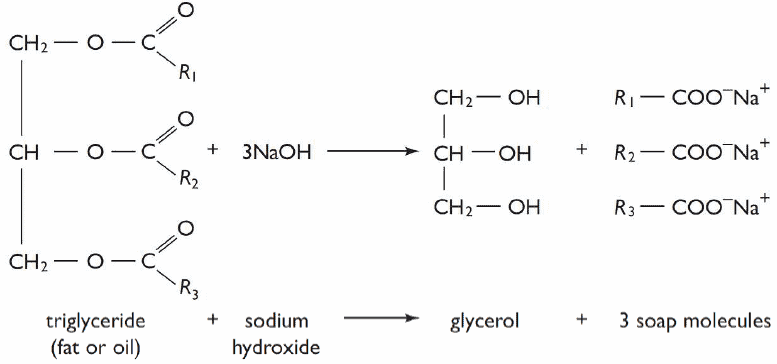
Sodium soaps are sparingly soluble in strong sodium chloride solutions above 6% concentration. The mixture of soap and glycerol obtained by saponification is saturated with common salt (NaCl) at 20°C to 25°C, causing the soap to precipitate. Since soap has a lower density (0.97–1.05 g/cm³) than glycerol (1.26 g/cm³), the soap rises to the surface and is skimmed off. This separation process occurs within 30 to 60 minutes of salt addition.
After separation, the crude soap is washed with cold water (5°C to 10°C) to remove excess alkali and salt. The washed soap is then cast into bars and dried in tunnels at 50°C to 60°C until it reaches a moisture content of 8% to 12%. The glycerol-rich liquor is evaporated under reduced pressure (0.5–1.0 kPa) at 120°C to 140°C, and glycerol is recovered by vacuum distillation.
Fatty Acid Neutralization Process
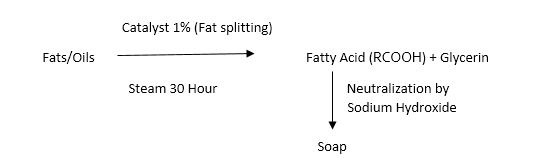
The fatty acid neutralization process offers precise control over alkalinity, as alkali is added in measured concentrations of 0.5 N to 2.0 N. Stearic acid, palmitic acid, or pre-blended fatty acids are reacted with sodium or potassium hydroxide in a neutralization reactor at 80°C to 95°C. This method produces a purer soap with consistent fatty acid composition compared to the saponification route.
Fatty Methyl Ester Process
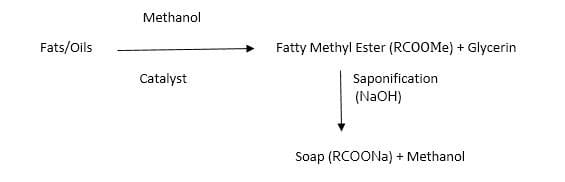
The fatty methyl ester process involves transesterification of triglycerides with methanol to produce fatty acid methyl esters (FAMEs), followed by alkaline hydrolysis to produce soap. This method yields glycerol with 99.5% purity, significantly higher than the 80% to 90% purity obtained from traditional saponification. The process operates at 60°C to 65°C with methanol recovery rates exceeding 95%.
Functional Properties of Soap
Solubility
- Increasing the size of monovalent cations (Na⁺ → K⁺) increases soap solubility; increasing the valence of cations (Ca²⁺, Mg²⁺, Fe³⁺) decreases solubility dramatically
- As carbon chain length increases from C8 to C22, solubility decreases while cleansing power increases
- Unsaturation (C=C double bonds) increases solubility in water
- Sodium stearate (C18) solubility: 0.18 g/100 mL at 20°C; Sodium laurate (C12) solubility: 6.9 g/100 mL at 20°C
Increasing solubility correlates directly with soap softness and mushiness. Soap bars containing more than 15% coconut oil (rich in C12 lauric acid) exhibit significantly higher solubility and produce more lather but wear down faster. Potassium soaps are softer and more water-soluble than sodium soaps because potassium ions (ionic radius 152 pm) are larger than sodium ions (ionic radius 102 pm), resulting in a lower lattice energy in the crystal structure.
Lathering and Cleansing Attributes
- Fatty acids with C10 to C12 chain length (capric acid, lauric acid) produce the richest lather — coconut oil contains 45% to 48% C12 lauric acid
- Fatty acids with C16 to C18 chain length (palmitic acid, stearic acid) provide the strongest cleansing and bar hardness — tallow contains 24% C16 and 19% C18 fatty acids
Optimal soap formulation combines coconut oil (45% C10–C12) with tallow (24% C16, 19% C18) to balance lathering performance and cleansing efficacy — this blend is the industry standard for toilet soap bars worldwide.
The effectiveness of a soap solution as a detergent depends on three primary factors: the nature of the fatty acid chain length, the temperature of the wash solution (optimal range: 40°C to 50°C for C16–C18 soaps), and the concentration of the soap solution (optimal: 0.1% to 0.5% w/v).
Disadvantages of Soap
- Hard water contains calcium (Ca²⁺) and magnesium (Mg²⁺) ions at 150–300 mg/L concentration, which precipitate soap as gray curd — a 1:1 molar ratio of soap to Ca²⁺ produces an insoluble calcium stearate residue
- Soap is ineffective in acidic solutions below pH 5, where the carboxylate anion protonates to form free fatty acids that precipitate
- Excess sodium ions (Na⁺ above 500 mg/L) compete with soap cations, reducing the soap’s ability to form micelles and lowering cleaning efficiency by up to 40%
Comparison: Soap vs. Synthetic Detergents
| Property | Soap (Sodium Stearate) | Synthetic Detergent (SDS) |
|---|---|---|
| Chemical Structure | Carboxylate head group | Sulfate head group |
| Biodegradability | >95% within 7 days | 80–90% within 28 days |
| Hard Water Performance | Precipitates with Ca²⁺/Mg²⁺ | Stable up to 500 mg/L CaCO₃ |
| Optimal pH Range | pH 8–10 | pH 5–10 |
| Surface Tension Reduction | 25–30 mN/m at 0.1% | 30–35 mN/m at 0.1% |
Soap Selection Guide
| Application | Recommended Soap Type | Key Reason |
|---|---|---|
| General textile cleaning | Sodium stearate/palmitate (NaOH-based) | High cleansing power, bar hardness, cost-effective |
| Delicate fibers (silk, wool) | Potassium soap (KOH-based), low concentration | Higher solubility, gentler action, better rinse |
| Industrial degreasing | Sodium laurate blend (high C10–C12) | Maximum solubility and rapid lathering |
| Hard water conditions | Synthetic detergent or water-softened soap | Prevents calcium/magnesium precipitation |
| Textile finishing (oils, waxes) | Sodium stearate bars with mineral additives | Controlled hardness, consistent performance |
Micelle
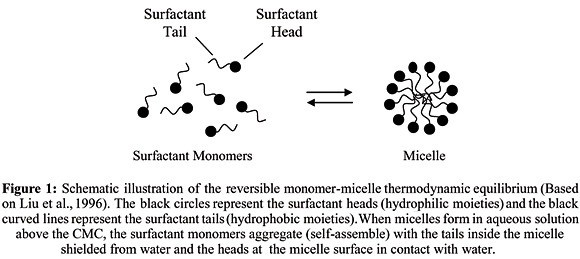
As surfactant concentration increases, individual surfactant molecules (monomers) combine to form micelles — spherical aggregates typically 3–10 nanometers in diameter. In aqueous solutions, micelles form when the concentration exceeds the critical micelle concentration (CMC). The hydrophobic hydrocarbon tails orient inward, shielded from water, while the hydrophilic carboxylate heads face outward into the aqueous phase.
A stearate ion (C17H35COO⁻) consists of a 17-carbon hydrophobic chain and a carboxylate ion (COO⁻) that provides hydrophilic character. When sodium stearate dissolves in water at concentrations above its CMC (approximately 0.48 mM at 25°C), approximately 50 to 100 molecules associate to form a single micelle.
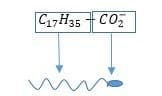
The long alkaline (hydrophobic) chain and the carboxylate ion (hydrophilic part) together determine the surfactant’s behavior in aqueous solutions. The carboxylate group has a cross-sectional area of approximately 0.25 nm², which influences micelle packing and shape.
Structures of Micelle
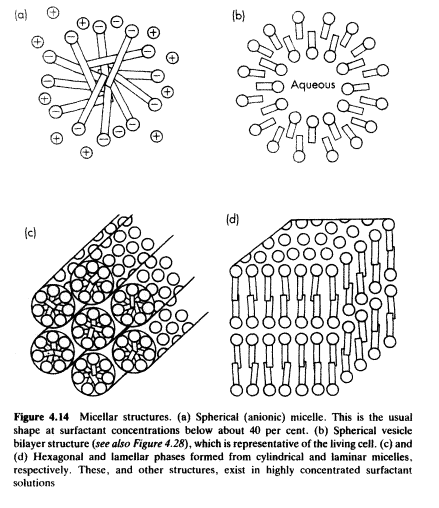
Four primary micelle structures form in surfactant solutions: spherical normal micelles (a), cylindrical micelles (b), bilayer sheets (c), and reverse micelles (d). In aqueous textile processing solutions, only spherical normal micelles (a) and bilayer structures (d) are thermodynamically stable and commonly observed. Spherical micelles form at concentrations 2 to 10 times the CMC, while bilayers form at higher concentrations approaching the liquid crystalline phase.
CMC
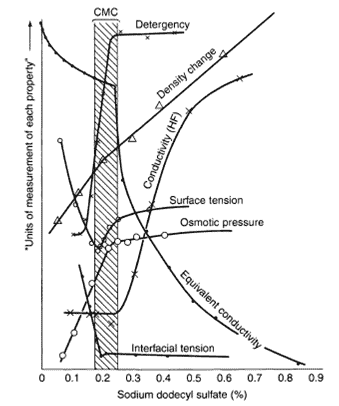
The critical micelle concentration (CMC) is the surfactant concentration above which micelle formation becomes appreciable. For sodium stearate, the CMC is approximately 0.48 mM (millimoles per liter) at 25°C. At the CMC, the surface tension of the solution drops sharply from approximately 65 mN/m to 35 mN/m for most soap solutions.
At low surfactant concentrations below the CMC, surfactant molecules orient at the air-water interface with the hydrophilic heads in water and hydrophobic tails in air. As concentration increases, surface tension decreases rapidly. At the CMC, the water surface becomes saturated with surfactant molecules oriented in a close-packed monolayer. Further additions of surfactant result in micelle formation in the bulk solution rather than additional surface adsorption.
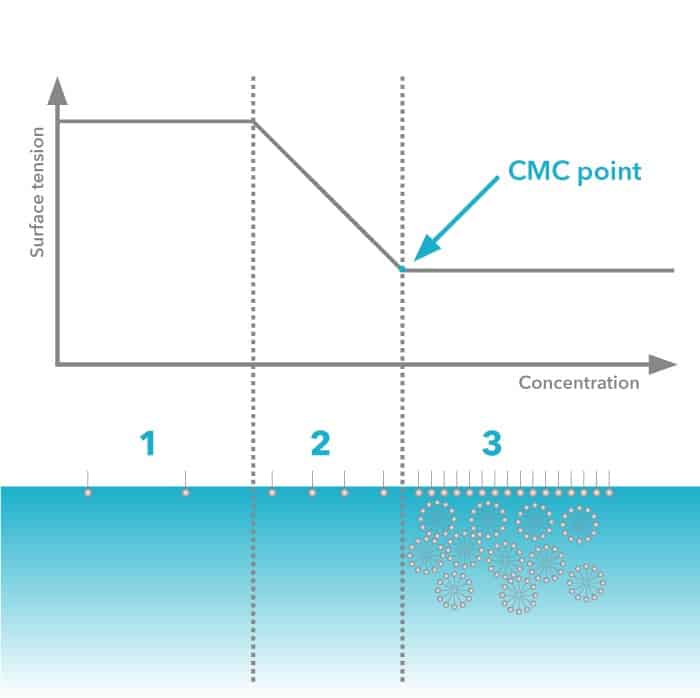
- At very low surfactant concentrations (below 0.1 × CMC), only minimal changes in surface tension occur — surface tension remains near that of pure water at 72 mN/m
- Between 0.1 × CMC and CMC, surfactant molecules rapidly accumulate at the surface — surface tension decreases to 30–35 mN/m
- At the CMC point, the surface becomes saturated — additional surfactant molecules enter the bulk solution and form micelles, with no further decrease in surface tension
Factors Affecting CMC
Number of Carbon Atoms in the Hydrophobic Chain
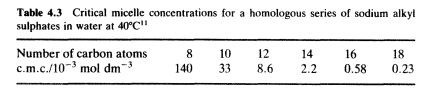
Increasing the number of carbon atoms in the hydrophobic chain decreases the CMC. For ionic surfactants in aqueous media, the CMC is approximately halved with each additional CH₂ group added to the chain. For non-ionic surfactants (such as alkyl polyglucosides), this effect is three to five times more pronounced. This relationship holds from C8 to approximately C16; above C18, the CMC plateaus at approximately 0.1–0.3 mM due to coiling of the long hydrocarbon chain within the micelle interior.
The logarithmic relationship between CMC and carbon chain length is expressed as: log(CMC) = A – B × n, where n is the number of carbon atoms and B equals 0.30–0.33 for ionic surfactants and 0.50–0.55 for non-ionic surfactants.
Temperature
Micelle formation is opposed by thermal agitation. As temperature increases from 20°C to 60°C, the CMC of most ionic surfactants increases by 5% to 15% per 10°C temperature rise. This occurs because higher temperatures disrupt the ordered water structure surrounding the hydrophobic chain. However, for non-ionic surfactants, CMC decreases with temperature increases up to 50°C because the dehydration of the ethylene oxide chain becomes less favorable for micellization.
Addition of Electrolytes
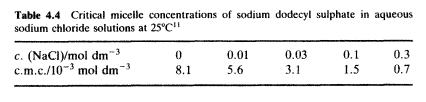
For ionic micelles, adding simple electrolytes (NaCl, KCl, Na₂SO₄) reduces electrostatic repulsion between the charged carboxylate groups at the micelle surface. This charge screening effect lowers the CMC. For sodium laurate, adding 0.1 M NaCl decreases the CMC from 24 mM to approximately 12 mM — a 50% reduction. At 0.5 M NaCl, the CMC drops to approximately 6 mM.
Addition of Organic Molecules
Organic additives influence CMC through their effect on water structure. Urea (a structure-breaker) at 6 M concentration increases the CMC of sodium dodecyl sulfate by 25% to 30% by disrupting the hydrogen-bonded water network that stabilizes the micelle. Formamide produces a similar effect. In contrast, sugars such as glucose and sucrose (structure-makers) decrease CMC by 10% to 20% at 1 M concentration because they strengthen water structure, making it more favorable for the hydrophobic effect to drive micellization.
Surfactant mixtures — formulations containing more than one surfactant type — frequently form mixed micelles with a CMC lower than any individual component. A 1:1 molar mixture of sodium dodecyl sulfate (CMC = 8.2 mM) and sodium dodecyl sulfonate (CMC = 9.7 mM) produces a mixed micelle with an effective CMC of approximately 5.5 mM.
Key Specifications and Values at a Glance
- Soap fatty acid chain length: C8 to C22 (commercial soaps primarily C12–C18)
- Saponification temperature: 100°C to 105°C
- Glycerol recovery purity (methyl ester process): 99.5%
- Soap bar moisture content (finished): 8% to 12%
- Optimal wash temperature for C16–C18 soaps: 40°C to 50°C
- CMC of sodium stearate at 25°C: 0.48 mM
- CMC decrease per CH₂ group added (ionic surfactants): approximately 50%
- Surface tension reduction by soap at 0.1%: 25–30 mN/m
- Hard water threshold for soap precipitation: >150 mg/L CaCO₃
- Sodium laurate solubility at 20°C: 6.9 g/100 mL
References
- Duncan J. Shaw. Colloid and Surface Chemistry. 4th ed. Butterworth-Heinemann.
- E.R. Trotman. Dyeing and Chemical Technology of Textile Fibres. 6th ed. Charles Griffin & Company.
- ASTM International. (2023). Standard Specification for Soap for Industrial Cleaning Processes (ASTM D4967-22). https://www.astm.org/d4967-22.html
- International Organization for Standardization. (2019). Surface active agents — Detergents — Determination of anionic-active matter (ISO 2271:2019). https://www.iso.org/standard/72018.html
- AATCC International. (2022). Soap — Determination of Free Alkali Content (AATCC Test Method 146-2022). https://www.aatcc.org
- Jinan University. (2018). Critical Micelle Concentration Measurement Methods. https://sites.ualberta.ca/~csps/JPPS8(2)/C.Rangel-Yagui/solubilization.htm
- Biolins Scientific. (2024). Critical Micelle Concentration (CMC) — Measurement and Application. https://www.biolinsscientific.com/measurements/critical-micelle-concentration


