
Water Repellency Test of Fabric by Spray Rating Tester

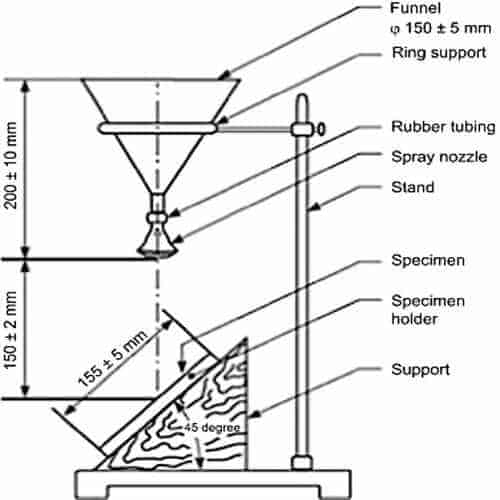
The AATCC Test Method 22 — Water Repellency: Spray Test measures a fabric’s resistance to surface wetting by applying 250 ml of water at 27°C ± 1°C through a spray head onto a specimen inclined at 45°, then rating the resulting wetting pattern against a standardized 0–100 photographic scale. The test quantifies water repellency by comparing fabric appearance to the AATCC 22 photographic reference chart after controlled spray exposure — a method equivalent to ISO 4920 and BS EN 24920. Fabrics achieving a spray rating of 70 or higher are considered water-resistant and suitable for outdoor apparel, workwear, and technical textiles.
Water repellency differs from waterproofing: a waterproof fabric must withstand a hydrostatic water column of at least 1 meter before penetration, while water-repellent fabrics resist wetting under light rain or accidental contact but will allow water through under sufficient pressure or prolonged exposure. This finish is achieved by treating fabric with paraffin waxes, silicones, acid-based melamine resins, or fluorocarbon polymers — all of which reduce fiber surface energy below water’s surface tension of approximately 72 mN/m at 20°C, causing water droplets to bead and roll off rather than spreading.
Condition fabric specimens for a minimum of 4 hours at 20°C ± 2°C and 65% ± 2% relative humidity before testing. Cut each specimen to 6 inches (152 mm) diameter, mount in the specimen hoop without folds or creases, and test a minimum of 5 specimens per sample to obtain a reliable average rating.
AATCC Water Repellency Test of Fabric by Spray Rating Tester
The American Association of Textile Chemists and Colorists (AATCC) defines water repellency as the resistance of a fabric to surface wetting by water. The AATCC Test Method 22 — Water Repellency: Spray Test quantifies this property using a visual rating scale. The tested material’s result is determined by comparing the fabric’s appearance against the standardized AATCC photographic reference chart after exposure to a controlled water spray. This method is technically equivalent to ISO 4920 and BS EN 24920.
Apparatus
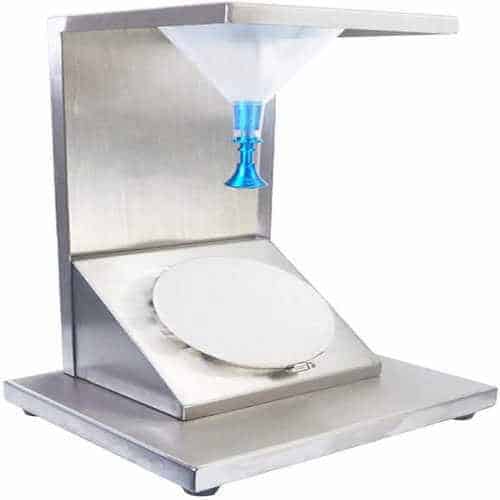
- Spray Tester (conforming to AATCC 22 specifications, with a 150 mm spray head distance)
- Scissors
- Fabric specimen (minimum 6 in × 6 in / 152 mm × 152 mm per test)
- Measuring cylinder (250 ml capacity, Class A tolerance)
- Thermometer (0–50°C range, ±1°C accuracy)
- Conditioned water (250 ml per test at 27°C ± 1°C)
- Specimen hooping frame (6-inch / 152 mm diameter embroidery hoop)
- AATCC 22 photographic rating scale chart
- Collection basin (positioned under the specimen area)
Precautions
Water temperature must be maintained at 27°C ± 1°C (80°F ± 2°F) throughout the test. The water shall be poured steadily at a uniform flow rate over 25–30 seconds. A collection basin must be positioned under the specimen area to capture run-off water. Testing must be conducted in a draft-free environment to ensure consistent spray distribution.
Sample Preparation
Condition the fabric specimens for a minimum of 4 hours in the standard testing atmosphere before testing. Cut each specimen to fit the 6-inch (152 mm) diameter specimen hoop with sufficient tension to prevent folding or creasing. Prepare a minimum of 5 specimens per sample to obtain a reliable average rating.
Standard Testing Atmosphere
The standard atmosphere for textile testing must be maintained at 20°C ± 2°C (68°F ± 3.6°F) and 65% ± 2% relative humidity. Moisture content in the fabric directly affects test results — changes in fabric weight from atmospheric moisture can compromise the accuracy of the spray rating. The specimens must reach moisture equilibrium in this environment before testing begins.
Working Procedure
- Secure the conditioned fabric specimen flat in the specimen hoop, ensuring the fabric surface is free of folds, creases, or tension marks.
- Place the specimen hoop into the spray tester specimen area, oriented so the fabric is inclined at a 45° angle to the horizontal.
- Measure exactly 250 ml of distilled or deionized water and verify the temperature is 27°C ± 1°C using the calibrated thermometer.
- Position the water reservoir funnel at the top of the instrument and pour the 250 ml of water at 27°C steadily over 25–30 seconds, maintaining uniform distribution across the spray head.
- After all water has been sprayed, immediately remove the specimen hoop and compare the wetting pattern on the fabric against the AATCC 22 photographic rating scale.
- Record the rating to the nearest whole number. Interpolation between ratings is not permitted.
- Repeat steps 1–6 for all 5 specimens. Record individual ratings in a data log.
- Calculate the arithmetic mean of all 5 individual ratings. Round the final result to the nearest whole number — this is the reported spray rating for the sample.
AATCC 22 Spray Test Rating Scale
The AATCC 22 spray rating scale ranges from 0 to 100, with higher values indicating greater water repellency. The rating is determined by visual comparison against the standardized AATCC photographic chart.
| Rating | Description | Wetted Area | Application Guidance |
|---|---|---|---|
| 100 | No wetting; no water droplets adhere to the fabric surface | 0% | Excellent repellency; outerwear, technical performance fabrics |
| 90 | Small random wetted spots; isolated droplet penetration | <5% | High-performance outdoor apparel |
| 80 | Wetting of the specimen surface with small droplets; partial penetration | 5–15% | Moderate-performance apparel and home textiles |
| 70 | Wetting of the entire specimen upper surface; partial penetration through fabric | 15–30% | General water-resistance; workwear, upholstery |
| 60 | Wetting penetrating through the fabric; specimens feels damp | 30–50% | Entry-level water resistance; casual use |
| 50 | Wetting of the entire specimen including back surface | 50–75% | Minimal water repellency; not suitable for wet weather |
| 0 | Complete saturation; wetting and penetration through entire specimen | 100% | Untreated or fully wetted fabric; no repellency |
Key Parameters at a Glance
| Parameter | Specification |
|---|---|
| Test Method | AATCC 22 (ISO 4920, BS EN 24920) |
| Water Temperature | 27°C ± 1°C (80°F ± 2°F) |
| Water Volume | 250 ml per test |
| Specimen Hoop Diameter | 6 inches (152 mm) |
| Specimen Inclination Angle | 45° from horizontal |
| Spray Head Height Above Specimen | 150 mm (6 inches) |
| Number of Specimens | 5 minimum per sample |
| Standard Atmosphere | 20°C ± 2°C, 65% ± 2% RH |
| Specimen Conditioning Time | Minimum 4 hours |
| Rating Scale Range | 0 (complete wetting) to 100 (no wetting) |
Water Repellent Treatment Chemistry
Modern water-repellent treatments fall into four main chemical categories, each with distinct performance characteristics:
| Treatment Type | Examples | Water Repellency | Durability | Limitations |
|---|---|---|---|---|
| Paraffin Wax | Aluminum/zirconium stearate emulsions | Moderate | Low (washes out) | Flammability risk; reduces fabric breathability |
| Melamine Resin | Stearic acid + melamine-formaldehyde | Good | Moderate | Formaldehyde release; may reduce tear strength |
| Silicone-based | Polydimethylsiloxane (PDMS) | Good | Good (laundry/dry cleaning resistant) | Can increase pilling; attracts hydrophobic dirt |
| Fluorocarbon (FC) | Perfluoroalkyl acrylate polymers | Excellent (water + oil repellency) | Excellent (durable through 30+ wash cycles) | PFAS ecological concerns; minimum C8 chain length required for oil repellency |
The surface tension of water at 20°C is approximately 72 mN/m — one of the highest among common liquids. Effective water-repellent finishes must reduce fiber surface energy below this threshold. Fluorocarbons achieve the lowest surface energy of all treatment types, which is why they are specified for high-performance outerwear and technical textiles. Silicone-based treatments are widely used in mid-tier applications where cost-effectiveness and environmental compliance are priorities.
Industry Applications and Requirements
Water-repellent fabrics serve diverse market segments with specific performance thresholds:
- Sportswear and activewear: Spray rating 70–90 required; durability through 20–30 wash cycles; must maintain breathability
- Military and tactical apparel: Spray rating 80–100; must withstand 50+ wash cycles; often combined with flame-retardant finishes
- Home textiles (upholstery, awnings): Spray rating 70–80; high UV and mildew resistance required; 3–5 year outdoor durability
- Medical bandages: Must prevent both water ingress and biological fluid wicking; cytotoxicity testing mandatory
- Automotive interiors: Spray rating 70+; resistance to skin oils, sun lotions, and food stains; colorfastness required
Remarks
The AATCC Test Method 22 — Water Repellency: Spray Test is one of the most widely adopted quality control procedures in the textile industry. Laboratories, manufacturers, and brand quality assurance teams use it to verify that water-repellent treatments meet specified performance thresholds. The spray test is particularly valued for its speed, reproducibility, and low equipment cost.
Equivalent standards include ISO 4920:1981 (confirmed current in 2026) and BS EN 24920, both of which use the same spray principle and rating methodology. When a fabric specification calls for “spray rating of 70” or higher, any of these three standards may be used for compliance testing.
References
- American Association of Textile Chemists and Colorists. (AATCC). AATCC Test Method 22 — Water Repellency: Spray Test. AATCC Technical Manual, current edition. https://www.aatcc.org/
- International Organization for Standardization. (1981). ISO 4920: Textile fabrics — Determination of resistance to surface wetting (spray test). ISO. https://www.iso.org/
- British Standards Institution. BS EN 24920 — Textile fabrics: Determination of resistance to surface wetting (spray test). BSI. https://www.bsi.org.uk/
- Schindler, W. D., & Hauser, P. J. (2004). Chemical Finishing of Textiles. Woodhead Publishing. In: ScienceDirect Topics — Repellency. https://www.sciencedirect.com/topics/engineering/repellency
- Hill, P. J., Taylor, M., Goswami, P., & Blackburn, R. S. (2017). Substitution of PFAS chemistry in outdoor apparel and the impact on repellency performance. Chemosphere, 181, 500–507. https://doi.org/10.1016/j.chemosphere.2017.04.122
- Schellenberger, S., Hill, P. J., Levenstam, O., Gillgard, P., Cousins, I. T., Taylor, M., & Blackburn, R. S. (2019). Highly fluorinated chemicals in functional textiles can be replaced by re-evaluating liquid repellency and end-user requirements. Journal of Cleaner Production, 217, 134–143. https://doi.org/10.1016/j.jclepro.2019.01.160


