
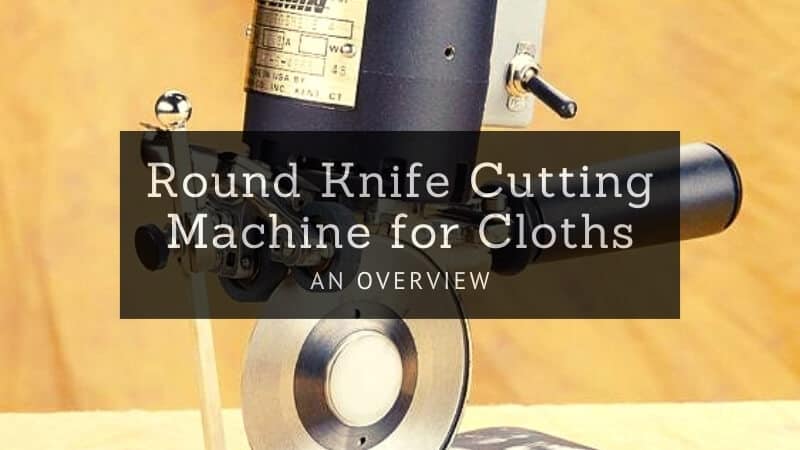
Round Knife Cutting Machine for Cloths – An Overview

Round Knife Cutting Machine for Cloths: Complete Guide
A round knife cutting machine is a rotary fabric cutting tool used for slicing fabric layers during apparel manufacturing. Its circular blade—often with a slightly octagonal profile—ranges from 60 mm to 200 mm (2.362–7.874 inches) in diameter and rotates continuously to generate clean cuts along curved and nonlinear cutting lines. The machine is compact, lightweight, and highly flexible, making it ideal for contour cutting in small to medium production runs where precision on curves matters more than raw throughput.
Key operational constraints define its practical range: the machine cannot cut notches, maximum lay height is limited to approximately 40% of the blade diameter, and it is best suited for multilayer fabric stacks up to 20–30 plies thick. Three distinct blade edge profiles handle different fabric types—waved edge for stretch and knit fabrics, toothed edge for slippery synthetics, and circular edge for woven fabrics requiring clean, non-fraying cuts.
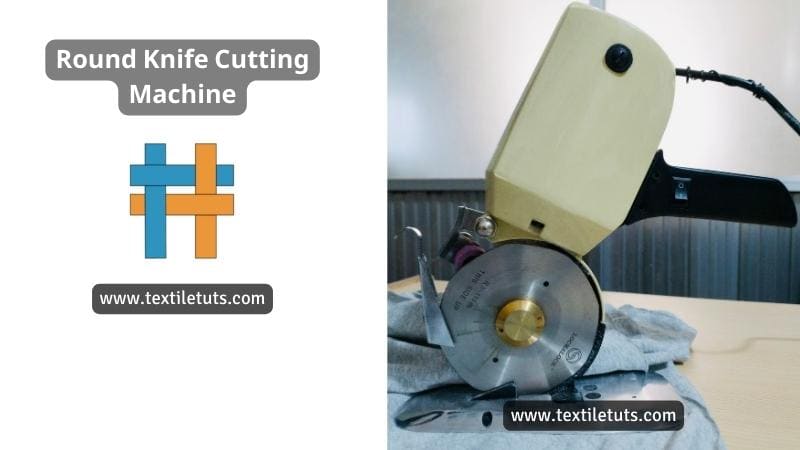
Features of Rotary Fabric Cutting Machine
A round knife cutting machine operates with a rotating circular blade driven by an electric motor. The machine achieves cutting speeds 10 times higher than straight knife cutting machines, though it is limited to lower lay heights. Its compact design and low weight deliver excellent maneuverability for curved cuts in single-ply and multilayer fabric stacks up to 20–30 plies thick.
- Round knife cutting machines cost more than straight knife counterparts of equivalent capacity
- The blade is circular with a slightly octagonal cutting edge for smooth rotation
- Knife diameter ranges from 60 mm to 200 mm (2.362–7.874 inches)
- A manual grinder mounted on the machine sharpens the blade when needed
- Three distinct cut edge profiles suit different fabric types:
- Waved edge — produces a serrated cut ideal for stretch and knit fabrics, reducing selvage curl
- Toothed edge — features small notches along the blade circumference for improved grip on slippery synthetic fabrics
- Circular edge — a smooth continuous edge for woven fabrics requiring clean, non-fraying cuts
- Motor RPM ranges from 800 to 1,600 depending on the machine model and blade diameter
- The handle attaches directly above the blade assembly for tactile control
- Low machine weight provides excellent maneuverability around tight curves
- The operator lubricates the blade manually via a grease inlet on the machine body
- Fabric plies are severed by continuous blade rotation
- High flexibility enables cutting of nonlinear shapes in fabric without repositioning the lay
- The base plate applies controlled tension to the fabric surface during cutting, maintaining ply alignment
- Maximum effective cutting depth reaches 40% of the blade diameter due to the geometry of rotation
- Key machine components include the base plate, electric motor, handle, knife guard, and sharpening assembly
Main Parts of a Round Knife Fabric Cutter
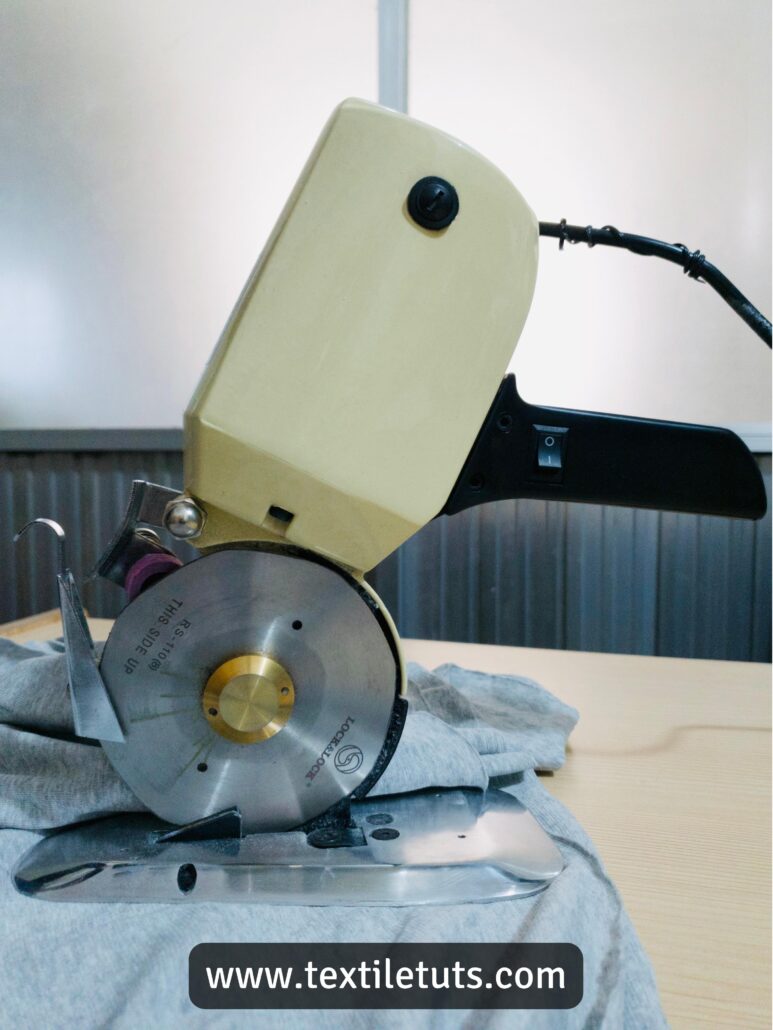
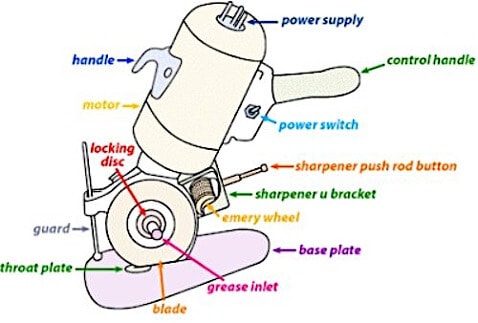
1. Handle
The handle is the primary grip point the operator holds during cutting. It is constructed from durable molded plastic or metal with a contoured grip surface, allowing precise guidance of the machine along curved cutting lines. The handle connects directly to the blade spindle assembly above the guard.
2. Motor
The electric motor drives blade rotation at 800–1,600 RPM. Motor power typically ranges from 0.25 kW to 0.75 kW for handheld round knife cutters used in textile applications. The motor is mounted concentrically with the blade shaft to minimize vibration and ensure smooth cutting action.
3. Power Switch
The power switch activates and deactivates the motor, controlling blade rotation. Safety standards for industrial textile machinery require a dead-man switch design that immediately halts blade rotation when released.
4. Blade
The circular blade is the cutting element, manufactured from hardened tool steel or tungsten carbide for extended service life. Blade diameters range from 60 mm to 200 mm depending on the machine model. The blade requires careful handling due to its extremely sharp cutting edge along the entire circumference.
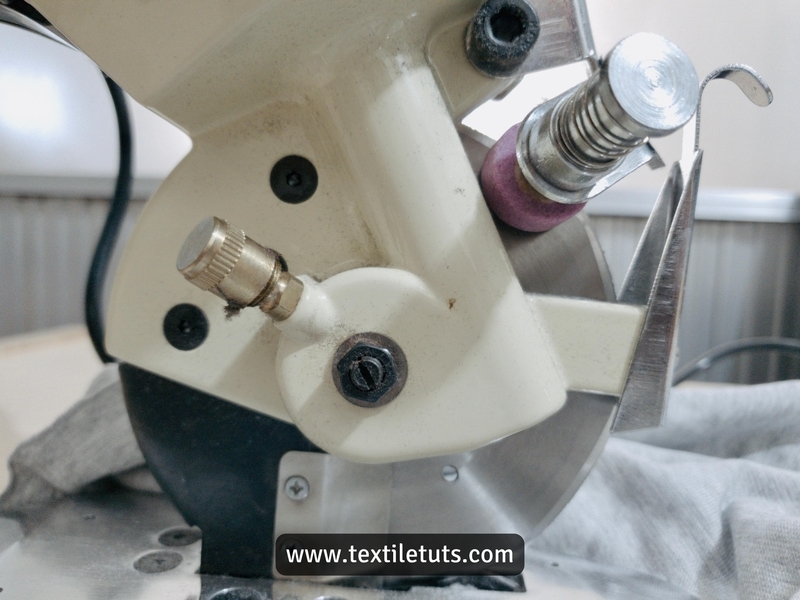
5. Throat Plate
The throat plate is a metal guide positioned at the base of the blade. It guides fabric into the cutting zone and holds the material in place during blade rotation, preventing the fabric from bunching or pulling away from the cut line.
6. Base Plate
The base plate is a flat metal platform that sits beneath the fabric lay. It applies uniform tension across the fabric surface, keeping all plies aligned during cutting. The base plate features a grid pattern for measuring and aligning fabric before cutting.
7. Central Handle
The central handle provides a secondary grip point directly above the blade center. It gives operators added control during detailed contour cutting and keeps the operator’s hand away from the cutting edge, reducing injury risk.
8. Power Supply
The power supply connects the machine to a standard electrical outlet (typically 110V–240V AC depending on region). A flexible power cord routes from the supply to the motor, allowing unrestricted movement during operation.
9. Sharpener Push Rod Button
The sharpener push rod button is located on the underside of the machine. When pressed, it advances the emery wheel into contact with the rotating blade, enabling on-machine sharpening without disassembling the blade assembly.
10. Locking Disc
The locking disc secures the blade on the spindle during operation and locks the blade position when the machine is not in use. Proper engagement of the locking disc prevents blade rotation during blade changes or maintenance.
11. Guard
The blade guard is a metal guard that surrounds the upper portion of the blade, exposing only the cutting edge at the bottom. It prevents accidental contact with the operator’s hand during cutting and must meet OSHA safety standards for industrial cutting equipment.
12. Grease Inlet
The grease inlet accepts lubricant (typically lithium-based grease) that flows to the blade bearing and spindle assembly. Regular lubrication every 8–10 operating hours maintains smooth blade rotation and extends bearing life. Lack of lubrication leads to premature bearing failure and inconsistent cutting quality.
13. Emery Wheel
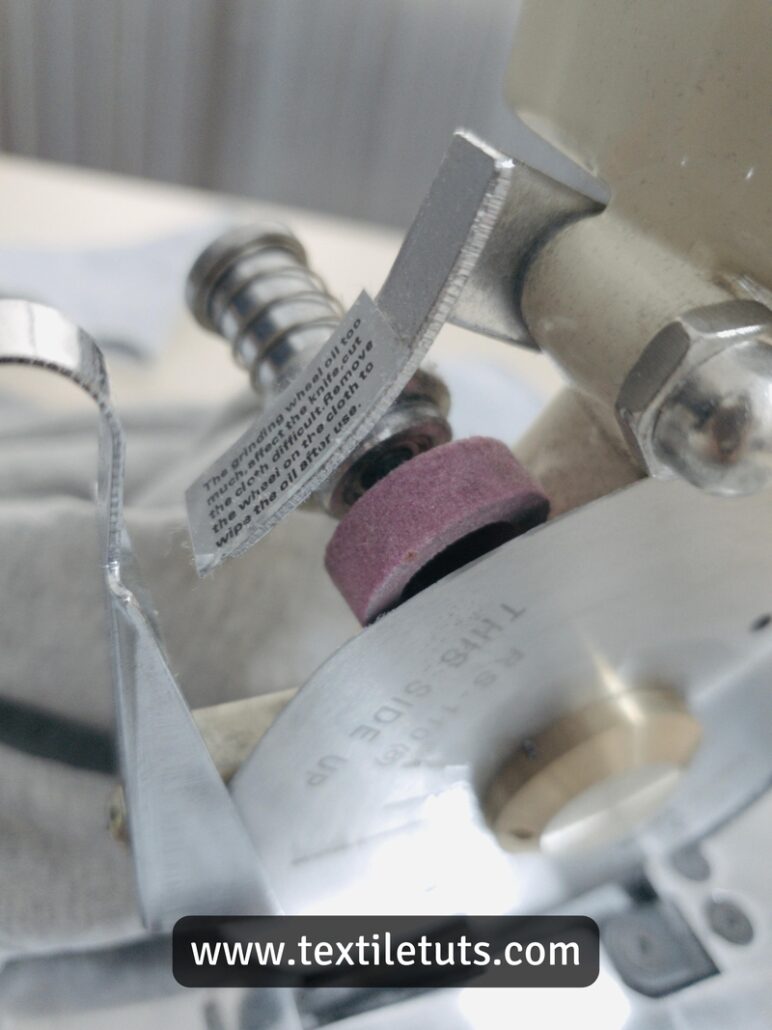
The emery wheel is a cylindrical grinding stone mounted adjacent to the blade. When the sharpener push rod is engaged, the emery wheel contacts the blade edge and resharpens it by grinding away metal. The emery wheel requires replacement after 40–60 sharpening cycles as the surface becomes glazed and ineffective.
Types of Knives Used in a Rotary Cutter
Different cutting applications require specific blade profiles. The seven primary knife types used in rotary fabric cutting machines are:
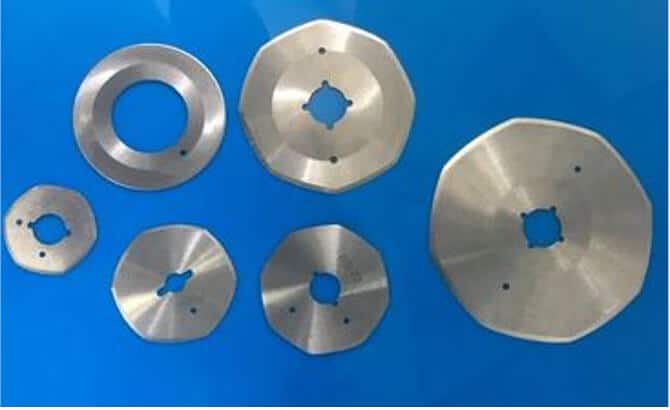
- Round knife — the standard circular blade for general fabric cutting; available in diameters from 60 mm to 200 mm
- Bowie knife — a larger profile blade used for cutting thick multilayer fabric lays in heavy apparel manufacturing
- Throwing knife — a specialized blade requiring a highly skilled operator for freehand fabric contouring
- Sharpening knife — a maintenance blade profile used exclusively for resharpening the emery wheel surface
- Utility knife — a general-purpose blade for lightweight fabrics and trim work where precision is less critical
- Automatic knife — a motor-actuated blade used in automated cutting systems where consistent feed rates are required
- Cutter knife — a disposable blade type with a snap-off segment design for rapid blade changes in high-volume production
The Function of Main Parts
- Handle — provides the operator’s primary grip point for guiding the machine along the intended cutting line
- Motor — drives blade rotation at 800–1,600 RPM to sever fabric fibers cleanly
- Power switch — activates and immediately halts motor operation for safe start-up and shutdown
- Blade — the rotating circular cutting element that slices through fabric layers upon contact
- Throat plate — guides fabric into the cutting zone and maintains ply alignment during the cut
- Base plate — supports the fabric lay and applies controlled surface tension to ensure a clean, consistent cut across all plies
- Power supply — delivers electrical energy to the motor through an insulated flexible cord
- Sharpener push rod button — advances the emery wheel into contact with the rotating blade for on-machine sharpening
- Sharpening mechanism — consists of the emery wheel and mount, positioned on both sides of the blade; the mechanism must be cleaned after every use to remove fabric fiber buildup that degrades sharpening performance
- Locking disc — locks the blade in a fixed position on the spindle during idle storage and blade changes
- Guard — prevents accidental hand contact with the blade edge during operation, reducing workplace injury risk
Cutting Process of a Typical Round Knife Fabric Cutter
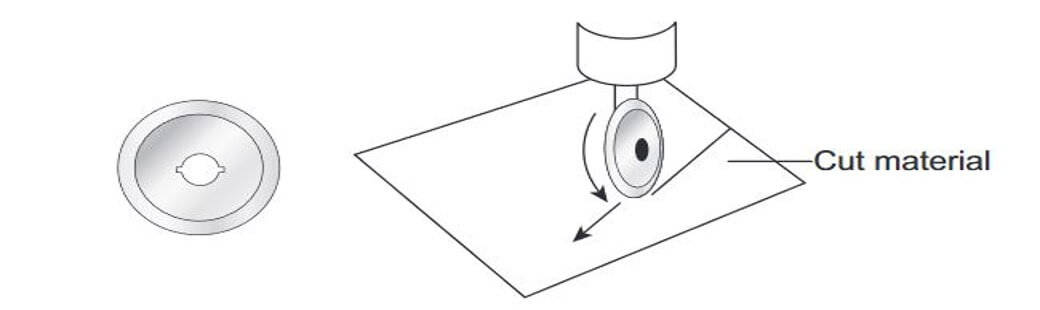
Rotary blade knives—commonly called “pizza wheel” cutters—are circular and roll continuously over the fabric surface during cutting. The operator guides the machine along the intended cutting line while the blade rotates against the material. This mechanism is also employed in electric fabric cutter machines designed for crafters and DIY enthusiasts.
The cutting process involves placing the fabric lay on the base plate, applying downward pressure to compress the plies, then rolling the rotating blade along the pattern line. The base plate grid aids in alignment, and the throat plate prevents fabric bunching at the entry point. Cutting speed depends on blade sharpness, fabric type, and lay height—operators typically advance at 0.3–0.5 meters per second for woven fabrics.
How to Sharpen the Blade of a Rotary Cutter
Maintaining a sharp blade is essential for clean cuts and operator safety. The sharpening process involves two stages: initial positioning and active sharpening with the blade running.
First, position the machine so the emery roller contacts the cutting blade surface. Press the emery roller against the blade with light, steady pressure as demonstrated in the first video below. This sets the sharpening angle before the blade is in motion.
Next, activate the blade motor and repeat the same contact motion while the blade rotates at operating speed. Hold the emery roller against the spinning blade for 15–30 seconds per session. The second video illustrates this live sharpening technique.
After sharpening, wipe the blade edge clean with a dry cloth and apply a light machine oil coating to prevent corrosion. Lubricate the grease inlet every 8–10 operating hours to maintain smooth spindle rotation and prevent premature bearing wear.
Round Knife Cutting Machine: Safety Checklist and Maintenance Schedule
Regular maintenance and adherence to safety protocols extend machine service life and reduce workplace injury risk. Follow this operator checklist to keep the machine running at peak performance.
| Safety Checklist — Before Each Use | ✓ |
|---|---|
| Verify the blade guard is intact and properly seated before powering on | ☐ |
| Confirm the dead-man power switch releases and halts blade rotation immediately | ☐ |
| Check that the locking disc is fully disengaged before starting the motor | ☐ |
| Inspect the blade for chips, cracks, or dull edges before operation | ☐ |
| Ensure the power cord shows no visible damage or exposed wiring | ☐ |
| Confirm the fabric lay height does not exceed 40% of the blade diameter | ☐ |
| Keep hands and loose clothing clear of the blade and handle assembly at all times | ☐ |
| Maintenance Task | Interval | Notes |
|---|---|---|
| Lubricate grease inlet (lithium-based grease) | Every 8–10 operating hours | Prevents bearing failure and spindle wear |
| Sharpen blade with emery wheel | When cutting quality declines | Hold emery roller 15–30 seconds per session while blade runs |
| Clean emery wheel and sharpening mechanism | After every use | Remove fabric fiber buildup that degrades sharpening performance |
| Replace emery wheel | Every 40–60 sharpening sessions | Replace when surface becomes glazed and ineffective |
| Apply blade corrosion inhibitor (light machine oil) | After each sharpening session | Wipe blade clean, then coat cutting edge |
| Inspect power cord and switch | Weekly | Check for fraying, damage, or switch lag |
| Full blade and guard inspection | Monthly | Look for cracks, chips, or deformation in blade and guard assembly |
Advantages of Round Knife Fabric Cutters
- Excellent for cutting mild to moderate curvatures in fabric due to continuous blade rotation
- Highly maneuverable and easy to control, thanks to its compact size and low weight
- The preferred tool for small lay heights where a straight knife machine cannot achieve the required precision
- Cuts both single-ply fabric and multilayer stacks ranging from 1 to 30 plies depending on blade diameter
- Cutting efficiency is up to 10 times higher than comparable straight knife machines for curved cutting tasks
- Extensively used in suit-making, tailored garment production, and pattern making applications
Disadvantages of Round Knife Fabric Cutters
- Maximum cut depth is constrained by blade diameter—lay heights above 40% of blade diameter cannot be cut
- The machine relies on a manual grinder for blade sharpening, requiring operator intervention and downtime
- Blade RPM (800–1,600) is significantly lower than straight knife machines, reducing throughput on straight cuts
- Lower productivity compared to straight knife machines limits use to small-batch and specialty production
- Extremely tight curve radii are difficult to achieve due to the fixed blade diameter
- Not suitable for high-volume bulk production environments where straight knife or band knife machines dominate
- The machine requires manual lubrication at the grease inlet at regular intervals
- Throwing knife operation demands a highly skilled operator with specialized training to achieve accurate cuts
Uses of Rotary Knife Cutting Machine
The machine’s flexibility makes it well-suited for contour cutting along curved and nonlinear pattern lines. The operator can maneuver it around the natural curvatures of cutting patterns, though extreme radii exceeding the blade diameter are not achievable. This makes the round knife cutter the tool of choice for pre-cutting leather components for cobbler sewing machines.
Additional applications include cutting large garment panels from fabric lays, block cutting of fabric units from wide-width textiles, and producing sample garments in small-batch manufacturing. DIY crafters, home users, and small-scale workshops benefit most from its portability and ease of use. The machine also sees regular use in tailored suit production where curved cuts are frequent and lot sizes are small.
Round Knife vs Straight Knife Cutting Machine: A Comparison
| # | Parameter | Round Knife | Straight Knife |
|---|---|---|---|
| 01 | Machine-Fabric Arrangement | Machine is stationary; fabric moves under the blade | Machine moves along the fabric; fabric is fixed |
| 02 | Blade Thickness | Narrow blade profile; typically 1.5–3 mm thick | Thicker band knife; typically 0.5–1.2 mm thick |
| 03 | Workload Capacity | Handles higher workloads per unit time in curved cuts | Handles lower workloads but excels in straight cuts |
| 04 | Cut Angle Flexibility | Cuts fabric layers at a fixed 90° angle only | Cuts fabric at any angle along the cutting plane |
| 05 | Safety Record | Lower accident rate due to enclosed blade design | Higher accident rate due to exposed oscillating blade |
| 06 | Blade Motion | Continuous circular rotation; operates like a saw blade | Vertical reciprocating motion; does not resemble a saw |
| 07 | Cut Type | Continuous cut requiring freehand guidance; cannot cut notches | Intermittent cutting motion enables notch cutting capability |
Round Knife Cutting Machine: Quick-Reference Specifications
| Specification | Value |
|---|---|
| Blade Diameter Range | 60 mm – 200 mm (2.362″ – 7.874″) |
| Motor Speed (RPM) | 800 – 1,600 RPM |
| Maximum Effective Cut Depth | 40% of blade diameter |
| Motor Power Range | 0.25 kW – 0.75 kW |
| Fabric Ply Capacity | 1 – 30 plies (varies by blade size) |
| Blade Thickness | 1.5 mm – 3 mm |
| Cutting Speed (Woven Fabric) | 0.3 – 0.5 meters/second |
| Cutting Efficiency vs. Straight Knife | Up to 10× higher for curved cuts |
| Lubrication Interval | Every 8 – 10 operating hours |
| Emery Wheel Replacement Cycle | Every 40 – 60 sharpening sessions |
Conclusion
The round knife cutting machine is lightweight, compact, and highly flexible. These characteristics have driven its increasing adoption in the apparel industry for small-batch and specialty production. The machine excels at curved and contour cuts in fabric layers up to 30 plies thick, making it indispensable for tailored garment manufacturing and pattern work. Pairing a round knife cutter with a precision French curve ruler set further improves cutting accuracy for complex pattern shapes.
The decision to use a round knife cutting machine depends on the final product design, production volume, and required cut geometry. For high-volume straight cuts, a straight knife machine delivers superior productivity. For curved cuts in small to medium production runs, the round knife cutter is the definitive choice in modern garment manufacturing.
References
- TextileTuts. (2024). Straight Knife Cutting Machine. https://textiletuts.com/straight-knife-cutting-machine/
- TextileTuts. (2024). Electric Fabric Cutter Machine. https://textiletuts.com/best-fabric-cutting-machine/
- TextileTuts. (2024). Best Cobbler Sewing Machine Reviews. https://www.textiletuts.com/best-cobbler-sewing-machine-reviews/
- TextileTuts. (2024). French Curve Ruler Set. https://www.textiletuts.com/french-curve-ruler-set/
- Woolmark Company. (2024). Textile Machinery Technology. https://www.woolmark.com/
- Cotton Incorporated. (2024). Textile Machinery and Technology Resources. https://www.cottonworks.com/
- ISO. (2024). Textile Machinery Standards. https://www.iso.org/
- American Association of Textile Chemists and Colorists (AATCC). (2024). Technical Resources. https://www.aatcc.org/technical/


