
Carding: Functions|Actions|Clothing|IGS Grinding|Coiling|HP Card

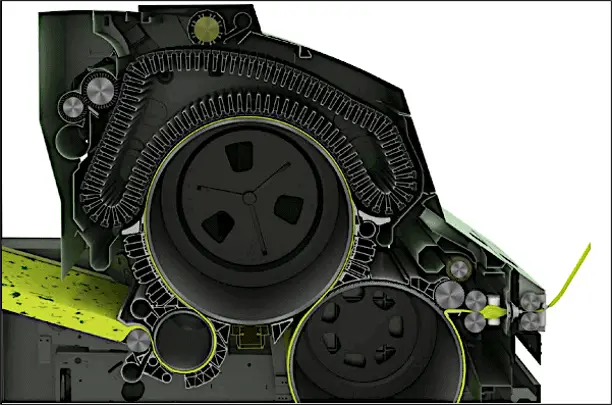
Carding is the process of reducing entangled fiber flocks to a filmy web by passing the flocks between two narrowly spaced, oppositely moving surfaces covered with sharp-edged wire points. It is the heart of the spinning mill — a single carding machine such as the Rieter Card C 80 achieves production rates of up to 120 kg/h, and a well-tuned modern carding machine typically achieves a Neps Removal Efficiency (NRE) of 70–90%.
Two sayings sum up carding’s importance in yarn manufacturing: “The card is the heart of the spinning mill” and “Well carded is half spun.” No other machine compensates for as many defects that originate upstream, making accurate carding essential for selecting, opening, cleaning, and parallelizing fibers without degrading them.
Quick Reference: High-Performance Carding Machine Specs
| Parameter | Rieter Card C 80 | Rieter Card C 81 | Rieter Card C 75 |
|---|---|---|---|
| Max Production Rate | 120 kg/h | Up to 40% more sliver vs. competitors | >100 kg/h (HP card) |
| Energy Efficiency | — | — | Up to 30% reduction via motor control |
| Active Carding Area | — | — | Largest in industry |
| Special Feature | — | Higher sliver output | Carding Gap Control, IGS, ACI |
What is Carding?
Carding is the process of reducing entangled fiber flocks to a filmy web by passing the flocks between two narrowly spaced, oppositely moving surfaces covered with sharp-edged wire points.
No other machine in the spinning factory compensates for defects that originate from carding. This makes it essential that carding accurately selects, opens, cleans, and parallelizes fibers without degrading or damaging them. The doffer converts individualized and separated fibers into a web due to its considerably lower surface speed relative to the core cylinder.
Functions of the Carding Machine
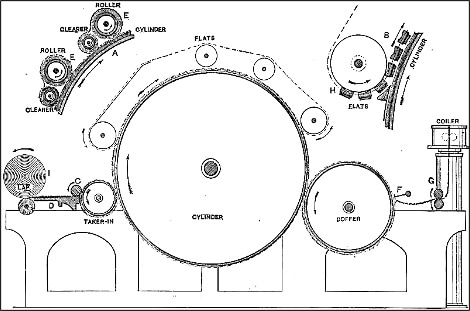
The primary functions of the carding machine are:
- Individualization of the fibers and bringing them to single fiber state
- Disentanglement of the fiber neps
- Removal of the contamination of fibers
- Elimination of the trash, dust and micro dust
- Identification of the shortest fibers that lack the spinning ability and eliminate them
- Forming the fiber blending
- Formation of fiber orientation and alignment
- Generating sliver in order to facilitate the subsequent processes
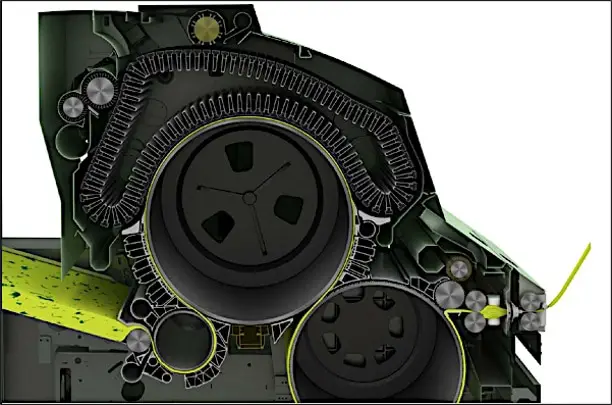
Working Principle of Carding Machine
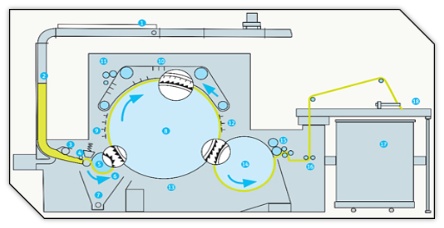
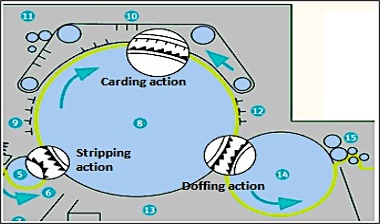
- The raw material, i.e., the chute, is delivered by means of pipe ducting into the feed chute (2) of the carding frame. A uniformly compacted batt of 500–900 ktex is made in the chute.
- A carrying roller (3) passes this material to the feeding zone (4). This comprises a feed roll and a feed plate intended to forward the sheet of fiber gradually into the operating range of the taker-in (5).
- These flocks are forwarded over the grid tool (6) and transported to the core cylinder (8). The flock material drops the majority of its contaminations. Suction channels (7) take away the impurities.
- The flocks themselves are passed along with the core cylinder and opened up into a single fiber state between the flats and the cylinder. The flats (10) consist of 80–116 separable carding bars joined into a belt moving on a never-ending track.
- In the course of this coming back, a cleaning component (11) takes out fibers, contaminants, neps, dirt, trash, dust, and foreign matters from the flats’ bars.
- A stripping instrument (15) pulls the filmy web from the doffer. After calendar rollers (16) have compacted the sliver to some degree, the coiler (18) dumps it in sliver cans (17).
Actions in Carding
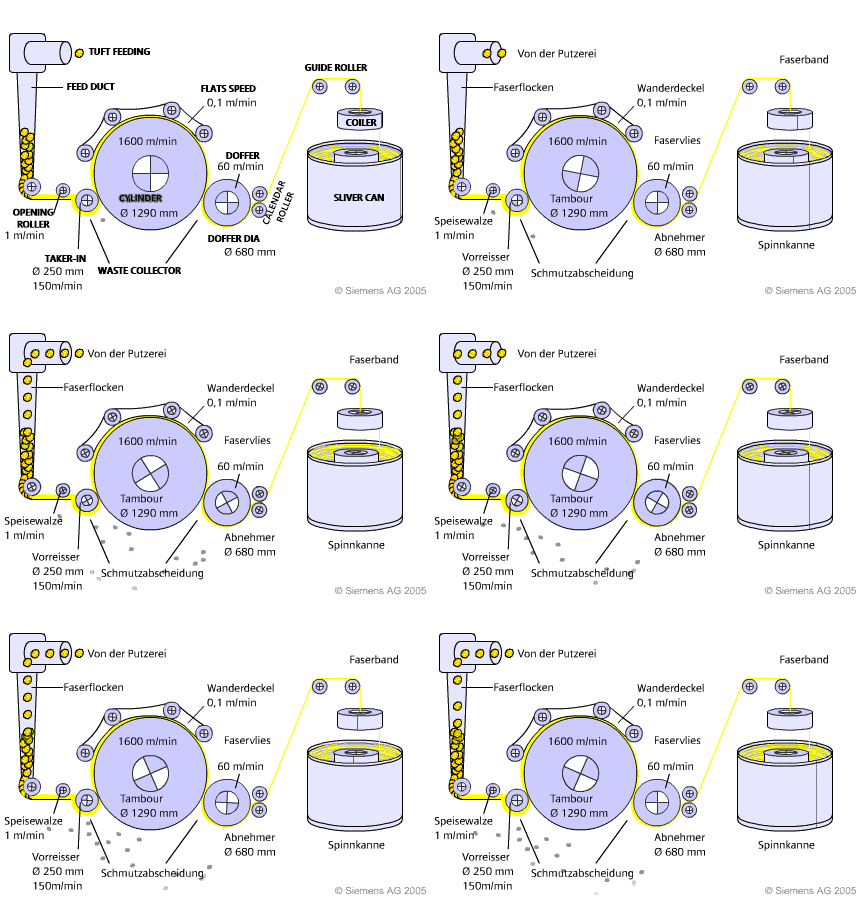
Carding Action
Carding action occurs between the flat and the cylinder. The wire direction is reversed between them, and the flat and cylinder movement directions are also reversed.
Consequences of Carding Action
- Supreme individualization of fibers is attained in this action.
- Entanglement of fibers, short fibers, dust are eliminated.
Stripping Action
Stripping action occurs between licker-in and cylinder, and also between doffer and stripper. The wire direction is identical between them, while the movement directions are reversed.
Consequences of Stripping Action
- Impurities and micro-dust are eliminated by stripping action.
Doffing Action
Doffing action occurs between doffer and cylinder. The wire direction is reversed between them, but the doffer and cylinder movement directions are identical.
Consequences of Doffing Action
- To collect the singular fibers from cylinder and convert into a filmy web.
- Formation of sliver is executed by this action.
What is Card Clothing?
Card clothing consists of fine, narrowly spaced, exclusively bent, and sharp-edged wires used to cover the external surface of licker-in, core cylinder, flats, and doffer of a carding machine. The wire points are precisely engineered to individualize fibers while minimizing damage during the carding process.
Categories of Card Clothing
1. Flexible Clothing
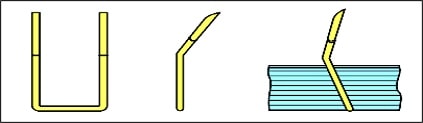
Flexible clothing provides round hooks or oval-shaped hooks with sharp-edged wire that is set into elastic, flexible, multi-ply cloth backing. All of the hooks are twisted into a U-shape and are bent with a knee that moves when the bending load is applied and returns to its original position when the load is removed. Currently, short-staple and medium-staple spinning factories use this clothing primarily around the flats bar.
Benefits of Flexible Card Clothing
- Density of wire point is extraordinary.
- Better carding action is obtained.
- Flexibility of wire point is remarkable.
- Fiber damage is exceptionally lower.
- Not very expensive.
- These clothing are repairable.
Drawbacks of Flexible Card Clothing
- Elastic rubber or textile cloth is used as base material.
- Consistent sharpening or grinding is essential.
- High probability of teeth loss since wires are loosely attached.
- High probability of wire and foundation material degradation due to remarkable flexibility.
Base Materials Used for Flexible Card Clothing
There are two main types of base materials used for flexible card clothing:
- Leather
- Plied Fabric
Leather as Flexible Card Clothing
Leather is the finest and most widely used base material for flexible card clothing.
Benefits of Leather as Flexible Card Clothing
- Oil and water are not required to join this clothing.
- It is reasonably of superior quality.
Drawbacks of Leather as Flexible Card Clothing
- Very expensive to use.
- Elastic characteristics are not up to the mark.
Plied Fabric as Flexible Card Clothing
1. Double Ply (2 ply) Base
a) Warp – Cotton or Linen and Weft – Woolen
b) Back cloth – Cotton
2. Triple Ply (3 ply) Base
a) Face cloth – Cotton
b) Warp – Linen and Weft – Woolen
c) Back cloth – Cotton
3. Quad Ply (4 ply) Base
a) Face cloth – Vulcanized rubber
b) Cotton cloth
c) Warp – Linen and Weft – Woolen
d) Back cloth – Cotton
4. Penta Ply (5 ply) Base
a) Face cloth – Vulcanized rubber
b) Cotton cloth
c) Cotton cloth
d) Warp – Linen and Weft – Woolen
e) Back cloth – Cotton (Single)
Characteristics of Base Materials
- Satisfactory strength and flexibility.
- Adequate width and stiffness to grip the wires in their spot.
- Unaffected to lubricant, temperature, humidity and early ageing.
- Ample resiliency.
2. Semi-Rigid Card Clothing
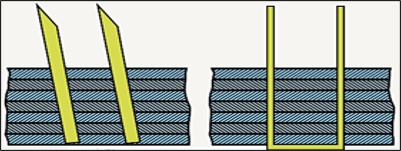
Semi-rigid card clothing resembles the construction of flexible card clothing but uses higher layers of cloth and comprises hooks of wire having squared X-sections. There is no knee in this clothing system. It sometimes comprises reinforced round wire where a knee could be present.
Semi-rigid clothing does not choke with fiber as flexible clothing does, and consequently removes less flat stripping. Furthermore, semi-rigid card clothing does not require grinding as frequently as flexible card clothing.
3. Rigid or Metallic Card Clothing
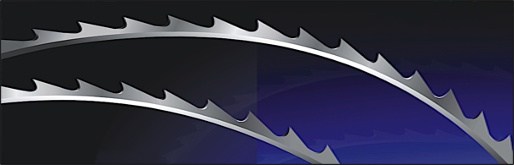
Rigid or metallic clothing consists of continuous, self-sufficient wire assemblies where the teeth are cut at the minimum probable spacing. No foundation material is needed in this system. The wire resembles a saw tooth since they do not possess any knee. Currently, the licker-in, core cylinder, and the doffer are covered with metallic or rigid card clothing.
Benefits of Metallic Wire Card Clothing
- Rigid or metallic card clothing does not require any foundation material.
- Probability of teeth loss is nearly zero.
- Rigid clothing requires reduced sharpening and stripping.
- It has the flexibility to accommodate each carding angle.
- Since it requires reduced sharpening and stripping, production is much higher.
Drawbacks of Metallic Wire Card Clothing
- Metallic wire points become harsh on the fiber and damage them to a great extent.
- Rectifying the wires in the factory is difficult if repairs are needed.
- The entire clothing must be rewound if any share of the wire is broken.
- Rigid card clothing is very expensive to use.
Card Clothing Types: Quick Comparison
| Feature | Flexible | Semi-Rigid | Rigid / Metallic |
|---|---|---|---|
| Foundation material | Leather or plied fabric | Multiple cloth layers | None required |
| Wire type | Round/oval hooks with knee | Squared X-section hooks | Saw-tooth, continuous wire |
| Grinding frequency | Regular grinding needed | Less frequent | Reduced sharpening needed |
| Fiber damage | Exceptionally lower | Moderate | Can be high — wire points become harsh |
| Teeth/hook loss risk | High (loosely attached) | Low | Nearly zero |
| Cost | Moderate (leather: expensive) | Moderate | Very expensive |
| Repairability | Repairable | Difficult in-factory repair | Must rewind entire clothing if damaged |
| Choking with fiber | Yes — causes more flat stripping | No | No |
| Typical application | Flats bar (short/medium staple) | General carding surfaces | Licker-in, cylinder, doffer |
What is Grinding?
The wires of taker-in, core cylinder, flats, and doffer are consistently in action with fiber and its contaminants. After a certain time or definite amount of cleaning cycles, they gradually start to lose their sharpness and progressively become blunt. Grinding becomes essential for the card clothing wires to sustain sharpness so that optimum cleaning can be achieved.
Significance of Grinding
- Maintaining the optimum sharpness of the clothing wire points.
- Retaining the identical stature of the wire points.
- Achieving consistent carding action and even sliver constantly.
Categories of Grinding
- Traverse wheel grinding
- Long roller grinding
Integrated Grinding System (IGS)
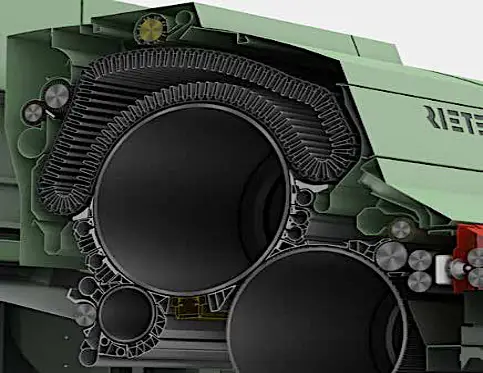
Rieter, Switzerland offers the Integrated Grinding System (IGS) that ensures uniform quality card sliver and increases the serviceability of the card. This system maintains clothing sharpness throughout production, reducing downtime for manual grinding.
The repeated wear of the card clothing causes it to lose sharpness as production increases. The Integrated Grinding System (IGS) resolves this situation from the beginning by maintaining the clothing eternally sharp.
In the IGS-classic, a grinding rock is mechanically progressed across the cylinder clothing during production. This action is executed 400 times over the anticipated service life span of the card clothing.
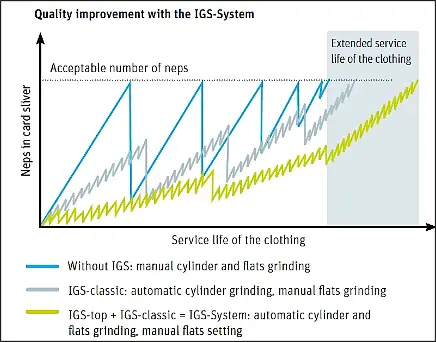
The IGS-top hones the flats’ card clothing entirely mechanically. The control component estimates the grinding cycles over the pre-elected service life time of the flats’ card clothing. Several minor grinding actions ensure that the quality is more constant than in a flat grinding roller.
The usage of IGS-classic prolongs the life phase of the cylinder clothing by 10–20% in all executions. This reduces repair requirements and decreases machine stoppage time required for labor-intensive grinding operations.
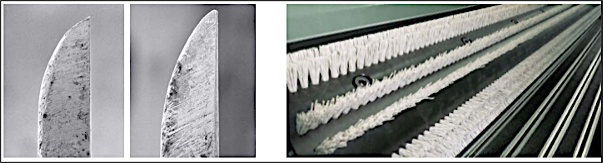
Mounting: Mounting is the process of setting new wire around the carding parts like taker-in, core cylinder, and doffer, rather than repairing the existing one. Similarly, mounting is executed when grinding is not sufficient to sustain the optimum quality of the delivered materials.
What is Coiling?
The procedure through which a sliver is dumped, collected, and stored in a sliver can in a coil shape is called the coiling mechanism.
Significance of Coiling
- The motive of coiling is to place the compressed sliver in a well-ordered method in a cylindrical sliver can.
- While unraveling slivers from the deposited cans at the next process, they come out without becoming knotted or overextended.
Categories of Coiling
Over Center Coiling
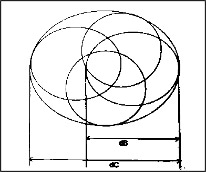
In over center coiling, the radius of the can is smaller than the diameter of the circle of the sliver. This method is typically used with small to medium-sized cans ranging from 6 to 12 inches in diameter.
Under Center Coiling
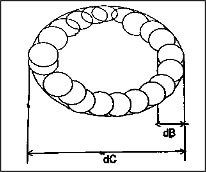
In under center coiling, the radius of the can is greater than the diameter of the circle of the sliver. This configuration accommodates larger cans typically ranging from 14 to 24 inches in diameter.
Neps Removal Efficiency (NRE)
The neps per gram eliminated from the carding machine, expressed as a proportion of the neps per gram in the carding mat, is defined as Neps Removal Efficiency (NRE).
Formula:
NRE% = {(Neps/gram in Feed Material – Neps/gram in Delivered Material) ÷ Neps/gram in Feed Material} × 100%
A well-tuned modern carding machine typically achieves an NRE of 70–90%, depending on fiber type, machine settings, and clothing condition. Higher efficiency indicates better removal of tangled fiber clusters before spinning.
Differences Between Carded and Combed Yarn
Following are the differences between carded and combed yarn:
| Carded Yarn | #SL | Combed Yarn |
|---|---|---|
| We attain this yarn lacking combing. | 1. | We attain this yarn by combing. |
| Comparatively the eminence of carded yarn is not up to the mark. | 2. | Combed yarn is superior to carded yarn in terms of quality. |
| Higher percentage of short fiber is present. | 3. | Comber combs out the short fibers. |
| No need to use lap former. | 4. | We need to use super lap former. |
| Comparatively the tensile properties of carded yarn is not up to the mark. | 5. | Combed yarn is superior to carded yarn in terms of strength with same TPI. |
| Irregularity is comparatively higher. | 6. | Combed yarn is more regular. |
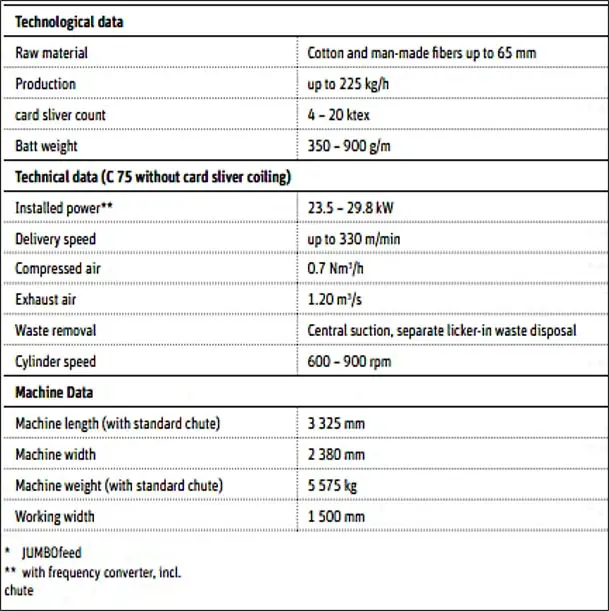
Technical Data of Three High-Performance Cards
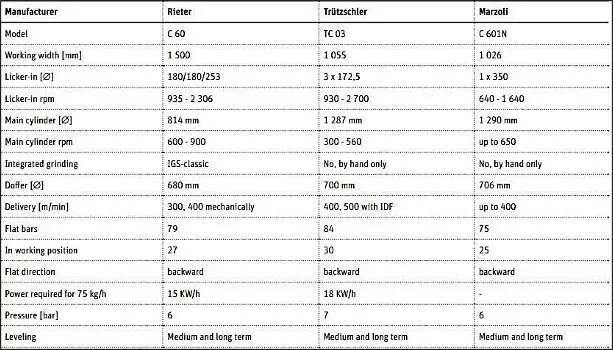
Rieter HP Card C 75 Machine Data
High-performance (HP) carding machines produce 100 kg/hr card sliver or more. The Rieter C 75 represents state-of-the-art technology in high-performance carding, featuring the largest active carding area in the industry and Carding Gap Control for consistent fiber alignment.
Card Production Calculation
Problem-01: If, Delivery roller speed = 220 m/min;
Sliver hank = 0.09 Ne;
Efficiency = 85%;
Find out the production of carding machine.
Solution:
Production (kg)/hr = {(220 × 1.0936 × 60 × 0.85) ÷ (840 × 0.09 × 2.2046)} kg/hr = 73.62 kg/hr
Problem-02: Find out the production per day in lbs. of a modern carding machine from the following data:
Doffer speed = 200 m/min;
Delivery sliver weight = 68 grains/yd;
Waste = 3%;
Efficiency = 95%:
Tension draft = 1.1
Solution:
Production per day = {200 × 1.09 × 60 × 24 × 68 × 0.95 × 1.1 × (100-3)} ÷ (100 × 7000) lbs = 3091.13 lbs
Problem-03: If, Lap hank = 0.012 Ne;
Sliver hank = 0.11;
Find the draft of carding machine.
Solution:
Draft = Delivery ÷ Feed = (0.11 ÷ 0.012) = 9.16666
Frequently Asked Questions
What is the prime function of a carding machine?
The primary function of the carding machine is to individualize the fibers from the batt. Carding brings the material into the single fiber stage by separating all fibers completely, eliminating neps—entanglements among the fibers—from the material. This action occurs between the reversal movement of flats and cylinder.
Why carding is called the heart of spinning and well card is half spun?
Yarn imperfections include thick places, thin places, neps, slubs, and hairiness. Among all of them, neps are the most dangerous. Carding removes this fault effectively.
If neps are not removed properly during carding, this fault propagates through the entire process—in fabric production, dyeing, printing, and finishing. At winding, the number of cuts by the EYC (electronic yarn clearer) becomes exceptionally high, and the splices in these cuts generate additional faults.
If neps remain after carding, they deteriorate the final yarn to such an extent that the yarn becomes unusable. This is why carding is called the heart of spinning, and why well carded is half spun.
Why Rieter Card C 75 is much ahead of its competitors?
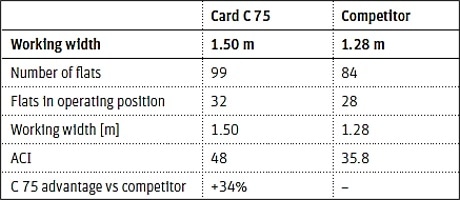
The Rieter Card C 75 has the highest working width of any carding machine available, making it the most productive in the spinning industry. It also provides the Active Carding Index (ACI), which measures carding intensity, along with the Integrated Grinding System (IGS) that prolongs clothing service life significantly.
What is the usual production rate of a carding machine?
Production rate depends on raw material quality, machine performance, and required parameters of the end product. Conventional machines typically produce more with man-made fibers than with cotton in spinning mills.
Management keeps production rate slightly below capacity to achieve greater quality. Modern HP cards produce beyond 100 kg/hr, with some machines such as the Rieter Card C 80 reaching 120 kg/h.


