
Is Carbon Fiber Bulletproof – The Myth VS The Reality

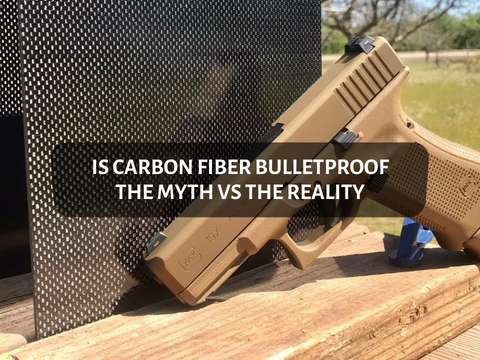
Carbon fiber is not bulletproof. Despite its exceptional strength-to-weight ratio and widespread use in aerospace and automotive applications, carbon fiber cannot stop bullets as a standalone material. The misconception stems from carbon fiber’s presence in layered body armor systems, where it works alongside Kevlar, ceramics, and UHMWPE to achieve ballistic protection.
This article explains why carbon fiber alone cannot provide bulletproof protection, how ballistic armor systems actually work, and what materials make effective body armor possible.
The Origin of the Bulletproof Carbon Fiber Myth
The belief that carbon fiber is bulletproof arises from a misunderstanding of how ballistic armor systems work. Carbon fiber does appear in body armor construction, but only as one component in a multi-layer composite system.
Understanding carbon fiber’s actual properties reveals why the myth persists:
| Property | Carbon Fiber Value | Steel Comparison |
|---|---|---|
| Tensile Strength | 1,500–7,000 MPa | ~600–1,000 MPa |
| Young’s Modulus | 200–400 GPa | ~200 GPa |
| Density | 1.8 g/cm³ | 7.85 g/cm³ |
| Max Service Temperature | 500°C (932°F) | ~1,500°C |
| Thermal Expansion | 0.5 × 10⁻⁶/°C | ~12 × 10⁻⁶/°C |
These properties make carbon fiber one of the strongest man-made materials available. However, ballistic protection requires energy dissipation mechanisms that carbon fiber alone cannot provide.
NIJ Protection Levels Quick Reference
| NIJ Level | Threat Rounds | Typical Protection |
|---|---|---|
| IIIA | 9mm, .40 S&W, .44 Magnum | Soft armor, up to 12mm thick |
| II | 9mm, .357 Magnum | Soft armor, lighter weight |
| III | 7.62×51mm NATO | Hard plate required |
| IV | .30-06 M2AP armor-piercing | Hard ceramic/UHMWPE plate |
Backface signature—the deformation pushed toward the wearer’s body—must remain at 44mm or less for the armor to pass NIJ certification, regardless of whether penetration occurs.
The Hard Truth About Carbon Fiber and Ballistic Protection
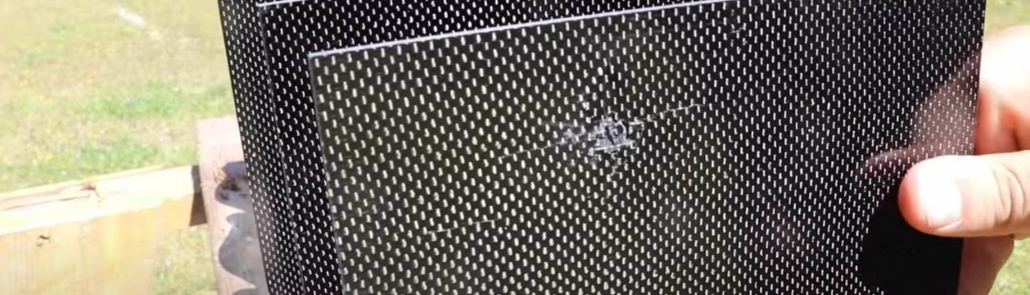
No material is completely bulletproof. The term “bulletproof” itself is a misnomer — the correct classification is “bullet-resistant.” Even the most advanced armor systems have specific threat levels they can defeat.
Research published in IOP Conference Series Materials Science and Engineering demonstrates precisely what happens when bullets strike carbon fiber composites. The material exhibits brittle failure characteristics, cracking radially from the impact point rather than absorbing and distributing the energy.
How Bullet-Resistant Vests Actually Work
Modern bullet-resistant vests function through layered energy management systems. In a typical configuration, carbon fiber layers help fracture incoming projectiles while supplementary layers capture and dissipate the remaining energy.
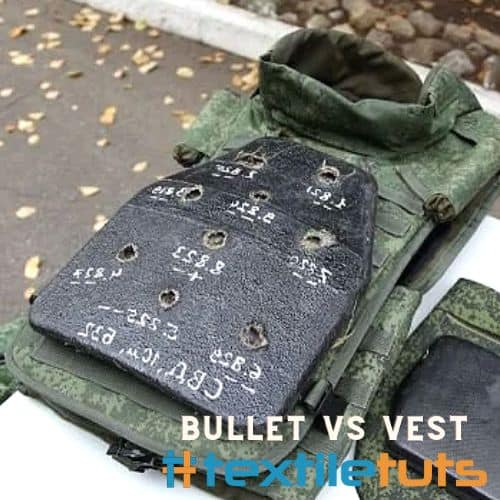
Soft armor systems typically reach NIJ Level IIIA protection, capable of stopping 9mm, .40 S&W, and .44 Magnum ammunition. Hard armor plates rated NIJ Level IV must defeat .30-06 M2AP armor-piercing rounds with a backface signature of 44mm or less.
Ballistic panels incorporate rigid plates made from ceramics (aluminum oxide, boron carbide, silicon carbide), ultra-high-molecular-weight polyethylene (UHMWPE), or steel. These plates provide additional protection for vital organs in the chest and abdomen region.
Body Armor Materials Comparison
| Material | Strength-to-Weight | Ballistic Use | Limitations |
|---|---|---|---|
| Kevlar (Aramid) | 5× steel by weight | Soft armor panels | Degrades in UV/heat over time |
| UHMWPE | High strength, very light | Lightweight hard plates | Poor high-temperature resistance |
| Carbon Fiber | Exceptional | Component in composites | Brittle failure, no energy absorption |
| Ceramics (SiC, B₄C) | High hardness | Hard plate facings | Cracks on impact, single-use |
| Steel | Moderate | Budget hard plates | Heavy, can cause spalling |
Materials Used in Modern Body Armor Systems
Several advanced materials contribute to effective ballistic protection. Each offers distinct mechanical and protective properties.
Carbon Nanotubes
Carbon nanotubes represent a hollow cylindrical arrangement of carbon atoms in a hexagonal lattice structure. These nanoscale tubes exhibit extraordinary strength-to-weight ratios that exceed conventional carbon fiber.

NanoArmor Advanced Rifle Plates incorporate carbon nanotube technology to defeat multiple ammunition types while minimizing blunt force trauma transmitted to the wearer.
Types of Carbon Nanotubes
- Single-walled carbon nanotubes (SWCNTs) — highest tensile strength and most expensive option
- Multi-walled carbon nanotubes (MWCNTs) — moderate strength with lower production cost
- Graphene nanoribbons — comparable to SWCNTs in strength with exceptional expense
- Carbon nanofoam — novel material with energy-absorbing lattice structure
Kevlar
Kevlar is a para-aramid synthetic fiber with repeating molecular chains that align parallel to each other. By weight, Kevlar exhibits five times the tensile strength of steel, reaching maximum fiber tenacity of 23 grams per denier.
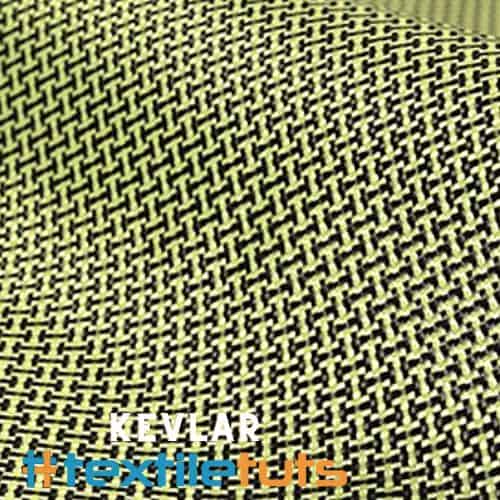
Kevlar vests work by trapping bullets in a fiber web that absorbs kinetic energy through fiber deformation and friction. This energy dissipation mechanism significantly reduces the momentum transferred to the wearer’s body.
Kevlar Grades and Applications
- Kevlar 29 — standard ballistic grade with ultimate tensile strength for body armor
- Kevlar 49 — aerospace and automotive grade with superior heat resistance up to 427°C (800°F)
- Kevlar 119 — high-abrasion-resistant grade specifically formulated for vest construction
Aramid Fibers
Aramid fiber consists of extremely thin synthetic filaments twisted into yarns with exceptional tensile strength. The molecular chain structure creates strong covalent bonds that resist impact forces.
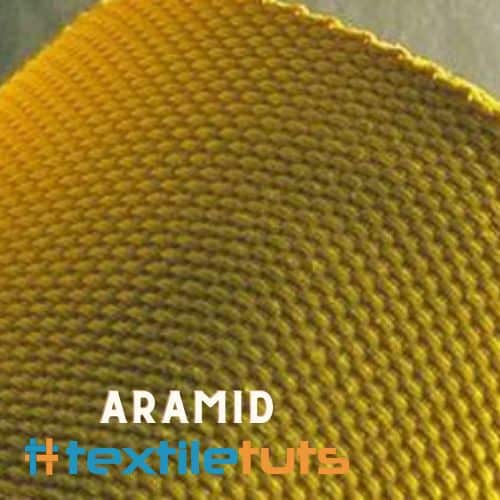
These fibers provide a lightweight and breathable protective option, making them popular for safety equipment worn during extended periods. Their inherent flame resistance also adds thermal protection.
Aramid Fiber Types
- Poly(p-phenylene terephthalamide) (PPD-T) — high-performance fiber used in advanced armor systems
- Poly(m-phenylene isophthalamide) (MPD-I) — cost-effective option for budget-conscious body armor
- Poly(o-phenylene isophthalamide) (OP I) — thermoplastic resin used in injection-molded mechanical components
- Poly(hexamethylene adipamide) (HMA) — nylon-based thermoplastic first developed in the 1930s with toughness properties
Carbon Fiber Properties and Specifications
Carbon fiber demonstrates impressive mechanical characteristics that make it valuable across industries:
- Tensile strength: 1,500–7,000 MPa depending on fiber grade
- Specific stiffness: 200–400 GPa
- Density: 1.6–2.0 g/cm³
- Elongation at break: 0.5–2.5%
- Thermal conductivity: 5–200 W/(m·K)
Both the British and American militaries have expressed active interest in developing carbon fiber woven from carbon nanotubes, which would combine the benefits of both materials for next-generation armor systems.
Frequently Asked Questions
Can carbon fiber break under impact?
Yes, carbon fiber can fracture upon impact. Carbon fiber composites exhibit brittle failure modes when subjected to sharp or high-velocity impacts. Insufficient panel thickness will allow penetration by high-powered rifle ammunition even if small-caliber rounds are deflected.
What causes carbon fiber to fail?
Epoxy resin matrices that bind carbon fiber composites degrade over time from UV exposure and thermal cycling, reducing structural integrity. Sharp-point impacts concentrate stress at localized areas, causing crack propagation through the laminate. The interface between fiber and resin represents the weakest link in most composite structures.
What is carbon fiber made of?
Carbon fiber consists of organic polymer chains with carbon atoms as the primary constituent. Precursor materials include polyacrylonitrile (PAN), petroleum pitch, and rayon. After carbonization at temperatures exceeding 1,000°C, the resulting fibers contain 90–95% carbon content.
How thick is typical ballistic armor?
Soft armor panels range from 6mm to 12mm in thickness. Hard armor plates measure 20mm to 30mm depending on the threat rating. Even with adequate thickness, bullets may still cause serious blunt force trauma without penetration — the backface signature measures how far the armor deforms toward the wearer’s body.
What colors does carbon fiber come in?
Raw carbon fiber has a distinctive black appearance due to light absorption across the carbon content. Surface coatings, dyes, or colored prepreg resins can produce gray, red, blue, or custom colors. Aerospace applications typically preserve natural black for weight minimization.
How does carbon fiber compare to fiberglass?
Carbon fiber exceeds fiberglass in tensile strength by a factor of three to five. A carbon fiber laminate at 1.8 g/cm³ density provides superior strength-to-weight ratio compared to fiberglass at 2.5 g/cm³. The higher stiffness of carbon fiber also improves structural deflection resistance.
Conclusion
Carbon fiber is not bulletproof as a standalone material. While it plays a role in multi-layer body armor systems, achieving effective ballistic protection requires combining carbon fiber with complementary materials like Kevlar, ceramics, or UHMWPE. Understanding the difference between bullet-resistant and bulletproof clarifies why no single material can claim true bulletproof status.
Despite its limitations against ballistic threats, carbon fiber remains one of the most remarkable engineered materials. Its exceptional strength, light weight, and versatility ensure continued demand across aerospace, automotive, sporting goods, and marine applications.
References
- National Institute of Justice. (2017). NIJ Standard-0101.06: Ballistic Resistance of Body Armor. U.S. Department of Justice.
- Wikipedia. (2024). Bulletproof Vest. Wikimedia Foundation.


