
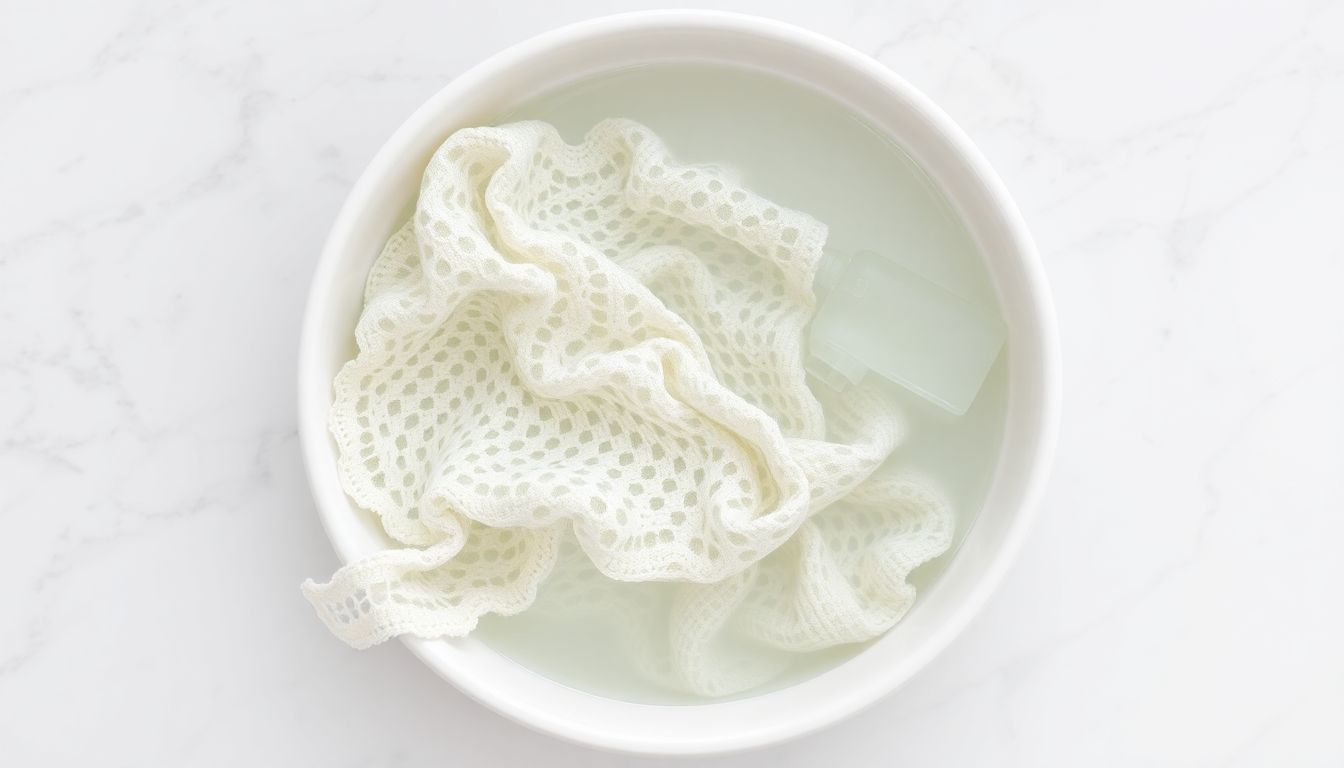
How to Wash Lace Fabric Without Damage

Lace fabric must be washed by hand in cool water under 30°C using a gentle, enzyme-free detergent, with no rubbing, wringing, or agitation — the open-network thread structure of lace tears and distorts irreversibly under mechanical stress, and synthetic lace fibers (nylon, polyester) melt or deform above 40°C. Cotton and silk lace are also vulnerable: cotton lace shrinks without cold water control, and silk lace loses tensile strength when agitated wet. Hand washing with a 10–15 minute soak and a flat-dry finish is the only safe method for all lace types.
Lace Fabric Requires Hand Washing Because Mechanical Stress and Heat Permanently Damage Its Open-Mesh Structure
Lace requires hand washing in cool water because its open-mesh structure — with no backing layer to distribute mechanical stress — makes it uniquely vulnerable to permanent damage from agitation, heat, and enzyme-based detergents. Unlike woven fabrics where threads are supported by a backing layer, every thread in lace bears the full load independently. When those threads are snagged, stretched, or abraded, the damage is irreversible. Lace is constructed from fine threads — cotton, silk, nylon, or polyester — knotted, twisted, or looped into an open decorative net structure.
The International Association for Textile Care labeling (following ISO 3758) classifies lace as a delicate garment requiring mild mechanical treatment. Agitation from machine tumbling or hand rubbing causes threads to shift out of alignment, resulting in snags, runs, and permanent distortion of the decorative pattern. There is no pressing, steaming, or reshaping technique that restores torn or stretched lace — the structural integrity is irreversibly lost.
Heat poses a different but equally serious threat across all lace fiber types. According to AATCC test standards for textile care, synthetic lace fibers — primarily nylon and polyester — begin to soften and permanently pucker at temperatures exceeding 40°C (104°F). Cotton lace fibers experience progressive shrinkage when washed above 30°C without subsequent dimensional stabilization. Silk lace, a protein fiber, loses up to 20% of its tensile strength when wet and exposed to agitation or high heat, according to textile testing literature on silk fiber degradation.
Enzyme-based laundry detergents present a chemical hazard specific to protein-fiber lace. Protease enzymes — the stain-fighting agents in many standard biological detergents — digest silk and wool fibers on a molecular level. Even a single wash with an enzyme detergent causes measurable fiber weakening in protein textiles, as documented in textile chemistry literature. Fabric softener, while marketed as beneficial, coats lace fibers with a waxy residue that fills the open mesh gaps and progressively attracts more soil with each subsequent wash.
How to Read Lace Care Labels Using ISO 3758:2012 Symbols
Lace care symbols are defined by ISO 3758:2012, the international textile care labeling standard, and learning to read these symbols prevents the most common and preventable lace damage. Every lace garment should carry a care label with standardized symbols for washing, bleaching, drying, and ironing. The symbols use a basin, triangle, circle, and iron iconography to convey specific care instructions that apply to all textile products including delicate lace fabrics. Learning to interpret these symbols correctly is the first step in safe lace maintenance.
| Symbol | Meaning | Lace Care Implication |
|---|---|---|
| Basin with hand | Hand wash only, max 40°C | Safe for most lace; wash at 20–30°C, never at the 40°C maximum |
| Basin with number (e.g., 30) | Machine wash at that temperature in °C | Only for modern synthetic lace; use delicate cycle |
| Basin with single bar below | Synthetics cycle — medium agitation | Not recommended for lace; bar indicates reduced mechanical action |
| Basin with double bar below | Wool/silk cycle — very gentle treatment | Closest safe machine option for synthetic lace, if label permits |
| Crossed-out basin | Do not wash — dry clean only | Follow strictly for antique, heirloom, or heavily embellished lace |
| Crossed-out triangle | No bleach — chlorine or oxygen bleach prohibited | Never use chlorine bleach (e.g., pure sodium hypochlorite) or oxygen bleach on lace |
| Crossed-out circle | No tumble dry | Lay flat to dry; tumble drying melts or shrinks lace permanently |
| Iron with one dot | Low heat iron — max 110°C | Safe for cotton lace only; never iron synthetic lace |
When in doubt with unlabelled vintage lace, heirloom lace, or lace with unknown fiber content, default to cold hand wash and flat dry. The risk of following an incorrect care assumption far outweighs the minimal effort of a cautious approach. Antique lace with historical or monetary value should always be assessed by a textile conservator before any wet treatment.
Hand Washing Lace: The Only Universally Safe Method for All Lace Types
Hand washing is the universally safe method for every lace type — cotton, silk, nylon, polyester, and blends. The principle is simple: let water and detergent do the work, not friction. Mechanical action is the enemy of lace structure. The process requires cool water at 20–30°C, an enzyme-free liquid detergent, a 10–15 minute soak period, and a flat-dry finish. No rubbing, wringing, or agitation at any stage. Each step is designed to clean the fabric while preserving the delicate open-mesh structure that defines lace.
- Fill a clean basin or sink with cool water. Target 20–30°C (68–86°F) — err toward the cooler end for silk and cotton lace. Never exceed 30°C.
- Add 2–3 drops of a gentle, enzyme-free liquid detergent. Woolite Delicates, Perwoll Care & Refresh, and Delicate Wash from The Laundress are the standard textile-care recommendations. Powder detergents do not dissolve fully in cool water and leave residue in the lace mesh.
- Submerge the lace garment gently by pressing it down under the water surface with a flat palm. Do not bunch, fold, or wring the fabric at this stage — force it flat and let saturation occur naturally over 30–60 seconds.
- Swirl the water slowly around the lace using a gentle circular motion of your hand — one slow orbit per second. The water moving through the mesh is what lifts soil, not friction against your skin or the basin surface.
- Allow the garment to soak for 10–15 minutes. This duration is sufficient to dissolve body oils, perspiration residue, and light soiling without any mechanical stress. Do not soak for longer than 20 minutes — prolonged water exposure can weaken some dye bonds in silk lace.
- Lift the lace out of the basin carefully, supporting its full weight with both hands in a flat, horizontal position. Lace saturated with water is extremely vulnerable to stretching from its own mass.
- Drain the basin completely. Refill with clean cool water at the same temperature for the first rinse.
- Submerge the lace again and perform one slow swirl to rinse. Drain. Repeat with a second fresh water refill. The water should run completely clear after 2–3 rinses before you proceed to drying — any remaining detergent will leave a residue in the mesh.
- Do not wring, twist, or squeeze the lace at any point. Lay the lace flat on a clean, dry, white cotton towel (white prevents dye transfer from a colored towel to damp white lace).
- Roll the towel and lace together loosely like a scroll. Apply gentle pressure with your palms to absorb excess water — do not press hard or crush the lace structure. Unroll, transfer to a second dry towel, and repeat if significant moisture remains.
Machine Washing Lace: Only When the Care Label Explicitly Permits It
Machine washing is only acceptable for modern machine-made synthetic lace — specifically nylon or polyester lace — that carries an explicit machine wash care label permitting 30°C. Any lace that is hand-made, antique, embellished with beadwork or embroidery, or composed of cotton or silk must not be machine washed under any circumstances. The care label must specifically state machine wash compatibility before considering this method, and even then, only with a fine-mesh lingerie bag, delicate cycle, cold water at maximum 30°C, and 400 rpm or lower spin speed.
If the care label permits machine washing, the following conditions are non-negotiable:
- Fine-mesh lingerie bag (1–2 mm mesh): Place the lace inside a sealed fine-mesh bag before putting it in the machine drum. This prevents the lace from snagging on the drum surface, the agitator (in a top-loader), or any heavy garment. Without this bag, machine washing is not safe for any lace type regardless of the care label.
- Delicate or hand-wash cycle: Select the machine’s most gentle cycle. Water temperature must be cold — maximum 30°C (86°F). Do not select a normal or heavy cycle.
- Spin speed: 400 rpm or lower: High spin speeds generate centrifugal forces that distort and stretch lace mesh. If your machine does not allow manual rpm selection, choose the minimum spin speed available on the delicate cycle.
- Liquid detergent only: Dissolved liquid detergent rinses completely from the lace mesh. Powder detergent particles — even in small quantities — lodge in the open structure of lace and are difficult to remove fully, leading to skin irritation or fiber degradation over time.
- Wash lace alone or only with other delicates: Denim, garments with metal zippers or rivets, and heavy fabrics will damage lace even inside a mesh bag through impact and abrasion. Wash lace separately from all other garment types.
Never machine wash antique lace, hand-made lace, broderie anglaise with embroidery, or any lace with beading, appliqué, or metal thread. For these items, the only safe method is hand washing as described above.
How to Dry Lace Without Causing Permanent Distortion or Damage
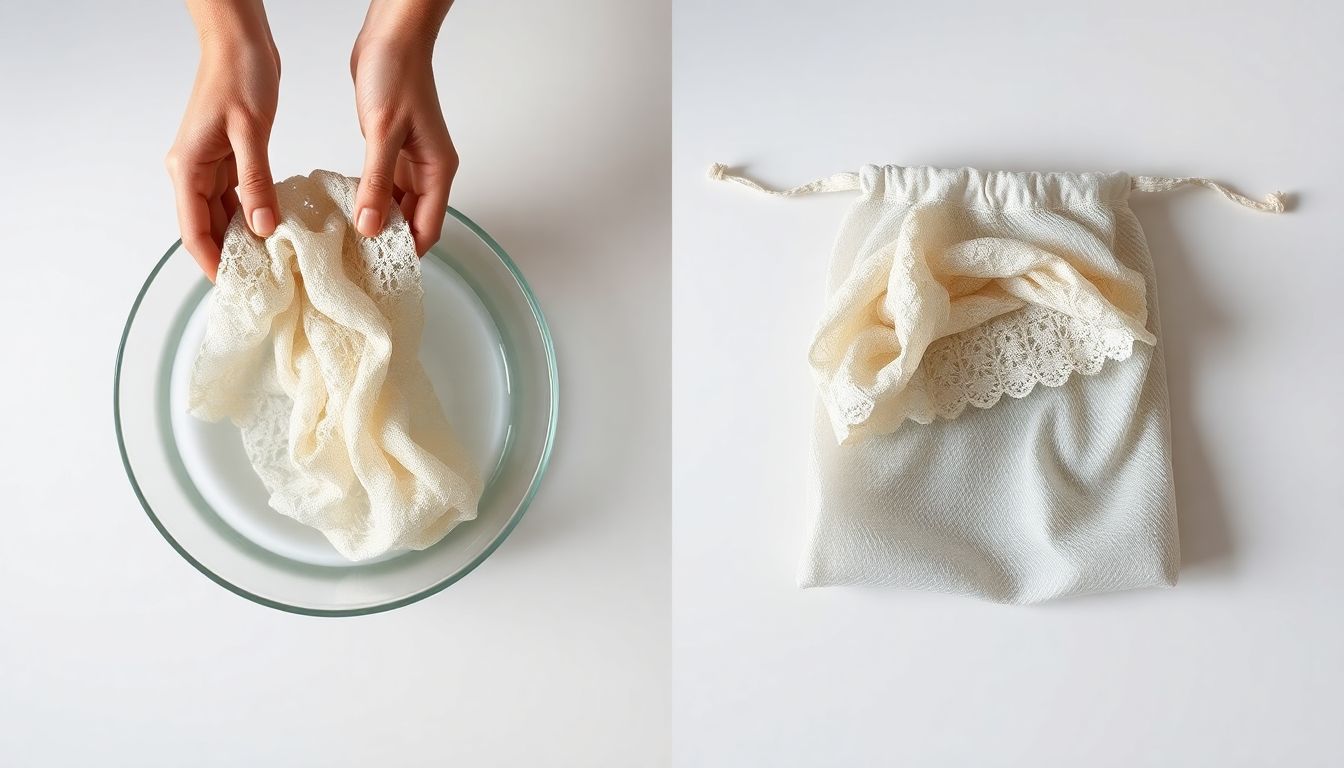
Tumble drying is the single most damaging finishing step for lace. The heat sinters synthetic fibers (nylon softens above 40°C, polyester above 60°C), shrinks cotton lace, and tumbles the delicate mesh structure into permanent tangles. According to textile care standards, the crossed-out circle symbol on a lace care label means exactly what it says — no tumble drying under any circumstances. Hanging lace to dry is equally problematic because the weight of water-saturated lace pulling downward under gravity stretches the open-mesh structure beyond recovery. A lace doily or curtain hung at its edge can stretch by several centimeters, distorting the pattern irreparably.
- After pressing between towels to remove surface moisture, lay the lace flat on a clean, dry white towel or a mesh drying rack. A flat mesh rack allows air circulation both above and below the lace, promoting even drying without the distortion caused by hanging.
- While the lace is still damp — this is critical — gently reshape it by hand to its original dimensions. Smooth out any creases or folds with your fingertips. Lace that is reshaped while damp sets to that shape as it dries; lace dried in a distorted position retains that distortion permanently.
- Dry at room temperature, away from direct sunlight and away from direct heat sources such as radiators or forced-air vents. Ultraviolet radiation causes progressive yellowing in both cotton and silk lace — a slow photochemical degradation that becomes visible after multiple drying cycles in sunlight. Cotton lace yellows noticeably after 3–5 hours of direct sun exposure.
- Allow the lace to dry completely before folding or storing. Damp lace in storage develops mildew within 24–48 hours in the warm, humid environment inside a closet or drawer. Mildew in lace mesh is difficult to remove without chemicals that may damage the fibers or dyes.
Choosing the Right Detergent and Tools for Safe Lace Care
Using the correct detergent and tools is as important as the washing technique itself. The wrong product causes damage that no washing method can prevent. Enzyme-based detergents are the primary hazard for protein-fiber lace (silk and wool), while powder detergents leave residue in the lace mesh even when fully dissolved. Fabric softener creates a waxy coating that progressively attracts soil, and bleach — whether chlorine or oxygen-based — causes fiber degradation or dissolution. The only safe detergents for all lace types are gentle, enzyme-free liquid formulas specifically formulated for delicate fabrics, used in minimal quantities of just 2–3 drops per basin.
| Product Type | Recommended for Lace | Why |
|---|---|---|
| Enzyme-free liquid detergent (e.g., Woolite Delicates, Perwoll Care & Refresh) | Yes — 2–3 drops per basin | Contains surfactants without protease enzymes; safe for all fiber types including silk and cotton |
| Standard laundry detergent (liquid or powder) | No | Contains protease and amylase enzymes that digest protein fibers (silk, wool) and break down fine cotton fibers |
| Biological detergent | No — strictly avoided | High enzyme concentration specifically designed to digest organic proteins; severe fiber damage after single wash |
| Oxygen bleach (hydrogen peroxide-based) | No | Even oxygen bleach can degrade silk fibers and damage delicate lace dye; risk outweighs any whitening benefit |
| Chlorine bleach | No — never use | Dissolves lace fibers on contact; will destroy the mesh structure within seconds |
| Fabric softener | No | Coats fibers with a silicone residue that fills lace mesh, reduces breathability, and attracts subsequent soil accumulation |
The essential tools for lace care are straightforward: a clean white cotton towel (or two) for pressing, a mesh drying rack for flat drying, and — if machine washing is label-permitted — a fine-mesh lingerie bag with 1–2 mm mesh openings. A white or neutral-colored towel prevents dye transfer to damp white lace, which can occur within minutes of contact with a colored towel.
For ironing cotton lace after it is fully dry: a damp pressing cloth placed between the iron and the lace, with the iron set to the lowest heat (one dot — under 110°C / 230°F), will remove stubborn creases. Iron synthetic lace (nylon or polyester) never — the minimum ironing temperature for these fibers is already above the threshold where they begin to soften and pucker. For silk lace, a cool iron (one dot, under 110°C) through a pressing cloth is acceptable, but steaming on a hanger is the safest finishing option for all lace types. Never apply a steam iron directly to synthetic lace — the direct steam heat and moisture can cause pucker marks that are impossible to reverse.
For more guidance on caring for other delicate fabrics, consult the Complete Fabric Care Guide, which covers hand wash techniques, detergent selection, and drying methods for the full range of delicate textiles.
Frequently Asked Questions
Can you put lace in the washing machine?
Machine washing is only safe for modern synthetic lace that explicitly carries a 30°C machine wash care label. It must be placed inside a fine-mesh lingerie bag and washed on the delicate cycle at cold water with a spin speed of 400 rpm or lower. Antique, hand-made, or embellished lace must always be hand washed.
What detergent should you use to wash lace?
Use a gentle, enzyme-free liquid detergent formulated for delicates — Woolite Delicates and Perwoll are the standard recommendations. Standard laundry detergents contain protease enzymes that digest silk and weaken fine fibers; fabric softener leaves a residue in lace mesh that attracts soil over time. Use only 2–3 drops per basin.
How do you dry lace fabric after washing?
Press the washed lace between two clean dry towels to remove excess water — never wring or twist. Lay the lace flat on a towel or mesh rack, reshape by hand while damp, and allow it to air dry at room temperature away from direct sunlight and heat. Hanging lace to dry or tumble drying both cause permanent distortion.
Can you iron lace fabric?
Cotton lace can be lightly pressed through a damp pressing cloth using a cool iron set to under 110°C — never apply the iron directly to lace. Synthetic lace (nylon or polyester) cannot be ironed; heat above 40–60°C melts or puckers the fibers. Silk lace should be pressed only with a cool iron through a pressing cloth. Steaming on a hanger is the safest option for all lace types.
References
- ISO. (2012). ISO 3758:2012 — Textiles — Care labelling symbols. International Organization for Standardization.
- AATCC. (2021). Technical Manual of the American Association of Textile Chemists and Colorists. AATCC.
- Gulbin, G. & Freddi, G. (2003). Silk Fiber Processing. In Handbook of Textile Fiber Structure. Woodhead Publishing. ScienceDirect.
- The Woolmark Company. (n.d.). Garment Care — Woolmark Learning. The Woolmark Company.


