
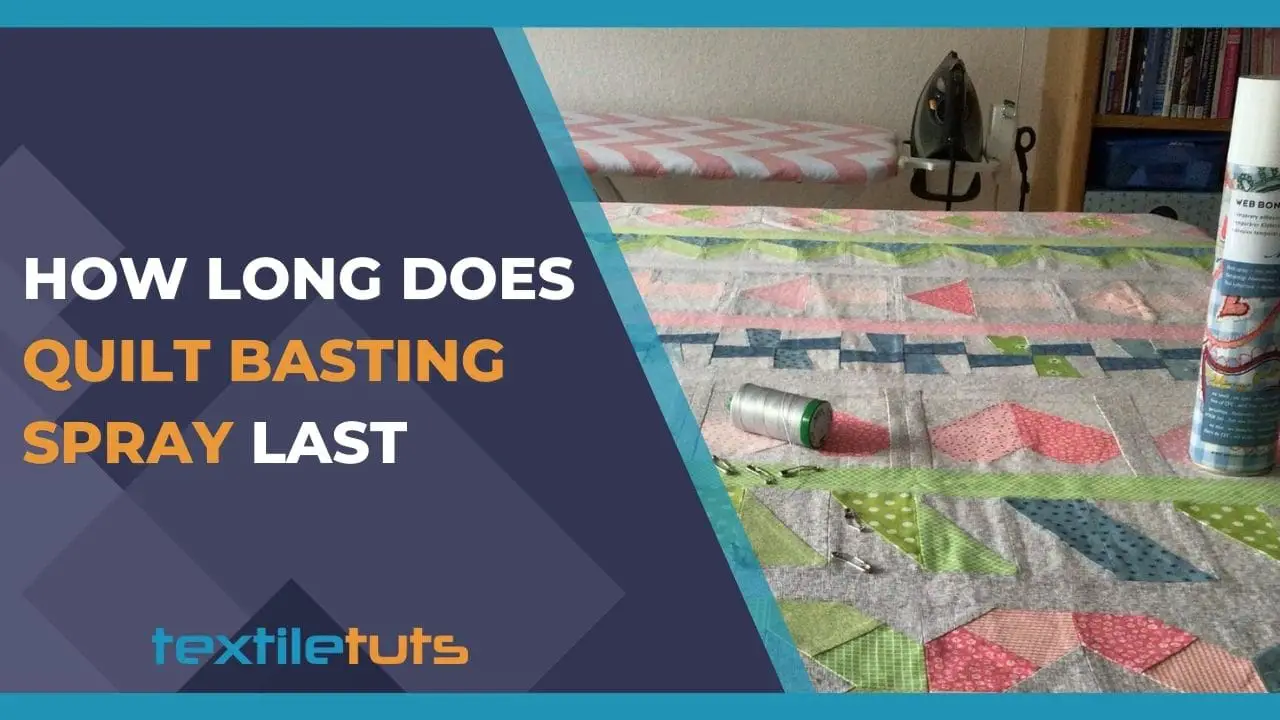
How Long Does Quilt Basting Spray Last?

Quilt basting spray remains effective for approximately 6 months after opening when stored properly in a cool, dry location. Different brands vary in duration—the KK2000 formula absorbs fully within 2–5 days after application, while 505 Spray and Fix holds for roughly 4 months on cotton blends and about 2 months on polyester. This makes spray adhesive one of the most convenient temporary bonding methods for quilters who need to hold fabric layers securely before stitching.
Among the various methods available for basting a quilt—including pins, quilting clips, and magnets—spray adhesive has become one of the most widely adopted techniques in modern quilting communities due to its speed, even coverage, and fabric-friendly removal properties.
Basting Spray Brand Comparison
| Feature | KK2000 | 505 Spray and Fix |
|---|---|---|
| Duration on Cotton | 2–5 days (full dissipation) | ~4 months |
| Duration on Polyester | 2–5 days (full dissipation) | ~2 months |
| Absorption Time | 1–1.5 days | Immediate bond |
| Water Solubility | Water-resistant after curing | Water-resistant after curing |
| Acid-Free | Yes | Yes |
What Is Basting Spray?
Basting spray is a aerosol adhesive specifically formulated for textile applications. The product comes in pressurized cans and dispenses a fine mist of adhesive directly onto the backing fabric, creating a temporary bond that holds the quilt top, batting, and backing securely together during the stitching process.
One significant advantage of basting spray over traditional pin methods is that it leaves no holes in the fabric. This eliminates the risk of snagging on pin points during machine quilting and reduces the likelihood of fabric distortion that can occur when pins are inserted and removed repeatedly.
Shelf Life and Storage of Quilt Basting Spray
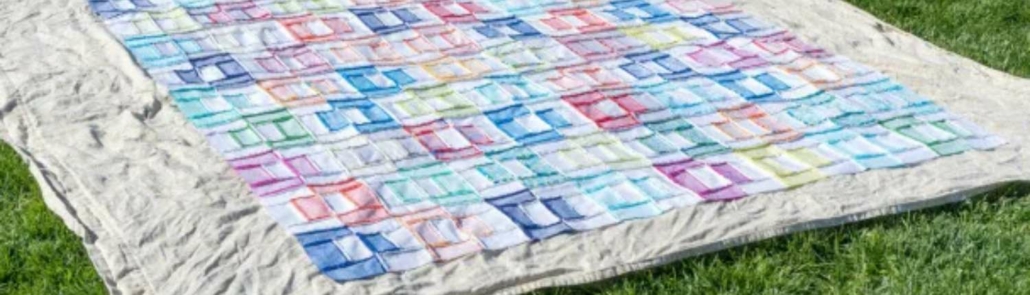
After opening a can of basting spray, the adhesive remains effective for approximately 6 months when stored properly. To maximize shelf life, store the can in a cool, dry location away from direct sunlight and heat sources. Extreme temperatures can degrade the aerosol propellant and affect the adhesive’s spray pattern and bonding strength.
Shake the can thoroughly before each use to ensure the adhesive compounds are properly mixed. A well-shaken can produces an even mist distribution, while an inadequately shaken can may deliver inconsistent coverage that creates weak spots in the basting bond.
Key Facts at a Glance
- Shelf life after opening: ~6 months
- Dry bond time: 30 minutes (at 70°F / 21°C, 50% humidity)
- Optimal application temperature: 65–75°F (18–24°C)
- Optimal humidity: Below 60% relative humidity
- Spray distance: 8–12 inches from fabric
- Wait time before positioning: 30 seconds to 1 minute (until tacky)
- Coats recommended: 2 light coats in perpendicular directions
Drying Time for Quilt Basting Spray
Basting spray typically requires 30 minutes to reach full dry bond strength under standard room conditions (approximately 70°F/21°C at 50% relative humidity). If you need faster drying, positioning a fan to circulate air across the sprayed surface accelerates the process considerably.
For optimal results, lay your quilt batting on a flat surface immediately after spraying the backing fabric. Lower the quilt top gently into position before the adhesive becomes tacky. Working from the center outward helps eliminate wrinkles and air pockets that can compromise the final quilt’s appearance.
The KK2000 formula specifically requires patience—it absorbs fully into fabric within 1–1.5 days, which means the initial bond continues strengthening over this period. Attempting to wash a KK2000-basted quilt prematurely may cause the adhesive to clump into sticky residues that prove difficult to remove.
Comparing Basting Spray to Other Quilting Methods
Each basting method offers distinct advantages. Spray adhesive provides the most even coverage across large quilt surfaces and requires no additional equipment beyond the can itself. Pins offer precise, adjustable control but can create obstacles during machine quilting when stitches must navigate around them. Quilting clips work well for smaller projects but prove time-consuming for full-size quilts.
The choice between methods ultimately depends on project scale, personal preference, and whether the quilter is working with a domestic machine or a long-arm system. Many experienced quilters maintain multiple basting methods in their toolkit and select the most appropriate technique based on each project’s specific requirements.
Water Solubility and Washability
Most quilt basting sprays are not water-soluble once fully cured. The KK2000 formula, for instance, transitions to a water-resistant state after its 2–5 day absorption period. If you need to launder your quilt before the adhesive fully dissipates, the spray may not release cleanly and could leave residue on your fabric.
For projects requiring early washing—such as gift quilts or items that may encounter spills during use—consider using a wash-away stabilizer or a basting method that releases more readily, such as pin basting on a design wall.
Using Basting Spray for Hand Quilting
Hand quilting presents unique challenges when using adhesive basting. Because hand quilting requires the needle to pass repeatedly through all three fabric layers, any adhesive that becomes stiff or tacky after curing can cause needle drag, making the stitching process exhausting and potentially damaging to thread quality.
For hand quilting projects, pin basting remains the recommended approach. Insert safety pins at 3–4 inch intervals across the entire quilt surface, ensuring the layers remain flat and wrinkle-free. This method allows the needle to pass through fabric without encountering any adhesive interference.
Hairspray as a Basting Substitute
Some crafters attempt to substitute household hairspray for commercial basting spray due to cost considerations. This approach carries significant risks. Hairspray formulations are not designed for textile bonding and may contain additives—such as PVP polymers and alcohol—that can stain, discolor, or weaken fabric fibers over time.
Additionally, hairspray lacks the acid-free formulation essential for protecting fabric integrity. The pH imbalance can cause fiber degradation, particularly in delicate materials like silk or vintage fabrics. Professional basting sprays are specifically engineered to provide temporary adhesion without compromising fabric quality.
Best Practices for Spray Basting Success
Successful spray basting requires attention to environmental conditions and technique. Work in a well-ventilated space with low humidity—when moisture levels exceed 60% relative humidity, the adhesive may not cure properly and can leave tacky residues. Temperature also plays a critical role; application between 65–75°F (18–24°C) produces optimal bonding results.
Hold the spray can approximately 8–12 inches from the fabric surface and apply in light, even coats using a sweeping motion. Heavy application leads to adhesive bunching and increased drying time. Two light coats applied in perpendicular directions typically provide more uniform coverage than a single heavy application.
Allow the adhesive to become slightly tacky before positioning the quilt top—usually 30 seconds to 1 minute after spraying. This intermediate stage offers the best balance between initial grab and repositioning ability if layer alignment needs adjustment.
Conclusion
Quilt basting spray offers quilters a reliable, efficient method for securing fabric layers before stitching. With a typical shelf life of 6 months after opening and a 30-minute drying time under standard conditions, the product provides convenient temporary bonding for projects of all sizes. Brands like KK2000 and 505 Spray and Fix have established track records within the quilting community, offering predictable performance across various fabric types.
Whether you are a beginner learning foundational quilting techniques or an experienced quilter working on complex commissioned pieces, spray basting merits consideration as part of your technique repertoire. Its ability to hold layers securely without leaving permanent marks makes it particularly valuable for intricate quilting patterns where precision alignment directly impacts the finished project’s visual quality.
References
- OSHA. (2024). Occupational Safety and Health Administration Aerosol Safety Guidelines. U.S. Department of Labor.
- CDC/NIOSH. (2024). NIOSH Pocket Guide to Chemical Hazards. National Institute for Occupational Safety and Health.


