
3D Textile | 3D Textile Design | 3D Textile Techniques

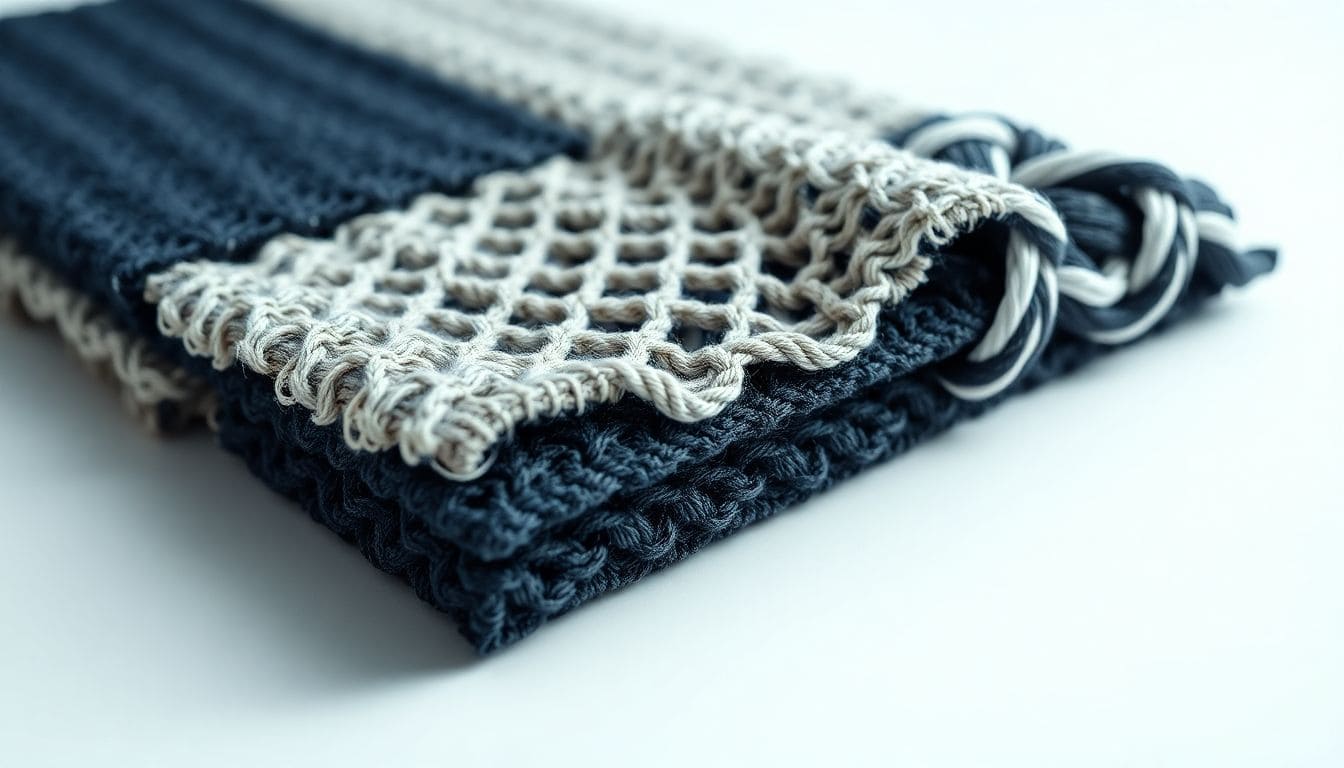
One of the significant innovations in modern textile technology is 3D textile. Traditional textile materials possess an internal 3D structure, but manufacturers typically use them as single-layer, planar, or cylindrical 2D sheets. 3D textiles push beyond these traditional boundaries by incorporating volumetric designs and structures that enhance functionality and aesthetic appeal.
Understanding 3D Textile: Definition and Structure
3D textiles are defined by three distinct structural configurations: (1) single-layer materials with overall 3D shaping, (2) solid planar materials with multiple layers, and (3) solid multilayer materials with complex 3D geometries. Multi-layer hollow structures also fall under this category. Unlike conventional 2D textiles that lie flat, 3D textiles add thickness and volume to create materials with enhanced mechanical properties, improved dimensional stability, and superior performance characteristics.
Types of 3D Textile Design
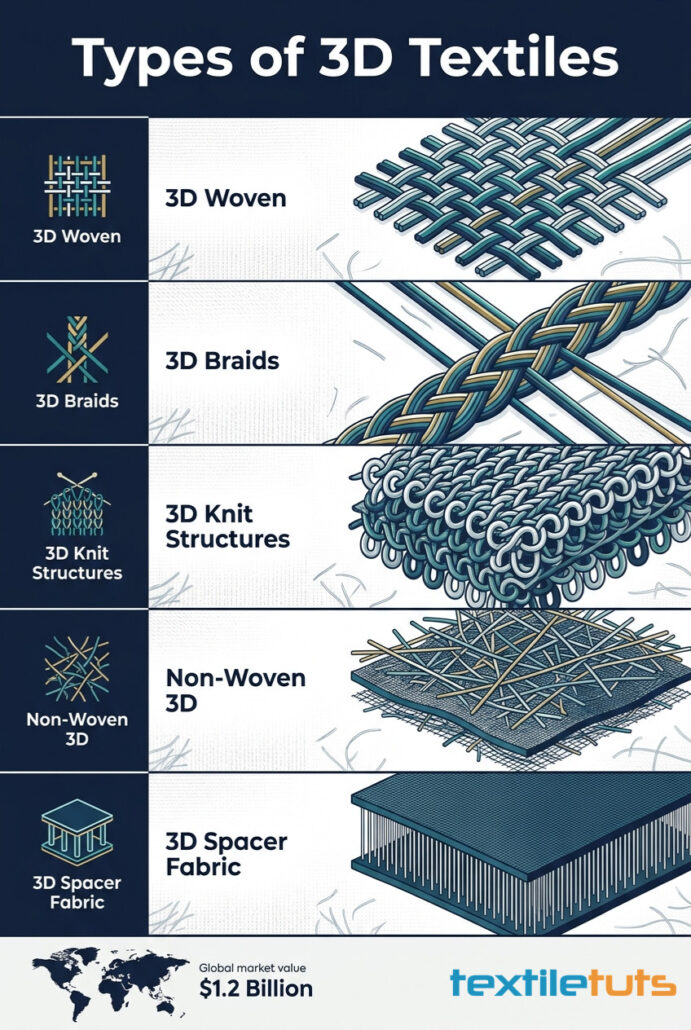
The textile industry recognizes five primary categories of 3D textiles, each with distinct manufacturing processes and applications.
3D Woven Textiles
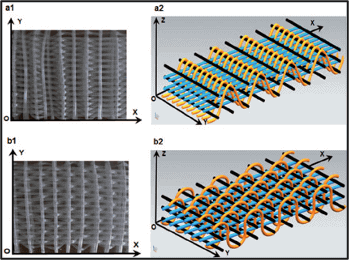
3D woven textiles require interlacing along the X-axis, Y-axis, and Z-axis simultaneously. Yarns cross in three mutually perpendicular directions, creating structures with thicknesses ranging from 5mm to 50mm. The warp yarns move both vertically and horizontally to achieve interlacement with through-the-thickness yarns.
These textiles require specialized weaving machines equipped with dual-directional shedding systems. The weave design process is significantly more complex than conventional weaving. TexEng Limited’s ‘Weave Engineer’ software automates the design calculations, reducing development time by approximately 60% compared to manual methods.
3D Braids
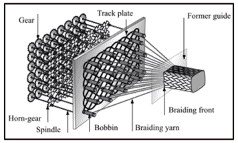
3D braiding creates complex structures where yarn layers interlace diagonally. The braiding process uses horn gears to control package movement around a central axis. Standard 3D braiding machines operate at speeds between 200 and 500 rpm, depending on the material and braid angle required.
Four-step braiding technology solves traditional limitations by using computer-controlled carriage movement. This method achieves braid angles between 15° and 85°, enabling precise control over structural properties. Production speed for large-diameter products decreases by up to 40% at diameters exceeding 300mm.
3D Knit Structures
3D knitting produces complex integral shapes through computer-controlled weft knitting machines. This technology manufactures complete garments in a single process, eliminating 80% of traditional sewing operations. The loop length in weft knitting typically ranges from 2mm to 8mm, determining fabric stretch and recovery properties.
Spacer fabrics represent another 3D knit category. These materials feature spacer threads ranging from 1mm to 20mm connecting two knit layers, creating breathable structures with compression resistance between 5kPa and 50kPa. Warp knitting produces multi-axial structures with binder yarns holding the configuration together.
Non-Woven 3D Textile
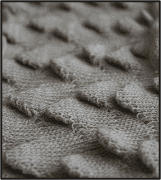
Non-woven 3D textiles encompass three main categories:
- High bulk flat non-wovens with thicknesses between 2mm and 15mm, produced through cross-laying, vertical folding (achieving 3D ratios up to 8:1), or needling with spacer fibers bridging 2mm to 10mm gaps
- Non-woven 3D molded shapes formed at temperatures between 150°C and 220°C
- Electrospun nanofiber meshes with fiber diameters ranging from 50nm to 500nm
Advanced 3D Textile Manufacturing Techniques
Beyond the primary manufacturing methods, several advanced techniques produce distinctive 3D textile structures.
False Interlacing Technology
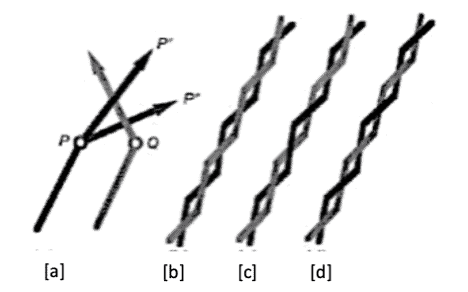
False interlacing reverses yarn package movement in pairs during interlacing. This technique achieves production rates 30% higher than conventional methods. Four pattern variations exist: over-and-under crossing, single-yarn over patterns, alternating over-and-under sections, and alternating patterns at each crossing point.
Spiderweb Structure Formation
Spiderweb structures form when yarns bond together hypersonically at frequencies between 20kHz and 40kHz. The resulting structures exhibit porosity rates between 40% and 85%, making them suitable for filtration and membrane applications.
Stitched and Embroidered 3D Structures
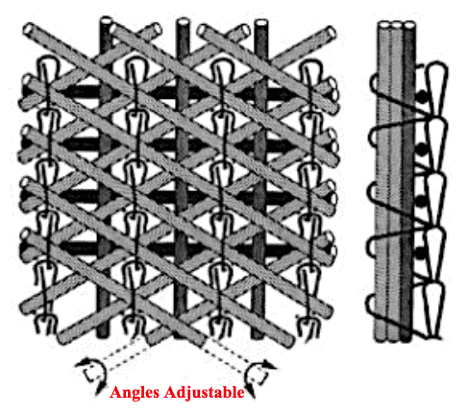
Traditional 3D garment construction uses two-layer fabric stitching with interlocked loops ranging from 3mm to 12mm in height. Modern embroidery techniques sew elaborate stitch patterns into base fabrics at stitch densities between 500 and 2000 stitches per square meter. For free-standing 3D structures, the base material dissolves during processing, leaving only the embroidered framework.
Draping and Press-Forming Methods
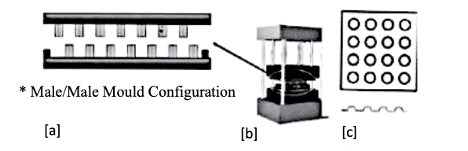
Press-forming uses mould temperatures between 160°C and 200°C with pressures ranging from 0.5MPa to 5MPa to shape non-woven fabrics. The process achieves forming speeds of 1 to 5 cycles per minute depending on material thickness and complexity. This technique produces components with dimensional tolerances within ±0.5mm.
3D Textile Techniques for Fabric Pot Manufacturing
3D textile techniques significantly improve fabric pot quality and functionality. These manufacturing methods create fabric pots with enhanced air pruning properties (increasing root branching by up to 200%), superior water drainage (achieving permeability rates of 150-300 L/m²/hr), and durability ratings exceeding 5 years under UV exposure. The 3D textile structure provides 40% better root zone aeration compared to traditional fabric pot materials.
Biomimetic Principles Driving 3D Textile Innovation
Biomimetic principles in textile engineering drive innovation by mimicking nature’s proven designs. Spider silk inspires fibers with tensile strengths reaching 1.4 GPa. Seashell layer structures inform multilayer composites with impact resistance improvements of 300-500% over monolithic materials. These bio-inspired textiles deliver sustainable, lightweight solutions with strength-to-weight ratios exceeding 15 kN·m/kg. Industries from fashion to healthcare to aerospace now depend on these advanced materials.
Applications and Uses of 3D Textiles
3D textiles serve functional and aesthetic purposes across multiple industries. The global 3D textile market exceeds $1.2 billion annually, with applications spanning:
- Aerospace, Automobile, and Military: Gas turbine fan blades operating at temperatures exceeding 400°C, helicopter rotor blades with fatigue lives exceeding 5,000 hours, military vehicle armor panels stopping projectiles at velocities up to 900 m/s, and aircraft interior components meeting FAA 15G crashworthiness standards.
- Sports and Leisure: Athletic footwear midsoles with energy return rates of 55-70%, compression garments providing 15-30mmHg pressure, and golf club heads achieving 320-350 ft/s ball speeds.
- Medical: Vascular grafts with patency rates exceeding 85% at 5 years, tissue engineering scaffolds with pore sizes between 100μm and 500μm, wound dressings reducing healing time by 30-40%, and implants meeting ISO 7198 biocompatibility standards.
- Protection: Soft body armor achieving NIJ Level IIIA protection (up to 9mm and .44 Magnum threats), helmets meeting DOT FMVSS 218 standards, and vehicle armor panels adding 15-45kg per vehicle.
- Filtration: HEPA-grade filters capturing 99.97% of particles at 0.3μm, liquid filtration systems achieving 0.5-100μm cut points, and membrane supports with porosity rates of 60-80%.
- Papermaking: Forming fabrics with 4-8% void space for even hot air distribution at temperatures up to 300°C.
- Geotextiles: Separation fabrics lasting 50-100 years with puncture resistance exceeding 1kN, filtration fabrics with flow rates of 20-200 L/m²/s.
- Construction: Temporary bridges supporting loads up to 60kN/m², building cladding with R-values of 3.5-6.5 per inch, and composite floor panels reducing structural weight by 25-40%.
REFERENCES
- Chen, X. (2012). Advances in 3D Textiles. Woodhead Publishing.
- National Institute of Justice. (2018). Ballistic Resistance of Body Armor. NIJ Standard 0101.06.
- ASTM International. (2020). Standard Specification for Woven and Knitted Fabric Interval Pressure Transducers. ASTM F2146-13.
- ISO. (2017). Cardiovascular Implants—Tubular Vascular Prostheses. ISO 7198:2017.
- U.S. Department of Transportation. (2017). Federal Motor Vehicle Safety Standard 218: Motorcycle Helmets. NHTSA.
- FAA. (2018). Aircraft Interior Crashworthiness. AC 25.562-1C.


