
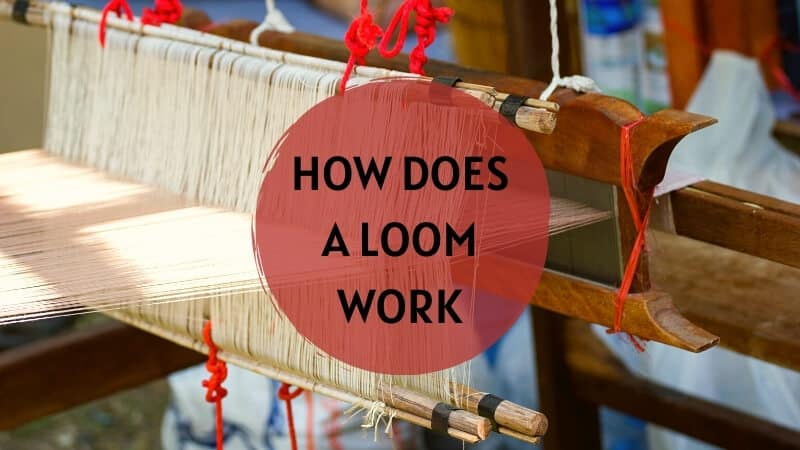
How Does A Loom Work?

A loom works by interlacing two thread systems—warp (vertical threads held under tension) and weft (horizontal threads inserted through sheds)—to create fabric. The weaver raises specific warp threads to form an opening called the shed, passes the weft thread through, then beats it into place with a reed. This fundamental warp-and-weft interaction mechanism has remained essentially unchanged for thousands of years, though modern looms operate at vastly higher speeds than ancient hand looms.
This guide covers all the essential mechanisms of loom operation, from basic warp-and-weft principles to the specific mechanical processes that create woven fabric.
Types of Looms
Before learning how a loom works, you should understand the types of looms available. Each type offers distinct characteristics suited for different weaving projects.
| Loom Type | Portability | Width Capacity | Pattern Capability | Best For |
|---|---|---|---|---|
| Back Strap | Highly Portable | Limited by weaver’s body | Simple weaves | Traditional, portable weaving |
| Tapestry / Frame | Portable | 25–100 cm (10–40 in) | Flat weaves, imagery | Beginners, wall hangings |
| Inkle | Most Portable | Up to 8 cm (3 in) | Straps, belts, trim | Bands, straps, trim work |
| Rigid Heddle | Portable | Standard heddle 10 cm height | Plain weave | Beginners, portable projects |
| Table Loom | Semi-portable | 60–100 cm (24–40 in) | 4–16 shaft patterns | Intermediate–advanced |
| Floor Loom | Stationary | 150–200 cm (60–80 in) | 4–8 shaft, complex weaves | Large projects, rugs, production |
Back Strap Loom
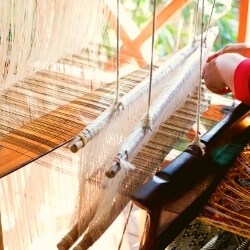
The oldest and most traditional loom is the back strap loom, created by ancient civilizations and still used by many weavers worldwide.
The weaver ties the warp to a stationary object and anchors the other end to their body. Warp tension is maintained at approximately 5–10 kg (11–22 lbs) using the weaver’s body weight.
Tapestry Loom
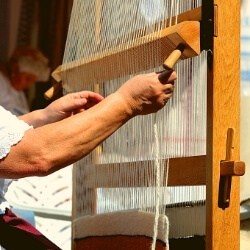
One of the simplest looms is the tapestry loom, also known as a frame loom. The tapestry size is limited to the frame dimensions, typically ranging from 25 cm to 100 cm (10 to 40 inches) in width.
To expand tapestry size, choose a larger frame. The best tapestry loom features an adjustable frame that accommodates multiple sizes.
Inkle Loom
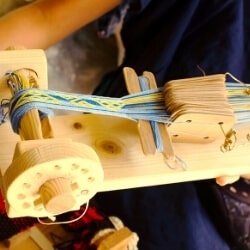
The inkle loom is the most portable version, designed specifically for weaving straps, belts, and trim up to 8 cm (3 inches) wide.
While commonly used by beginner weavers, veterans use the best inkle loom to create complex patterns using cotton, linen, and wool yarns in counts from Ne 4/1 to Ne 20/2.
Rigid Heddle Loom

The rigid-heddle loom is ideal for beginners and experienced weavers alike. Standard heddles measure 10 cm (4 inches) in height and accommodate yarn up to 8 mm (5/16 inch) diameter.
This portable loom operates with or without a stand and produces plain weave at 12 by 9 threads per square centimeter (30 by 23 threads per square inch).
Table Loom
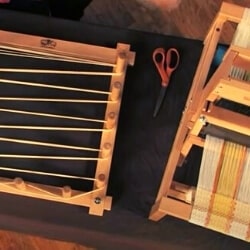
The table loom is a more complex, portable version that accommodates 4 to 16 shafts, enabling the creation of intricate weaves including twills and satins.
These looms are designed for use on a table or stand. The best table looms feature 8–12 shafts and reed widths of 60–100 cm (24–40 inches).
Floor Loom
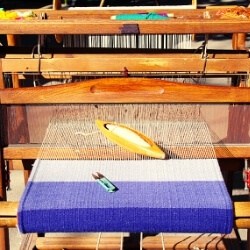
Floor looms feature 4–8 shafts and are built for larger projects including fabrics 150–200 cm (60–80 inches) wide, rugs, and tapestries. These are the largest home weaving looms available.
Floor looms are freestanding and can be mechanically or electronically controlled by a dobby mechanism that lifts and lowers harnesses. A dobby loom with 8 treadles creates a maximum of 256 sheds (2^8 combinations).
Loom Mechanics
Understanding the different types of looms helps you choose the right one. However, the fundamental mechanism remains consistent across all loom types.
Once you understand the basic principles of warp and weft interaction, you can operate any loom.
Warp Beam and Thread Path
The warp is tied to the warp beam at the rear of the loom. Warp threads extend from the beam, passing through the heddles and reed before reaching the cloth beam at the front.
Standard warp tension ranges from 10–30 kg (22–66 lbs) depending on yarn type and desired fabric density. Cotton warp typically requires 15–20 kg tension while linen may require up to 25 kg.
Beam Rolling Mechanism
During weaving, warp threads roll forward from the back beam as the cloth builds. The cloth wraps around the front beam at a rate of approximately 0.5–1.0 cm per picks of weft inserted.
Each warp thread passes through a reed (typically 10–20 dents per cm) and heddle. Standard heddles are made of steel or nylon and number from 100 to 1200 per loom.
Harness and Lever Operation
Harnesses connect to levers that the weaver operates by hand or foot. Each lever lift raises specific heddles, which in turn lifts designated warp threads to create the shed.
The shed opening allows the weft thread to pass through. The shed width typically equals 80–90% of the total reed width to ensure proper weft beat-up.
Harness Configuration and Pattern Complexity
Each lever controls a different harness arrangement. More harnesses enable more complex patterns. A 4-shaft loom creates twill weaves while an 8-shaft loom produces satins and complex geometric patterns.
The number of possible shed configurations follows the formula 2^n, where n equals the number of treadles. Eight treadles produce 256 unique shed combinations.
Picking Motion
The primary motion involves inserting weft yarn through the warp shed. The picking mechanism propels the weft-carrying shuttle across the shed at controlled speeds.
Conventional shuttle looms operate at 150–160 picks per minute. Modern rapier looms reach 600–700 picks per minute, while projectile looms achieve up to 1,050 picks per minute.
Beating Process
Beating, also called beating up or beating in, pushes the newly inserted pick into the fell of the cloth. The reed beats at a rate of 80–250 times per minute, depending on loom type and fabric construction.
This action occurs as the shed transitions and completes before the next shed fully forms. Proper beat-up force ensures a fabric density of 26 strands per inch (10 strands per cm) for standard plain weave.
Take-Off and Doffing
During take-off, the woven fabric is released from the loom. The weaver removes loops from the pegs at the top, then releases the bottom loops from the breast beam.
After removal, the weaver cuts the loops open to create finished edges. The resulting fabric is then inspected for quality and prepared for finishing processes including washing and pressing.
Key Loom Specifications Quick Reference
| Specification | Value |
|---|---|
| Warp Tension Range | 10–30 kg (22–66 lbs) |
| Cotton Warp Tension | 15–20 kg (33–44 lbs) |
| Linen Warp Tension | Up to 25 kg (55 lbs) |
| Shed Width | 80–90% of reed width |
| Fabric Density (Plain Weave) | 26 strands/inch (10 strands/cm) |
| Reed Dent Density | 10–20 dents/cm |
| Heddles per Loom | 100–1,200 |
| Beating Rate | 80–250 beats/minute |
| Shuttle Loom Speed | 150–160 picks/min |
| Rapier Loom Speed | 600–700 picks/min |
| Projectile Loom Speed | Up to 1,050 picks/min |
| Dobby 8-Treadle Combinations | 256 shed configurations |
| Cloth Advance Rate | 0.5–1.0 cm per pick |
Conclusion
This guide covers the essential mechanisms of looms and the various types available for weavers.
Understanding these fundamentals helps you select the appropriate loom for your projects and master weaving techniques more effectively.
The guide to starting weaving provides additional details for beginners ready to begin their weaving journey.
References
- Sultan, R. (2021). Weaving – Wikipedia. Wikimedia Foundation.
- Loom. (2023). Loom – Wikipedia. Wikimedia Foundation.
- Handbook of Weaving. (2020). ResearchGate Publication. Researchers from various institutions have documented loom specifications including power requirements of 0.125–0.5 hp (100–400W) for automatic looms.


