
What Is Recycled Polyester (rPET)? Properties and Environmental Impact

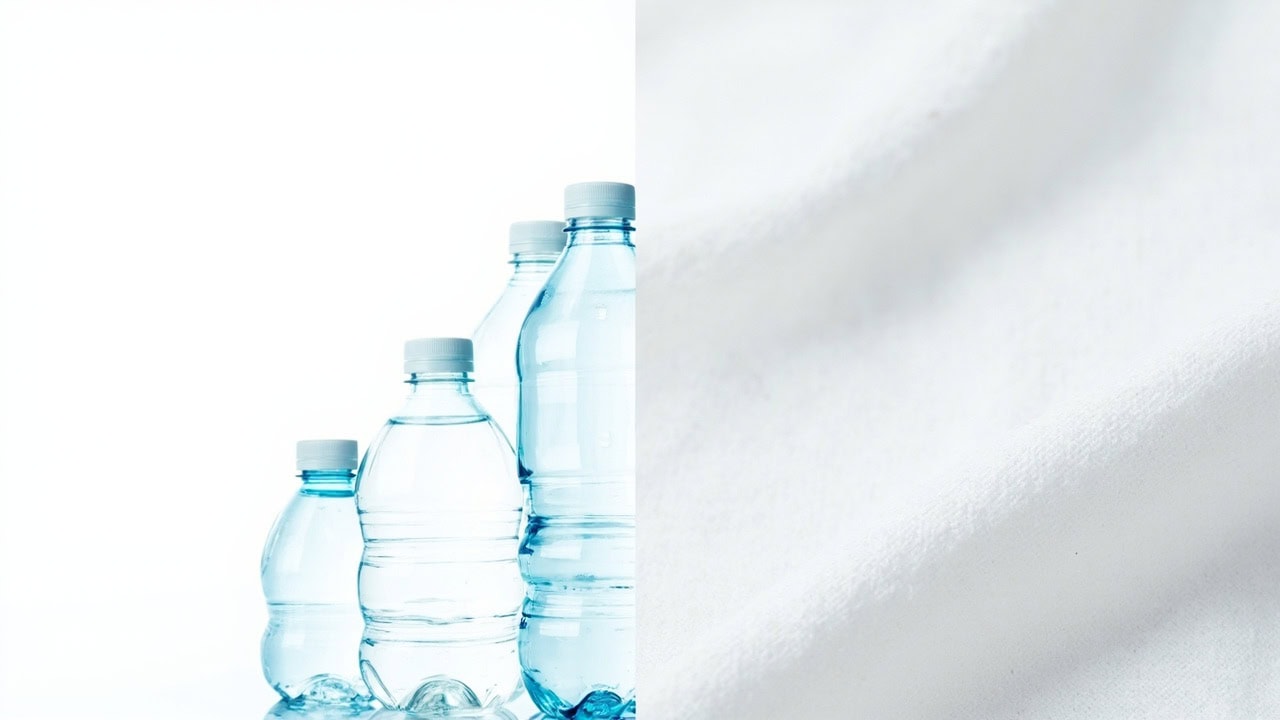
Recycled polyester (rPET) is a synthetic fiber made by processing post-consumer plastic bottles into polyester polymer that performs identically to virgin polyester while reducing landfill waste and carbon footprint. Each kilogram of rPET fabric is produced from approximately 60 plastic bottles, displacing virgin petroleum-based polyester and preventing bottles from entering oceans or landfills.
Definition: What Is Recycled Polyester (rPET)?
rPET (Recycled Polyester Token) is a polyester fiber produced from reclaimed plastic containers — primarily polyethylene terephthalate (PET) from post-consumer water and soda bottles. The molecular formula of PET — (C10H8O4)n — is chemically identical whether the starting material is a virgin petroleum derivative or a post-consumer plastic bottle. This means rPET delivers the same tensile strength (35–85 cN/tex), abrasion resistance, and dimensional stability as virgin polyester without requiring new petroleum feedstock.
rPET is certified under the Global Recycled Standard (GRS) and OEKO-TEX Recycled Standard when meeting minimum 20% recycled content thresholds. The GRS, administered by Textile Exchange, tracks recycled content through the entire supply chain using a chain-of-custody model, ensuring verifiability from collection point to final product. Brands including Repreve (from Unifi), EcoCircle (from Far Eastern New Century), and Roica (from Asahi Kasei) have built their textile identities around certified rPET fibers.
The case for rPET rests on a simple arithmetic: global polyester production exceeds 60 million tons annually, and PET bottles represent a fraction of that volume as feedstock — but a fraction of 60 million is still enormous. Every ton of rPET fiber displaces approximately one ton of virgin polyester that would otherwise be produced from petroleum-derived MEG (monoethylene glycol) and PTA (purified terephthalic acid).
How rPET Is Made: From Plastic Bottle to Polyester Fiber
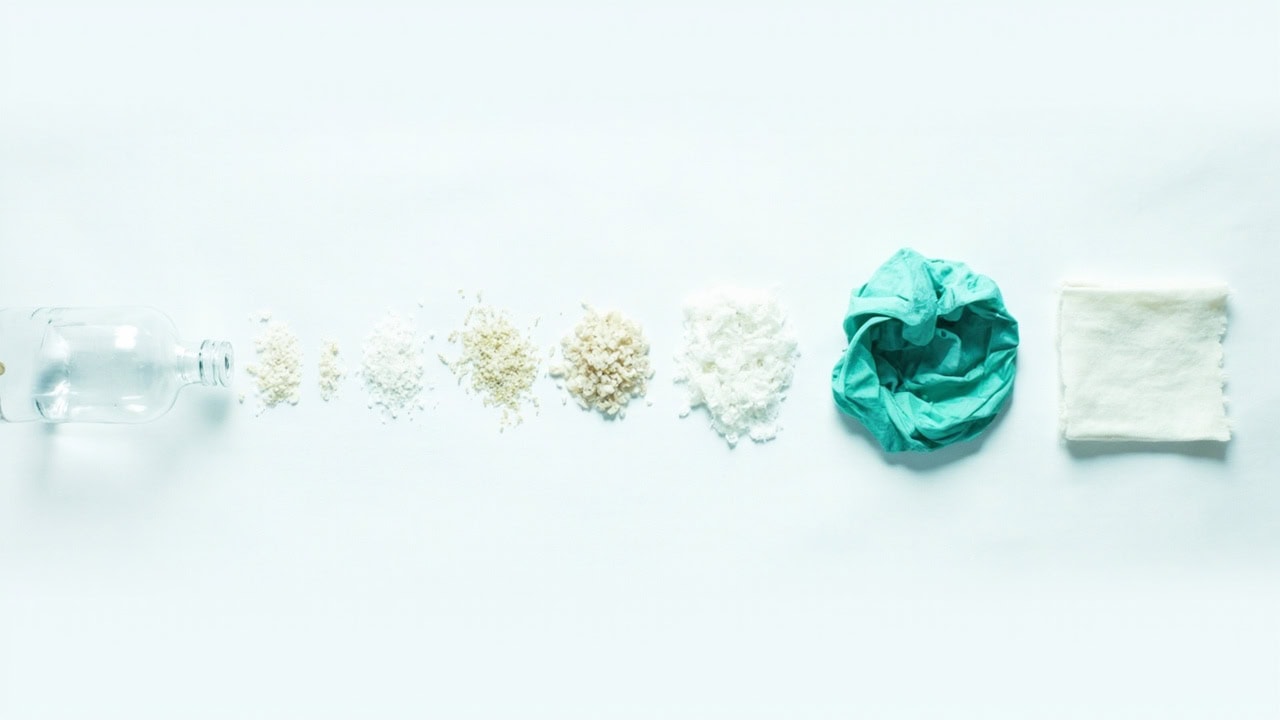
The rPET production process transforms discarded plastic containers into high-performance textile fiber through five distinct mechanical and thermal stages. Each step is designed to remove contaminants while preserving the PET polymer chain as much as possible.
- Collection and sorting: Post-consumer PET bottles are collected through municipal recycling programs and bottling deposit schemes, then sorted by color (clear, blue, green) and stripped of caps, labels, and adhesive residues.
- Shredding: Sorted bottles are mechanically shredded into PET flakes approximately 8–12mm in size. The flakes are magnetically separated from any remaining metal fragments.
- Washing and decontamination: Flakes are washed in hot water at 80–100°C to dissolve and remove residual adhesives, labels, organic contaminants, and surface impurities. This stage is critical — residual contamination directly affects the tenacity and colorability of the final fiber.
- Melting and extrusion: Clean flakes are dried to remove moisture, then melted at 260–290°C and extruded through spinnerets (metal plates with hundreds of precision holes) to form polyester filament.
- Solid-state polymerization (SSP): Extruded filament is heated below its melting point (200–250°C) in a nitrogen atmosphere to increase molecular weight and improve tensile properties — compensating for the mild polymer chain scission that occurs during the melt extrusion stage.
- Spinning and drawing: The polymer is spun into fiber through conventional melt-spinning and then drawn (oriented) at ratios of 3:1 to 4:1 to align polymer chains along the fiber axis, producing the strength and elongation characteristics required for textile end-use.
The result is a polyester filament with 59% lower energy consumption and 71% lower CO2 emissions per ton compared to virgin polyester production — while achieving identical textile performance specifications.
Key Properties Table: rPET vs. Virgin Polyester vs. Cotton
| Property | rPET Polyester | Virgin Polyester | Cotton |
|---|---|---|---|
| Tensile strength | 35–85 cN/tex | 35–85 cN/tex | 20–60 cN/tex |
| Moisture absorption | 0.4% (low) | 0.4% (low) | 7–8% (high) |
| Breathability | Low (tight weave needed) | Low (tight weave needed) | High |
| Quick-dry | Excellent | Excellent | Poor |
| UV resistance | Good (with finish) | Good | Poor |
| Shrinkage | 1–3% (low) | 1–3% (low) | 3–7% (moderate) |
| CO2 footprint per kg | 1.8 kg CO2 | 6.2 kg CO2 | 8 kg CO2 |
| Energy consumption per ton | 40 MJ/kg | 98 MJ/kg | 55 MJ/kg |
rPET’s moisture absorption of just 0.4% means it does not wick perspiration into the fiber — instead, moisture travels through capillary action along the fiber surface, making it effective in tightly woven or knitted constructions designed specifically for moisture management. This is why rPET performs exceptionally well in activewear and sportswear where quick-dry is a primary performance requirement.
Types and Varieties of Recycled Polyester
Not all rPET is created equal. The production method determines the quality ceiling, environmental benefit, and circularity potential of the resulting fiber. Four primary categories dominate the market:
- Mechanical recycled PET: Flakes are melted and re-extruded through conventional melt-spinning. This is the most established and lowest-cost route. However, each melt cycle causes polymer chain scission — molecular weight decreases with each pass — resulting in slightly lower fiber tenacity compared to virgin material. Mechanical rPET is what most “recycled” labels refer to today.
- Chemical recycled PET: PET is depolymerized back to its monomers — either BHET (bis-hydroxyethyl terephthalate) or PTA (purified terephthalic acid) plus MEG — which are then repolymerized into virgin-quality polyester. This process maintains fiber quality indefinitely through unlimited recycling cycles and is the only true closed-loop circular model. Companies including Loop Industries and Jeveeta are scaling chemical recycling capacity rapidly.
- Ocean-bound plastic rPET (OBP rPET): Bottles are collected from coastal areas within 50km of shorelines in countries lacking adequate waste management infrastructure — before they enter the ocean. Certified by the Ocean Bound Plastic (OBP) Neutrality Program, this variant addresses marine plastic pollution directly while producing standard-quality rPET fiber.
- rPET blends: rPET is combined with organic cotton, Tencel (lyocell), or modal to reduce overall petroleum footprint while improving hand feel and moisture absorption. A 50/50 rPET-cotton blend offers meaningfully lower environmental impact than pure virgin polyester while maintaining processability on standard cotton-dominant spinning systems.
- Halogen-free flame-retardant rPET: A technical variant produced with phosphorus-based or nitrogen-based flame retardant systems rather than halogenated compounds. Used in workwear, transportation seating, and upholstery where FR performance is required by contract specification (e.g., EN ISO 11612 for protective apparel).
Common Uses and Applications
rPET has moved from niche sustainability marketing into mainstream textile production across virtually every fabric end-use category. Its performance profile — high tensile strength, excellent dimensional stability, and fast drying — makes it the default recycled fiber choice for brands with environmental commitments.
- Activewear and sportswear: rPET is the dominant recycled fiber in major sportswear lines from Patagonia, Adidas, Nike, and REI. Its moisture-wicking geometry (achieved through modified cross-section fibers), shape retention, and quick-dry performance meet the technical requirements of high-output physical activity while supporting sustainability marketing claims.
- Outdoor apparel: Fleece jackets, soft-shell layers, insulation fills (600-fill and above), and backpacks benefit from rPET’s durability, weather resistance, and colorfastness. Outdoor brands have been among the earliest and most aggressive adopters of rPET certification.
- Home textiles: Carpeting (including carpet tiles), upholstery fabrics, curtains, and bedding increasingly incorporate rPET as manufacturers respond to commercial specification requirements and consumer demand for sustainable interiors.
- Bags and accessories: Reusable shopping bags, laptop sleeves, and backpacks are frequently marketed on environmental credentials derived from rPET content — one 20-liter bag typically requires 8–10 post-consumer plastic bottles.
- Nonwoven geotextiles: Civil engineering applications — road underlayment, erosion control blankets, and drainage membranes — value PET’s long-term durability and chemical resistance. rPET geotextiles provide the same mechanical performance while diverting plastic from waste streams.
Pros and Cons of rPET
| Pros | Cons |
|---|---|
| 59% less energy than virgin polyester | Still sheds microplastics during washing |
| 71% fewer CO2 emissions per ton | Chemical recycling is energy-intensive |
| Diverts plastic from landfills and oceans | Blends complicate end-of-life recycling |
| Certified traceable chain of custody | Mechanical recycling degrades polymer quality |
| Performs identically to virgin polyester | Renewable energy needed to fully realize carbon savings |
| Supports circular economy closed-loop goals | Slight premium cost vs. virgin material |
The microplastic shedding issue is the most significant unsolved drawback. Studies consistently show that rPET fleece fabrics release between 100,000 and 700,000 synthetic microfibers per wash cycle — a rate statistically equivalent to virgin polyester. Since microplastics persist in aquatic environments and have been detected in human blood, lung tissue, and placental tissue, this is a material concern that fiber producers and brands are actively researching through modified fiber coatings and alternative polymer chemistries.
Sustainability Impact: The Real Numbers
The headline environmental benefits of rPET are compelling — but a full lifecycle assessment reveals both genuine impact and important caveats.
- 60,000 bottles per ton: One ton of rPET fiber is produced from approximately 60,000 post-consumer 500ml plastic bottles. This is the most widely cited conversion figure, though exact ratios vary by bottle weight and processing yield.
- 5.8 barrels of oil saved per ton: Virgin polyester production requires approximately 5.8 barrels of crude oil per ton of fiber output — oil that becomes feedstock for PTA and MEG synthesis. rPET displaces this entire petroleum demand.
- 14 million tons capacity by 2024: Global rPET production capacity reached approximately 14 million tons by 2024 according to Textile Exchange’s Preferred Fiber & Materials Market Report. This represents roughly 15% of total global polyester production capacity — indicating massive upside for further substitution.
- 71% CO2 reduction: A peer-reviewed lifecycle assessment comparing mechanical rPET to virgin polyester consistently finds 65–75% lower CO2 equivalent emissions per kilogram of fiber, making rPET one of the most impactful textile sustainability interventions currently at scale.
- Major brand commitments: Patagonia, Adidas, Nike, and REI have publicly committed to 50–100% recycled materials in their products by 2025–2030. These commitments are driving significant rPET capacity investment and helping scale chemical recycling beyond its current niche.
The critical caveat: one rPET fleece jacket releases approximately 250,000 microplastic fibers per wash cycle. Over the jacket’s lifetime — say 100 washes — that is 25 million microplastic fibers entering wastewater systems. Unless captured by a microfiber filter (such as a Guppyfriend wash bag or Planet Care filter), these fibers pass through standard wastewater treatment and enter rivers, lakes, and oceans.
Care Summary: How to Wash and Maintain rPET Garments
rPET garments require the same care protocols as virgin polyester — with one critical addition: microplastic shedding mitigation. The following care guidelines will maximize garment longevity while minimizing both fiber degradation and environmental release.
- Wash cold (30°C or below): Machine wash on a gentle or permanent-press cycle using cold water. High temperatures accelerate polymer hydrolysis and increase mechanical agitation stress, both of which promote fiber degradation and microplastic release.
- Use liquid detergent: Powder detergents contain abrasive alkaline compounds that physically abrade synthetic fiber surfaces during the wash cycle. Liquid detergents are chemically milder and reduce mechanical fiber damage.
- Air dry when possible: Air drying eliminates the mechanical tumbling that generates the most fiber friction and microplastic release. If tumble drying is necessary, use the lowest heat setting.
- Avoid fabric softener: Fabric softeners coat synthetic fibers with a hydrophobic silicone layer that reduces moisture-wicking performance — the opposite of what rPET activewear is designed to do. Skip the softener entirely.
- Use a microfiber filter: The single most impactful consumer action is washing rPET garments in a Guppyfriend wash bag, Planet Care filter, or similar microfiber capture device. These reduce microplastic fiber release to wash wastewater by 75–90% according to manufacturer testing.
rPET garments share the same care requirements as virgin polyester — no special handling is needed beyond the standard synthetic wash protocol, with the addition of microfiber filtration for environmental protection.
Frequently Asked Questions
Q: Is recycled polyester as durable as virgin polyester?
A: Yes — rPET has identical tensile strength (35–85 cN/tex), abrasion resistance, and dimensional stability to virgin polyester because it is chemically the same PET polymer. The molecular weight may be slightly lower after mechanical recycling, but chemical-recycled rPET is indistinguishable from virgin fiber in performance testing.
Q: How much plastic does one rPET garment save?
A: A single rPET fleece jacket (approximately 300g of fiber) is made from 15–20 post-consumer plastic bottles. One ton of rPET fiber diverts roughly 60,000 bottles from landfills or oceans and saves 5.8 barrels of oil compared to virgin polyester production.
Q: Does rPET shed microplastics like virgin polyester?
A: Yes — rPET sheds microplastics at roughly the same rate as virgin polyester during washing. One wash cycle can release 100,000–700,000 synthetic microfibers. Using a microfiber filter (like the Guppyfriend bag or Planet Care filter) is the most effective consumer-side solution to prevent these fibers from reaching waterways.
Q: What is the difference between mechanical and chemical recycling for rPET?
A: Mechanical recycling melts existing PET flakes and re-extrudes them — simple but causes polymer chain shortening with each cycle (fiber quality degrades). Chemical recycling depolymerizes PET back to its monomers (BHET or PTA), which are then repolymerized — this produces virgin-quality fiber indefinitely and is considered true circular recycling. Most rPET on the market today is mechanically recycled; chemical recycling capacity is expanding rapidly.
References
- Textile Exchange. (2024). Preferred Fiber & Materials Market Report 2024 — Recycled Polyester Section. Textile Exchange.
- Global Recycled Standard (GRS). (2023). GRS Standard Document v4.2 — Chain of Custody Requirements. Textile Exchange.
- OEKO-TEX Association. (2024). OEKO-TEX Recycled Standard — Minimum Content and Testing Requirements. OEKO-TEX Association.
- Napper, I.E. & Thompson, R.C. (2020). Environmental Science & Technology — Release of Plastic Microfibers from Synthetic Clothing During Washing. ACS Publications.
- Shen, M. et al. (2020). Reusable Shopping Bags and rPET — Life Cycle Assessment Comparing Recycling Scenarios. Science of the Total Environment.
- Loop Industries. (2024). Infinite Loop Technology — depolymerization and monomer purification process. Loop Industries.
- Ellen MacArthur Foundation. (2021). The New Plastics Economy — Polyester Value Chain Circularity. Ellen MacArthur Foundation.
- B kadri. (2023). Microfiber Shedding from rPET vs Virgin Polyester — Comparative Wash Study. ResearchGate.


