
Warp Knit vs. Weft Knit: How Knitting Direction Changes Fabric

Warp knit and weft knit differ fundamentally in their loop formation direction: warp knits are made with parallel warp yarns looped vertically through the fabric using latch needles, producing a stable, run-resistant structure with minimal stretch. Weft knits are made from a single yarn fed horizontally across the needle bed. This creates loops that interlock row-by-row, yielding a soft, 4-way stretch fabric that is prone to runs. Tricot is the most common warp knit type. Jersey is the most common weft knit. Understanding this distinction determines whether a fabric will perform correctly in activewear, shapewear, or everyday garments.
What Is Warp Knitting?
Warp knitting is a fabric production method in which parallel warp yarns — oriented vertically, running the length of the fabric — are interlooped simultaneously across the fabric width. Unlike weft knitting, where a single yarn builds loops row by row, warp knitting employs 500 to 2,000 individual warp yarns per meter of fabric width. Each yarn is controlled by its own needle. All yarns feed simultaneously from a large warp beam mounted at the top of the knitting machine. Each yarn traces a series of overlap and underlap courses that lock the structure together horizontally (Spencer, 2001).
The simultaneous loop formation using latch needles (also called spring needles) produces a partially drawn-out fabric structure as it exits the machine. Critically, this structure does not unravel when cut on any edge. This is a defining performance advantage of warp knits over weft knits. The interlocking loop architecture creates a stable, dimensionally consistent fabric with controlled stretch properties.
Common warp knit structures include tricot (the most common type, fine and lightweight with a soft hand), raschel (coarser and heavier, capable of incorporating decorative jacquard patterns), milanese (a historical structure with excellent draping properties), and simplex (a two-needle-bed warp knit used for finer technical fabrics). Tricot warp knit is the workhorse of the intimate apparel and activewear lining industries. It is valued for its fine gauge, smooth surface, and run-resistant properties.
Tricot fabrics are used extensively in lingerie, activewear linings, swimwear, and shapewear. Raschel warp knits serve heavier applications. These include sportswear, automotive upholstery, industrial mesh, and filtration media. The ability to incorporate multiaxial reinforcement and open, breathable mesh structures provides functional advantages in these applications.
Specific stretch properties of warp knit fabrics: standard Tricot warp knit typically stretches 15–30% in the crosswise direction and only 3–10% in the lengthwise direction (ITMA, 2024). This controlled, directional stretch makes warp knits ideal for applications where dimensional stability is required — such as swimwear leg holes, compression panels, and shapewear bodysuits.
What Is Weft Knitting?
Weft knitting is a fabric production method in which a single yarn is fed horizontally (weft-wise, crosswise) across the needle bed. Loops are built one row (course) at a time. The yarn is supplied from a cone or spool positioned to the side of the knitting machine.
As each horizontal row of loops is completed, the needle bed advances. The next row is built directly on top of the previous one. All loops in a course are connected laterally. This creates the characteristic soft, drapey hand of weft-knit fabrics.
Weft knits offer 4-way stretch. They stretch both lengthwise (in the course direction) and crosswise (in the wale direction). This exceptional elasticity comes from the sequential row-by-row loop construction. Each new row anchors into the previous row but is not mechanically dependent on adjacent lateral loops.
The trade-off is vulnerability. A broken stitch or snagged yarn can cause a run (also called a ladder) to propagate across the fabric width. The loop structure depends on each row’s continuous interlooping with its neighbors. A single broken loop can cascade into a visible horizontal flaw.
Major weft knit structures include jersey (single knit, the most common knit fabric worldwide), rib (double knit with two interlocked rows of stitches, used for cuffs and collars), interlock (a finer double knit with good dimensional stability), and purl (a reversible structure that creates bulk and texture). Jersey weft knit is the universal fabric of everyday apparel. T-shirts, dresses, underwear, activewear, and casual garments all rely on jersey’s soft hand and 4-way stretch for comfort.
Warp Knit vs. Weft Knit: Side-by-Side Comparison
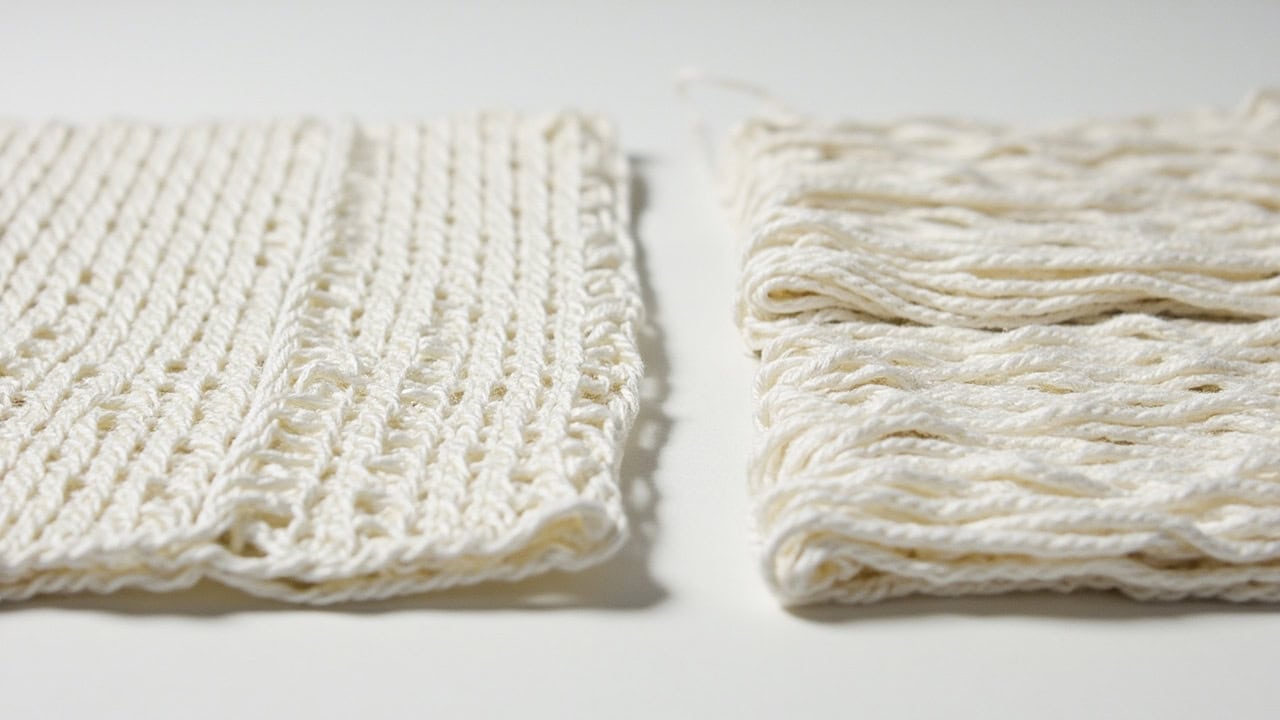
The fundamental difference between warp knit vs. weft knit fabrics lies in loop formation direction, stretch characteristics, and structural stability. The table below summarizes key performance attributes for fabric selection in garment design and technical applications (CottonWorks, 2025).
| Property | Warp Knit | Weft Knit |
|---|---|---|
| Yarn direction | Vertical (warp yarns run lengthwise) | Horizontal (single yarn feeds crosswise) |
| Loop formation | All loops formed simultaneously | Loops built row by row, course by course |
| Stretch direction | Mostly crosswise (moderate: 15–30%) | 4-way stretch (lengthwise + crosswise) |
| Stretch lengthwise | 3–10% (minimal) | 30–100%+ depending on construction |
| Run resistance | High — loops cannot unravel | Low — runs propagate horizontally |
| Dimensional stability | High (low shrinkage, low stretch-out) | Moderate (can stretch out over time) |
| Fabric recovery | Good but limited stretch range | Excellent 4-way stretch recovery |
| Common types | Tricot, raschel, milanese, simplex | Jersey, rib, interlock, purl |
| Typical uses | Lingerie, swimwear linings, activewear, shapewear, mesh, upholstery | T-shirts, dresses, underwear, sweaters, activewear |
| Production speed | Very fast (high machine efficiency) | Slower than warp knits |
| Cost | Moderate to high (specialized machines) | Lower (simpler machinery) |
| Drape | Moderate (slightly stiff) | Soft and drapey |
| Breathability | Good (open structures available) | Good to excellent depending on weight |
| Unraveling when cut | Does not unravel | Can unravel on crosswise edge |
When to Choose Warp Knit Fabric
Warp knit fabrics are the correct choice whenever dimensional stability, run resistance, and controlled stretch take priority over maximum elasticity. Warp knits provide consistent compression without sagging or bagging out over the garment’s lifespan. They hold engineered shapes through repeated wear cycles.
- Shapewear and compression garments: Warp knit fabric’s dimensional stability and controlled crosswise stretch provide consistent compression. The fabric maintains the intended compression curve through repeated wear cycles. Tricot warp knit is the standard material for compression panels in shapewear garments.
- Swimwear and activewear linings: The run-resistant loop structure prevents laddering from sand, fingernails, rough pool surfaces, or equipment contact. A snag that would destroy a weft-knit jersey lining leaves a warp knit unscathed. Raschel warp knit fabric is commonly used in swimwear shells and linings.
- Lingerie and fine apparel: Tricot warp knit’s fine gauge and smooth surface create the lightweight, invisible layering required in brassieres, panties, and slipwear. Its partial extensibility allows the garment to follow body movement without distortion.
- Industrial and technical textiles: Raschel warp knit’s capacity to incorporate multiaxial reinforcement, open mesh architectures, and heavy yarns suits automotive seating and trim, medical mesh implants, filtration media, and agrotextile applications. Milanese warp knit fabric offers excellent draping properties for automotive headliner applications.
- Upholstery and furniture: Warp knit fabric does not unravel when cut, enabling precision cutting for fitted furniture covers without the seam finishing required by weft knits. Simplex warp knit fabric is used in technical upholstery and medical support surfaces.
- Footwear: Warp knit uppers deliver a sock-like fit with excellent dimensional stability. The fabric maintains its shape through the mechanical stress of lasting and repeated user wear cycles.
When to Choose Weft Knit Fabric
Weft knit fabrics are the correct choice when maximum comfort, stretch, and drapey hand are the primary performance requirements. Weft knits excel in applications where the fabric must move naturally with the body through a full range of motion without constraint.
- Everyday garments and T-shirts: Jersey weft knit offers the 4-way stretch and soft hand that casual apparel demands. The fabric moves with the body through a full range of motion without constraint, making it the definitive choice for the world’s most-worn garment.
- Dresses and draped garments: Weft knit fabric’s superior drape and fluid hand create flowing silhouettes that warp knits cannot achieve. The 4-way stretch allows the fabric to gather, drape, and follow body contours with natural elegance.
- Sweaters and heavy knits: Purl weft knit fabric creates bulk, texture, and complex decorative patterning — cables, intarsia, and jacquard effects — that warp knitting machines cannot produce. Rib knit fabric provides excellent recovery for cuffs, collars, and trim applications.
- Garments requiring high stretch and recovery: Athletic wear, dancewear, and body-conscious styles depend on weft knit fabric’s exceptional 4-way stretch recovery. The ability to stretch to 100% or more of its resting dimension and snap back repeatedly makes weft knits ideal for performance apparel. Interlock fabric offers improved dimensional stability compared to single jersey while maintaining 4-way stretch.
- Quick-production fashion: Simpler weft knit circular or flat bed machinery allows faster sampling, smaller minimum order quantities, and more rapid product development cycles. This advantages fashion brands responding to short-lead trends.
Knitting Direction and Fabric Performance
The direction of loop formation — whether vertical (warp) or horizontal (weft) — determines virtually every performance characteristic of a knit fabric. Understanding these relationships is essential for proper fabric selection and garment design.
Machine direction and stretch: Warp knits have virtually no lengthwise stretch (typically 3–10%) because each warp yarn is an independent vertical chain locked to its neighbors by underlap connections. The primary stretch axis is crosswise (15–30% for standard Tricot) (ITMA, 2024). Weft knits stretch in both directions because each new row of loops is built on top of the previous row. Any deformation in one row propagates into adjacent rows, allowing the entire fabric to elongate under tension.
Cut-and-sew performance: Warp knit fabrics can be cut on any edge — lengthwise, crosswise, or bias — without unraveling. This makes them ideal for precision cutting in automated cut-and-sew operations. Weft knit fabrics should be cut on the crosswise grain (perpendicular to the wale direction) to minimize raveling at the cut edge.
Seam behavior: Warp knit seams lie flat and maintain dimensional stability because the fabric itself does not stretch significantly in either direction. Weft knit seams are prone to puckering or stretching out under tension unless stabilized with appropriate seam construction techniques. Coverstitch, twin-needle stitching, or elastic thread seams distribute the load and maintain seam integrity through repeated stretch cycles.
Pattern matching and distortion: The directional nature of knit loop structures means printed patterns, stripes, and checks must be carefully aligned with the fabric’s grain. Warp knits exhibit less pattern distortion during finishing because their stable structure resists the dimensional changes that occur in weft knits during wet-processing, heat-setting, or mechanical finishing. Weft knits can skew, distort, or rotate during wet processing, making pattern alignment more challenging in production.
Care Comparison: Warp Knit vs. Weft Knit
Different loop architectures respond differently to mechanical agitation, heat, and chemical exposure. Following the correct care protocol extends garment life and maintains fabric performance (CottonWorks, 2025).
Warp Knit Care (Tricot, Raschel)
- Washing: Machine wash cold (30°C / 86°F maximum) on a gentle or delicate cycle. The loop structure of warp knits can distort under excessive mechanical agitation, particularly in fabrics containing elastane or spandex. Turn garments inside out to protect the surface from abrasion against the drum.
- Drying: Tumble dry on low heat (40°C / 104°F maximum) or line dry. High heat can affect the dimensional stability of some warp knit constructions, particularly raschel fabrics with complex jacquard patterns or adhesive finishes.
- Fabric softener: Avoid fabric softener with elastane-blend warp knits. Softeners deposit a coating on elastic fibers that reduces their recovery ability. This causes compression garments to lose their shaping effectiveness after repeated softening cycles.
- Ironing: Iron on low heat (110°C / 230°F maximum) with a pressing cloth if needed. Some warp knits, particularly raschel structures, can withstand moderate heat. Direct contact with a hot iron can flatten the loop structure and create unwanted shine on the fabric surface.
Weft Knit Care (Jersey, Rib, Interlock)
- Washing: Machine wash cold to warm (up to 40°C / 104°F) depending on fiber content. Cotton-rich weft knits tolerate warmer washes. Synthetic blends (polyester, nylon) should be washed at lower temperatures to prevent pilling and preserve dye fastness.
- Drying: Tumble dry on low heat or line dry. Heavy sweater knits (cable knit, purl structures) will stretch permanently if hung while wet due to the fabric’s self-weight pulling the elastic structure out of shape. Fold these garments rather than hanging them.
- Shrinkage: Avoid high-heat drying for cotton-rich weft knits. Mechanical drying at temperatures above 60°C / 140°F can cause progressive shrinkage in cotton weft knits. This occurs due to the relaxation of spinning twist and fabric construction stress. Air drying or low-heat tumble drying is recommended for cotton jersey garments.
- Storage: Fold knits rather than hanging. Weft knits stretch under their own weight when hung, causing permanent distortion — particularly at the shoulder points. Folded storage in drawers or on shelves maintains the garment’s original dimensions.
Frequently Asked Questions
Q: What is the main difference between warp knit and weft knit fabric?
A: The main difference is the direction of yarn loop formation: warp knits are made with vertical warp yarns looped simultaneously to create a stable, run-resistant fabric with mostly crosswise stretch; weft knits are made from a single yarn fed horizontally, row by row, creating a soft, 4-way stretch fabric that is prone to runs. Warp knits like Tricot are used in shapewear and swimwear; weft knits like jersey are used in T-shirts and dresses.
Q: Does warp knit fabric stretch?
A: Warp knit fabrics have moderate crosswise stretch but minimal lengthwise stretch — they are dimensionally stable in the vertical direction. Tricot warp knit typically stretches 15–30% crosswise and only 3–10% lengthwise (ITMA, 2024). This directional stretch makes warp knits ideal for applications where controlled, directional stretch is needed — like swimwear leg holes or compression panels.
Q: Can warp knit fabric run?
A: No — warp knit fabrics are run-resistant by construction. Each warp yarn forms an interlocked chain of loops that is not dependent on adjacent yarns. Even if a needle breaks or a yarn breaks, the fabric structure does not propagate a ladder (run). This is why warp knit fabrics are preferred for swimwear, activewear linings, and applications where snagging is a risk.
Q: Which knit type is better for T-shirts — warp knit or weft knit?
A: Weft knit jersey is the universal choice for T-shirts. Jersey’s 4-way stretch, soft hand, and excellent drape create the comfort and casual appearance that T-shirt consumers expect. Warp knit fabrics are too stable and stiff for T-shirt applications — they lack the natural give and recovery that makes jersey feel comfortable against the skin during daily wear.
References
- International Textile Manufacturing Association. (2024). Knit Fabric Standards and Testing Protocols. ITMA Publications. https://www.itma.org
- American Society for Testing and Materials. (2023). ASTM D3885-20: Standard Test Method for Abrasion Resistance of Textile Fabrics. ASTM International. https://www.astm.org
- Cotton Incorporated. (2025). Knit Fabric Construction and Performance Guide. CottonWorks. https://cottonworks.com
- Kaur, A., & Majumdar, A. (2020). “Comparative Study of Warp and Weft Knitted Fabrics for Stretch and Recovery Properties.” Journal of Textile Science & Engineering, 10(4), 1–7. https://www.sciencedirect.com
- Spencer, D. J. (2001). Knitting Technology: A Comprehensive Handbook and Practical Guide (3rd ed.). Woodhead Publishing.


