
How to Wash Cashmere at Home (And Keep It Soft)

Cashmere can be safely hand washed at home using the same principles as wool washing but with even more care — cashmere fibers average 14–19 microns diameter (finer than standard wool at 20–30 microns), making them more susceptible to felting. Cold water, pH-neutral cashmere shampoo, zero agitation, and flat drying preserve cashmere’s characteristic softness. “Dry clean only” labels on cashmere are manufacturer caution — most cashmere garments wash safely at home with the correct technique.
Understanding Cashmere Fiber (Why It Needs Special Care)
Cashmere comes from the undercoat of Cashmere goats (Capra hircus). Each spring, herders collect the animals’ soft undercoat through combing or shearing — a laborious process that yields roughly 150 grams of usable fiber per goat per year. That fiber is then de-haired to separate the fine undercoat from coarser guard hair, washed, carded, and spun into the yarn that becomes your sweater.
The reason cashmere demands more care than standard wool comes down to fiber diameter. Premium cashmere averages just 14–19 microns — far finer than a human hair at approximately 70 microns, and noticeably finer than typical wool fibers at 20–30 microns. Under the U.S. Wool Products Labeling Act, cashmere fiber must average no more than 19 microns in diameter, with no more than 3% of fibers exceeding 30 microns. The finer the fiber, the softer the feel — and the more vulnerable it is to heat felting and mechanical damage.
Cashmere is graded primarily by fiber fineness and length. Grade A represents the finest, longest fibers — the softest cashmere, but also the most delicate during washing. Grades B and C have slightly higher micron counts and longer staple lengths, making them somewhat more durable. The scales along the cashmere fiber shaft are identical in structure to wool scales, meaning the felting mechanism is the same — but because cashmere fibers are finer and pack more tightly together, felting risk is heightened if the garment is exposed to heat, agitation, or dramatic temperature changes during washing.
How Often Should Cashmere Be Washed?
Far less often than cotton or synthetic fibres. Cashmere’s natural antimicrobial properties — thanks to its hygroscopic fiber structure that absorbs and releases moisture efficiently — mean it resists odor-causing bacteria more effectively than most fabrics. A general rule is 3–5 wears between full washes.
Between wears, simply air the garment over a chair back or clothes hanger for 20–30 minutes. This allows moisture and residual odor to dissipate without a full wash cycle. For minor marks or spills, spot clean immediately: blot (never rub) with cold water and a small amount of cashmere shampoo, then lay flat to dry. Spot treating protects the surrounding fibers from unnecessary exposure to water and detergent.
Before seasonal storage, always wash the garment. Body oils, sweat, and traces of perfume or deodorant left in the fibers attract Tineola bisselliella — the common clothes moth — which feeds on the keratin protein in animal fibers. A clean garment in storage is far less attractive to moths than one worn repeatedly without washing.
Hand Washing Cashmere: Step-by-Step
Hand washing is the safest method for all cashmere, particularly for Grade A garments or those with structured elements like shoulder padding or mixed fiber content. Here is exactly what to do.
What You Need
- Large basin, clean sink, or wide bowl
- Cold water — ideally 20°C (68°F) or cooler
- Cashmere-specific shampoo (The Laundress Wool & Cashmere Shampoo, Granger’s Wool Care, or plain baby shampoo as a budget substitute)
- Two clean, dry towels (white or light-colored to avoid dye transfer)
- Mesh laundry bag (optional, for the rinse phase)
Washing Steps
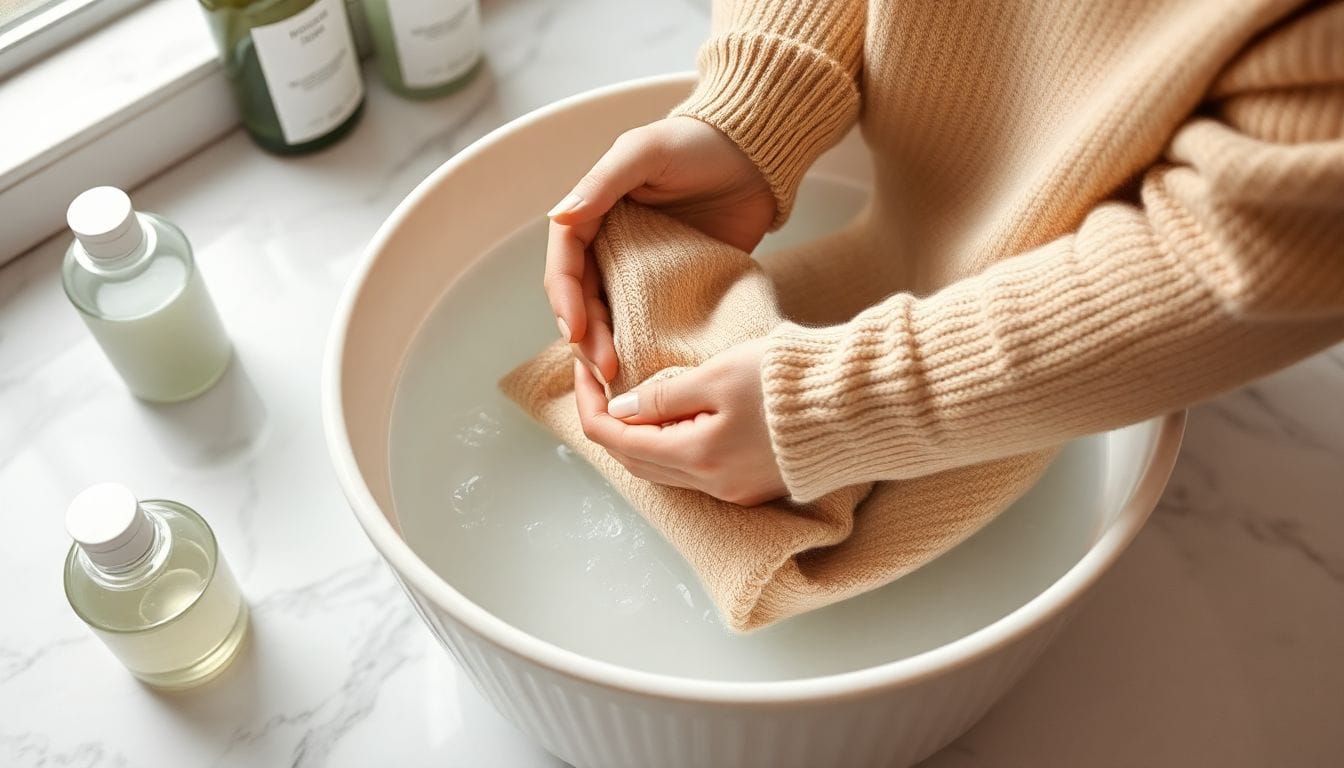
- Fill your basin with cold water (20°C/68°F or cooler) and add a small capful of cashmere shampoo. Swirl gently to disperse — do not create bubbles aggressively.
- Submerge the cashmere garment fully in the water. Press it down gently with your palms until it is completely saturated. Do not swish, rub, or scrub the fabric.
- Leave to soak passively for 15–20 minutes. Do not move the garment during this time — the mechanical action of agitating wet cashmere is what causes felting.
- Drain the basin. Refill with clean cold water at the same temperature as the wash water.
- Press the rinse water gently through the garment with your hands — do not squeeze, wring, or twist. Work from the top of the garment downward.
- Repeat the rinse with a fresh basin of clean cold water until the water runs clear and no detergent residue remains.
- Press the garment gently between your hands to remove excess water. Never wring — the torsional force permanently distorts the fiber structure.
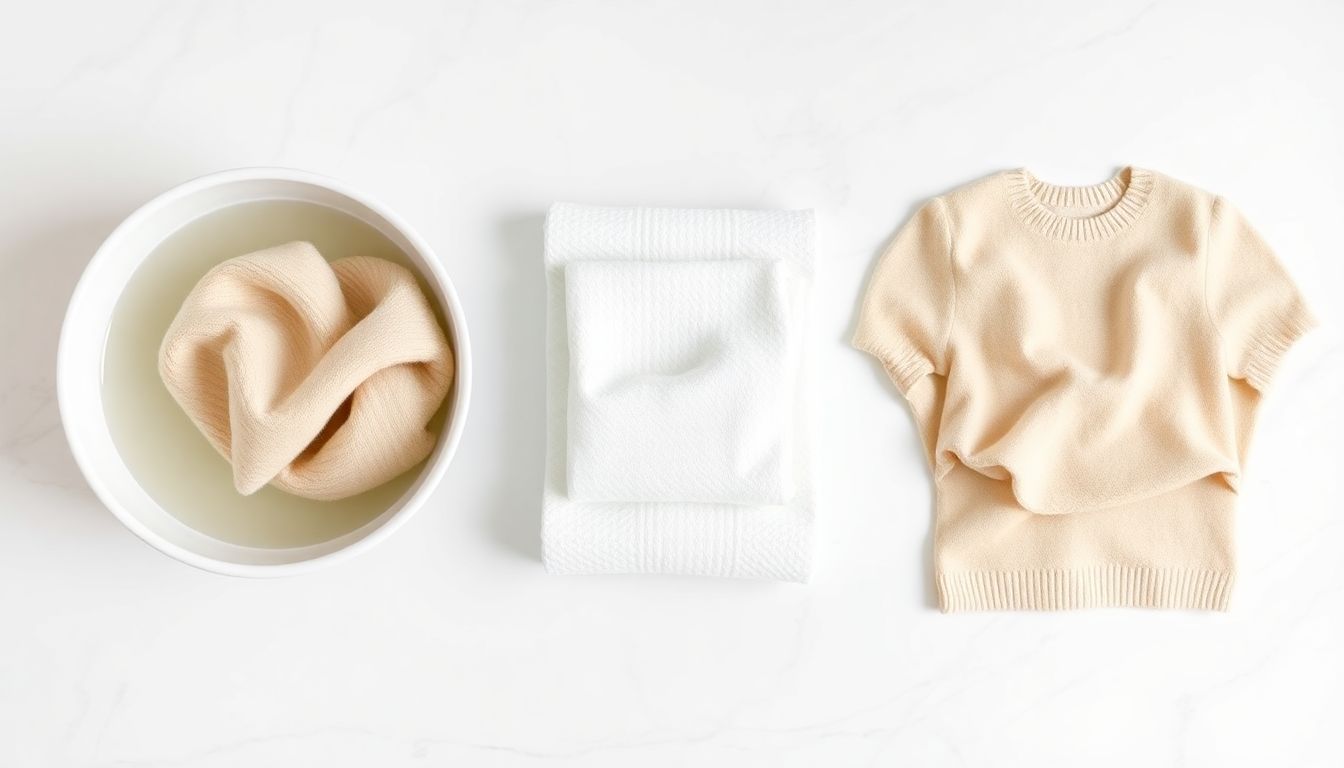
- Lay the garment on a dry towel. Fold the towel over the top and press firmly with your palms to absorb moisture. Do not roll the towel with the garment inside — rolling creates stretch and distortion.
- Unfold, gently reshape the garment to its original dimensions — straighten seams, restore the shoulder width, adjust the hem — and lay flat on a second dry towel in a well-ventilated area to air dry.
How to Dry Cashmere (Critical Step)
Flat drying is non-negotiable for cashmere. Wet cashmere fibers are particularly vulnerable to重力 distortion: when hung, the garment’s own weight pulls the fibers downward, creating permanent shoulder stretching and hem sagging that cannot be reversed by reshaping or re-washing.
Allow the garment to dry naturally at room temperature, and keep it away from three specific hazards:
- Radiators and heating vents: Direct heat damages the protein structure of cashmere fibers and accelerates pilling by drying the fibers unevenly and making them brittle.
- Direct sunlight: UV radiation degrades the keratin protein in cashmere, causing the fibers to weaken, fade, and become prone to breaking — particularly concerning for dyed cashmere, which will lose colour intensity.
- Cold draughts: Rapid temperature fluctuations and condensation can cause uneven drying, leading to fiber distortion and water spots on the garment surface.
Drying time varies by garment weight: a light cashmere T-shirt may dry in 24 hours, while a heavy knit sweater can require 48 hours or more. Flip the garment once midway through drying to prevent moisture concentrating on the underside and causing one side to stretch or warp.
Can Cashmere Be Machine Washed?
Only if the garment label specifically states “machine washable cashmere.” Many manufacturers apply a “dry clean only” label as a legal precaution rather than a technical requirement — but when a label does specify machine washing is acceptable, follow these rules precisely:
- Use a front-loading washing machine (or a top-loader without an agitator) to minimise mechanical action
- Cold water only — 20°C (68°F) maximum
- Select the wool, cashmere, or delicates cycle — these use slower agitation and longer soak periods
- Use the lowest possible spin speed, or skip the spin entirely — excess centrifugal force crushes and stretches the fibers
- Place the garment inside a mesh laundry bag for added protection against friction against the drum
Even when machine washing is permitted, hand washing remains the safer choice — particularly for garments made entirely of pure cashmere that you want to preserve in pristine condition over many years. Cashmere jumpers with structured shoulders, internal linings, or mixed fiber content should always be dry cleaned regardless of the label.
Cashmere Pilling and What to Do About It
Pilling on cashmere is not a defect — it is an inevitable result of wear. The fine fibers tangle and rub against each other during normal use, particularly in areas of highest friction: the underarms, inner elbows, cuffs, and the collar line where the garment contacts bare skin or outerwear.
Grade A cashmere — the finest, most premium quality — tends to pill less noticeably at first because the fibers are more uniform and tightly twisted in the yarn. However, when Grade A cashmere does pill, the balls break off more readily after washing, leaving a smooth, renewed surface underneath. Lower-grade cashmeres may pill more aggressively and the pills resist removal more stubbornly.
To remove pills, use a dedicated cashmere comb or an electric fabric shaver set to the lowest speed. Hold the garment taut and move the tool in one direction only — never back and forth. Never use a standard razor or disposable razor on cashmere: the blade scoring cuts into the fiber shaft and creates thin, weak spots that can develop into holes.
How to Store Cashmere
Folding is essential for cashmere storage. Hanging a cashmere sweater — even when dry — stretches the fibers at the shoulder seam over time, permanently distorting the garment’s silhouette. Fold each sweater into a neat rectangle and stack folded garments in a drawer or on a shelf.
Always clean cashmere before long-term storage. As noted, body oils and sweat are a food source for clothes moths (Tineola bisselliella), whose larvae can devastate a cashmere collection in weeks. Once a garment is clean, place it in a breathable cotton storage bag or wrap it in acid-free tissue paper — never in plastic bags or sealed containers, which trap moisture and can cause mildew and fiber degradation.
For natural moth protection, cedar blocks or cedar sachets are effective. Cedar oil repels adult moths, though it is less effective against larvae already hatching from eggs. Refresh cedar blocks every few months, as their repellent potency fades. Alternatively, dried lavender sachets or moth paper traps placed near (not directly on top of) folded cashmere provide additional deterrence without direct contact staining.
Frequently Asked Questions
Q: Can I wash cashmere in the washing machine?
A: Only if the label specifically says “machine washable.” Use cold water, the wool or delicates cycle, the lowest possible spin speed, and a mesh laundry bag. Hand washing remains the safest method for all cashmere garments regardless of label instructions.
Q: How do I make cashmere soft again after washing?
A: If cashmere has become rough after washing, soak it in a fresh basin of cold water with a few drops of hair conditioner for 20 minutes. The conditioner coats the fiber shafts and restores softness. Do not rinse it out — gently press the water out and lay flat to dry.
Q: Why does my cashmere smell after washing?
A: Cashmere has a mild natural fiber smell when damp — this is normal and not a cause for concern. If the smell is strong or musty, the garment was not dried quickly enough or was not fully rinsed of detergent. Re-wash and dry in a well-ventilated area promptly.
Q: How many times can you wash cashmere before it wears out?
A: Quality cashmere washed correctly — cold water, no agitation, flat dry — two to four times per season can last 20 years or more. The main causes of cashmere degradation are: excess heat, agitation felting, moth damage, and over-washing. Proper care dramatically extends the lifespan of cashmere garments.
References
- U.S. Wool Products Labeling Act. (2024). Fiber Content Labeling Standards for Cashmere and Wool. U.S. Federal Trade Commission. Retrieved from https://www.ftc.gov/
- CottonWorks. (2024). Cashmere Fiber Processing and Properties. Retrieved from https://www.cottonworks.com/
- International Wool Textile Organisation (IWTO). (2024). Wool Care and Maintenance Guidelines. Retrieved from https://iwto.org/
- Wikipedia. (2024). Cashmere Wool. Retrieved from https://en.wikipedia.org/wiki/Cashmere_wool


