
How to Thread a Sewing Machine: Step-by-Step for All Machines


Sewing machine threading is the process of routing thread from the spool through every control point on the machine in the correct sequence. Skipping any step or routing the thread incorrectly causes skipped stitches, thread bunching, and broken needles. Every machine model has the same core components — spool pin, tension discs, take-up lever, and needle eye — but the placement and shape of the thread guide elements varies, so always confirm your specific threading path before starting.
What Sewing Machine Threading Is and Why It Is the Foundation of Every Project
A correctly threaded machine creates a balanced stitch by maintaining proper thread tension throughout the entire thread path — from the spool on the spool pin, through the tension discs, up to the take-up lever, down to the needle eye, and finally forming a lockstitch. A lockstitch is a stitch formed by two threads — the needle thread from above and the bobbin thread from below — interlocking at each stitch through the fabric. Each thread stays on its own side of the material, with the needle thread looping through the bobbin thread at each stitch via the bobbin driver or hook assembly.
In sewing machine mechanics, tension refers to the pull of the thread between the needle and the bobbin. The machine uses tension discs and a tension regulator to control this pull, ensuring the upper thread and bobbin thread interlock at equal tension to form a proper lockstitch. When thread is routed incorrectly — even at a single point along this path — the tension balance collapses, producing tangled stitches, thread breakage, or fabric puckering. See our sewing machine tension guide for detailed adjustment instructions.
Incorrect threading is the leading cause of sewing machine problems. A significant proportion of sewing machine service issues trace back to improper threading of the upper thread path, the bobbin, or both. Before assuming your machine needs repair or adjustment, re-threading it completely is always the first and most important troubleshooting step. Understanding the universal threading sequence — and why each step matters — is foundational to every sewing project from hemming trousers to constructing couture garments.
The thread path follows the same core sequence across all machine types: mechanical, computerized, serger, and industrial. What changes between models is the placement, shape, and number of thread guide elements along that path. A computerized machine may add additional guides or include an automatic needle threader, but the fundamental route — spool → tension discs → take-up lever → needle — remains constant.
Tools and Materials Needed
Before beginning the threading process, gather the essential materials. Having everything at hand prevents mid-threading interruptions that can cause the thread to slip out of position:
- A sewing machine spool of thread matched to your fabric type — cotton thread for natural fibers, polyester or nylon thread for synthetic fabrics, silk thread for delicate silk projects
- A bobbin wound with compatible thread, inserted in the bobbin case or bobbin holder — also see our bobbin loading guide for step-by-step instructions
- Sharp scissors or thread snips for cutting thread cleanly at the spool and needle
- A machine needle matched to your fabric type and thread weight — see our sewing machine needle guide for help choosing the right needle; universal needles suit woven fabrics, ballpoint needles prevent snagging on knits, and sharp Microtex needles deliver precision stitching on silk or microfibers
- Your owner’s manual — the threading diagram specific to your machine model is the single most reliable reference for guide placement and sequence
Step-by-Step Threading Instructions
Follow each step in sequence without skipping. The order matters because each component in the thread path performs a specific mechanical function. Removing any step disrupts the tension balance and compromises stitch quality.
Step 1: Prepare the Machine
Raise the needle to its highest position by turning the hand wheel toward you — clockwise — until the needle stops at its apex. Threading with the needle down means the take-up lever is in a lower position, which cannot create proper thread seating and will cause immediate tension problems. When the needle reaches its highest point, the take-up lever is also at its highest position, creating the correct amount of slack in the thread path above the needle eye.
Once the needle is fully raised, lower the presser foot. This releases the tension discs inside the machine’s tension assembly — when the presser foot is down, the discs compress and grip the thread. Threading while the presser foot is raised leaves the tension discs open, allowing the thread to pass through without proper tension setting, which will cause the thread to slip and produce loose stitches.
Step 2: Place the Thread Spool
Position the spool on the spool pin with the thread unwinding in the correct direction. Most sewing machines require counter-clockwise unwind from a top-mounted spool pin — when the thread comes off the spool, it should pull from the side rather than creating a tight coil. Some machines have a spool cap or spool holder that sits on top of the spool to prevent it from spinning freely and catching on the spool pin.
Consult your owner’s manual for the specific unwind direction required by your machine. Placing the spool in the wrong orientation causes the thread to unwind in loops that catch on the spool cap or create kinks in the thread, leading to inconsistent tension and thread breakage mid-seam. On machines with horizontal and vertical spool pins, the required unwind direction for each may differ.
Step 3: Route Through the Thread Guides
Follow your machine’s numbered thread guide sequence — most machines mark these on the machine body near the thread path with stamped numbers or small arrows. The universal threading sequence is:
- Guide 1: The initial thread guide just above the spool — this holds the thread in the first fixed position after leaving the spool
- Guide 2: The tension disc assembly — thread passes between the two tension plates and must sit squarely in the tension slot, not on top of the discs
- Guide 3: The take-up lever — thread routes through this and must be pulled up fully into the lever slot; this is the most frequently missed guide in a threading sequence
- Guide 4: A second thread guide below the take-up lever that keeps the thread on a straight path toward the needle
- Guide 5: The needle clamp thread guide — a small wire or slot near the needle clamp that positions the thread just above the needle eye
The take-up lever is particularly important. It is a moving component that rises and falls with each needle stroke, pulling thread from the spool and feeding it to the needle. When the lever is at its highest point (as it is when the needle is fully raised), it creates a slack loop that accommodates the needle’s downward stroke. If thread is not seated in the take-up lever, this slack management fails, causing thread bunching and uneven stitches.
Step 4: Thread the Needle
Insert the thread through the front of the needle eye — although some machine models specifically require back-to-front threading, and a few high-end models thread front-to-back. Your owner’s manual specifies the correct direction. Leave approximately 6 inches (15 cm) of thread trailing behind the needle. This tail length is sufficient to prevent the thread from pulling back through the needle eye during the first few stitches, while being short enough to remain manageable.
For twin needle threading — used for decorative parallel rows of stitching on collars, cuffs, and hem edges — thread each needle separately following the same path. Both threads must be correctly seated through all thread guides and tension points. Some machines have a twin needle specific tension disc or spool pin configuration; check your manual for the correct setup. Twin needle stitching requires both needles to be the same size and type, and both threads must match in weight and fiber content for balanced tension.
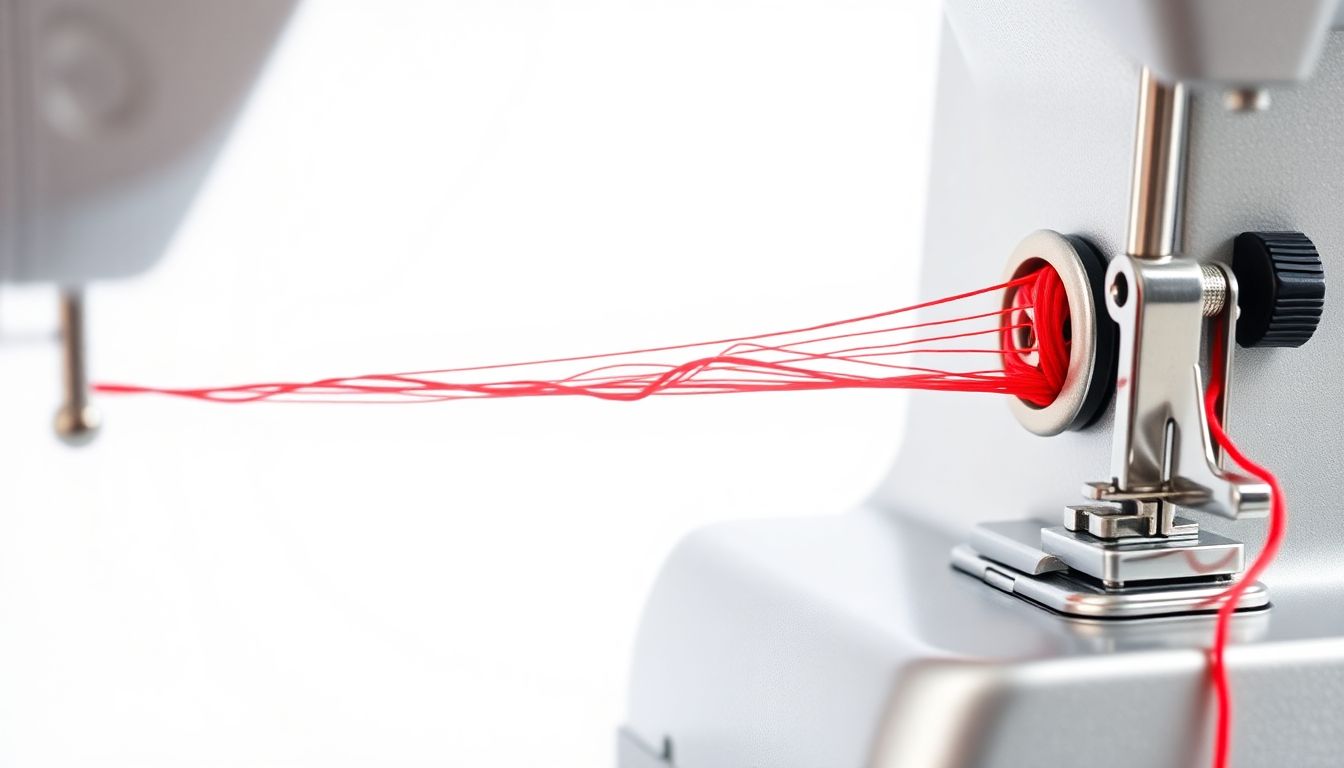
How to Load the Bobbin
Correct bobbin loading is as critical as upper threading. The bobbin and its spring-loaded tension mechanism are responsible for the lower half of the lockstitch. In a lockstitch, two threads — the needle thread from above and the bobbin thread from below — interlock at each stitch through the fabric. Each thread stays on its own side of the material, with the needle thread looping through the bobbin thread at each stitch via the bobbin driver or hook assembly.
Open the bobbin cover, located on the front of the machine below the needle plate. Remove the insert or cover plate to expose the bobbin case or bobbin holder. Insert the bobbin with thread unwinding in the direction indicated by the embossed diagram on the bobbin cover — clockwise for some models, counter-clockwise for others. The wrong bobbin orientation causes the thread to be pulled in the opposite direction of the hook race rotation, preventing proper interlock.
Pull the thread through the bobbin tension spring — you should feel slight resistance, an indication that the spring is applying correct tension to the bobbin thread. This resistance is what regulates how much bobbin thread is pulled per stitch cycle. Too little resistance means the bobbin thread pulls too freely, creating loops on the underside of the fabric; too much creates tight bobbin tension that pulls the needle thread down excessively, causing puckering.
Close the bobbin cover, leaving the bobbin thread tail accessible above the needle plate. Raise the needle thread tail by turning the hand wheel one full revolution clockwise — this raises the needle from its lowest point to its highest, which brings the take-up lever through its full cycle and pulls up a loop of bobbin thread through the needle plate. Both thread tails should now be accessible above the needle plate, ready to begin sewing.
Common Threading Mistakes and How to Fix Them
Most sewing machine problems that appear mechanical in nature are threading problems in disguise. Identifying the symptom correctly and knowing which threading error caused it saves unnecessary service trips and parts replacements. See our sewing machine troubleshooting guide for more help.
Thread Bunching Below the Needle Plate
Tangled thread accumulates on the underside of the fabric, between the needle plate and the bobbin cover. The machine sounds strained and the fabric does not advance.
Symptom: A mass of tangled thread accumulates on the underside of the fabric, between the needle plate and the bobbin cover. The machine sounds strained and the fabric does not advance.
Cause: The bobbin is loaded incorrectly — the thread may be unwinding in the wrong direction, or the thread is not caught under the bobbin tension spring. Incorrect bobbin tension (too loose) also causes bunching. In some cases, the upper thread is not properly seated in the take-up lever, so thread feeding is uneven.
Fix: Remove the bobbin entirely, check the unwind direction against the diagram on the bobbin cover, and reinsert it so the thread passes under the tension spring with the correct orientation. Then re-thread the upper thread completely with the needle raised to its highest position, ensuring the thread is seated in the take-up lever slot.
Thread Breaking Repeatedly
Thread snaps during sewing, sometimes immediately after starting or after several minutes of stitching. Breakage at the needle eye is the most common location.
Symptom: Thread snaps during sewing, sometimes immediately after starting or after several minutes of stitching. Breakage at the needle eye is the most common location.
Cause: Thread caught on a sharp edge at the spool cap or spool pin, a burr on the surface of the tension disc or needle eye, the wrong needle size for the thread weight, or the thread passing through the needle eye at an angle that creates friction. Thread that has been stored in humid conditions absorbs moisture and weakens, increasing breakage risk.
Fix: Inspect the entire thread path — spool cap, thread guides, tension discs, take-up lever — for any rough edges or snags. Replace the needle, as a dull or damaged needle creates a rough surface inside the needle eye that saws through thread. Verify the needle size matches the thread weight: a size 75/11 needle is appropriate for general-purpose 40–50 weight thread, while heavier topstitching threads require a larger needle such as size 90/14 or 100/16.
Skipped Stitches
The machine stitches normally for a few centimeters then produces a gap in the seam — missing stitches where the needle fails to form a loop with the bobbin thread.
Symptom: The machine stitches normally for a few centimeters then produces a gap in the seam — missing stitches where the needle fails to form a loop with the bobbin thread.
Cause: Needle inserted incorrectly — the flat side of the needle shank faces the wrong direction (should face the back on most machines). A dull, bent, or damaged needle fails to form a proper needle thread loop for the bobbin hook to catch. Thread not seated in the take-up lever causes uneven thread delivery that pulls the loop away from the hook timing.
Fix: Re-thread the machine completely from scratch with the needle at its highest position. Replace the needle — if skipping persists, the issue may be hook timing, which requires professional service. Check that the needle is inserted fully upward in the needle clamp and that the flat side of the needle shank is oriented correctly (typically toward the back of the machine).
Thread Loops on Underside of Fabric
Small loops of needle thread appear on the underside of the fabric — visible as neat circles of thread poking through from the top side.
Symptom: Small loops of needle thread appear on the underside of the fabric — visible as neat circles of thread poking through from the top side.
Cause: Top tension is set too loosely relative to the bobbin tension, allowing the needle thread to remain too loose on the underside. Alternatively, the bobbin thread is not properly caught in the hook race — a common occurrence after bobbin removal and reinsertion. Debris on the bobbin spring or in the bobbin case can also prevent proper tension regulation.
Fix: Re-thread the bobbin area, ensuring the thread is correctly routed under the bobbin tension spring and through the bobbin case retention tab. Clean any lint or thread fragments from the bobbin case and hook race with a small brush. If loops persist, the top tension may need to be increased slightly using the tension dial — turn it clockwise in small increments to tighten the upper thread relative to the bobbin.
When to Thread vs. When to Seek Professional Service
Knowing when a threading correction fixes the problem — and when the issue is mechanical — is key to efficient sewing and avoiding unnecessary repairs. Always re-thread when switching thread type, color, or weight, as different thread diameters and surface textures (silk vs. polyester vs. cotton) require subtle tension adjustments and affect how the thread seats in the tension discs and take-up lever.
Re-thread after the machine has been idle for more than a few hours. Thread absorbs moisture from the air — particularly in humid climates or unconditioned sewing rooms — and this moisture absorption causes thread to expand and change diameter. An expanded thread that fits snugly in the tension discs at 9 AM may become too slack by afternoon, causing tension-related stitching problems even though the threading path is correct.
If problems persist after proper and complete re-threading of both upper thread and bobbin — including replacing the needle, cleaning the bobbin case, and verifying bobbin orientation — the issue may be mechanical: worn tension discs that no longer grip thread evenly, hook timing that has drifted so the bobbin hook catches the needle thread loop at the wrong moment, or a damaged needle bar that affects needle depth. These require a qualified sewing machine technician with proper diagnostic equipment. Do not attempt to adjust hook timing yourself — it is a precision mechanical setting that, when altered without knowledge, can damage the hook race and bobbin case.
Frequently Asked Questions
Does the thread direction matter when placing the spool on the spool pin?
Yes — thread must unwind in the correct direction to prevent kinking and snagging. Most machines require counter-clockwise unwind from a top-mounted spool pin, but some require clockwise. Check your manual diagram.
Why do I need to raise the needle to its highest position before threading?
Raising the needle to its highest point also raises the take-up lever to its highest position, which creates the correct slack in the thread path. Threading with the needle down means the thread cannot properly seat in the take-up lever, causing tension problems.
My thread keeps breaking at the needle eye — what am I doing wrong?
A thread breaking at the needle eye is usually caused by a dull or damaged needle, a burr on the needle eye from prior use, or the wrong needle size for your thread weight. Replace the needle and re-thread, making sure the thread passes through the needle eye without forcing it.
Do computerized sewing machines thread differently than mechanical machines?
The core threading path is the same (spool → tension → take-up lever → needle), but computerized machines may have additional thread guides, an automatic needle threader, or a different bobbin loading mechanism. Always consult your specific owner’s manual — even machines from the same brand can have different threading paths.
References
- Sewing Machine. (2024). Wikipedia. https://en.wikipedia.org/wiki/Sewing_machine
- Brother Industries, Ltd. How to Thread a Sewing Machine. https://www.brother.com.au/sewing-tips/how-to-thread-a-sewing-machine
- Singer. How to Thread a Sewing Machine. https://www.singer.com/sewing-tutorials/how-to-thread-sewing-machine
- American Association of Textile Chemists and Colorists (AATCC). Textile Test Standards. https://www.aatcc.org
- CottonWorks. Sewing Machine Maintenance Knowledge. https://www.cottonworks.com


