
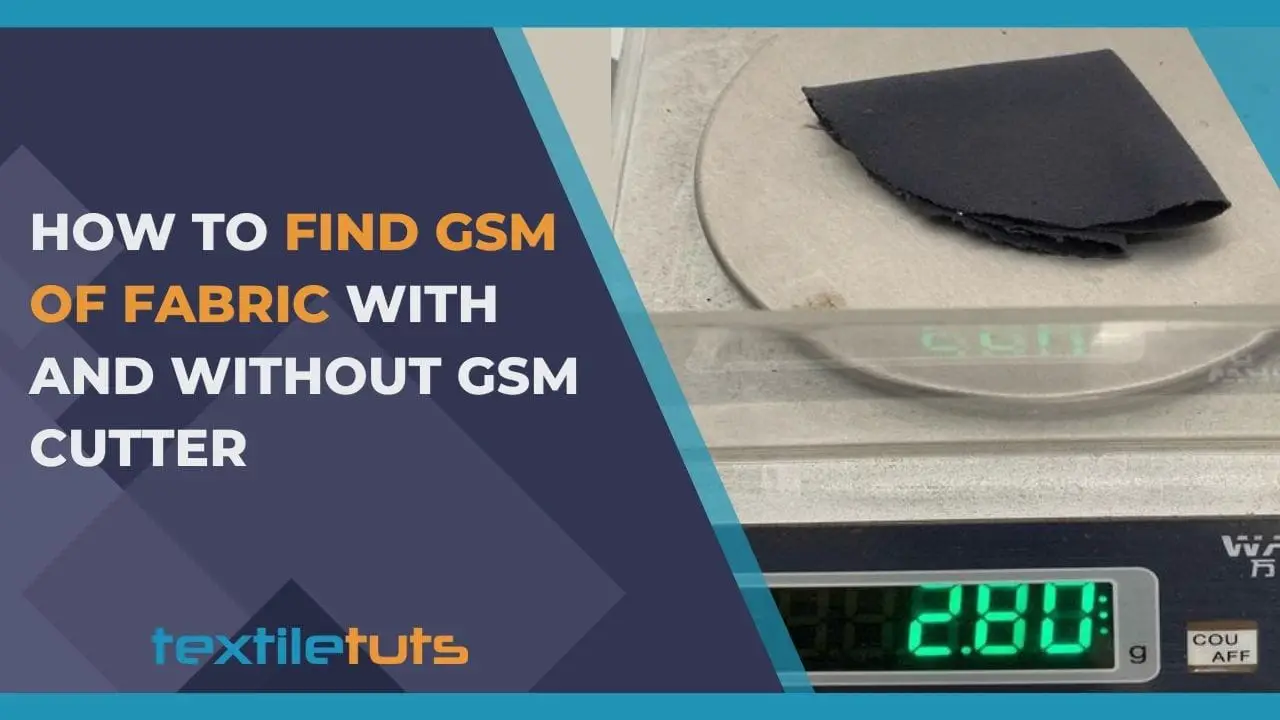
How to Find GSM of Fabric with and without GSM Cutter

To find GSM of fabric without a GSM cutter, use the template and balance method: cut a 10 cm × 10 cm sample (100 cm² area), weigh it on a precision balance to ±0.01 g, then multiply the weight in grams by 100 to get GSM. This straightforward technique produces results within 1–2% of the GSM cutter method and works with equipment found in most quality control labs or workshops.
Two primary methods exist for determining fabric GSM. The GSM cutter method uses a circular 11.28 cm diameter die to produce exactly 100 cm² samples. The template and balance method — covered in detail here — achieves comparable accuracy using a 10 cm × 10 cm template and a precision balance. This guide walks through the complete procedure with step-by-step instructions, required apparatus, and example calculations.
Standard testing requires controlled atmospheric conditions of 20°C ± 2°C with 65% ± 2% relative humidity per ASTM D1776. Fabric must be conditioned in this environment for a minimum of 24 hours before weighing, as moisture content directly affects fiber weight — cotton at 80% RH weighs approximately 8–10% more than oven-dry cotton.
Quick Reference: Key Specifications
| Parameter | Specification |
|---|---|
| Sample area | 100 cm² (10 cm × 10 cm template) |
| Number of samples | Minimum 5, from different fabric locations |
| Balance accuracy | ±0.01 g |
| Conditioning atmosphere | 20°C ± 2°C, 65% RH ± 2% |
| Conditioning duration | Minimum 24 hours |
| GSM formula | Weight (g) × 100 |
Template Method vs. GSM Cutter Method
| Factor | Template & Balance Method | GSM Cutter Method |
|---|---|---|
| Equipment cost | Lower (basic balance + template) | Higher (specialized circular die) |
| Sample geometry | Rectangular (10 cm × 10 cm) | Circular (11.28 cm diameter) |
| Cutting skill required | Moderate — straight cuts with scissors | Moderate — firm even pressure on die |
| Accuracy | ±1–2% with proper technique | ±1–2% with proper technique |
| Best for | Small labs, workshops, occasional testing | High-volume testing, production environments |
Required Apparatus
- Precision template (100 cm² area, 10 cm × 10 cm)
- Electric balance (accuracy ±0.01 g)
- Fabric scissors (sharp, for accurate cutting)
- Ruler scale (metric, 30 cm minimum)
Step-by-Step Measurement Procedure
- Relax the fabric — Pre-wash or expose fabric to ambient conditions for a minimum of 4 hours to eliminate residual sizing, printing chemicals, and storage tension that alter weight readings.
- Condition the samples — Place cut samples in standard atmosphere (20°C ± 2°C, 65% RH ± 2%) for a minimum of 24 hours per ASTM D1776.
- Cut 5 samples — Use the 10 cm × 10 cm template to cut samples from different areas: one near the selvedge, one from center, one from the opposite selvedge, and two from intermediate locations. Multiple cuts account for fabric construction variability across the roll width.
- Weigh each sample — Record the weight of each sample to ±0.01 g on the electric balance.
- Calculate individual GSM values — Multiply each weight by 100 (since 100 cm² × 100 = 10,000 cm² = 1 m²).
- Compute the mean GSM — Add all 5 GSM values and divide by 5 to obtain the average fabric GSM.
Formula: Fabric GSM = Weight of sample (g) × 100
Example: A 100 cm² sample weighs 1.58 g → GSM = 1.58 × 100 = 158 g/m²
Fabric GSM Categories and Typical Values
Fabric GSM ranges classify textiles into weight categories that determine their end-use applications:
| Category | GSM Range | Typical Applications |
|---|---|---|
| Extra Light | 8–136 g/m² | Lining fabric, sheer curtains |
| Light | 136–204 g/m² | Summer dresses, blouses, voile |
| Medium | 204–272 g/m² | Shirts, suiting, twill |
| Medium Heavy | 272–339 g/m² | Jackets, trousers, canvas |
| Heavy | 339–407 g/m² | Coats, upholstery, canvas |
| Extra Heavy | 407–475 g/m² | Industrial textiles, tarpaulins |
T-shirt fabrics typically range from 130–200 g/m². Summer-weight T-shirts use 130–150 g/m², while premium or heavyweight options reach 180–200 g/m². Cotton t-shirts average 160–180 g/m², whereas polyester blends commonly measure 140–160 g/m².
Sample Data Comparison
| With GSM Cutter | Without GSM Cutter | ||||||
| Sample No. | Weight (g) | GSM = Weight × 100 | Average GSM | Sample No. | Weight (g) | GSM = Weight × 100 | Average GSM |
| 1 | 1.56 | 156 | 158 | 1 | 1.58 | 158 | 157 |
| 2 | 1.60 | 160 | 2 | 1.62 | 162 | ||
| 3 | 1.53 | 153 | 3 | 1.52 | 152 | ||
| 4 | 1.62 | 162 | 4 | 1.55 | 155 | ||
| 5 | 1.59 | 159 | 5 | 1.58 | 158 | ||
The data above demonstrates that both methods yield comparable results when performed correctly. The GSM cutter method produced an average of 158 g/m², while the template method yielded 157 g/m²—a difference of only 1 g/m² (0.6%), well within acceptable testing tolerance.
GSM Calculation Formula Explained
The fundamental GSM formula is straightforward:
Fabric GSM = Weight of sample (g) × 100
This formula works because the GSM cutter produces exactly 100 cm² samples. Since 1 square meter equals 10,000 cm², multiplying a 100 cm² sample weight by 100 (10,000 ÷ 100) yields the grammage per square meter.
Worked Example:
Sample weight = 1.56 g
GSM = 1.56 × 100 = 156 g/m²
This calculation applies uniformly across all samples; the same multiplication factor (×100) converts any 100 cm² sample weight directly to GSM.
Measurement Accuracy Considerations
Several factors affect GSM measurement accuracy:
Sample Size: Testing fewer than 5 samples increases measurement uncertainty. ASTM D3776 recommends a minimum of 5 cuts per fabric lot. Larger sample sizes (10+ cuts) reduce standard deviation but increase testing time.
Balance Calibration: Verify balance calibration using 100 g, 500 g, and 1000 g Class F weights monthly. Uncalibrated balances introduce systematic errors of 0.5–2.0%.
Conditioning Time: Insufficient conditioning causes moisture-related weight errors. Allow minimum 24 hours in standard atmosphere, or until weight stabilizes to ±0.1 g across consecutive readings taken 2 hours apart.
Fabric Relaxation: Unrelaxed fabric contains residual manufacturing stresses. Pre-washing or prolonged ambient exposure (4–24 hours) before cutting eliminates spurious weight variations from this source.
Industry Applications
Textile testing laboratories, garment manufacturers, quality control inspectors, and fabric suppliers rely on GSM measurements for specification compliance, cost estimation, and quality assurance.
Fabric procurement teams specify GSM ranges in purchase orders to ensure consistency across production runs. A 180 g/m² cotton T-shirt fabric must fall within ±5% tolerance (171–189 g/m²) to meet specification.
Garment cost estimation uses GSM alongside fabric width and yield calculations. Heavier fabrics consume more material per unit, directly impacting fabric consumption and garment pricing. The fabric consumption calculator applies these values to predict material requirements.
Quality control departments perform GSM testing on incoming fabric rolls to verify conformance with contractual specifications. Rejected lots exceeding tolerance thresholds return to suppliers or trigger price negotiations.
Why GSM Cutter Samples Multiply by 100
The GSM cutter produces a circular sample with an 11.28 cm diameter. This specific dimension creates a surface area of exactly 100 cm².
Area Calculation:
Area = π × r² = π × (d/2)²
Area = 3.14159 × (11.28/2)²
Area = 3.14159 × (5.64)² = 3.14159 × 31.81 ≈ 100 cm²
Since 1 square meter = 10,000 cm², and each sample = 100 cm², the multiplier is 10,000 ÷ 100 = 100.
Converting centimeters to meters: 1 meter = 100 cm, therefore 1 square meter = 100 cm × 100 cm = 10,000 cm². The factor of 100 scales the 100 cm² sample weight to the 10,000 cm² equivalent.
Final Remarks
Both GSM measurement methods deliver accurate, reproducible results when technicians follow standard procedures and maintain proper atmospheric conditions. Testing laboratories and garment manufacturers use these techniques daily for quality assurance.
Critical requirements for accurate GSM testing include: calibrated instruments, standard atmospheric conditioning (20°C ± 2°C, 65% RH ± 2%), properly relaxed fabric samples, and sufficient sample quantities (minimum 5 cuts per lot).
The template method offers a practical alternative when GSM cutters are unavailable, producing results within 1–2% of cutter method values. Industrial fabric cutting machines streamline the process for high-volume testing environments.
References
- ASTM International. (2016). ASTM D1776/D1776M-16: Standard Practice for Conditioning and Testing Textiles. ASTM International.
- ASTM International. (2020). ASTM D3776/D3776M-20: Standard Test Methods for Mass Per Unit Area (Grammage) of Fabric. ASTM International.
- International Organization for Standardization. (2005). ISO 139:2005: Textiles—Standard Atmospheres for Conditioning and Testing. ISO.


