
Does Jute Shrink On Burning?- Jute Fiber Analysis

Jute does not shrink when exposed to flame. Unlike wool, which contracts under heat, or synthetic fibers that melt and tighten, jute ignites rapidly, burns vigorously, and leaves light gray ash with a characteristic wood-and-leaf odor.
Jute is a naturally occurring bast fiber derived from the Corchorus plant, used for centuries in industrial and domestic applications. Its cellulose-rich composition (65–75%) and lignin content (13–20%) mean it burns completely rather than shrinking. This article examines the science behind jute’s thermal behavior and what that means for product design and handling.
Jute Thermal Properties at a Glance
Ignition temperature: ~300°C (active pyrolysis at 500°C+)
Cellulose content: 65–75%
Lignin content: 13–20%
Thermal conductivity: 0.04–0.07 W/m·K
Moisture content: 8–13% (equilibrium at 65% RH, 20°C)
Melting behavior: None — decomposes thermally instead
Jute’s Response to Direct Flame Exposure
Jute is plant-based, biodegradable, compostable, and carbon neutral—properties that make it a preferred alternative to synthetic fibers in sustainable applications. The global jute market serves packaging, textile, and agricultural sectors where these environmental credentials carry significant weight.
Jute fibers consist primarily of cellulose (65–75% of fiber weight) and lignin (13–20% of fiber weight), with the remainder comprising hemicellulose and moisture. This composition determines how the fiber behaves when subjected to high temperatures. Cellulose, the dominant component, begins thermal degradation at approximately 300°C and undergoes active pyrolysis at or above 500°C, according to USDA Agricultural Research Service biomass studies.
Because of its high cellulose and lignin content, jute does not melt when exposed to flames. Lignin—a natural polymer with a glass transition temperature near 90°C—provides rigidity to plant cell walls but decomposes before reaching a true melting point. When held over an open flame, jute chars at the point of contact and burns progressively inward without pooling or dripping.
Individual jute fibers measure 1–4 meters (3.3–13.1 ft) in length and exhibit low thermal conductivity (approximately 0.04–0.07 W/m·K), which slows heat transfer through the material. This property gives jute-based products marginally better insulation performance than some synthetic alternatives, though the fiber remains fully combustible once ignition temperature is reached.
Fast pyrolysis of cellulose-based biomass—including jute—produces bio-oil (60–70 wt%), bio-char (15–25 wt%), and syngas (10–15 wt%) when heated rapidly to 500°C or above at approximately 1000°C/s. In open-air combustion rather than oxygen-limited pyrolysis, jute converts directly to carbon dioxide, water vapor, and ash.
Burning Behavior and Byproducts
When jute burns, it behaves like other organic plant matter. It ignites readily, sustains combustion until fully consumed, and leaves only mineral ash behind. The flame burns yellow, and the resulting ash is light gray with a characteristic wood-and-leaf smell—similar to burning wood or dried plant material.
The combustion rate depends on jute’s condition and arrangement. Dry, loose, or finely divided jute burns faster than dense, moist, or compressed material. Fire-retardant treatments can slow ignition and reduce flame spread but do not make jute fireproof.
Burning jute releases carbon dioxide (CO₂), water vapor, and carbon monoxide (CO) if combustion is incomplete. Additional byproducts may include volatile organic compounds (VOCs), particulate matter, and trace amounts of other combustion gases. Proper ventilation is essential when burning jute or any cellulose-based material.
Jute’s moisture content at ambient humidity typically ranges from 8–13% by weight (standard moisture regain of approximately 12.5%). Higher moisture content reduces combustibility marginally because additional heat energy is required to vaporize the water before the fiber ignites.
Natural Fibers Under Flame: Comparison
Different fiber types respond distinctly when exposed to flame. The table below summarizes how jute compares to other common natural and synthetic fibers.
| Fiber | Burn Behavior | Shrink on Heat? | Melts? | Ash Color |
|---|---|---|---|---|
| Jute | Ignites rapidly, yellow flame, burns progressively | No | No — decomposes thermally | Light gray |
| Wool | Smolders, self-extinguishes in short flame | Yes — contracts and curls | No | Black, crushable bead |
| Cotton | Ignites quickly, yellow flame, burns cleanly | No | No | Light gray, feathery |
| Linen (Flax) | Similar to cotton — ignites and burns | No | No | Gray ash |
| Hemp | Similar to cotton and jute — burns readily | No | No | Gray |
| Silk | Smolders, burns slowly, self-extinguishing | Slight — may curl | No | Black, crushable bead |
| Polyester | Melts, shrinks away from flame, drips | Yes — melts and contracts | Yes — melts ~260°C | Hard black bead |
| Nylon | Melts, shrinks, then burns | Yes — melts first | Yes — melts ~215°C | Hard gray bead |
Jute Fiber Characteristics
Jute’s physical properties determine its suitability for various applications and its behavior under thermal stress. The following characteristics distinguish jute from synthetic and other natural fibers.
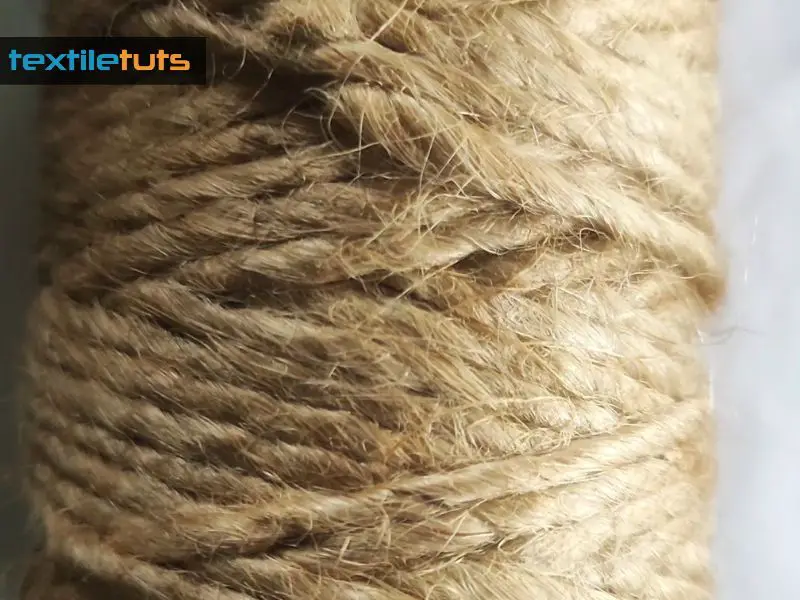
Jute possesses several defining properties:
Cellulose Composition
Jute fibers contain 65–75% cellulose by dry weight, making it one of the most cellulose-rich natural fibers available. Cellulose is a complex carbohydrate (C₆H₁₀O₅)n and the most abundant organic polymer on Earth. This high cellulose content gives jute its structural integrity and makes it fully biodegradable at end of life.
Tensile Strength and Durability
Jute fibers exhibit a tensile strength of approximately 400–800 MPa in raw form, with individual fiber tenacity ranging from 20–40 cN/tex. This strength makes jute suitable for heavy-duty applications such as burlap sacks, geotextiles, and rope. The fiber maintains structural integrity under normal use conditions but burns completely when exposed to open flame.
Hygroscopic Properties
Jute absorbs moisture readily, with equilibrium moisture content of 8–13% under normal atmospheric conditions (65% relative humidity, 20°C). This hygroscopic nature allows the fiber to regulate humidity in storage but also means jute expands when wet. Wetted jute fibers swell in diameter, and shrinkage of 3–5% can occur in jute fabrics after machine washing or soaking.
Low Thermal Conductivity
Jute’s thermal conductivity of approximately 0.04–0.07 W/m·K provides modest insulating properties. This is comparable to wood (0.1–0.2 W/m·K) and significantly lower than metals or dense synthetics. However, low thermal conductivity does not confer fire resistance—it merely slows the rate at which heat passes through the material.
Natural Luster and Color
Jute fibers display a natural golden sheen due to the presence of woody tissue in the fiber bundles. Raw jute ranges from off-white to brown in color depending on retting duration and fiber quality. This natural appearance is maintained in many jute products without synthetic dyes.
Jute Shrinkage After Washing
Unlike its response to flame, jute does exhibit shrinkage when exposed to water and agitation. When immersed in water, jute fibers absorb moisture and swell in diameter. This expansion can increase fiber cross-section by 5–10%.
As the fibers dry, they contract. Machine washing or hot water immersion typically causes 3–5% shrinkage in woven jute fabric. Hand washing in cold water produces less distortion, with shrinkage of 1–2%.
Spot cleaning with a damp cloth and mild detergent, or dry cleaning, represents the safest approach for jute garments and home textiles. If machine washing is unavoidable, a gentle cycle with cold water and air drying flat helps minimize dimensional change.
Common Misconceptions About Jute
Jute’s unique properties give rise to persistent myths. Understanding the science clarifies which concerns are valid and which are unfounded.
Myth: Jute Shrinks on Burning
Jute does not shrink when exposed to flame. Unlike wool, which undergoes progressive shrinkage under heat, or certain synthetic fibers that melt and tighten, jute burns. The fiber ignites at approximately 300°C, chars progressively, and converts to ash without contracting in dimension.
Myth: Jute Melts Under Heat
Jute does not melt. Melting requires a material to transition from solid to liquid at a specific temperature. Cellulose and lignin—both components of jute—decompose thermally rather than melt. Lignin’s glass transition occurs near 90°C, but true thermal decomposition with mass loss begins around 200–300°C.
Misinterpretation of Char Formation
When jute chars, the blackened surface layer may give the appearance of shrinkage to observers unfamiliar with the process. The char forms as a protective outer layer while the unburned fiber beneath retains its original dimensions until the flame front advances. This is char formation, not shrinkage.
Assuming Uniform Fiber Behavior
All fibers do not behave identically under thermal stress. Cellulose fibers (jute, linen, hemp, cotton) burn rather than melt or shrink. Protein fibers (wool, silk) char and form black beads when burned. Synthetic fibers (polyester, nylon) melt, drip, and may shrink away from flame. Recognizing these differences enables proper material selection and safety precautions.
Jute Near Heat: Pros and Cons
For applications where jute may be exposed to heat or flame, weigh the following factors:
| Pros | Cons |
|---|---|
| Carbon neutral and fully biodegradable at end of life | Burns completely when ignition temperature (~300°C) is reached |
| No toxic fumes from natural combustion (only CO₂, H₂O, ash) | No inherent fire resistance — fire-retardant treatment required for safety |
| Low thermal conductivity provides modest insulation | Self-extinguishing behavior only if flame is removed quickly (unlike wool) |
| Does not melt or drip — no hot plastic hazard | Charred jute loses all structural integrity immediately |
| Compostable after fire-retardant treatment (depending on chemical used) | Moisture content (8–13%) can affect combustion rate unpredictably |
Conclusion
Jute exhibits distinct behavior when exposed to flame: it ignites rapidly, burns vigorously, and leaves light gray ashes. The fiber does not shrink away from heat like wool, nor does it melt and drip like polyester. This combustion behavior directly reflects jute’s cellulose-rich composition (65–75%) and lignin content (13–20%).
The cellulose in jute undergoes thermal decomposition beginning at approximately 300°C, with active pyrolysis occurring at or above 500°C. The lignin component provides rigidity but does not prevent combustion. When held over an open flame, jute chars at the point of contact and burns progressively.
For applications near heat sources or open flame, jute products require fire retardant treatment or substitution with fire-resistant materials. Jute’s combustion behavior underscores the importance of proper material selection in textile, packaging, and construction applications where fire safety is a concern.
References
- USDA Agricultural Research Service, Eastern Regional Research Center. (n.d.). What is Pyrolysis?. U.S. Department of Agriculture.
- Wikipedia. (n.d.). Jute. Wikimedia Foundation.
- Wikipedia. (n.d.). Cellulose. Wikimedia Foundation.
- FAO Commodity Specialist. (2019). Back to Roots: FAO Launches New Website for World Cotton Day. Food and Agriculture Organization of the United Nations.


